Inspiration
World Lens was inspired by a combination of personal experience, creative collaboration, and a shared love of nature.
As a professional photographer, Latiece has spent years thinking about composition, framing, and the patience required to capture the right moment. She wanted to explore the idea of a camera training simulator that could help people practice those observational skills in a virtual environment and learn photography from home.
At the same time, my teammate Anna was excited about building living trees and animated birds, bringing a natural ecosystem to life inside a virtual world.
We realized these ideas fit perfectly together. A forest filled with birds creates the ideal setting for a photography experience.
When our teammate Dave joined the project, his experience working in the industry helped guide many of our technical decisions and kept the project moving forward. His perspective helped us focus on building systems that were both achievable within the hackathon timeframe and meaningful for the final experience.
Because the hackathon timeline was short, we pivoted from the original idea of a full camera training simulator to a gamified wildlife photography experience. By combining our ideas, we created World Lens — an interactive environment where players explore a forest ecosystem, observe bird species, and earn points for capturing well-composed wildlife photos.
What it does
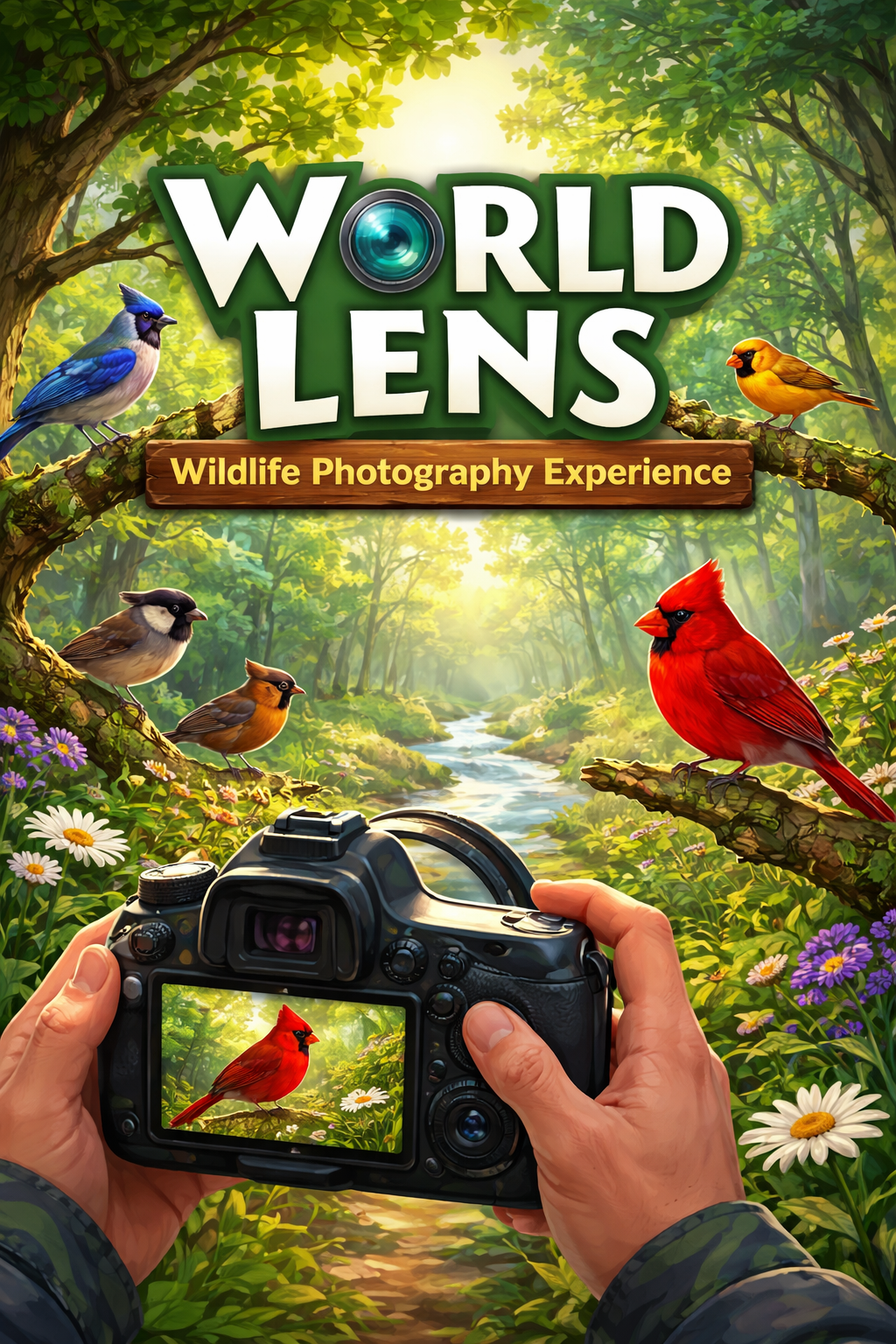
World Lens is an interactive wildlife photography experience where players explore a forest ecosystem and capture photos of birds using a simulated camera.
Players search for bird species including crows, sparrows, robins, chickadees, blue jays, goldfinches, and cardinals. Using a virtual camera viewfinder, players frame and photograph birds while trying to capture the best possible shot.
Each photo is evaluated using a scoring system that rewards:
Bird species rarity
Photo composition and framing
Capturing birds during interesting moments like flying
The experience transforms birdwatching into a gamified photography challenge that encourages observation, patience, and creative framing.
What makes World Lens especially unique is that the environment was generated using real-world photography, turning photographic imagery into an interactive natural space.
How we built it
World Lens was built using Unity as an immersive interactive experience.
We used the World Labs Marble SDK to generate a navigable forest environment from real photographic images. This allowed us to quickly create a natural landscape that players could explore.
Key systems we built include:
A camera simulator that allows players to aim, frame, and capture wildlife photos
A render-texture viewfinder system that mimics how a real camera works
A bird detection system that identifies species within the camera frame
A dynamic scoring system that evaluates composition, rarity, and bird behavior
A challenge-based gameplay system that gamifies the birdwatching experience
AI-driven bird sound aquisition
By combining environment generation, animated wildlife, and interactive camera mechanics, we created a playful wildlife photography experience.
Challenges we ran into
One of the biggest challenges was designing a system that could evaluate wildlife photos in real time. Detecting birds inside the camera frame and translating that into meaningful gameplay scores required balancing technical accuracy with simplicity.
Another challenge was integrating multiple systems within a short hackathon timeline. The project involved environment generation, animated wildlife, camera interaction, UI feedback, and gameplay scoring. We had intended real-time on demand world generation but that was deprioritized for time. However, voice->text prompting and AI analysis would allow us to build any world imaginable and bring it to life.
We also initially imagined building a full camera training simulator, but quickly realized that the timeline required us to simplify the idea. We pivoted toward a gamified birdwatching experience, which allowed us to focus on creating a complete and fun gameplay loop.
Accomplishments that we're proud of
We’re proud that we were able to combine photography, nature, and interactive technology into a cohesive experience.
Some highlights include:
Turning real photography into an explorable virtual environment
Building a working wildlife photography gameplay loop
Designing a scoring system that rewards observation and composition
Creating animated birds and environmental elements that make the world feel alive
We’re also proud of how the team collaborated and combined different skill sets to bring the project together in a short amount of time.
What we learned
This project gave us the opportunity to explore how interactive technology can transform observational activities like birdwatching into engaging gameplay.
Along the way we learned about:
Designing intuitive camera mechanics in an interactive environment
Evaluating visual composition in real time
Integrating environment generation with gameplay systems
Collaborating across different disciplines including photography, animation, and game development
The project also showed us how powerful it can be to combine artistic practices like photography with immersive technologies.
What's next for World Lens
In the future, we’d love to expand WorldLens into a richer wildlife exploration experience.
Some ideas for future development include:
Adding more bird species and wildlife behaviors
Expanding the environment into different ecosystems
Introducing photography missions and challenges
Adding educational information about bird species and habitats
Exploring multiplayer or shared photography experiences
Our goal is to continue developing World Lens as a creative platform that combines nature exploration, photography, and interactive storytelling.
Built With
- unity
- worldlabs

Log in or sign up for Devpost to join the conversation.