Inspiration
There are already many projects that use AI agents to simulate the future, forecast world events, or generate possible outcomes from a scenario. But as a heavy user of those tools, I kept noticing a gap: many of them feel detached from how reality actually changes.
Real societies are not just collections of isolated intelligent agents. People shift opinions because of social pressure, trust, emotion, identity, institutions, media exposure, psychological bias, group dynamics, and repeated interaction. Existing systems often do not model those sociological forces deeply enough. They also tend to produce predictions from one run, even though the future is highly non-deterministic. Small butterfly effects, prompt variance, and LLM randomness can completely change the trajectory.
WorldFork was inspired by that problem. Instead of asking an AI for one future, we wanted to build a system that forks the world into many possible futures, tracks how each one evolves, and uses sociology, emotion vectors, cohort behavior, and recursive branching to explain why different timelines diverge.
What it does
WorldFork.tech is a recursive social simulation platform for exploring alternate futures.
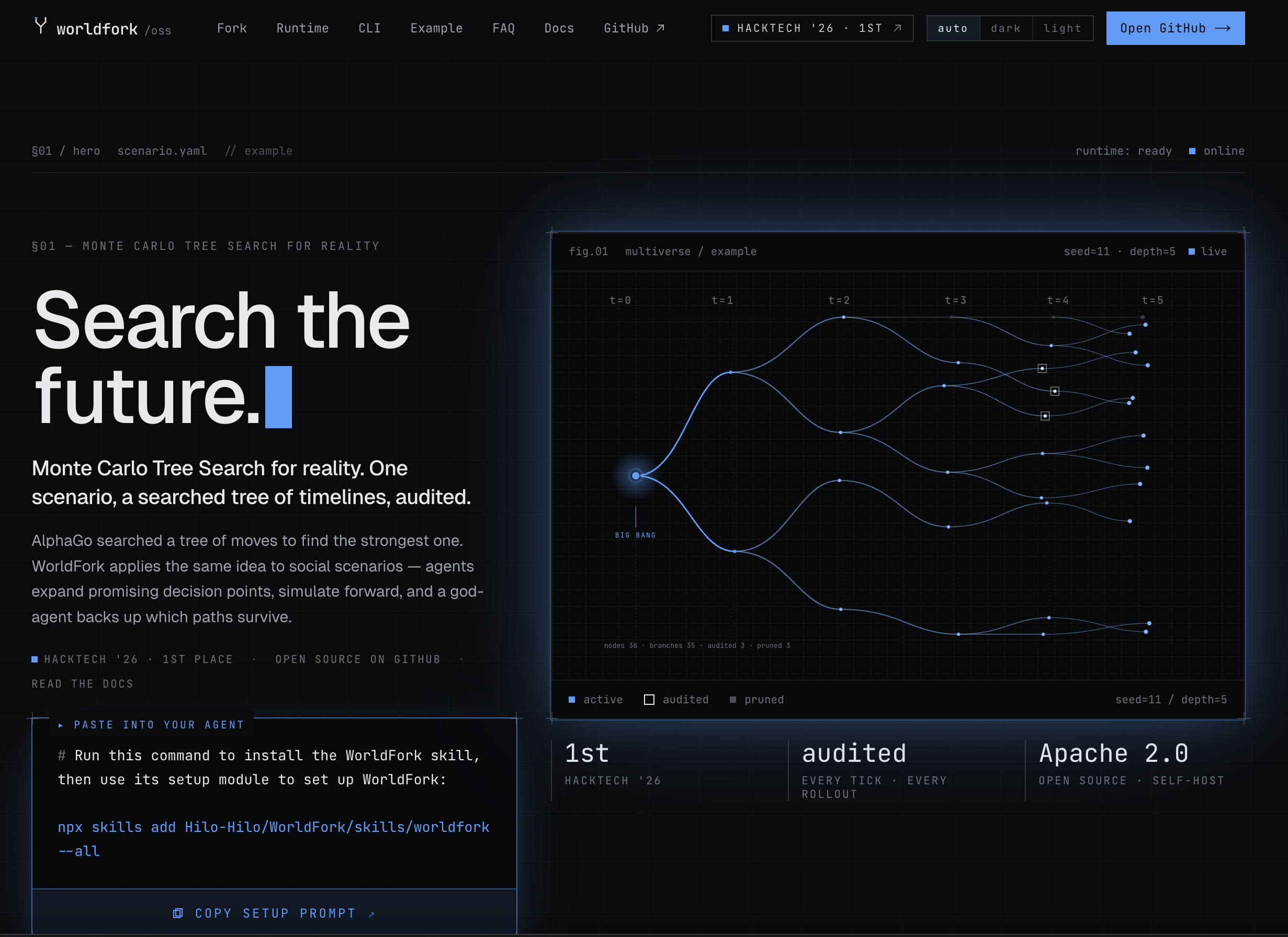
A user creates a root scenario, called a Big Bang, and WorldFork simulates how that scenario evolves over time. The system advances through ticks, creates branching timelines, and lets users inspect each possible world. Each timeline contains events, cohort shifts, actor decisions, social interactions, emotional changes, graph relationships, and structured reasoning traces.
Instead of producing one prediction, WorldFork produces a multiverse of possible outcomes. Users can compare timelines, inspect why branches happened, and understand how small changes in opinion, trust, emotion, or social pressure can reshape the future.
How we built it
We built WorldFork around a structured simulation architecture. The core entities are Big Bangs, multiverse timelines, ticks, actors, cohorts, events, social graphs, and reports.
The backend manages the simulation loop, branching logic, state snapshots, source-of-truth schemas, artifacts, logs, and reports. The system uses structured taxonomies for emotions, behavior axes, actor types, event types, graph edges, sociology parameters, and social action types so the simulation is not just free-form text generation.
A God Agent reviews simulation ticks and helps decide whether timelines should continue, branch, freeze, merge, or terminate. The frontend is designed as a research workbench where users can create simulations, inspect timelines, compare branches, and review the reasoning behind events.
Challenges we ran into
The biggest challenge was making the simulation both deep and understandable. Recursive futures can become complex very quickly, especially when each timeline contains actors, cohorts, emotions, events, graphs, and reports.
Another challenge was modeling social reality without pretending that one prediction is absolute truth. We had to design WorldFork around uncertainty, branching, and non-determinism from the beginning. We also had to think carefully about how to represent sociology and psychological bias in a way that is structured enough to inspect, but flexible enough to capture messy real-world behavior.
Accomplishments that we're proud of
We are proud that WorldFork is not just another AI prediction wrapper. It is built around a full simulation structure with recursive timelines, cohort behavior, sociology signals, emotion observability, event logs, graph layers, and report generation.
We are also proud of the core idea: treating the future as a multiverse instead of a single answer. WorldFork makes it possible to study not only what might happen, but why different futures emerge.
What we learned
We learned that prediction tools become much more useful when they expose uncertainty instead of hiding it. A single generated answer can feel confident, but a branching simulation shows how fragile that confidence can be.
We also learned that social simulation requires more than intelligent agents. It needs models of influence, identity, trust, bias, attention, emotion, institutions, and collective behavior. The most interesting part of the project was connecting AI agents with sociology so the system could simulate groups of people, not just individual responses.
What's next for WorldFork.tech
Next, we want to make WorldFork easier to use as a visual research workspace. That means better timeline comparison, clearer branch inspection, smoother scenario creation, and more readable final reports.
We also want to expand the sociology engine with stronger models for polarization, virality, institutional trust, coalition formation, public silence, and opinion drift. Long term, WorldFork.tech could become a tool for researchers, strategists, writers, and curious people who want to explore many possible futures instead of relying on one fragile prediction.


Log in or sign up for Devpost to join the conversation.