Inspiration
Autonomous robots are becoming increasingly common in warehouses, factories, and logistics environments. While they may perform well in controlled demonstrations, unexpected situations such as moving obstacles, narrow aisles, and poorly timed crossings can expose weaknesses in their navigation systems.
Testing every possible scenario manually is impractical, and random simulation may miss important edge cases.
What if AI could help decide what a robot should be tested against next?
That question inspired WorldForge, an AI guided testing platform that uses NVIDIA Nemotron to analyse robot simulation outcomes, identify potential failure patterns, and generate targeted scenarios to investigate them.
What it does
WorldForge allows developers to test a robot navigation policy in a virtual warehouse environment and explore how it behaves under different conditions.
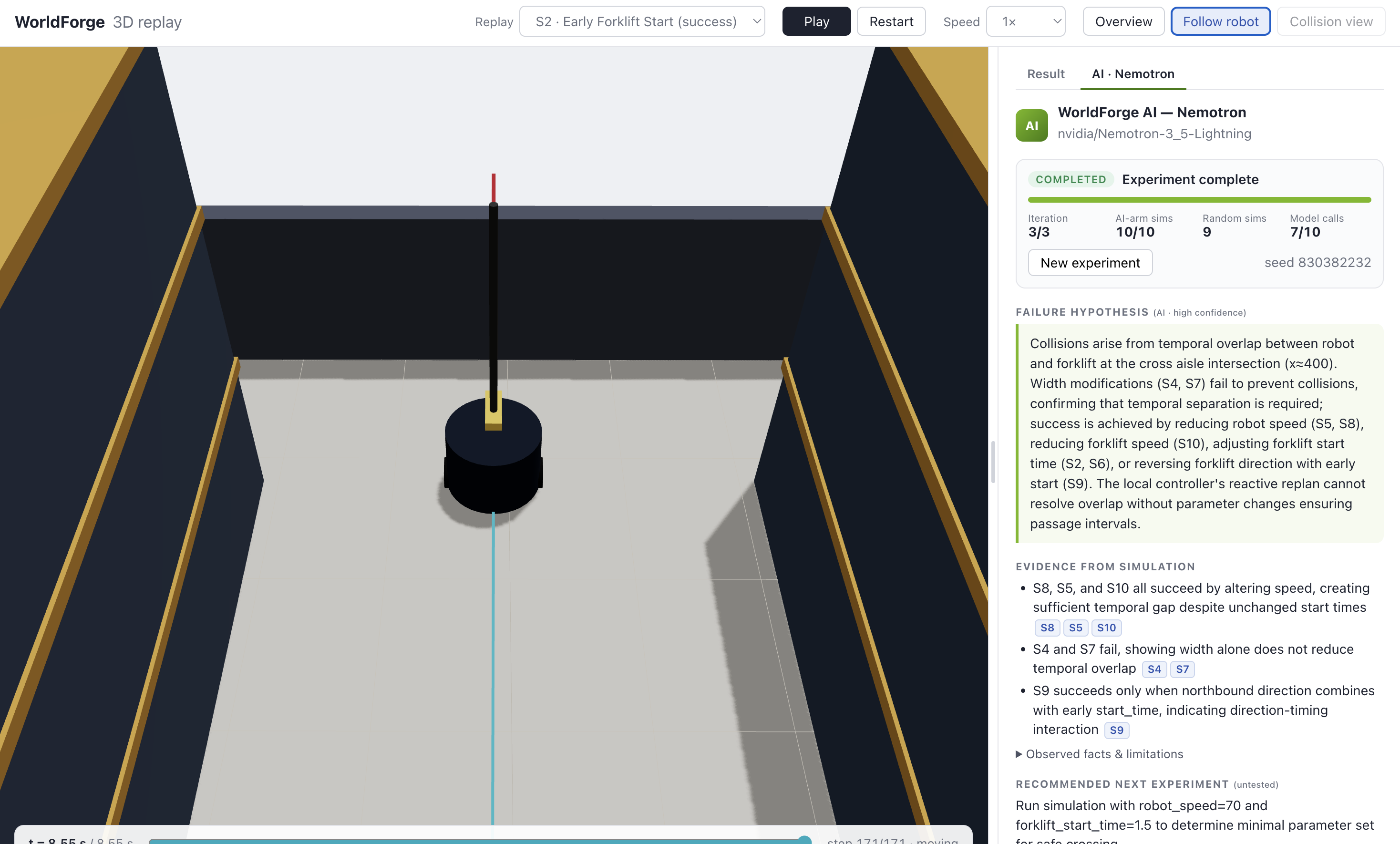
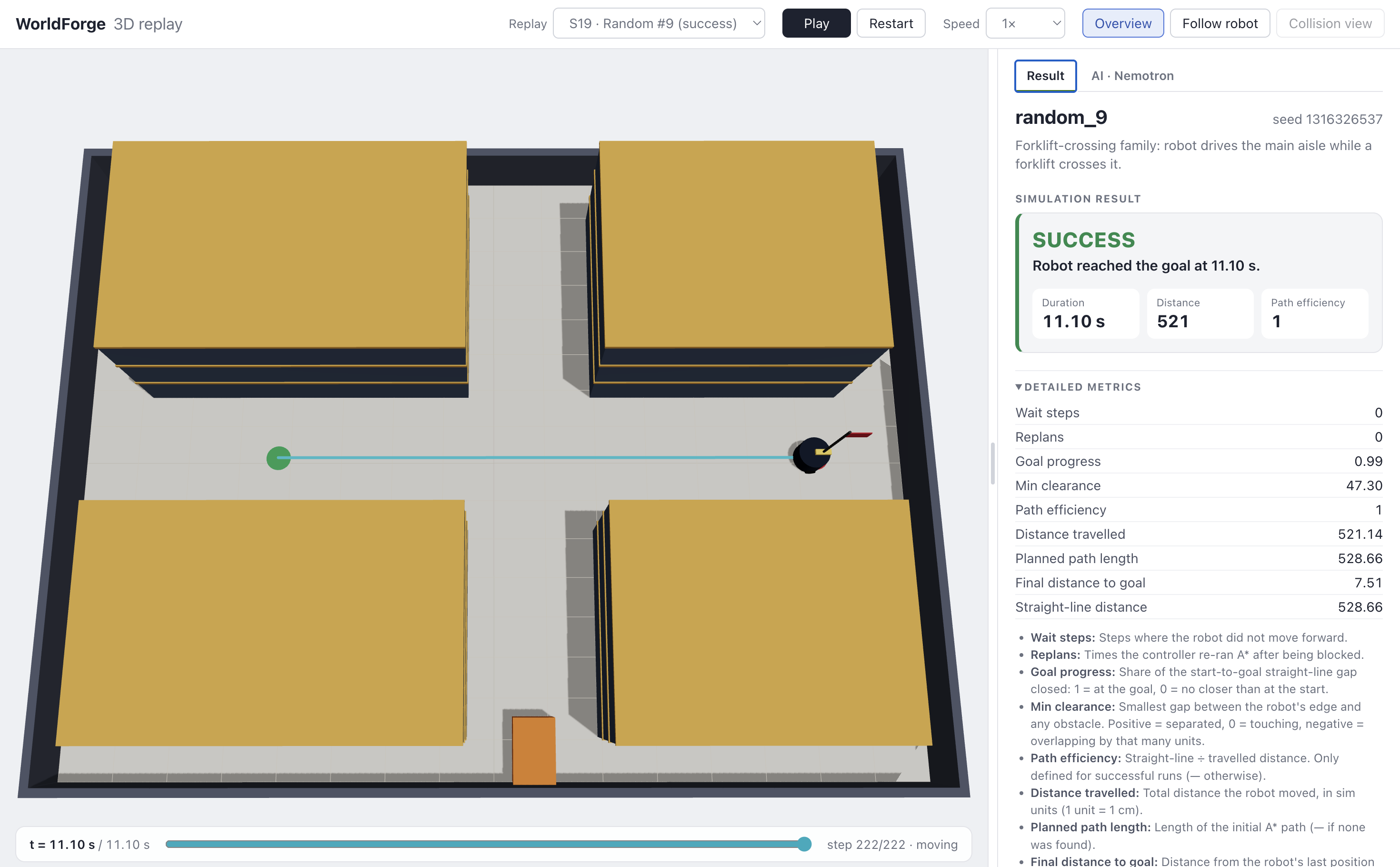
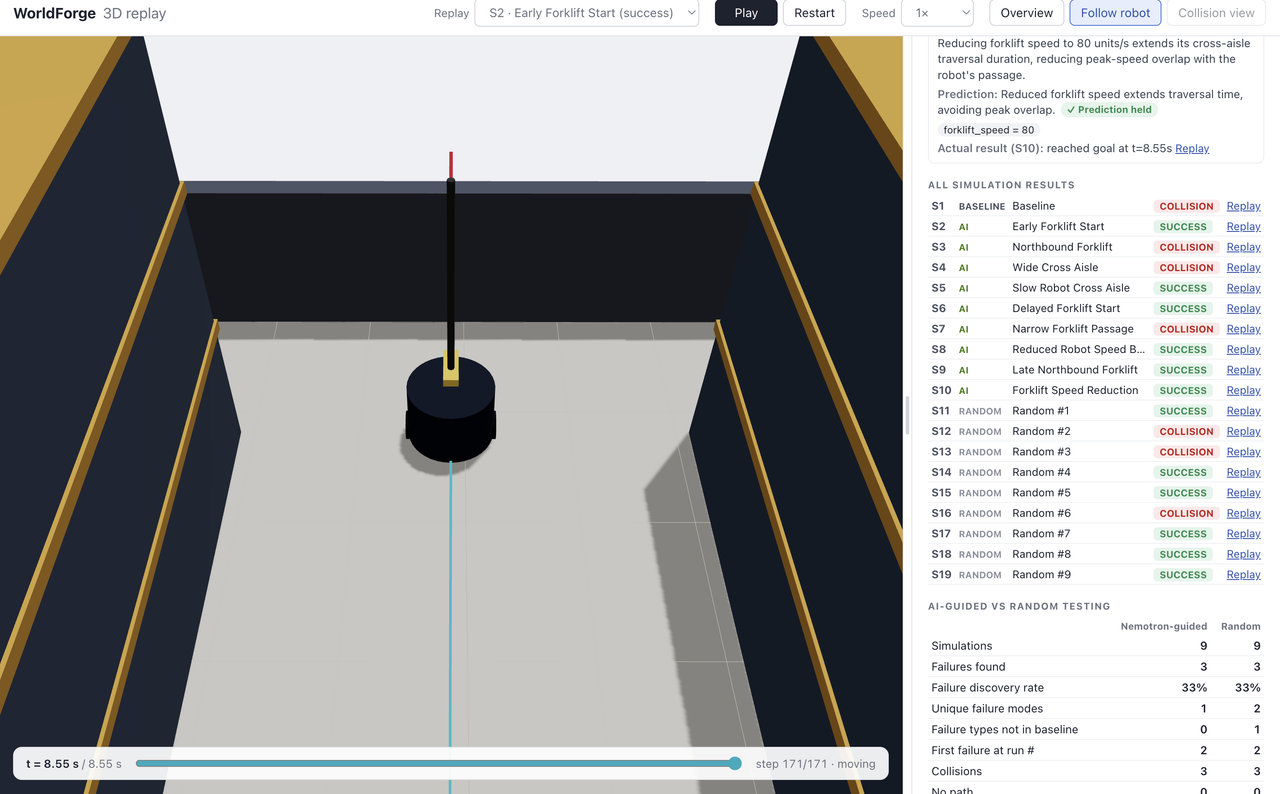
The platform combines a lightweight 2D simulation with an interactive 3D visualization.
Users can:
Run robot navigation scenarios involving static and moving obstacles.
Visualize robot movement and trajectories in an interactive 3D warehouse.
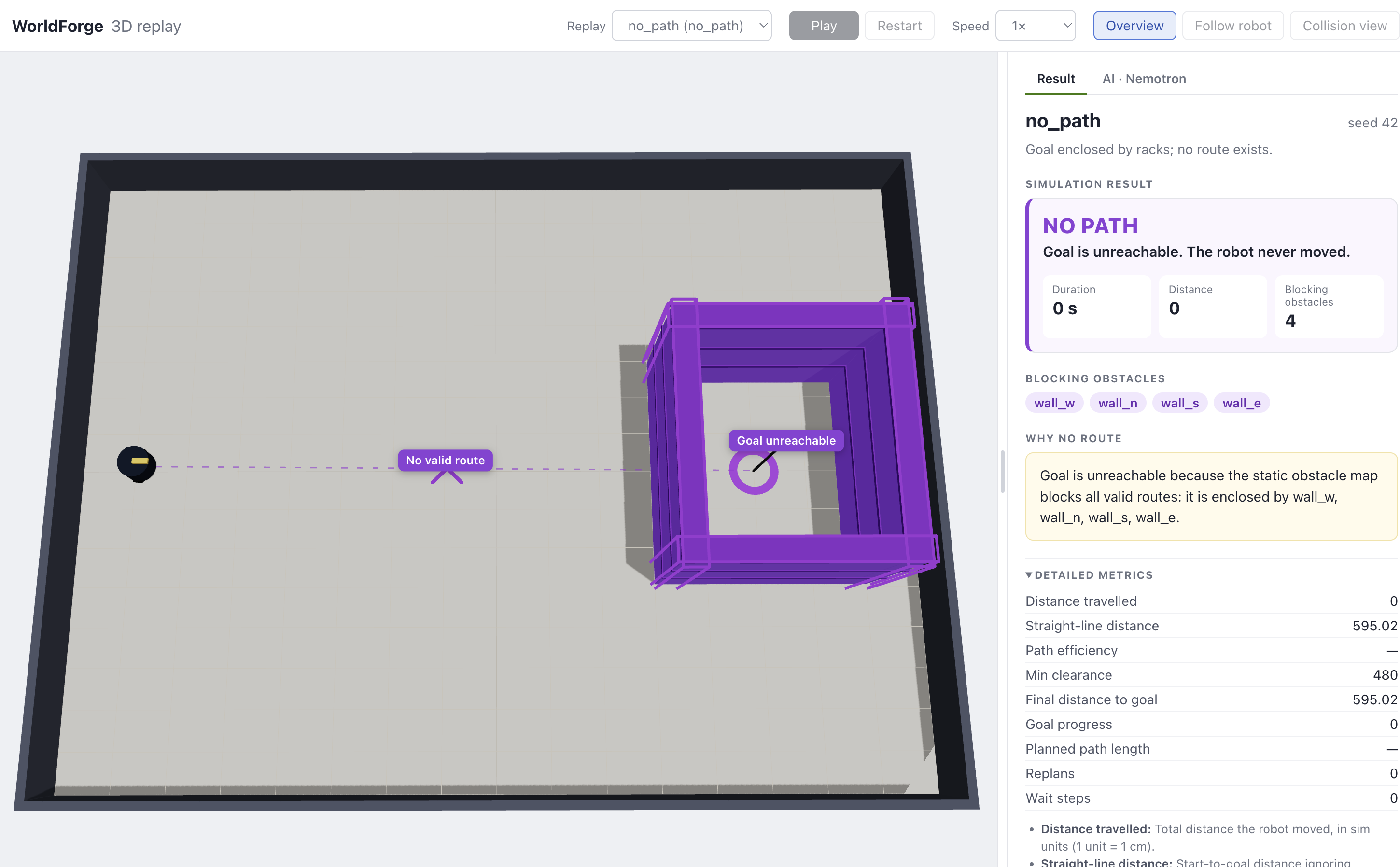
Detect collisions, timeouts, and unsuccessful navigation attempts.
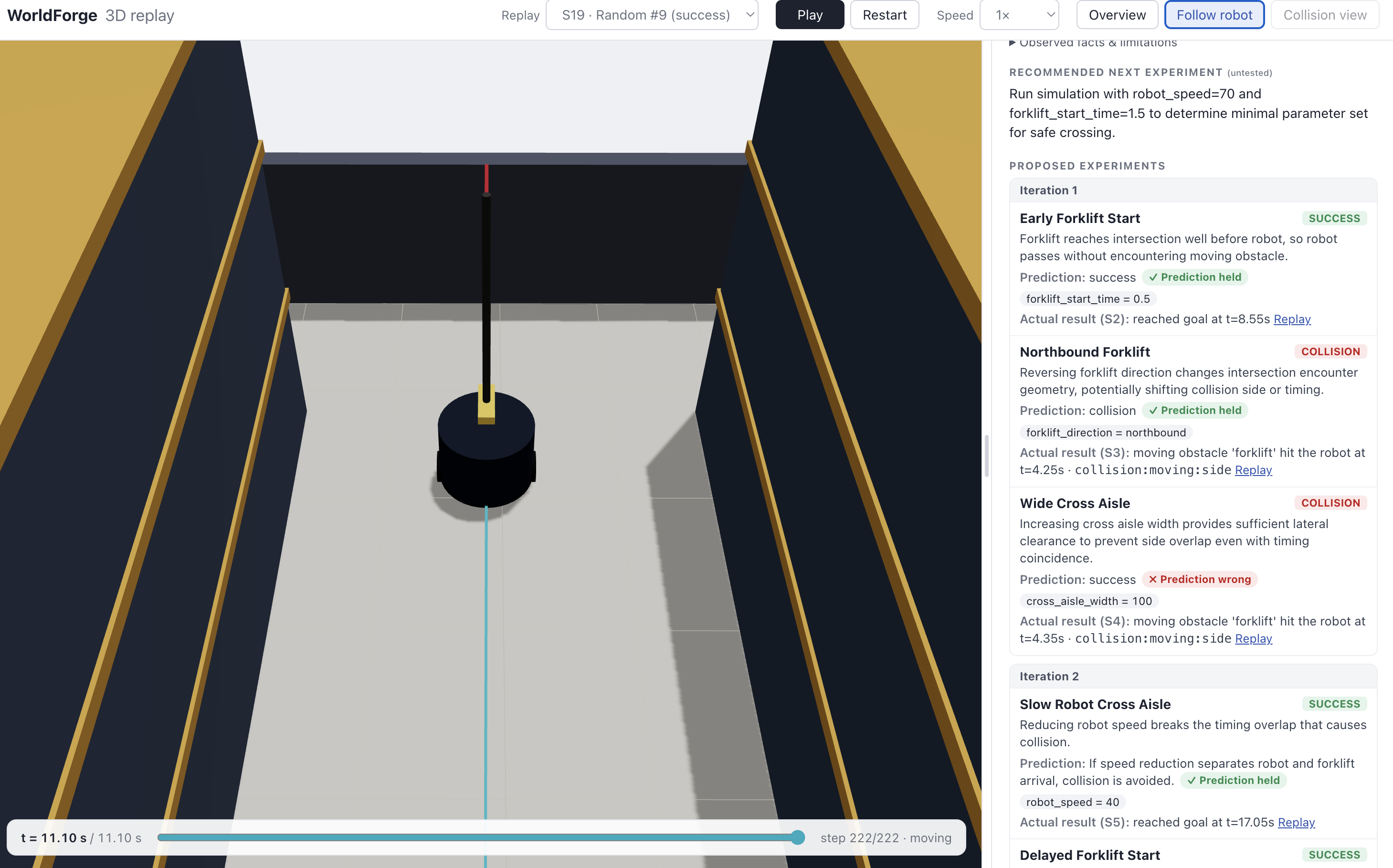
Use NVIDIA Nemotron to analyse simulation outcomes and generate targeted test scenarios.
Execute AI-generated scenarios and inspect their actual results.
How we built it
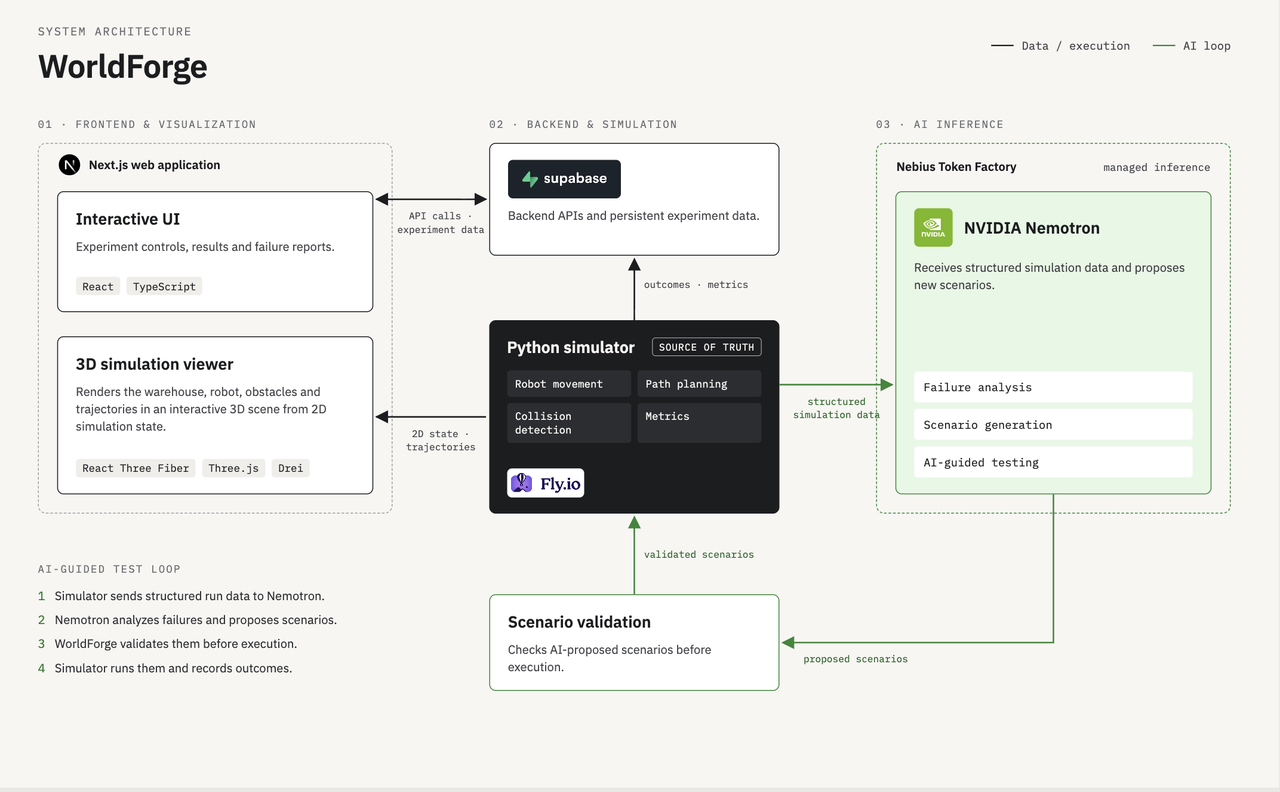
We built WorldForge using a combination of modern web technologies, simulation logic, and NVIDIA AI inference.
Frontend and visualization
Next.js: Web application framework.
React: Interactive user interface.
TypeScript: Type-safe application development.
Three.js: 3D rendering engine.
React Three Fiber: React-based rendering of the 3D warehouse environment.
Drei: Utilities and helpers for the Three.js scene.
The underlying simulation operates in 2D, while React Three Fiber and Three.js render the warehouse, robot, obstacles, and trajectories in an interactive 3D environment.
This allowed us to build a visually compelling simulation viewer without the overhead of a full 3D physics environment.
AI and backend
NVIDIA Nemotron: Failure analysis, scenario generation, and AI-guided testing.
Nebius Token Factory: Managed inference access to Nemotron.
Supabase: Backend APIs and persistent experiment data.
Python: Simulation execution, robot movement, path planning, collision detection, and metrics.
Challenges we ran into
Building a useful simulation within a short timeframe
A full robotics simulation environment can require substantial setup and computational resources. We wanted to focus on the AI-guided testing concept rather than spend most of the hackathon configuring a complex simulation stack.
We therefore built a lightweight 2D simulation and used a 3D viewer to make the robot's behaviour easier to understand.
Making AI meaningfully contribute to the system
Simply asking an LLM to generate warehouse layouts would not make WorldForge particularly useful.
The harder challenge was connecting Nemotron to actual simulation results so that it could analyse failures and propose new experiments based on previous outcomes.
We needed to separate AI-generated hypotheses from verified simulation results and ensure that every generated scenario was validated before execution.
Evaluating AI-guided testing
A generated scenario is not automatically a useful scenario.
We needed a way to measure whether AI-guided testing could discover meaningful failures compared with random testing.
This led us to introduce a random-testing baseline and metrics for failure discovery, simulation outcomes, and time to first failure.
Making the simulation understandable
Simulation data can be difficult to interpret through logs alone.
We used an interactive 3D warehouse viewer to make robot movement, obstacle interactions, trajectories, and collision events easier to inspect.
Accomplishments that we're proud of
Integrating NVIDIA Nemotron through Nebius Token Factory.
Building a working robot navigation simulator with collision detection and measurable outcomes.
Creating an interactive 3D warehouse visualization using Three.js and React Three Fiber.
Connecting simulation results to AI-generated failure analysis.
Implementing AI-guided scenario generation and experiment execution.
Introducing a random-testing baseline to evaluate the AI-guided approach.
Deploying the WorldForge application and bringing the complete workflow together.
What's next for Worldforge
WorldForge is currently focused on warehouse navigation and a lightweight simulation environment. There is significant room to expand its capabilities.
Our long-term vision is to make WorldForge a platform that helps robotics developers systematically discover, reproduce, and understand the edge cases that matter.
Built With
- fiber
- nextjs
- python
- three.js
- typescript

Log in or sign up for Devpost to join the conversation.