-
-
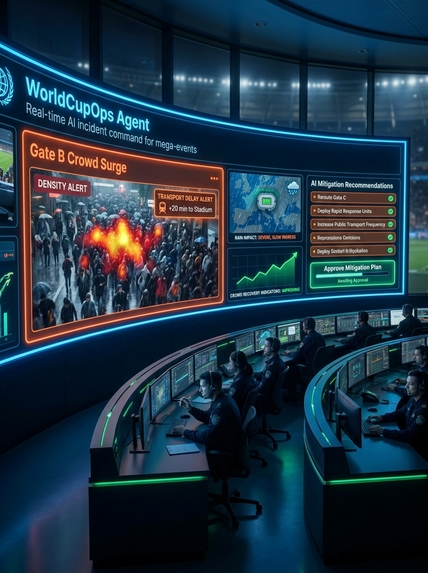
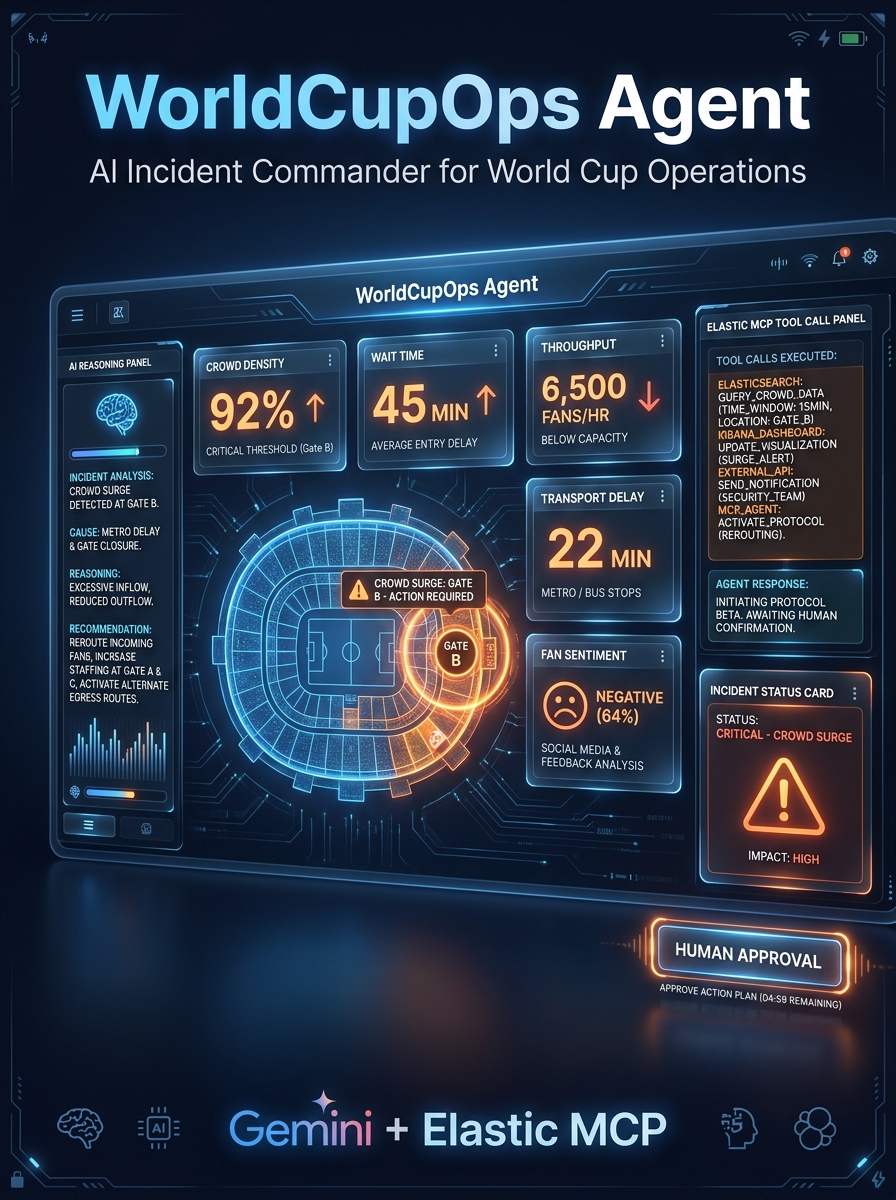
Stadium incident command scene
-
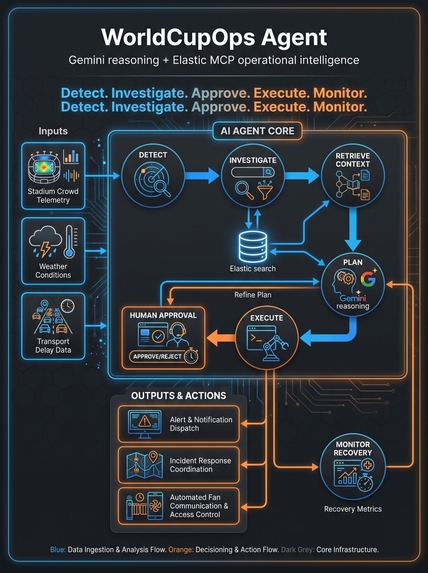
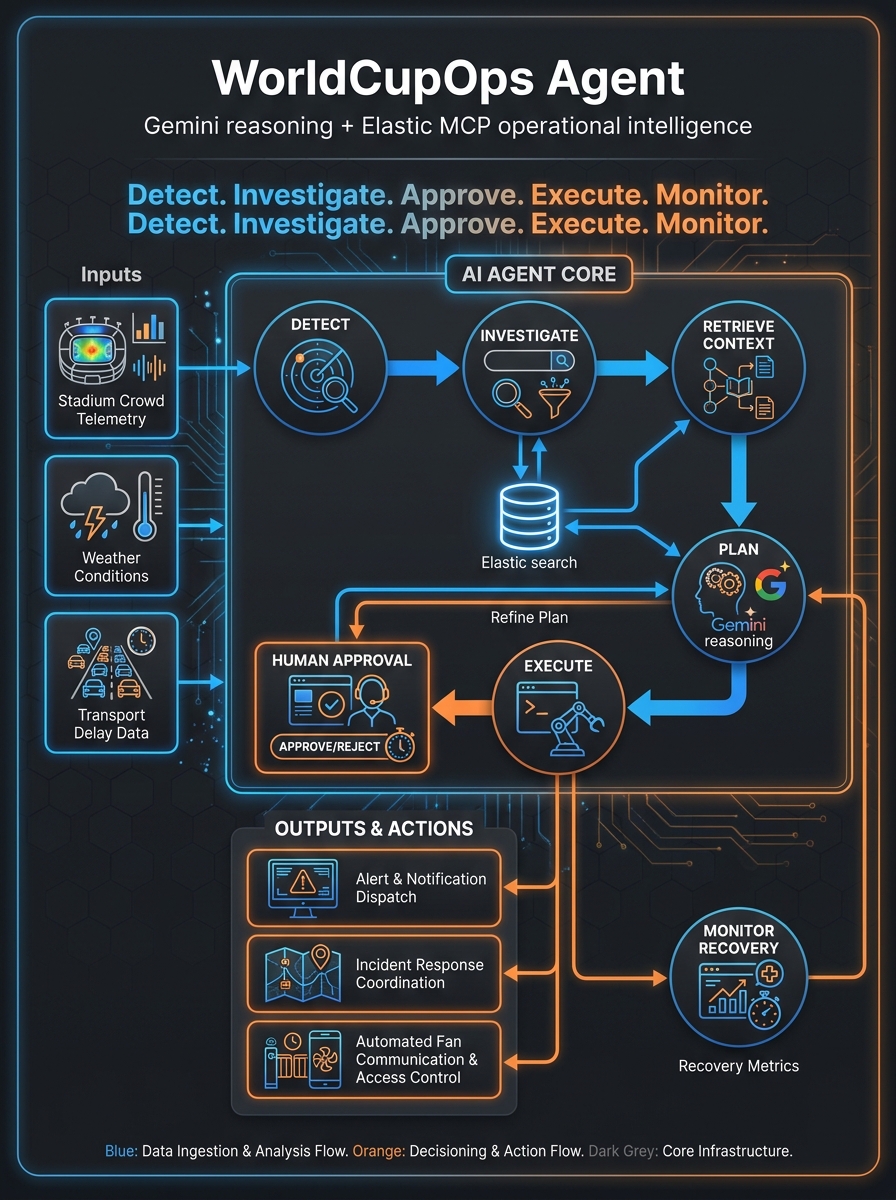
Agent workflow diagram
-
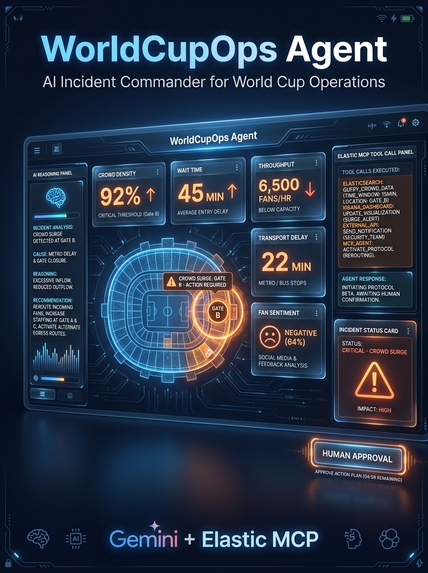
WorldCupOps Agent
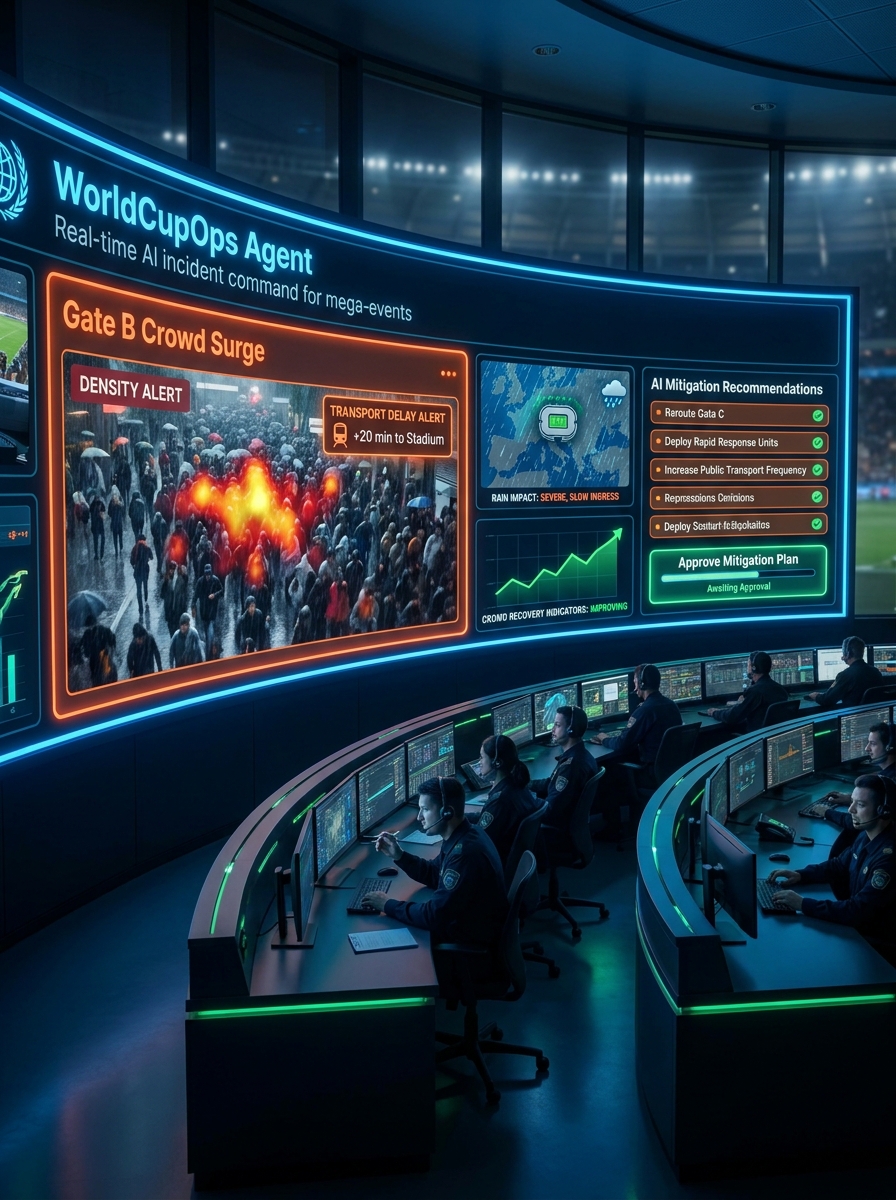
Inspiration
Large-scale events like the FIFA World Cup are incredibly difficult to operate in real time. A single stadium can have tens of thousands of fans, multiple entry gates, changing weather, transport delays, vendor issues, and social sentiment signals happening at the same time.
The inspiration for WorldCupOps AI Commander came from one question: what if an AI agent could act like an incident commander instead of just a chatbot?
We wanted to build an agent that could detect operational problems, investigate root causes, recommend actions, ask for human approval, execute approved workflows, and monitor recovery. The goal was to show AI that helps people take action safely during high-pressure real-world situations.
What it does
WorldCupOps AI Commander is a Gemini-powered AI operations agent for World Cup-scale stadium incidents.
The demo simulates a live stadium operations environment. During normal operations, the dashboard monitors crowd density, wait time, gate throughput, transport delay, and fan sentiment. Then a realistic incident is injected: Gate B experiences a crowd surge while rain slows entry processing, transport delays compress fan arrivals, and fan sentiment becomes negative.
The agent then performs a full operational response loop:
- Detects the anomaly from live telemetry.
- Investigates crowd, transport, weather, and sentiment signals.
- Uses Elastic MCP-style tool calls to retrieve operational context and similar historical incidents.
- Generates a mitigation plan with root causes, recommended actions, and estimated impact.
- Requires human approval before executing critical actions.
- Executes approved workflows such as opening an overflow gate, rerouting fans, dispatching stewards, and sending fan advisories.
- Monitors recovery and records each action in an audit trail.
The result is an AI system that does not just explain the problem — it helps operators resolve it.
How we built it
We built WorldCupOps AI Commander as a full-stack real-time operations platform.
The frontend is a dark-mode command dashboard built with Next.js, React, and Tailwind CSS. It displays live KPIs, a stadium operations map, incident status, AI reasoning, Elastic MCP tool calls, and a timeline/audit trail.
The backend is built with FastAPI and WebSockets. It runs a live simulator that generates operational data for crowd density, wait time, throughput, transport delay, and sentiment. The backend exposes APIs for injecting incidents, running the agent, approving mitigation actions, rolling back actions, and streaming live state to the dashboard.
Elastic is used as the operational intelligence layer. Elasticsearch stores incident context, historical patterns, and audit events. The agent demonstrates Elastic MCP-style tool usage by querying crowd telemetry, transport status, weather impact, and incident history.
Gemini is used as the reasoning layer. The agent analyzes the incident, identifies root causes, generates a structured mitigation plan, estimates operational impact, and keeps the human operator in control for safety-critical decisions.
The system is containerized with Docker Compose so the frontend, backend, Elasticsearch, and Kibana can run together locally.
Challenges we ran into
One of the biggest challenges was making the project feel like a true agent instead of a normal chatbot or static dashboard. To solve this, we focused on the complete operational loop: detect, investigate, plan, approve, execute, and monitor.
Another challenge was keeping the demo focused. World Cup operations can include many systems, such as ticketing, security, vendors, weather, transit, and emergency response. For the hackathon, we narrowed the experience to one clear and realistic scenario: Gate B crowd congestion caused by rain, late transit arrivals, and negative sentiment.
We also had to balance realism with hackathon speed. The telemetry is simulated, but the architecture is designed so real stadium sensors, weather APIs, transit feeds, ticketing systems, and security tools could be connected in the future.
Finally, we focused heavily on explainability. Operators need to understand why the agent made a recommendation, what tools it used, what actions were approved, and whether the situation improved afterward.
Accomplishments that we're proud of
We are proud that WorldCupOps AI Commander demonstrates a complete action-oriented agent workflow, not just a conversational interface.
The project includes:
- A real-time operations dashboard
- Live incident simulation
- AI-generated root-cause analysis
- Elastic MCP-style operational tool calls
- Human-in-the-loop approval
- Simulated action execution
- Rollback support
- Audit trail logging
- Recovery monitoring
We are also proud of the clarity of the demo. In under three minutes, the system shows a realistic incident, the agent investigation process, the mitigation plan, operator approval, execution, and recovery.
Most importantly, the project shows how AI agents can be used responsibly in high-pressure environments where human oversight, auditability, and safety matter.
What we learned
We learned that useful AI agents need more than a model. They need tools, memory, context, workflows, approvals, and observability.
We also learned that the best agent experiences make reasoning visible. In an operations environment, it is not enough for the AI to say what should happen. Operators need to see the data sources, tool calls, root causes, recommended actions, expected impact, and audit trail.
Another key learning was the importance of human-in-the-loop design. For safety-critical operations, the agent should assist and accelerate decision-making, but the human operator should remain in control of critical actions.
What's next for WorldCupOps AI Commander
Next, we would extend WorldCupOps AI Commander from a demo into a production-ready event operations platform.
Future improvements include:
- Full production Elastic MCP server integration
- Deployment with Google Cloud Agent Builder and Vertex AI
- Real-time ingestion from stadium sensors and access-control systems
- Live weather and transit API integrations
- Predictive crowd surge forecasting
- Multilingual fan notifications
- Vendor inventory optimization
- Security and medical incident workflows
- Real map-based routing
- Multi-agent collaboration between crowd, transport, vendor, and security agents
- Advanced observability with traces, metrics, and decision-quality analytics
The long-term vision is to create an AI operations layer for stadiums, airports, malls, conferences, and other high-density public spaces where teams need to detect problems early, coordinate action quickly, and keep people safe.
Built With
- agent
- ai
- api
- builder
- cloud
- compose
- css
- docker
- elastic
- elasticsearch
- fastapi
- gemini
- javascript
- kibana
- mcp
- next.js
- python
- react
- real-time
- rest
- simulation
- tailwind
- typescript
- vertex
- websockets

Log in or sign up for Devpost to join the conversation.