-
-
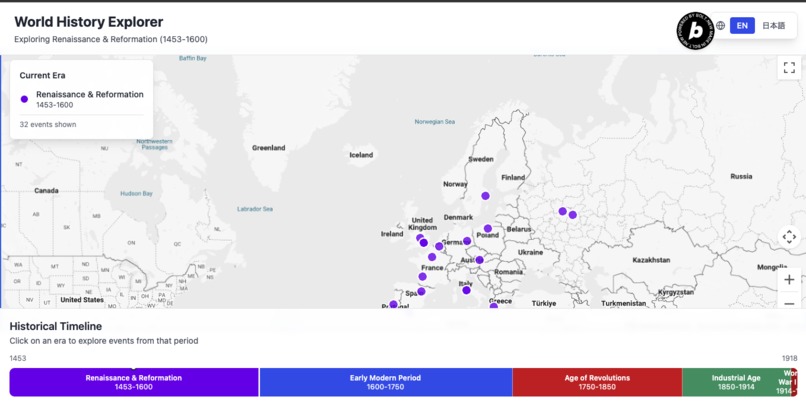
ScreenShot
Inspiration
What it does
How we built it
Challenges we ran into
Accomplishments that we're proud of
What we learned
What's next for World History Explore
About the Project: World History Explorer
Inspiration
World History Explorer was inspired by my passion for history and my desire to make learning about the past more visual, interactive, and accessible. I noticed that many educational resources present historical events in static timelines or dense textbooks, which can make it difficult for learners to see the connections between events across different regions and eras. My goal was to create a tool where anyone could intuitively explore world history both geographically and chronologically.
What I Learned
Through developing this project, I learned a great deal about:
- React and TypeScript: Building a robust and maintainable frontend using modern web technologies.
- Data Structuring: Organizing historical data to support bilingual descriptions, precise geolocation, and flexible era categorization.
- Map Integration: Embedding and customizing Google Maps for educational visualization.
- Internationalization (i18n): Implementing an interface and data that support both English and Japanese audiences.
- UI/UX Design: Creating an interface that is both informative and engaging for users of different backgrounds.
How I Built the Project
Planning & Research:
I started by researching significant world historical events and organizing them by eras and locations. I structured the data to include English and Japanese descriptions, precise dates, and geographic coordinates.Frontend Development:
The application was built with React and TypeScript for reliability and scalability. I designed core components for the timeline, map, event modal, and language selector, ensuring each part was reusable and easy to maintain.Map Visualization:
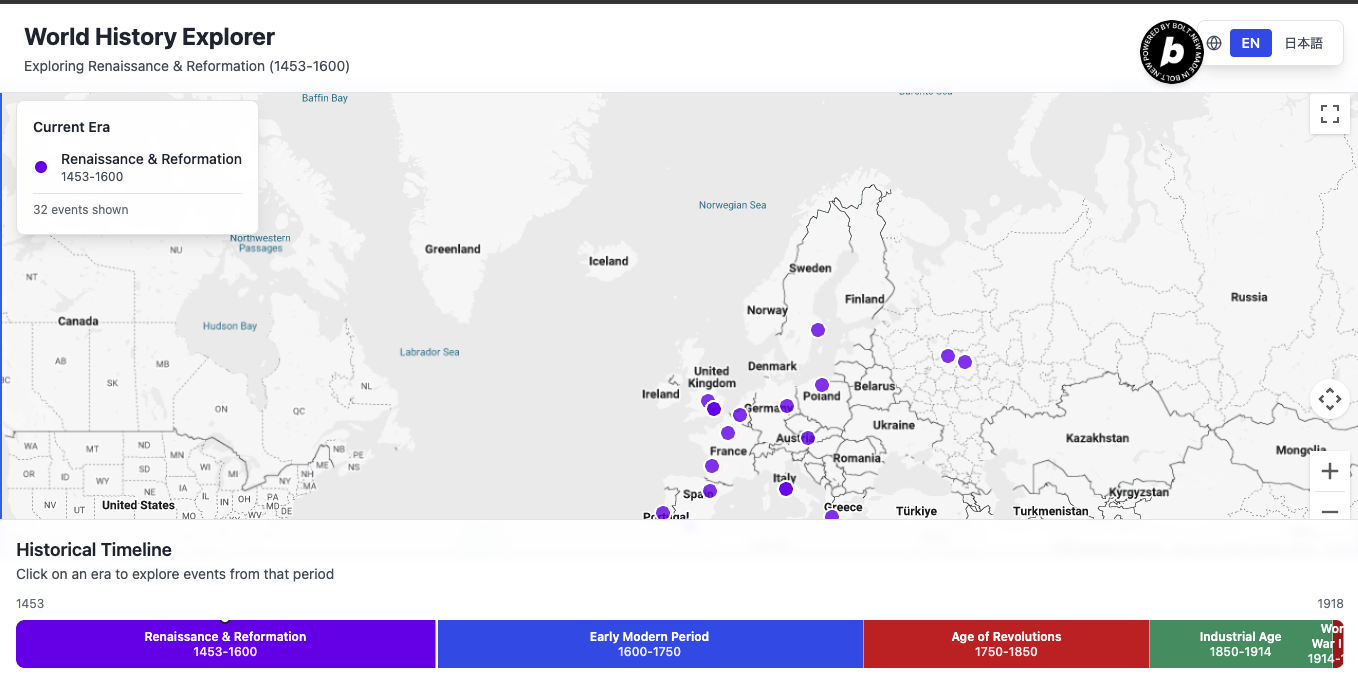
I integrated Google Maps to plot events geographically, allowing users to click markers for more details. Each marker dynamically switches languages and displays concise event summaries.Timeline & Era Navigation:
The timeline lets users navigate through different historical eras, with the map updating in real time to reflect the currently selected period.Internationalization:
I implemented language toggling for both the interface and event data, making the app accessible to both English and Japanese speakers.
Challenges Faced
Data Collection & Structuring:
Compiling a diverse and representative set of world events, then structuring them for bilingual use and precise geolocation, was time-consuming and required careful attention to accuracy.Map Marker Management:
Ensuring that map markers updated efficiently and correctly when users switched eras or languages presented technical challenges, especially in synchronizing state across components.User Experience:
Balancing the amount of information shown (not overwhelming the user, but giving enough context) required multiple design iterations and feedback.Internationalization:
Providing clear and natural translations for historical descriptions in both English and Japanese required not only linguistic accuracy but also cultural sensitivity.
Overall, creating World History Explorer was an enriching experience that combined my interests in history, technology, and education. I hope this project helps others discover and connect with world history in a new way!
Built With
- bolt.new
- google-maps
- json

Log in or sign up for Devpost to join the conversation.