-
-
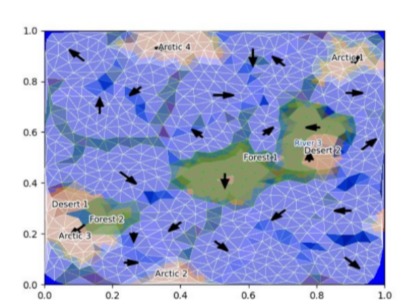
A procedurally generated map showing the movement of the plate tectonics, leading to land formation.
-
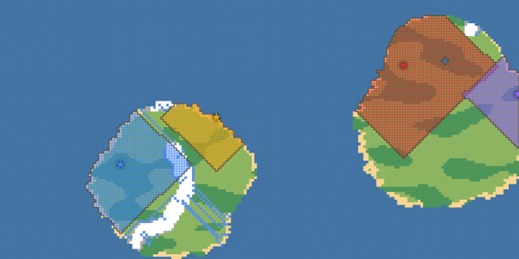
An example of civilization placement according to genAI parameters and biome scoring.
Inspiration
Geography has always played a pivotal role in shaping civilizations — influencing their agriculture, technology, social systems, religion, and politics. In some stories, the setting is so powerful to be a character in themselves. However, for authors and creatives, building such worlds from scratch can be incredibly time-consuming and requires a deep understanding of real-world systems.
Inspired by the meticulous worldbuilding of authors like Frank Herbert (Dune), who developed entire ecologies and rich political systems, we strived to create a tool that supports storytellers by taking care of the hardest parts—geography, climate, and historical justification—while assuring real-world, scientific basis of the setting and allowing authors to maintain creative control over the process.
What it does
WorldBuilder uses procedural generation based on real-world features that shape geography and climates (wind currents, ocean currents, plate tectonic movement, hotspots, etc.), and uses GenAI that takes in story details to contextualize it within this map.
How we built it
- Flask application: HTML/CSS+JavaScript+Bootstrap frontend, Python backend
- Python for procedural generation
- OpenAI for prototype story context reasoning
- Gemini API for proof of concept story context reasoning and civilization placement
- Heroku for deployment
Challenges we ran into
- Challenges of how to implement GenAI to be able to interpret the map
- Simulation of real-world geographic concepts to build realistic maps
- Having to switch deployments last-minute
Accomplishments that we're proud of
- Learning how to use LLM APIs for the first time that work in-tandem with other processes to generate meaningful results
- Sophisticated and technical procedural generation that has scientific basis
What we learned
- More about physical concepts of the world!
- How to use API integrations into web applications
- Different methods of deployment, such as Heroku and PythonAnywhere
What's next for WorldBuilder
- Putting markers around the map that tell the history of that location, or its significance to the story and the environment
- Generating a timeline of events that show the fall and rise of civilizations and their relationships to each other
- Completing the procedural map generation to account for ocean and wind currents
- Further worldbuilding details generation, such as clothing and language by region
- Placing characters within their respective civilizations


Log in or sign up for Devpost to join the conversation.