WorkTwin AI – AI-Powered Workforce Digital Twin for Smart Manufacturing
Inspiration
Manufacturing companies often need to assign employees to tasks while considering multiple factors such as skills, workload, availability, productivity, attendance, task priority, and deadlines. In many workplaces, these decisions are still handled manually using spreadsheets or simple task assignment systems.
We were inspired to build WorkTwin AI to make workforce planning more intelligent and proactive. Instead of only showing what is happening in the workforce, our system creates a digital representation of the workforce and uses AI to recommend better decisions.
The idea is to help managers answer questions such as:
- Which employee is best suited for a particular task?
- Which tasks are likely to be delayed?
- What happens if multiple employees are absent?
- How should employees be reassigned when production demand increases?
- Which skills are currently underutilized or in high demand?
What We Built
WorkTwin AI is an AI-powered Workforce Digital Twin designed for manufacturing environments.
The system combines employee information, skills, workload, availability, attendance, productivity, and task requirements to provide intelligent workforce insights.
Our prototype includes:
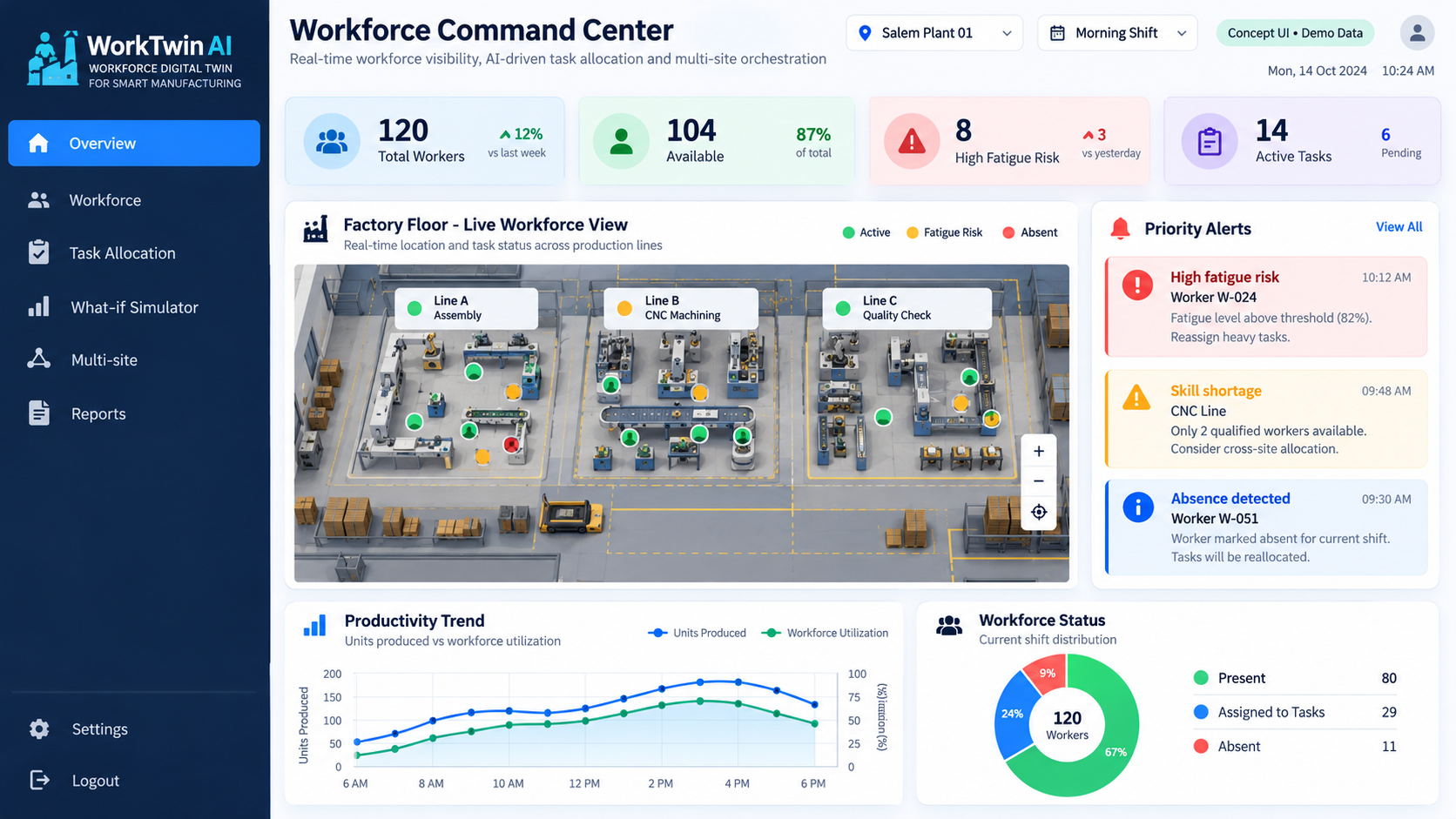
1. Workforce Digital Twin Dashboard
The dashboard provides a virtual view of the workforce, including:
- Employee availability
- Skills and skill levels
- Current workload
- Productivity
- Attendance
- Assigned tasks
- Workforce utilization
Employees can be represented with different status indicators to make the current workforce condition easy to understand.
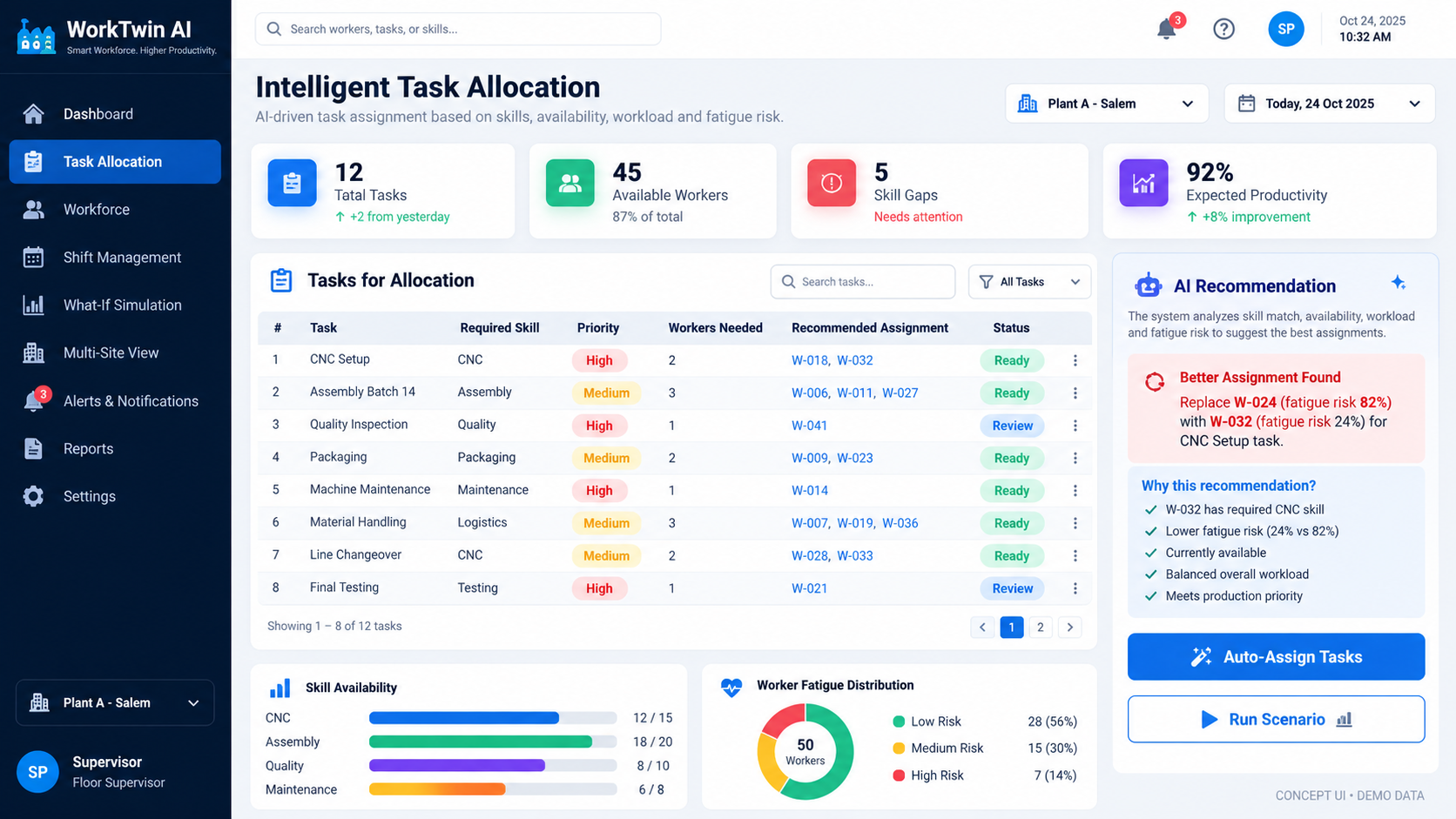
2. AI Employee–Task Recommendation
When a new task is created, WorkTwin AI evaluates available employees based on multiple factors such as:
- Skill match
- Availability
- Current workload
- Previous performance
- Experience
- Attendance
The system generates a ranked list of suitable employees instead of requiring a manager to manually check every employee.
3. Task Delay Prediction
WorkTwin AI analyzes task-related information such as:
- Task complexity
- Priority
- Deadline
- Number of available workers
- Current workload
- Required skills
- Historical task information
Based on these factors, the system estimates the probability that a task may be delayed and identifies high-risk tasks.
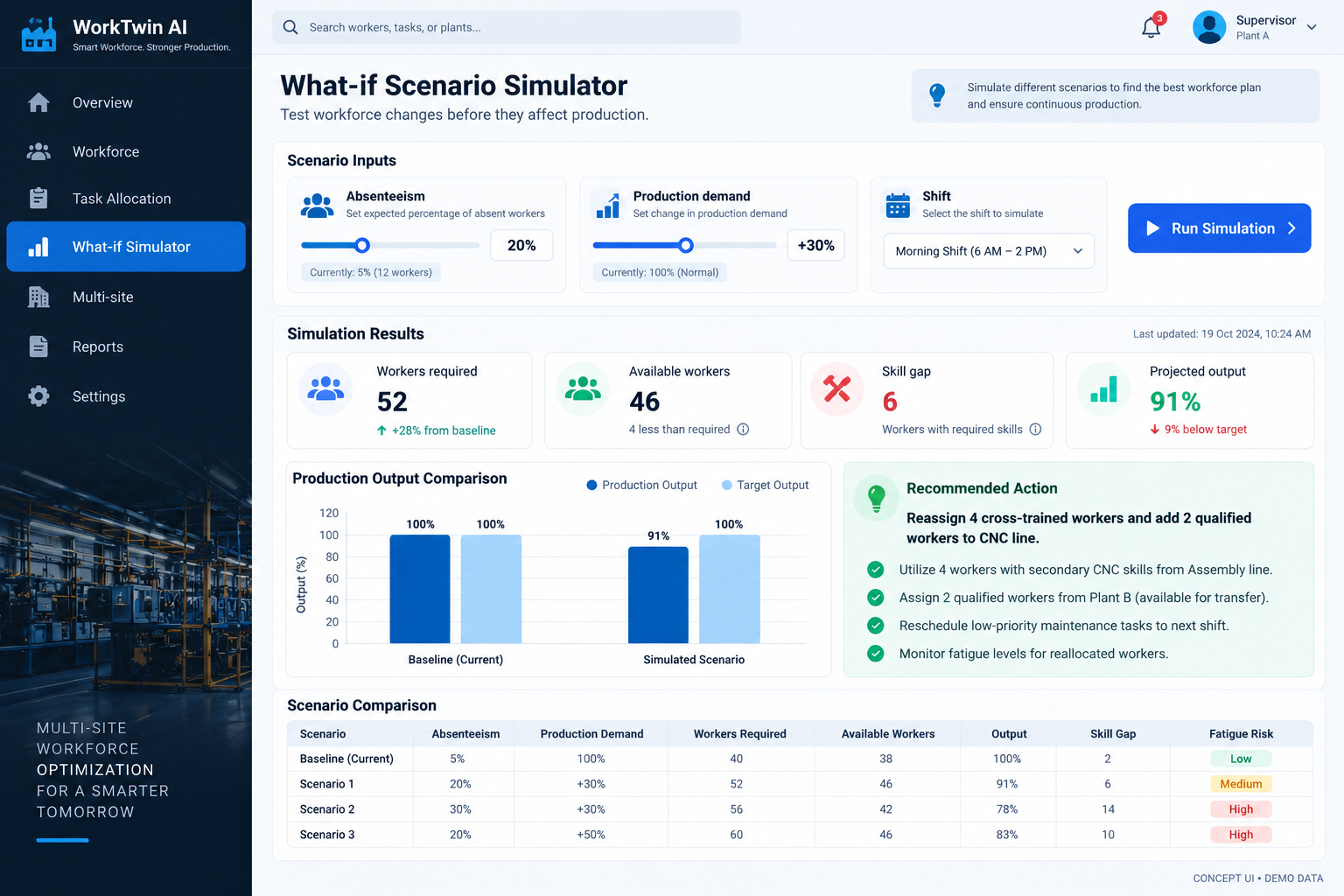
4. What-If Workforce Simulation
Managers can test different workforce scenarios before making real changes.
For example:
- What if two employees are absent?
- What if production demand increases by 30%?
- What if several urgent tasks arrive simultaneously?
The system recalculates workforce requirements and provides recommended task reallocations.
5. AI Workforce Assistant
The AI assistant allows managers to interact with workforce information using natural language.
For example:
"Who should handle the urgent packaging task?"
or
"Why is Task T102 at risk?"
The assistant provides an understandable explanation based on the available workforce data.
How We Built It
The prototype uses a web-based architecture:
Frontend → Spring Boot REST API → MySQL Database → AI Models → Workforce Dashboard
Technologies
- Frontend: HTML, CSS, JavaScript
- Backend: Java, Spring Boot
- Database: MySQL
- AI/ML: Python, scikit-learn
- Visualization: Chart.js
- Version Control: GitHub
- Deployment: Cloud-based deployment
The Spring Boot backend manages employees, tasks, attendance, assignments, and workforce data. The AI layer processes this information to generate employee recommendations and task-risk predictions.
For the employee-task recommendation, we use an explainable scoring approach that considers factors such as skill match, availability, workload, performance, experience, and attendance.
The delay prediction component uses workforce and task attributes to identify tasks that have a higher probability of being delayed.
Challenges We Faced
One of our main challenges was designing an AI solution that could be realistic enough for a manufacturing environment while still being feasible as a hackathon prototype.
Another challenge was combining multiple workforce factors into meaningful recommendations. Simply selecting an employee based on skill was not sufficient because an employee may have the required skill but already have a high workload.
We therefore designed the recommendation process to consider multiple factors together.
We also had to simplify the concept of a large-scale workforce digital twin into a practical prototype. Instead of depending on physical factory hardware, our prototype can work with simulated workforce signals and existing workforce data. This makes the solution easier to demonstrate while keeping the architecture extensible to real IoT, wearable, HR, and production systems in the future.
What We Learned
Through this project, we learned how AI can be combined with traditional software systems to solve real operational problems.
We learned about:
- Workforce optimization
- Explainable AI-based recommendations
- Predictive analytics
- Digital twin concepts
- REST API integration
- Data-driven decision making
- Scenario-based simulation
- Building an end-to-end AI application
Most importantly, we learned that an effective AI system should not only produce predictions but should also provide information that helps people make better decisions.
Impact
WorkTwin AI aims to help manufacturing managers make workforce decisions faster and more intelligently.
Potential benefits include:
- Better employee utilization
- Improved skill-based task allocation
- Reduced workforce overload
- Early identification of task delays
- Faster response to absenteeism
- Better handling of demand changes
- More proactive workforce planning
Our prototype demonstrates the core concept and can be extended in the future to integrate real-time IoT devices, wearable sensors, HR systems, production systems, and multi-site manufacturing data.
Future Scope
Future versions of WorkTwin AI could include:
- Real-time IoT and wearable integration
- Multi-site workforce orchestration
- Advanced reinforcement-learning-based scheduling
- Ergonomic risk prediction
- Automated shift scheduling
- Integration with enterprise HR and production systems
- Federated learning for privacy-preserving multi-site analytics
WorkTwin AI is our step toward making workforce management more predictive, adaptive, and AI-driven.
Built With
- analytics
- api
- artificial
- boot
- chart.js
- css
- digital
- html
- intelligence
- java
- javascript
- learning
- machine
- mysql
- predictive
- python
- rest
- scikit-learn
- spring
- twin

Log in or sign up for Devpost to join the conversation.