-
-
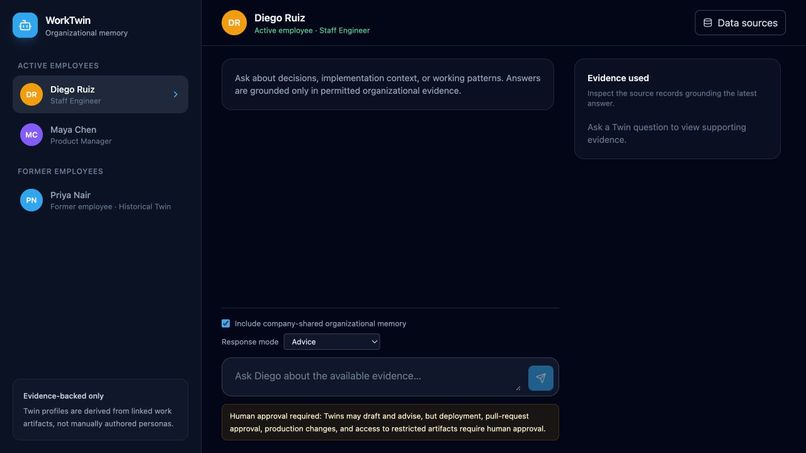
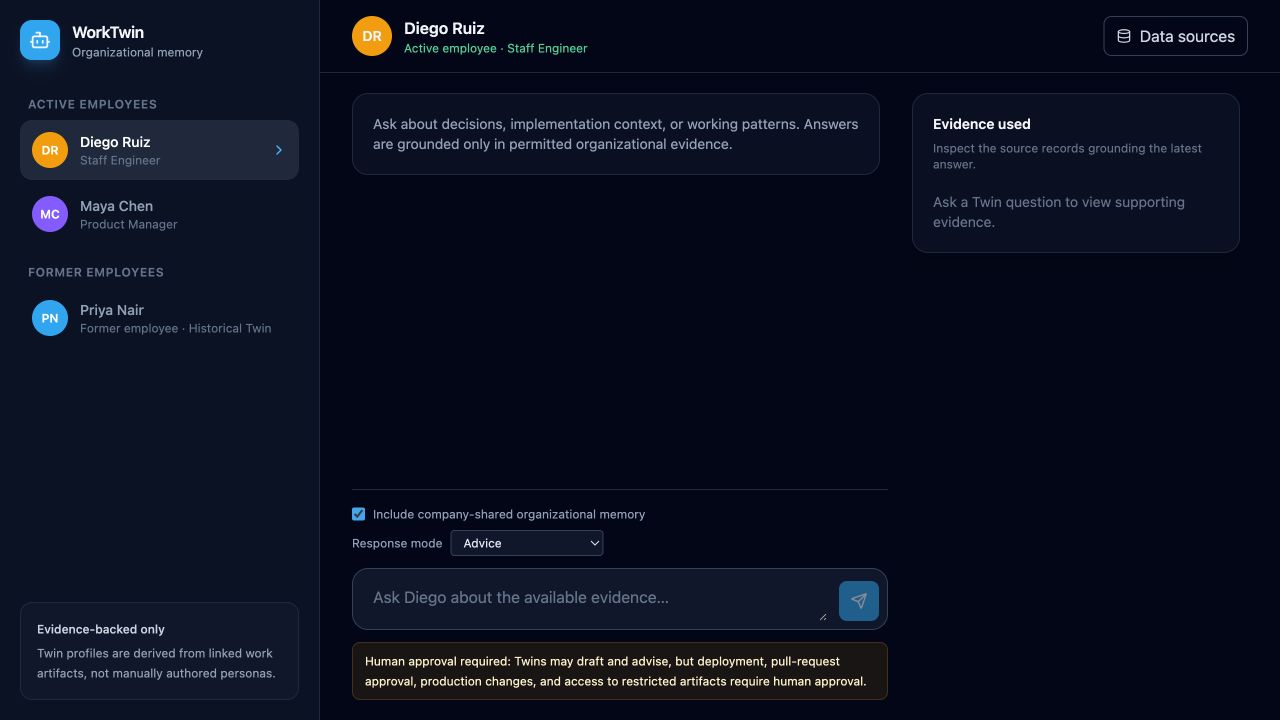
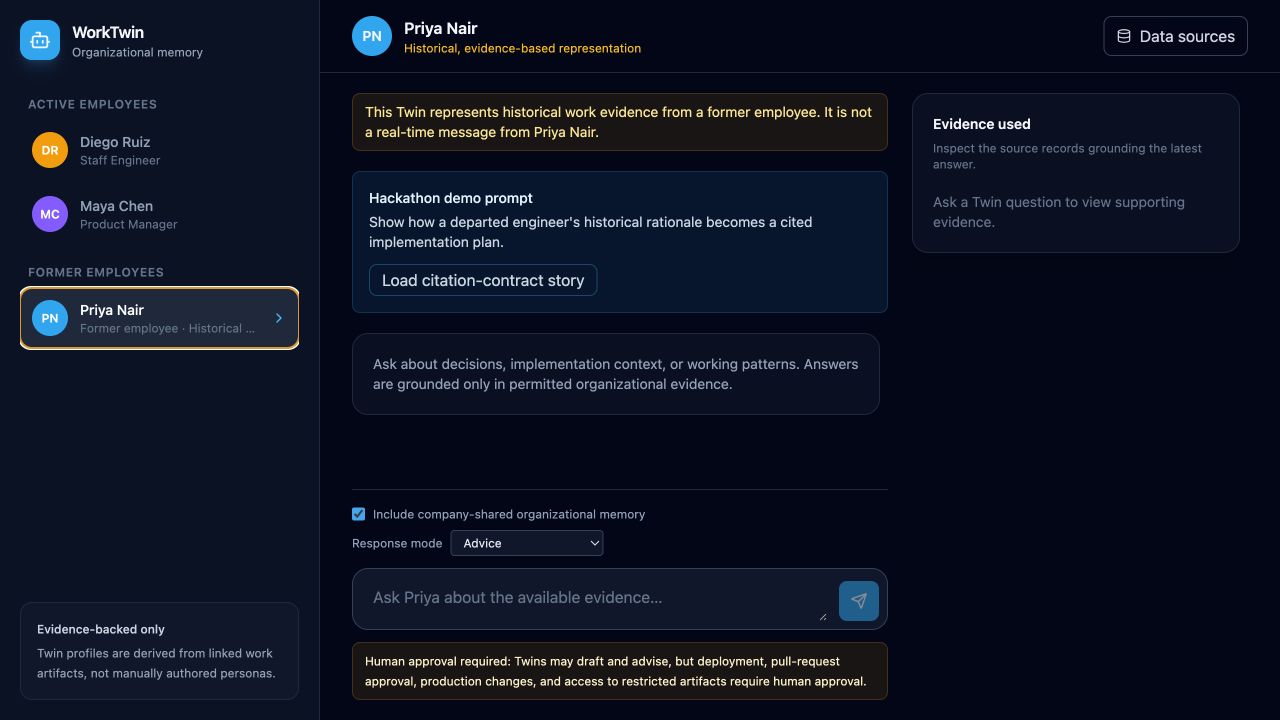
WorkTwin’s employee directory organizes active and former employees into evidence-backed Twins.
-
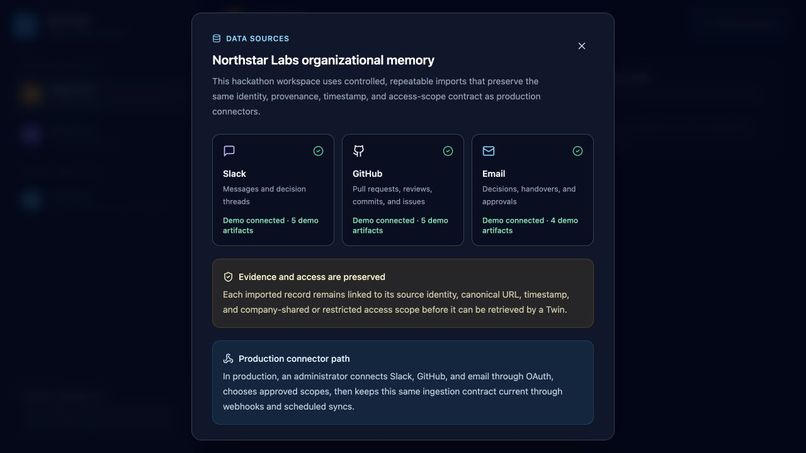
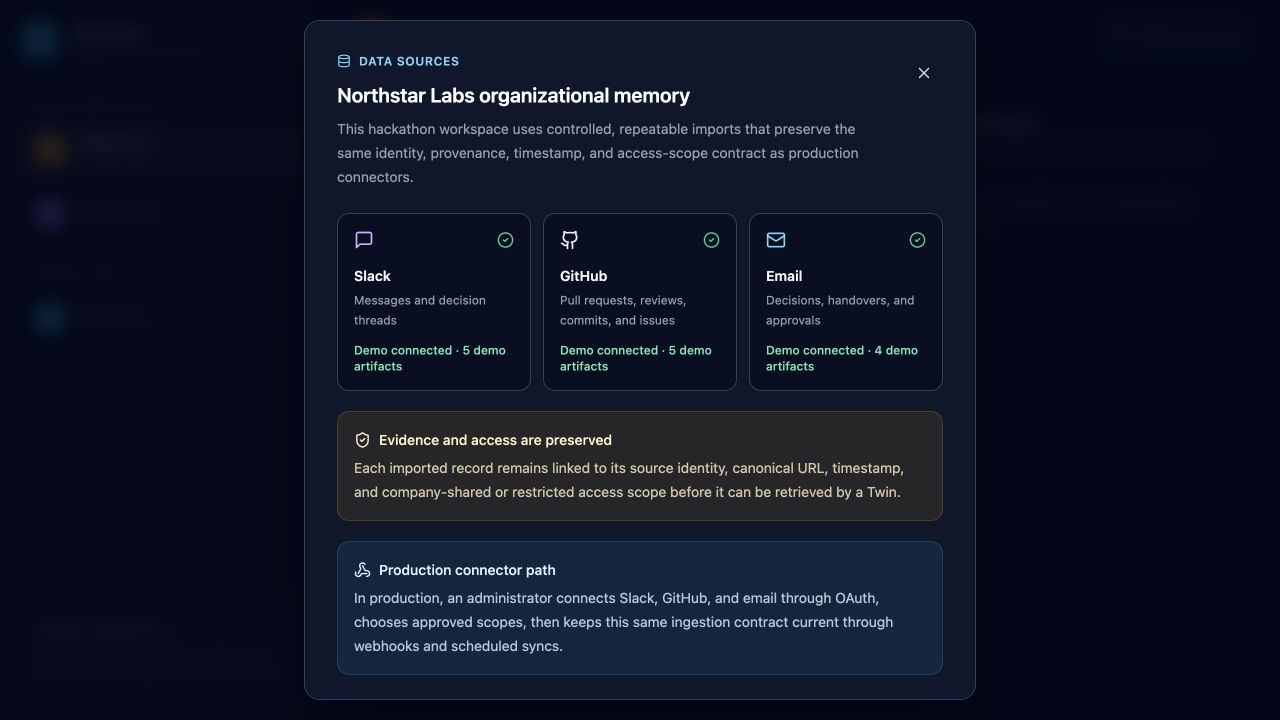
WorkTwin ingests Slack, GitHub, and email artifacts while preserving provenance, timestamps, and access scope.
-
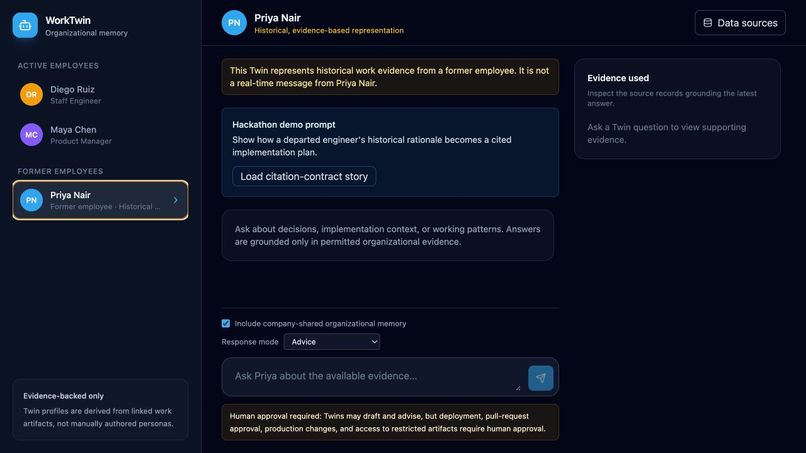
Priya Nair’s departed WorkTwin is clearly identified as a historical, evidence-based representation.
-
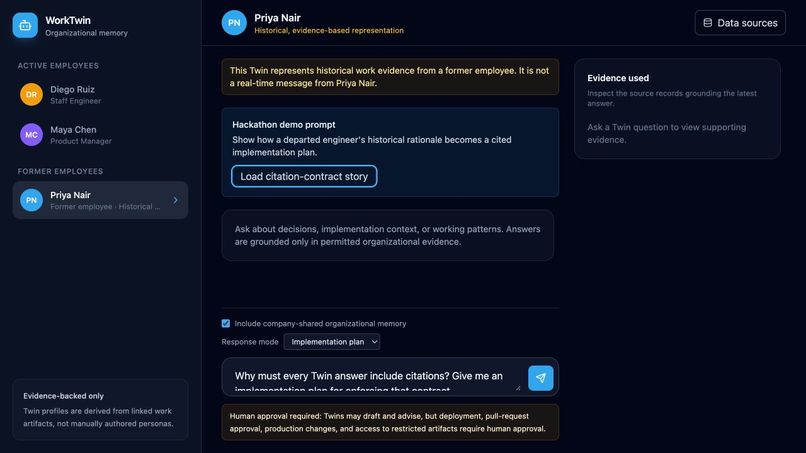
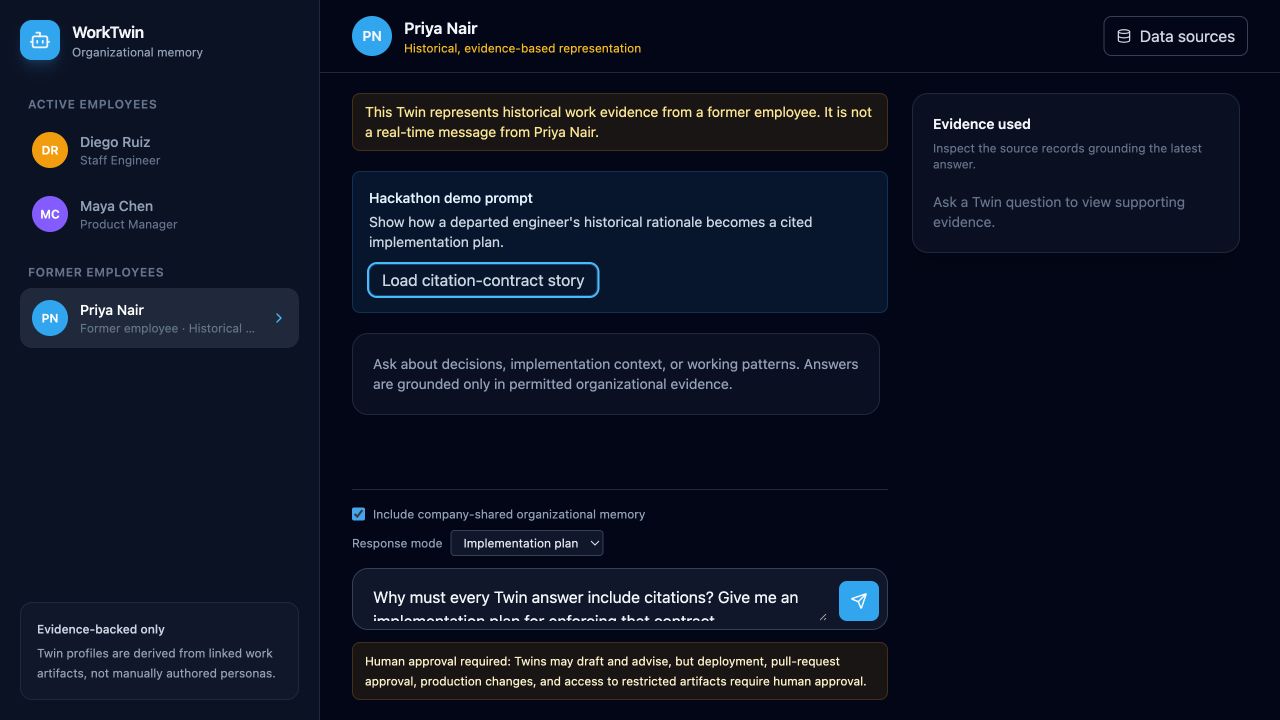
A teammate asks Priya’s Twin for a cited implementation plan using the guided demo prompt.
-
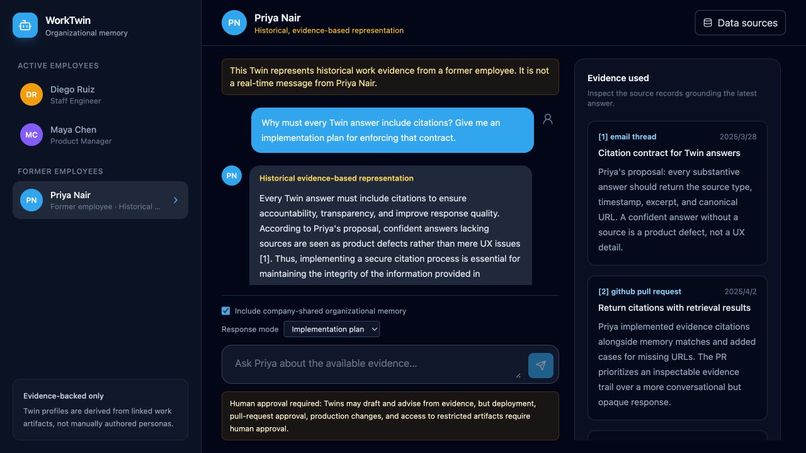
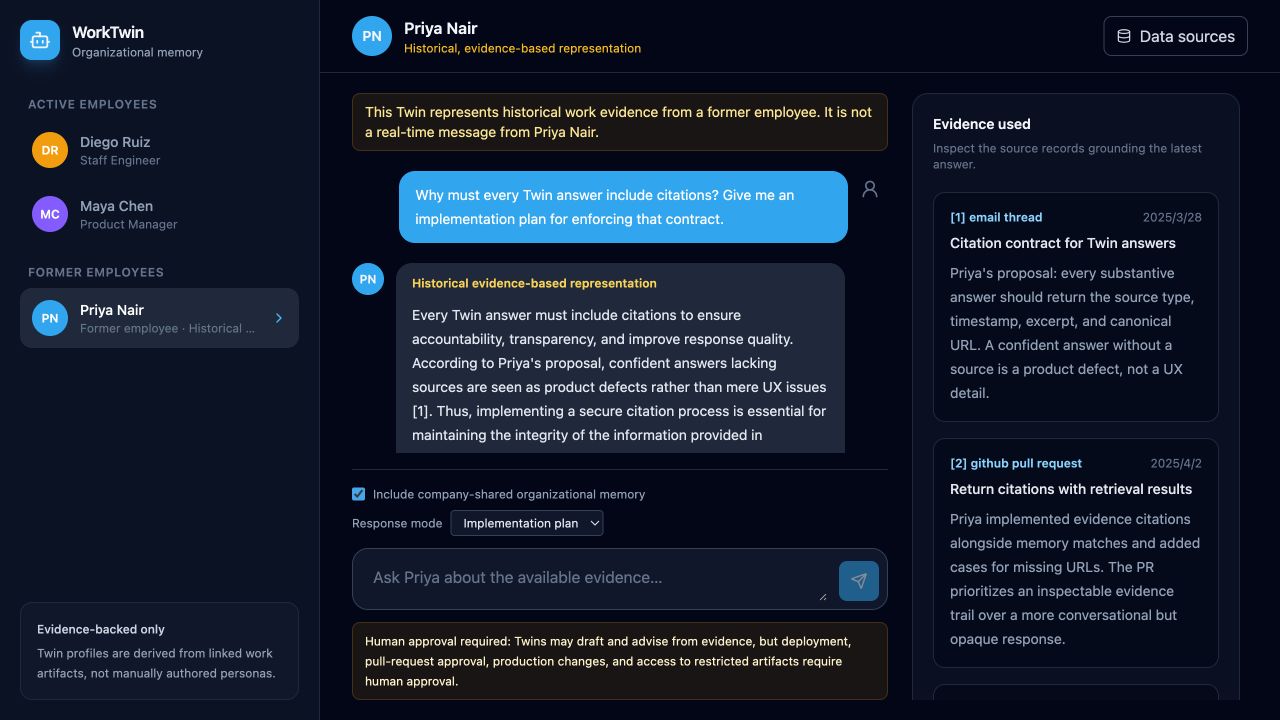
The Twin returns a grounded implementation plan alongside inspectable email and GitHub evidence.
-
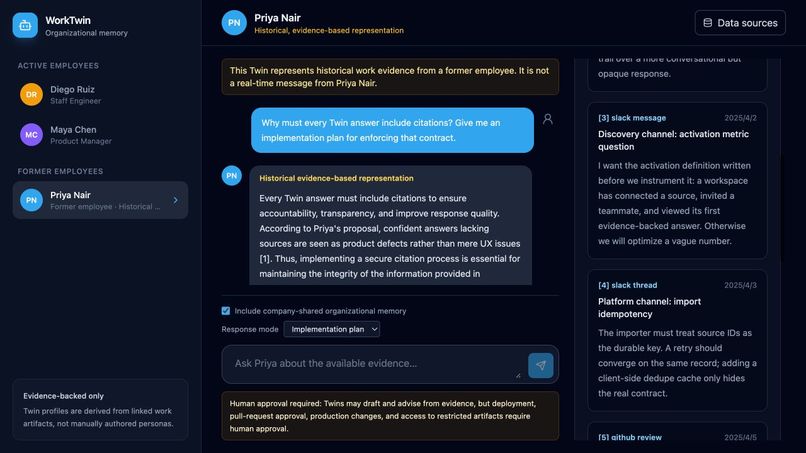
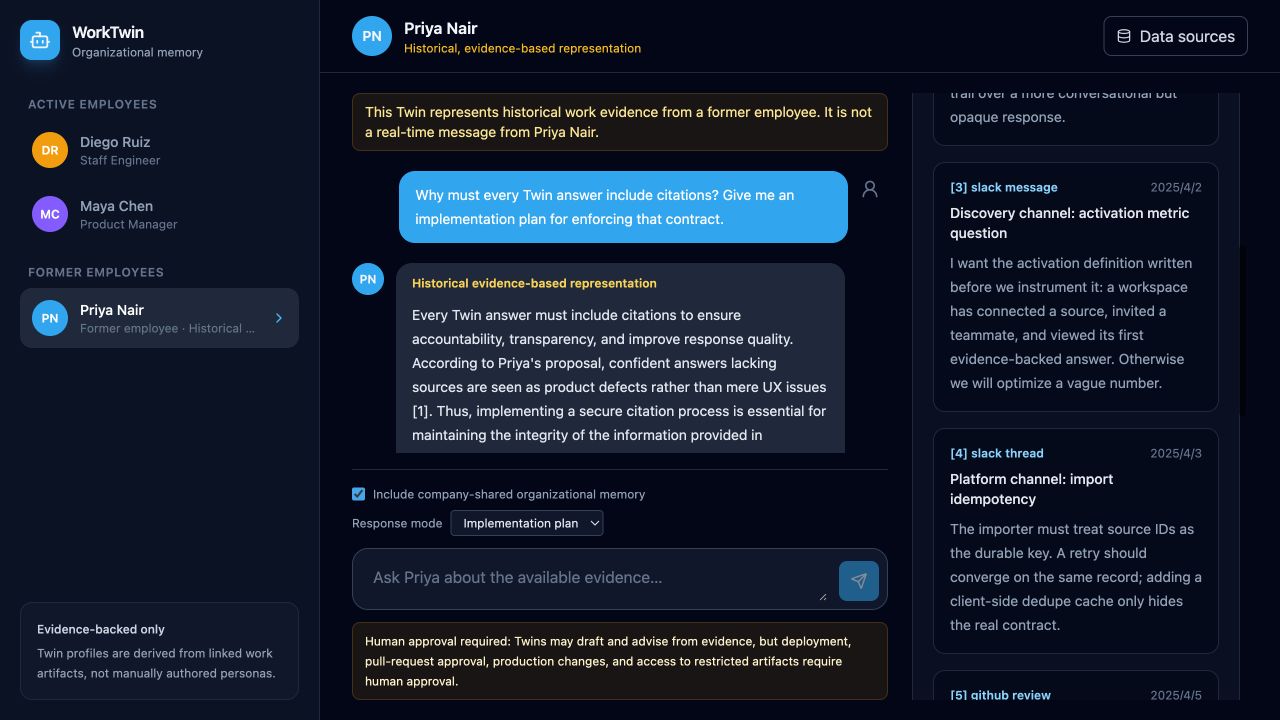
The evidence panel exposes supporting Slack discussions and source excerpts for verification.
Inspiration
When someone leaves a team, the organization does not only lose headcount. It loses the reasoning behind decisions, the context behind technical trade-offs, and the small pieces of knowledge scattered across Slack, GitHub, and email. I built WorkTwin around a question I have faced before: “Who knows why this was done?” I wanted that answer to remain available even after the original employee has changed roles or left the company—without pretending that they are still online.
What it does
WorkTwin creates evidence-backed Employee Twins from work artifacts rather than manually written personas. A teammate can select an active or former employee, ask about a past decision, and receive a grounded answer with inspectable citations. The response shows the source type, timestamp, excerpt, and canonical reference from Slack, GitHub, or email. For former employees, WorkTwin clearly labels the Twin as a historical, evidence-based representation. It can explain prior context and draft next steps, but it never claims real-time knowledge or acts as the employee.
How we built it
I built the frontend with React, Vite, TypeScript, Tailwind CSS, and Shadcn UI. The backend uses FastAPI and the official OpenAI Python SDK. Supabase provides PostgreSQL and pgvector storage for organizations, employees, source identities, work artifacts, memory chunks, derived Twin profiles, and interaction audit records. For the hackathon demo, I created repeatable Slack, GitHub, and email imports. Each artifact preserves its author, source type, timestamp, canonical URL, content, and access scope. I generate embeddings, retrieve permitted evidence, and use the OpenAI API to produce cited answers, implementation plans, and code drafts.
Challenges we ran into
The main challenge was making the product trustworthy rather than merely convincing. A fluent answer without evidence can sound useful while still being wrong or impossible to verify. I designed citations and provenance into the data model from the beginning. I also had to treat access controls seriously: restricted email should not become visible just because a related Slack discussion is company-shared. Another challenge was creating a reliable hackathon demo. Production Slack, GitHub, and email connectors require OAuth, webhooks, and live external dependencies. I used controlled imports that follow the same ingestion contract, so the demo remains stable while accurately representing the production architecture.
Accomplishments that we're proud of
- I built a complete evidence-backed Twin experience instead of a generic chatbot.
- I made every substantive answer inspectable through source citations.
- I clearly distinguished active employees from departed historical Twins.
- I added Slack, GitHub, and email provenance with timestamps, excerpts, URLs, and access scopes.
- I included implementation-plan and code-draft modes grounded in retrieved work history.
- I added human-approval guardrails for deployments, pull-request approval, production changes, and restricted access.
- I deployed a working end-to-end demo with a stable narrative and real UI flow.
What we learned
I learned that trust is a product feature. Citations are not a cosmetic addition—they change the conversation from “the model says so” to “this answer is supported by this email, pull request, and Slack thread.” I also learned that preserving knowledge requires boundaries. A WorkTwin should help people recover context, but it should not impersonate an employee, expose restricted information, or make consequential decisions independently.
What's next for WorkTwin
Next, I want to replace demo imports with live Slack, GitHub, and email OAuth connections, webhook ingestion, and scheduled syncs. I also plan to add richer sources such as documents, meeting transcripts, incident reports, and project-management tools. On the product side, I want better organization-wide search, memory freshness signals, stronger permission models, and review workflows for teams to validate or challenge derived knowledge. My goal is to make WorkTwin a reliable layer of organizational memory—one that helps knowledge stay with the company as teams evolve.
Built With
- api
- css
- embeddings
- fastapi
- openai
- pgvector
- postgresql
- python
- react
- render
- sdk
- search
- shadcn/ui
- supabase
- tailwind
- typescript
- vector
- vercel
- vite


Log in or sign up for Devpost to join the conversation.