-
-
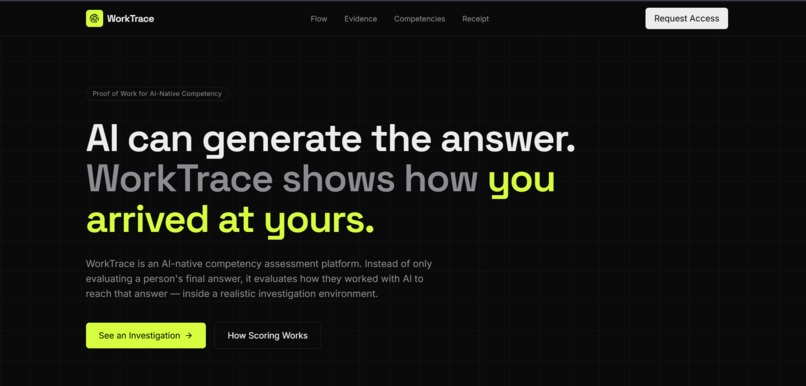
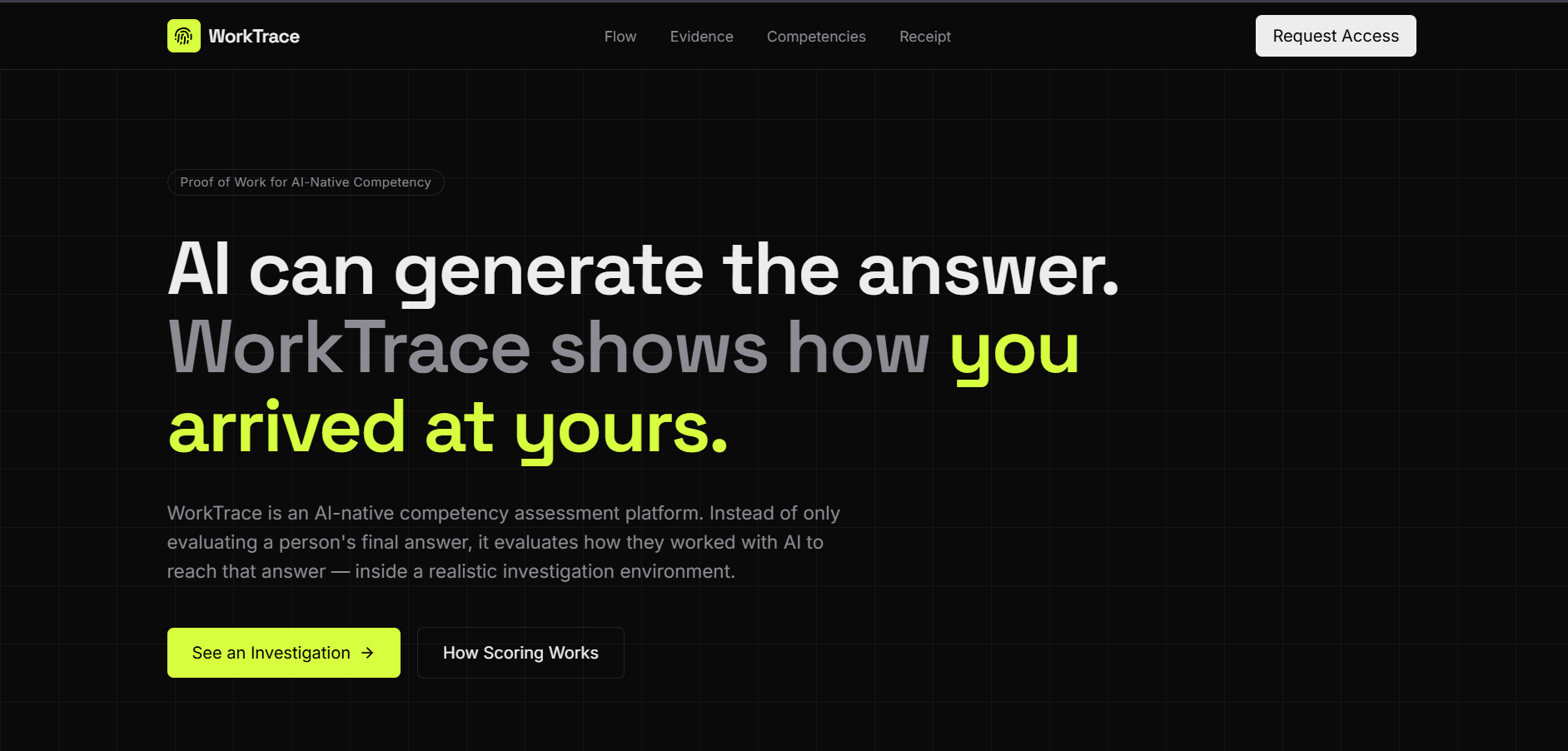
WorkTrace Home page
Inspiration
AI has changed how people create work. It makes it easy to generate polished final code, which breaks traditional testing.
A correct answer no longer proves that someone understood the problem. It doesn't show whether they inspected evidence, checked for AI hallucinations, verified suggestions, or made the decision themselves.
I built WorkTrace to make that process visible, moving from assessing final answers to evaluating the investigation behind them.
What it does
WorkTrace evaluates the investigation process, not only the final answer.
The learner works through a real investigation flow:
- Start a realistic investigation mission.
- Inspect the supplied codebase.
- Ask grounded questions to the AI teammate.
- Accept, reject, or verify AI suggestions.
- Collect evidence.
- Submit a final solution.
- Explain reasoning independently.
- Receive an evidence-grounded Competency Receipt.
WorkTrace generates a Competency Receipt from the completed investigation timeline. It links each competency assessment to recorded learner actions.
Core Trust Rule: AI chat and suggestions are context. Learner actions are the evidence.
How the Trust Model Works
- The backend records an ordered investigation timeline with sequence-numbered events.
- Persisted learner events become the evidence used by the evaluator.
- AI chat and suggestions cannot satisfy learner competency requirements.
- Learner decisions, evidence selections, verifications, the final solution, and the follow-up explanation act as competency anchors.
- The evaluator returns structured output grounded in recorded investigation events.
- The backend validates evaluator output and its evidence mappings before storing a Competency Receipt.
- Invalid evaluator output does not create a receipt; the completed investigation remains stored so evaluation can be retried smoothly.
How I built it
- Frontend: React, Vite, Redux Toolkit, Tailwind CSS, Framer Motion, and Monaco Editor.
- Backend: Node.js, Express, REST APIs, SQLite, and better-sqlite3.
- Development Collaborators: I used Codex and GPT-5.6 as development partners during OpenAI Build Week. They helped me build the full-stack flow, connect Redux state to backend APIs, debug persistence and API contracts, tighten the evaluator contract, and write and update tests.
- In-Product AI: Powered by the Google Gemini API for both the in-app AI teammate and the competency evaluator.
Challenges I ran into
1. Separating AI context from learner evidence
An AI suggestion can be useful, but it cannot prove learner competency. I made AI chat and suggestions separate from learner-owned events. The evaluator scores only from persisted learner events recorded during the investigation.
2. Making evaluator output safe and grounded
Evaluators can hallucinate event IDs or scores. The backend parses and strictly validates the evaluator’s structured response, competency mappings, and recorded event IDs before storing a receipt.
3. Preserving work when evaluation fails
If evaluation output is invalid or an API connection drops, WorkTrace does not generate a receipt, but the learner’s completed submission remains stored so evaluation can be retried without losing progress.
Accomplishments that I'm proud of
I am proud that the Competency Receipt is backed by real investigation data instead of hardcoded scores or sample evidence.
I am also proud of the trust model. A learner can use AI, disagree with it, and show why. WorkTrace treats that judgment as part of the assessment rather than treating AI use as something to hide.
The final receipt exposes a backend-sanitized timeline so the assessment can be inspected through the events that supported it.
What I learned
I learned that AI-native assessment is not mainly about detecting AI use—it is about understanding how a person uses AI.
The important signals are the questions they ask, the evidence they select, the suggestions they verify or reject, and the reasoning they provide afterward.
A final answer is still useful, but it is not the whole story.
What's next for WorkTrace
Shareable & Portable Receipts: Allowing job seekers to share public receipts on LinkedIn or resumes.
Role-Specific Missions: Letting hiring managers and teachers upload custom codebases and set tailored evaluation rubrics.
Richer Sandboxes: Supporting live code execution and automated test suites directly inside the workspace.
Adding more investigation missions and role-specific competency frameworks.
Exploring richer evidence types and team or hiring workflows.
Enabling Share and Export functionality (currently visible in the receipt UI as disabled future actions).
Built With
- axios
- better-sqlite3
- codex
- express.js
- framer-motion
- google-gemini-api
- gpt-5.6
- javascript
- monaco-editor
- node.js
- openai
- react
- redux
- rest-api
- sqlite
- tailwind
- vite
- vitest


Log in or sign up for Devpost to join the conversation.