-
-
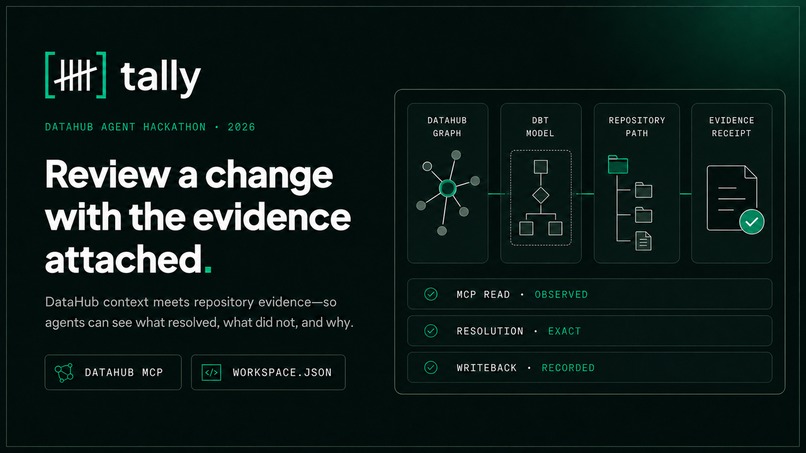
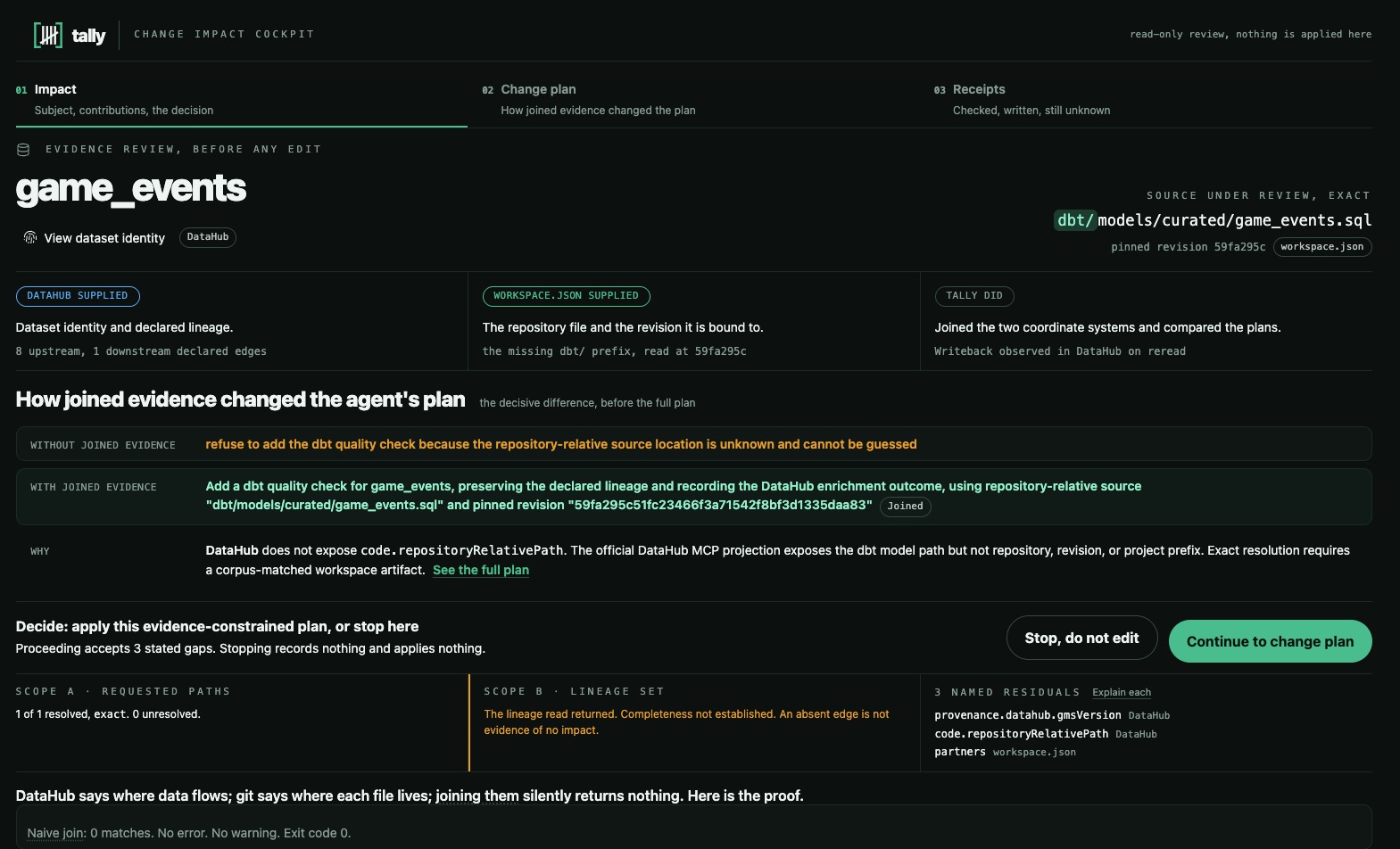
Tally change review cockpit — metadata and repository evidence attached.
-
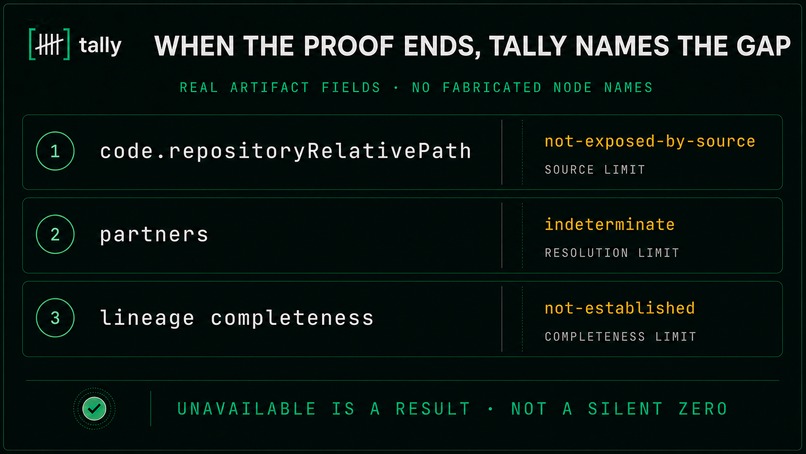
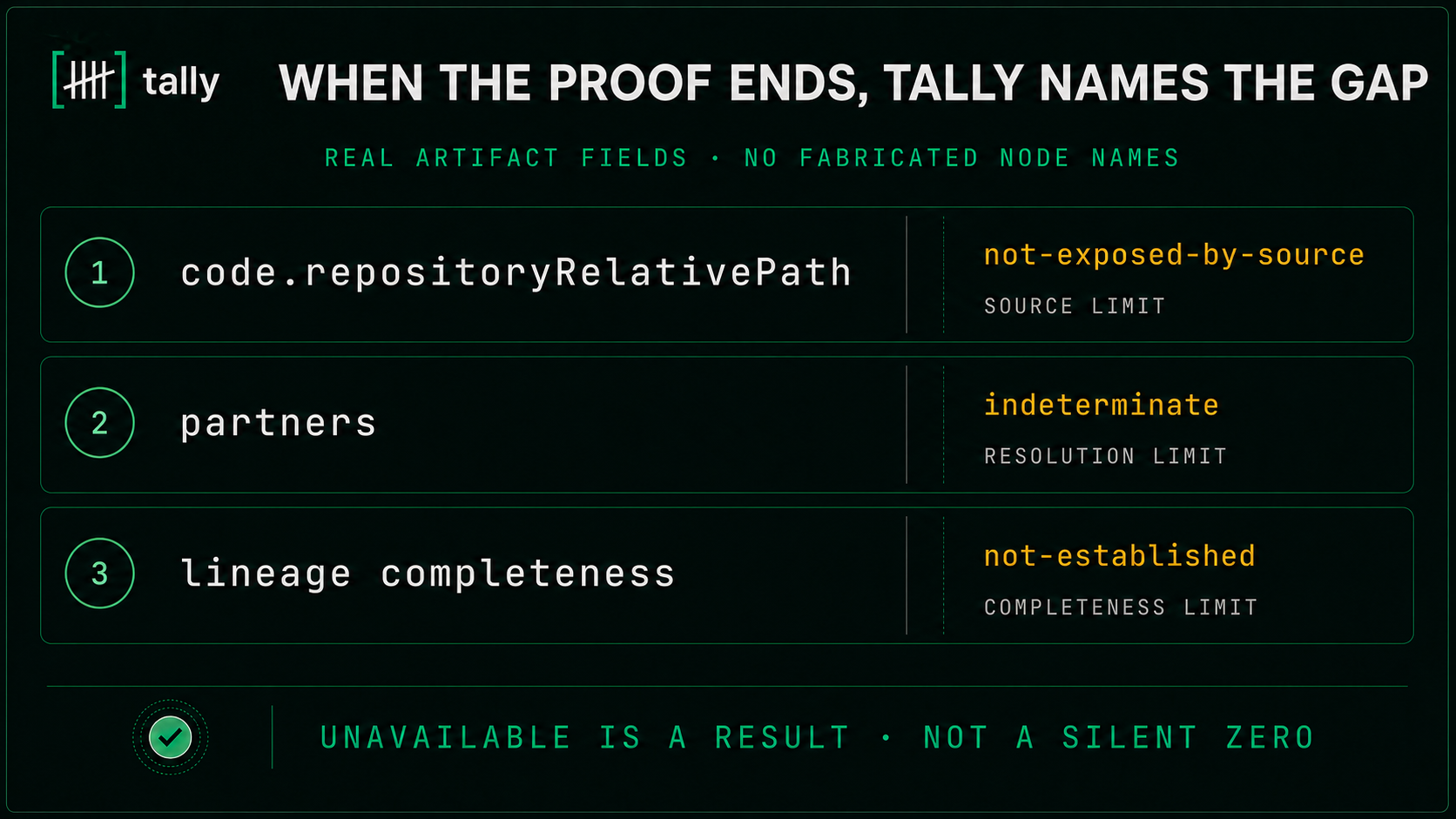
Independent axes keep path resolution, integrity, and lineage completeness honest.
-
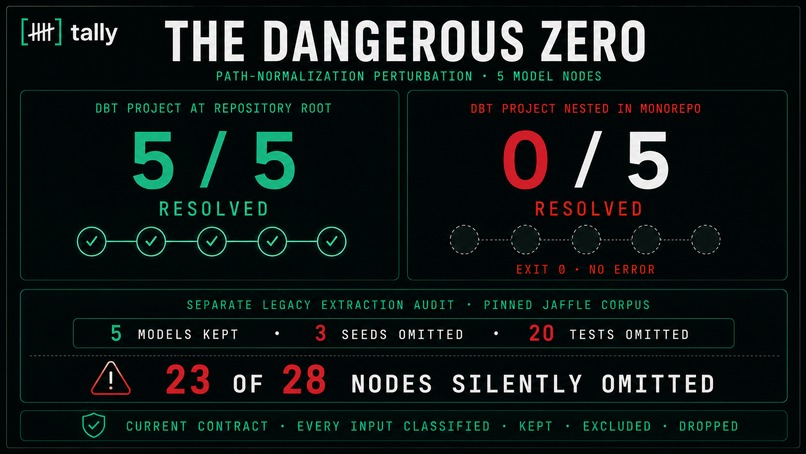
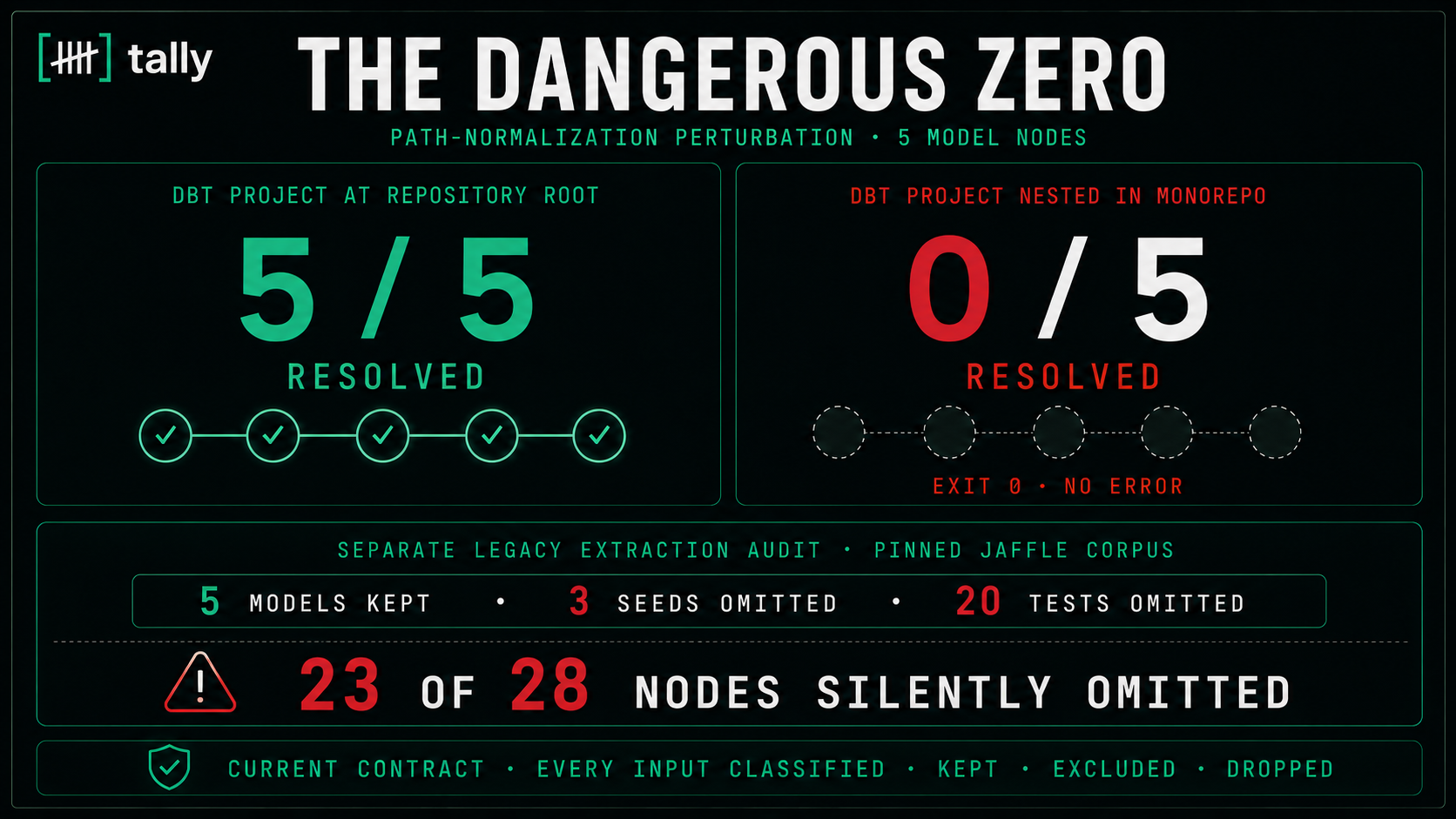
Dangerous zero: 5/5 at root, 0/5 nested; legacy extraction silently omitted 23 of 28.
-
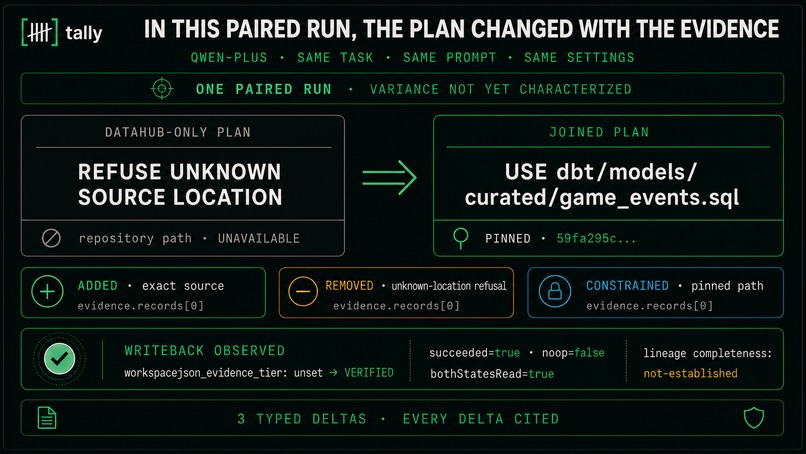
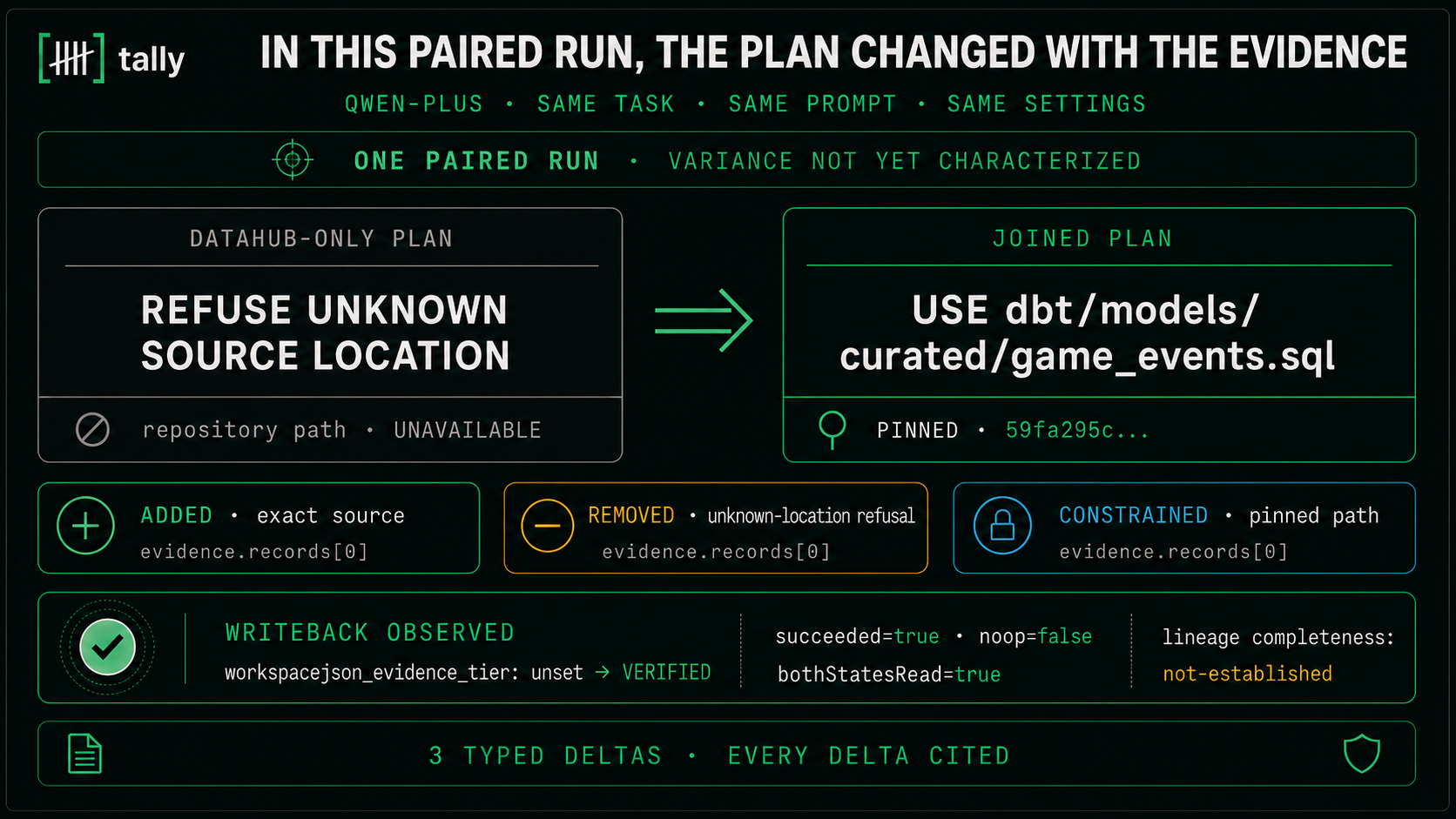
Same task and model: joined evidence changes refusal into an exact, pinned source plan.
-
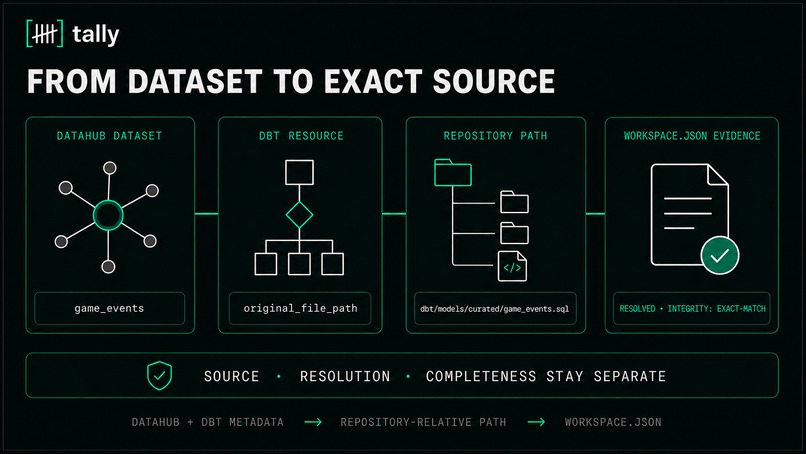
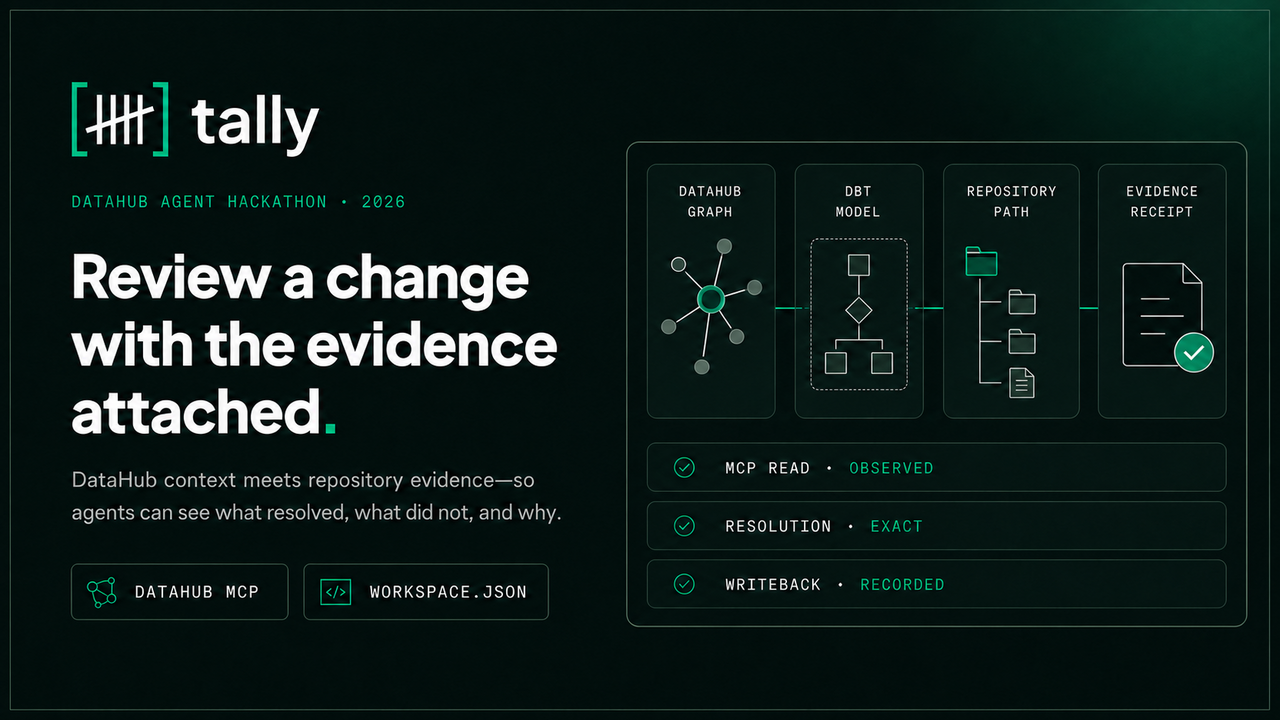
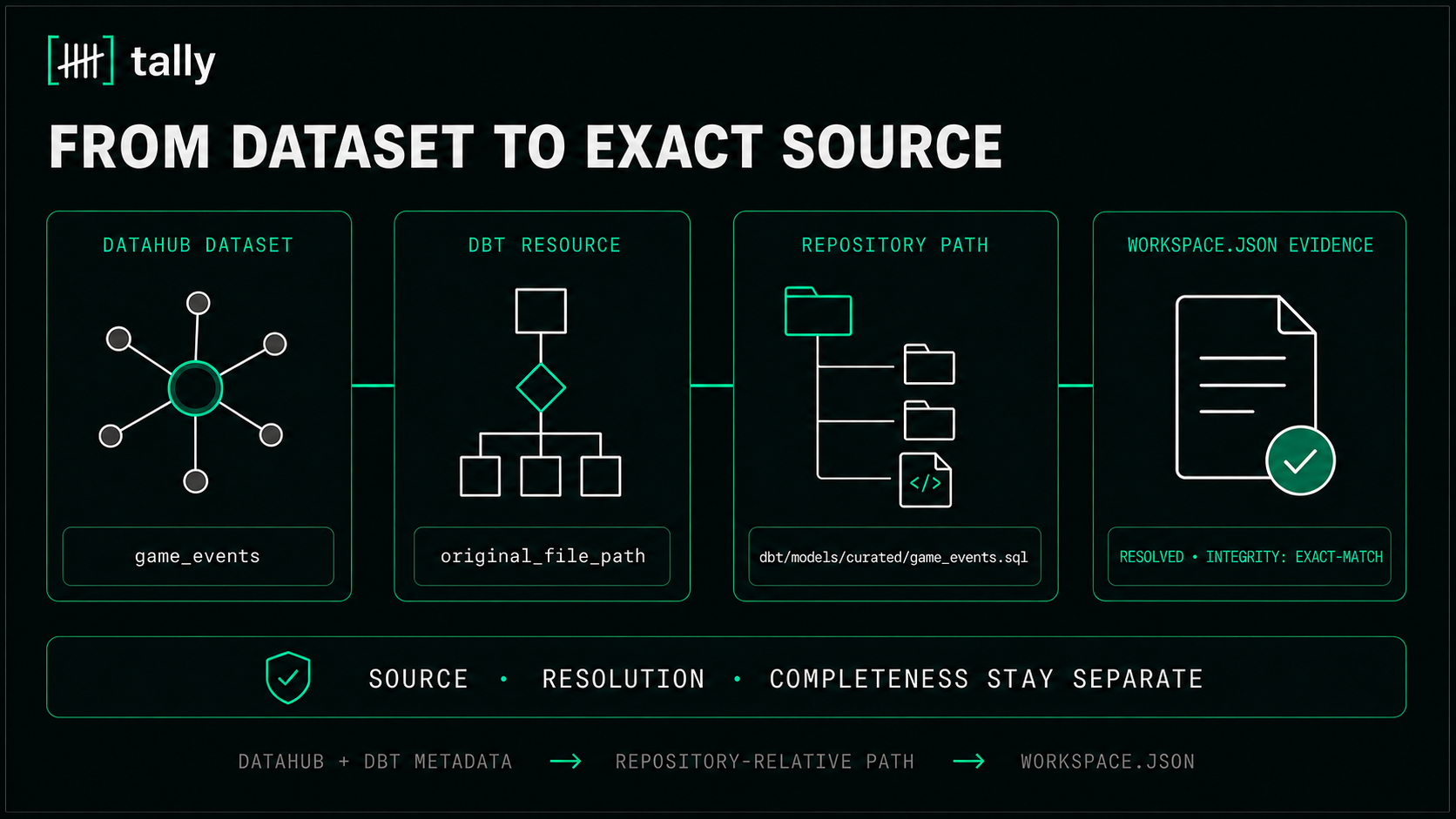
End to end: DataHub context → dbt path → workspace.json evidence → observed receipt.
-
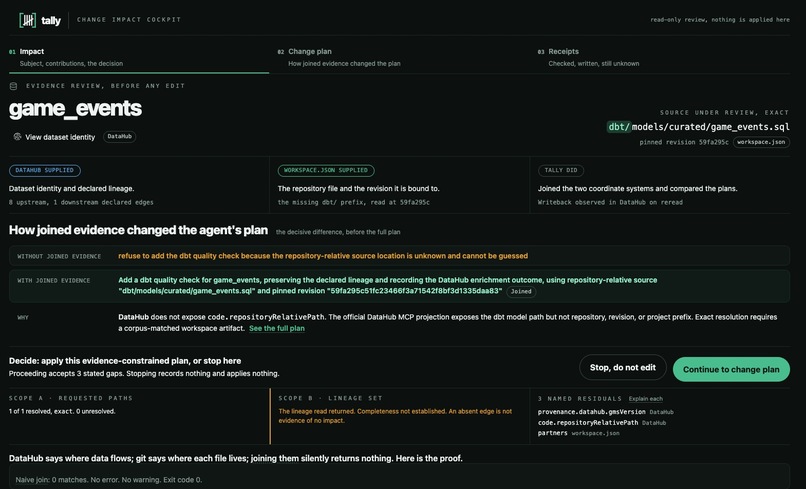
Impact Dashboard
Inspiration
The most dangerous integration failure is not always an exception. Sometimes it is a plausible zero.
DataHub can tell an agent which dataset matters, what depends on it, who owns it, and how it connects to the context graph. Before that agent can safely change production data code, it still has to answer a more operational question:
Which repository file actually produces this dataset, and how far can the available evidence be trusted?
That handoff breaks in a common repository layout. DataHub carries the dbt file path relative to the dbt project. Git and repository intelligence use paths relative to the repository root. When the dbt project lives under dbt/, the two systems name the same file differently.
I measured the consequence:
- Project at the repository root: 5 of 5 models resolved
- The same project nested under
dbt/: 0 of 5 models resolved - Process exit code in both cases: 0
Nothing crashed. Zero looked like a valid answer.
I built Tally to make that failure impossible to hide and to show exactly how revision bound repository identity changes an agent's proposed action.
What Tally does
Tally is a context safe change impact agent and cockpit for DataHub. It:
- Reads the canonical DataHub dataset URN, schema, ownership, and lineage through the official DataHub MCP Server.
- Reads the dbt file path DataHub already carries without reconstructing dataset identity.
- Normalizes the dbt project relative path into a repository relative source path.
- Joins that path to a pinned
workspace.jsonrepository artifact. - Emits a typed, evidence bounded
ChangeImpactEvent. - Compares the agent's plan with DataHub context alone versus joined repository identity.
- Writes a narrow enrichment back to DataHub and observes the before and after states.
- Renders Impact, Change plan, and Receipts in an offline cockpit.
The result is not merely a filename. Tally shows how the dataset resolved to code, which system owns each fact, what was actually observed, and where the proof ends.
- Open the live cockpit
- Read the judging guide
- Inspect the public repository
- View the product showcase
The shipped end to end proof
I ran one complete judge inspectable path against DataHub OSS using the official DataHub MCP Server and a pinned public Transfermarkt dbt corpus.
DataHub context was read, not reconstructed
The captured event observed:
- 8 upstream lineage edges
- 1 downstream lineage edge
- successful reads in both directions
- completeness established against pinned readiness manifests
The dataset identity remains the URN returned by DataHub. Tally does not recreate it from dbt naming conventions.
The dataset resolved to exact, pinned code
Tally joined the DataHub dataset to:
dbt/models/curated/game_events.sql
The source is bound to Transfermarkt revision:
59fa295c51fc23466f3a71542f8bf3d1335daa83
This is the coordinate mismatch the product exists to solve:
- dbt path:
models/curated/game_events.sql - repository path:
dbt/models/curated/game_events.sql
Joined repository identity consistently changed the plan
I ran Qwen Plus under two controlled conditions with the same task, model, prompt, decoding settings, repository revision, and DataHub snapshot. The context envelope was the only varying input.
Across 10 controlled paired runs:
- Exact source revision in the plan: 0 of 10 DataHub only, 10 of 10 joined context
- Distinct normalized step sequences: 5 DataHub only, 1 joined context
- Refusal present in DataHub only plans: 10 of 10
- Refusal removed after joining repository identity: 10 of 10
- Partial or failed pairs: 0
The DataHub only result was not a failure. It correctly refused because the repository relative source location was unknown and could not be guessed. Joined context supplied the exact path and pinned revision, allowing the same task to propose a checkable quality edit.
This is a controlled comparison on one task with one model at temperature 0. It is not a significance test or a claim about models in general.
Inspect HAC-150, including raw outputs and aggregation
Evidence was contributed back to DataHub
Tally wrote the workspacejson_evidence_tier structured property through DataHub's GraphQL mutation surface, then reread the state to produce an observed receipt.
The receipt keeps these outcomes separate:
- accepted mutation
- no op
- refusal
- omission
- accepted but not yet observed
- observed success
Tally writes only evidence it owns. It does not overwrite human authored descriptions, risk scores, or unrelated structured properties.
The complete checksummed live evidence package is available in the HAC-152 evaluation bundle.
Nothing vanishes
Every attempted dbt node resolution is classified as:
- Kept: resolved to repository evidence
- Dropped: expected to resolve, but did not
- Excluded: deliberately outside the requested resolution set
The resolver enforces:
kept + dropped + excluded = total
On the pinned proof corpus, all 28 nodes are accounted for:
- 8 kept dataset bearing nodes
- 20 test nodes excluded by policy
- 0 dropped
An empty collection cannot silently stand in for a failed read, unsupported node, or incomplete result.
Evidence axes stay independent
Tally does not let one successful check launder another claim:
- A successful lineage read does not imply exhaustive lineage.
- An exact repository match does not imply behavioral co change evidence.
- A mutation response does not prove that the intended state became observable.
- An agent plan is not treated as observed metadata.
- Missing, failed, not queried, indeterminate, and not exposed by the source are different states.
That makes Tally safe to place before an agent, CI workflow, or developer preparing to change production data code. It either shows where the evidence leads or states why the action should stop.
How I built it
Tally is a public Apache 2.0 TypeScript and Node.js application.
- React 19, Vite, and Tailwind power the cockpit.
- Zod validates the runtime evidence contracts.
- DataHub OSS and the official DataHub MCP Server provide the catalog surface.
- dbt, DuckDB, and Python provide the public data projects.
- Qwen Plus performs the controlled plan comparison.
- Vitest covers contracts, adapters, invariants, fixtures, and view models.
- Playwright and axe cover the judge route across Chromium, Firefox, and WebKit.
The dependency direction is deliberate:
DataHub context graph + workspace.json repository identity -> Tally change evidence
DataHub supplies the canonical dataset identity, schema, lineage, governance context, and writeback destination. workspace.json supplies revision bound repository paths and artifact provenance. Tally is the DataHub application that joins them.
The neutral workspace.json producer remains independent of DataHub. DataHub MCP reads, native dataset identity, dbt path interpretation, plan comparison, cockpit rendering, and enrichment writeback remain inside Tally.
The ChangeImpactEvent and PlanComparisonArtifact are separate contracts. Observed integration facts live in the event. Agent output lives in the comparison and binds back to exactly one event digest. This prevents an inference from masquerading as observed metadata.
Build window and prior work disclosure
I built Tally alone.
I am also the creator and maintainer of workspace.json, the pre existing open source repository context standard that Tally consumes. The standard and its broader ecosystem existed before this hackathon.
Tally itself was newly created during the submission period. The first commit in workspacejson/datahub-agent is dated July 24, 2026. The DataHub integration, MCP transport, evidence contracts, cockpit, evaluations, writeback path, and judging materials were built for this hackathon.
During the same period, I strengthened the public workspace.json CLI and standard around reproducible generation, adapter parity, stable read paths, and contract correctness because building Tally exposed where the producer and consumer boundary needed more rigor. Those ecosystem improvements support Tally, but I do not count them as newly created DataHub application code.
Tally is not a request for DataHub to adopt a proprietary dependency. It demonstrates that revision bound repository identity is a missing input for DataHub agents, and that an open artifact is one reproducible way to supply it.
Challenges I ran into
Three coordinate systems looked identical until they were not
A dbt manifest records original_file_path relative to its project. Git reports paths relative to the repository root. A tool may run from either location.
At the repository root, simple equality appeared correct. In a nested project, it collapsed from 5 of 5 to 0 of 5.
Correcting normalization was only half the fix. The output contract also had to account for every input so a future mismatch could not disappear as another empty list.
The graph converges asynchronously
During a clean live run, an upstream lineage read arrived before DataHub's graph index had converged. Tally refused to reinterpret the unreadable response as zero upstreams.
After convergence, the same official MCP path observed the expected lineage. I captured the timing condition and built bounded readiness evidence instead of hiding it behind an arbitrary fixed sleep.
Proving a write is harder than sending one
A successful mutation response does not prove the intended graph state became visible. Tally reads before and after, polls to a bound, distinguishes success from no op and refusal, and emits a receipt even when the intended state is not reached.
A verifier can look green without doing the work
One early comparison gate could remain green when the official MCP binary was unavailable because no mismatch had been observed. It now reports the comparison as inconclusive and names what did not run. No observation is no longer treated as successful verification.
Accomplishments
- Built a complete DataHub system integration from a new repository during the hackathon window.
- Implemented the dataset URN to dbt model to repository file to
workspace.jsonjoin. - Reproduced the silent zero through a controlled 5 of 5 versus 0 of 5 perturbation.
- Read live DataHub context and lineage through the official MCP server.
- Ran 10 controlled paired plan comparisons with complete raw outputs and checksums.
- Wrote a narrow structured property back to DataHub and verified the intended state through reread.
- Preserved provenance, read status, completeness, resolution, unavailability, evidence tier, and writeback as independent axes.
- Completed 13 focused correctness and readiness audits.
- Passed the required TypeScript, lint, clean room, test, browser, production build, and asset governance gates.
- Shipped a live cockpit, visual README, judging guide, reproducible evaluation bundles, and public source.
DataHub feedback and upstream contributions
Building against a real DataHub instance produced eleven findings and one open question. I excluded one initially suspected DataHub defect after proving that the fault belonged to my own adapter. That correction remains in the feedback record because a trustworthy audit should show where it was wrong.
Read the complete DataHub feedback record
I also opened two upstream contributions generated directly by the integration work:
- Expose
Dataset.externalUrlthroughget_entities - Scope the structured property set and replace note to the API it describes
Both contributions remain open. I do not claim acceptance or endorsement.
What I learned
The most dangerous answer in an integration is often not an exception. It is a believable result produced from incomplete evidence.
Metadata aware development crosses catalog identities, transformation graph identities, project relative paths, repository relative paths, code intelligence keys, and agent plans. A production quality agent cannot merely connect those systems. It must account for every attempted connection, preserve ownership of each claim, and explain where the chain stops.
Observability belongs in the contract, not in debugging output added after a failure. The accounting invariant, digest binding, explicit unavailable states, and observed writeback receipt are what make this workflow trustworthy enough to place before an automated code action.
An agent should not merely know more. It should know and show when it does not know enough.
Limits
- HAC-150 is one controlled task with one model, not a general model evaluation.
- Transfermarkt is the judge facing nested project demonstration. Jaffle Shop remains the clean install and proof corpus because its root level layout cannot reproduce the prefix mismatch.
- The bound event does not establish behavioral co change partners, so Tally does not assert them.
- The official MCP server does not expose
Dataset.externalUrl, so Tally records that gap rather than fabricating a source link. - Evidence contract 1.4 now separates declared completeness parameters from the provenance of the read that actually executed. Historical 1.3 evidence remains immutable rather than being rewritten to look newer than what was captured.
What's next
The next step is to validate the same repository identity boundary with another DataHub workflow and explore a first class integration that lets DataHub agents consume revision bound repository context without coupling DataHub to one proprietary tool.
The destination is not another agent that says, "this dataset is upstream."
It is an agent that identifies the responsible code, shows how it reached that conclusion, reveals how the evidence changes the plan, contributes useful context back to DataHub, and refuses to guess when the proof runs out.
Built With
- datahub
- dbt
- duckdb
- node.js
- python
- typescript
- vitest

Log in or sign up for Devpost to join the conversation.