EEvery team struggles with the same problem: too many tools, scattered tasks, and endless status meetings. We were inspired by the idea that work should flow, not stall. We wanted to build something that feels like a natural extension of how teams actually work — not another complicated dashboard to manage.
GPT-5.6 and Codex gave us the power to create an AI agent that understands context, automates repetitive workflows, and keeps everyone in sync without constant check-ins.
What We Built
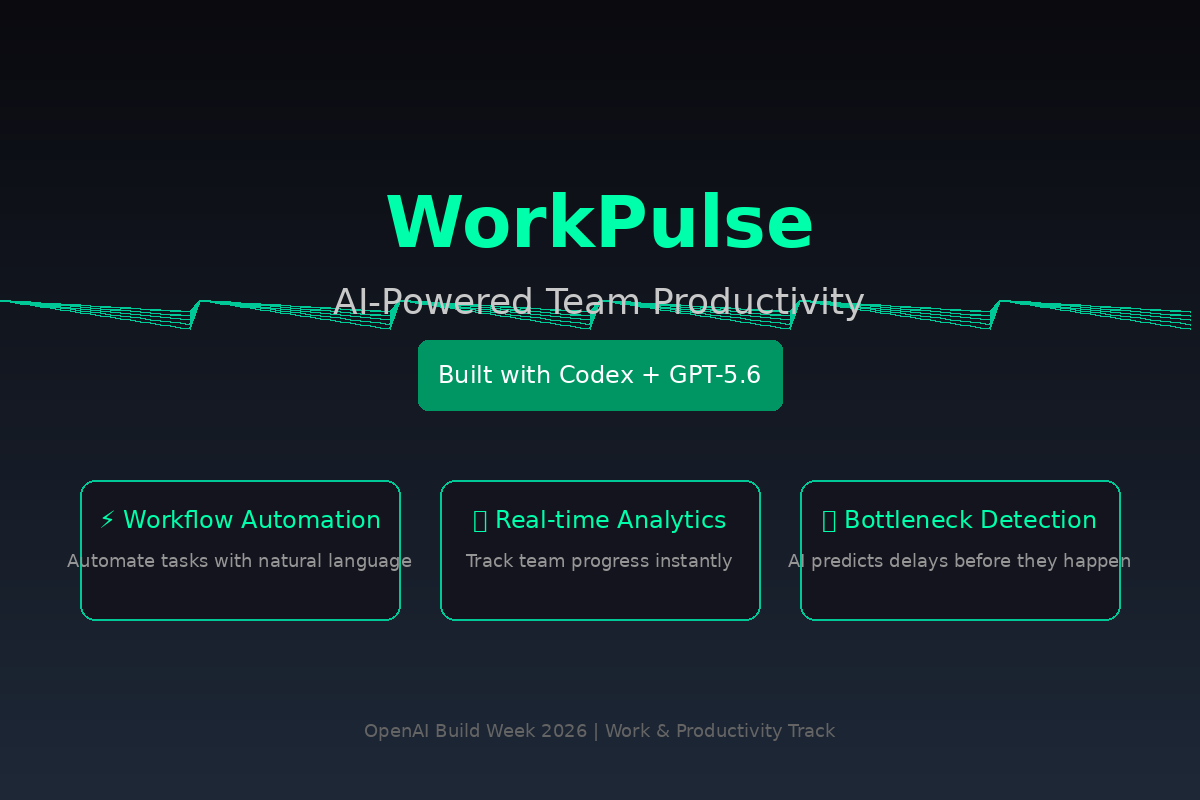
WorkPulse is an AI-powered team productivity platform that uses Codex and GPT-5.6 to:
- Automate task workflows — Create, assign, and track tasks through natural language commands
- Generate real-time reports — Summarize team progress, blockers, and deadlines automatically
- Integrate with existing tools — Connect with Slack, Notion, GitHub, and Jira via API
- Predict bottlenecks — Use GPT-5.6 to analyze patterns and flag potential delays before they happen
The core experience runs inside ChatGPT via the Devpost plugin, making it accessible without leaving the workspace teams already use.
How We Built It
We started by defining the key pain points: context switching, manual updates, and unclear priorities.
Using Codex, we rapidly prototyped the backend logic, API integrations, and automation engines. GPT-5.6 helped us:
- Design the conversational interface
- Generate structured data from unstructured team chatter
- Build intelligent routing for tasks and notifications
The majority of core functionality was built in a single Codex session, where we iterated on the workflow engine and testing pipeline in real time.
Challenges We Faced
Context retention — Keeping GPT-5.6 aware of long-running project context across multiple sessions required careful prompt engineering and state management.
Tool integration — Each third-party API (Slack, Notion, GitHub) had different auth flows and rate limits. We used Codex to generate adapter patterns quickly.
Balancing automation and control — We didn't want WorkPulse to feel like a black box. We added human-in-the-loop checkpoints for critical decisions.
What We Learned
- Codex accelerates scaffolding — We built the entire API layer and test suite in a fraction of the time it would take manually.
- GPT-5.6 excels at reasoning — It helped us design the bottleneck prediction logic by analyzing synthetic team data patterns.
- AI-native tools need trust — Transparency features (explainable decisions, undo actions) were just as important as the automation itself.
What's Next
- Mobile app for on-the-go pulse checks
- Voice commands via Whisper integration
- Custom workflow templates trained on team-specific patterns
- Public API so other builders can extend WorkPulse
Built With
- amazon-web-services
- codex
- docker
- fastapi
- github-actions
- github-api
- gpt-5.6
- javascript
- jira-api
- jwt
- node.js
- notion-api
- oauth-2.0
- openai
- postgresql
- python
- react
- redis
- rest-api
- slack-api
- tailwind-css
- typescript
- vercel
- websocket

Log in or sign up for Devpost to join the conversation.