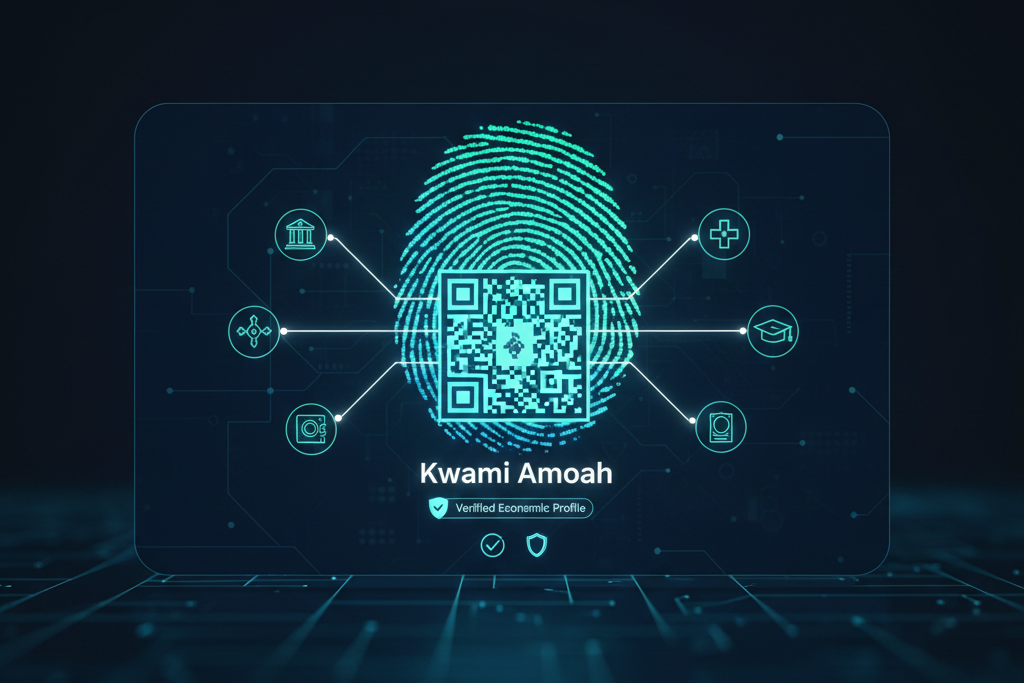
REACH — PROJECT STORY
WHAT INSPIRED US
In countries like Rwanda, almost everyone has a national ID — even newborns. Yet millions of people still cannot access loans, insurance, or key public services.
Why?
Because identity does not equal economic proof.
Informal workers — moto drivers, farmers, vendors, freelancers — do not lack IDs. They lack verifiable records of work, income, and trust. No payslips. No employer letters. No credit history.
That gap between who you are and what you do is what inspired Reach.
We realized the real problem was not identity issuance. It was economic visibility.
WHAT WE BUILT
Reach is a digital economic identity layer built on top of an existing government ID.
It allows informal workers to:
• Build a verifiable work history • Get endorsed by trusted community verifiers • Generate a portable economic profile • Share only the minimum data needed to access loans or services
In short:
A national ID answers: Who are you? Reach answers: Can you be trusted economically?
HOW IT WORKS (CONCEPTUALLY)
A user registers using their national ID number.
An economic profile is created, including:
Work type (e.g., farmer, moto driver)
Duration of activity
Community or cooperative verification
Each verification is issued as a digitally signed credential.
Institutions (banks, MFIs, NGOs) scan a QR code or call an API to verify trust.
Only required information is shared — privacy by design.
Trust Level = f(v, d, c)
Where: v = number and role of verifiers d = duration of consistent activity c = confirmed outcomes (e.g., loan repayment)
Trust is not a single score. It is an aggregation of verified signals.
HOW WE BUILT IT
We focused on depth over hype.
Tech Stack: Backend: Java Database: Mysql API: RESTful services Security: Public/private key signatures Identity: QR-based verification flow
Core Components: • Identity service linked to national ID • Verification service with role-based verifiers • Economic profile and work record service • Verification API for financial institutions
System Design Principles: • Offline-first (syncs when connectivity returns) • Extensible across sectors • Built to complement, not compete with, government systems
CHALLENGES WE FACED
“But everyone already has an ID.”
This was the biggest conceptual challenge.
We reframed the problem: We are not replacing civil IDs. We are adding an economic identity layer.
Once that clicked, everything aligned.
Preventing Fraud Without Overengineering
We needed trust without unnecessary complexity.
Solution: • Multiple independent verifiers • Role-based verification weights • Immutable audit trail with revocation support
No hype. Just strong system design.
Balancing Privacy and Utility
Institutions want data. Users need protection.
We implemented: • Minimal data disclosure • User-controlled sharing • Verification without exposing full profiles
Trust should not require surveillance.
WHAT WE LEARNED
• Having an ID does not mean being economically included • Informal economies need infrastructure, not charity • Simple systems beat flashy technology • The best digital identity systems integrate — they do not replace
Identity is not just about recognition. It is about opportunity.
WHY THIS MATTERS
Reach supports:
• Financial inclusion — access to credit and savings • Agriculture — farmer input loans and insurance • Public services — fair targeting of social programs • Mobility — portable identity for informal and displaced workers
One platform. Multiple sectors. Real impact.
FINAL THOUGHT
Reach is not just a hackathon project.
It is a missing layer in how we recognize work, trust, and economic contribution — especially for people the formal system continues to overlook.

Log in or sign up for Devpost to join the conversation.