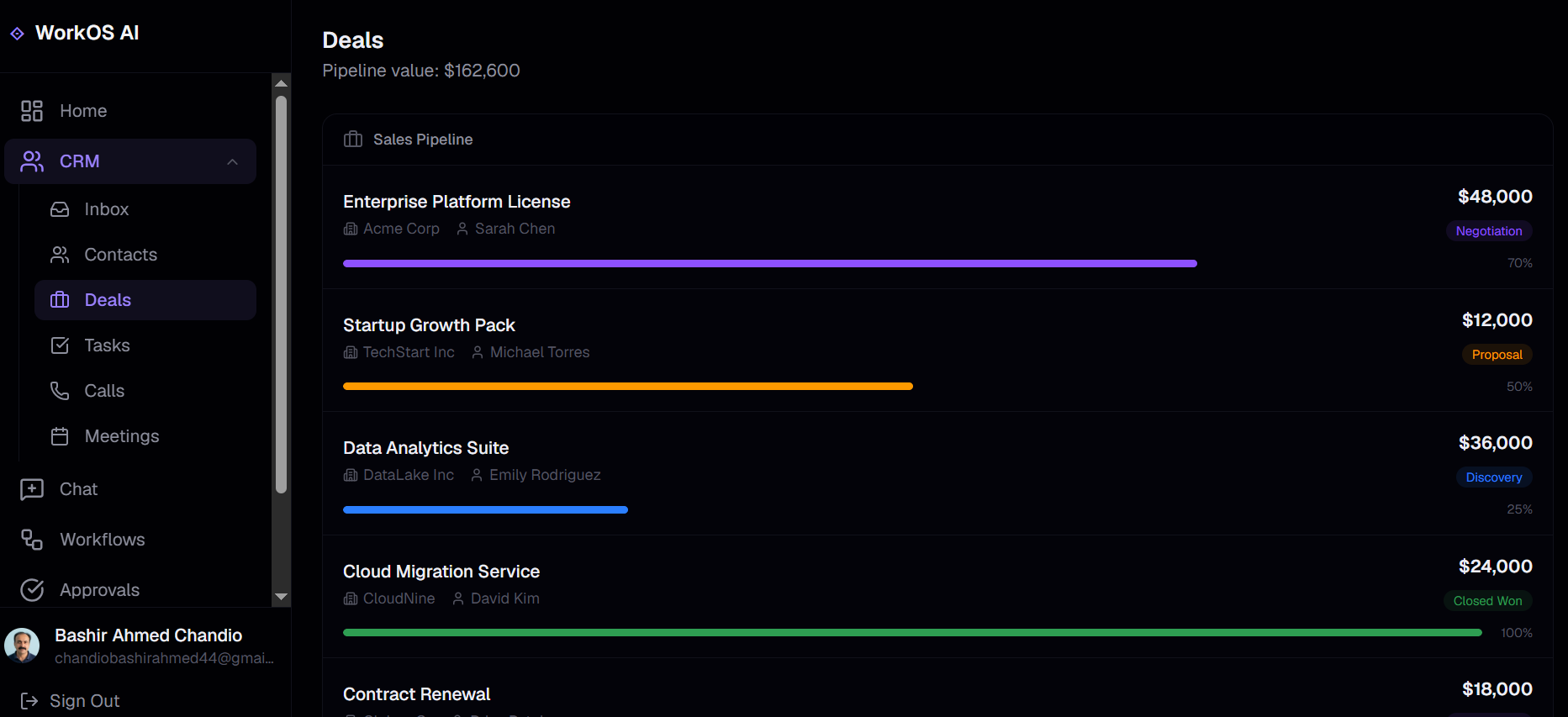
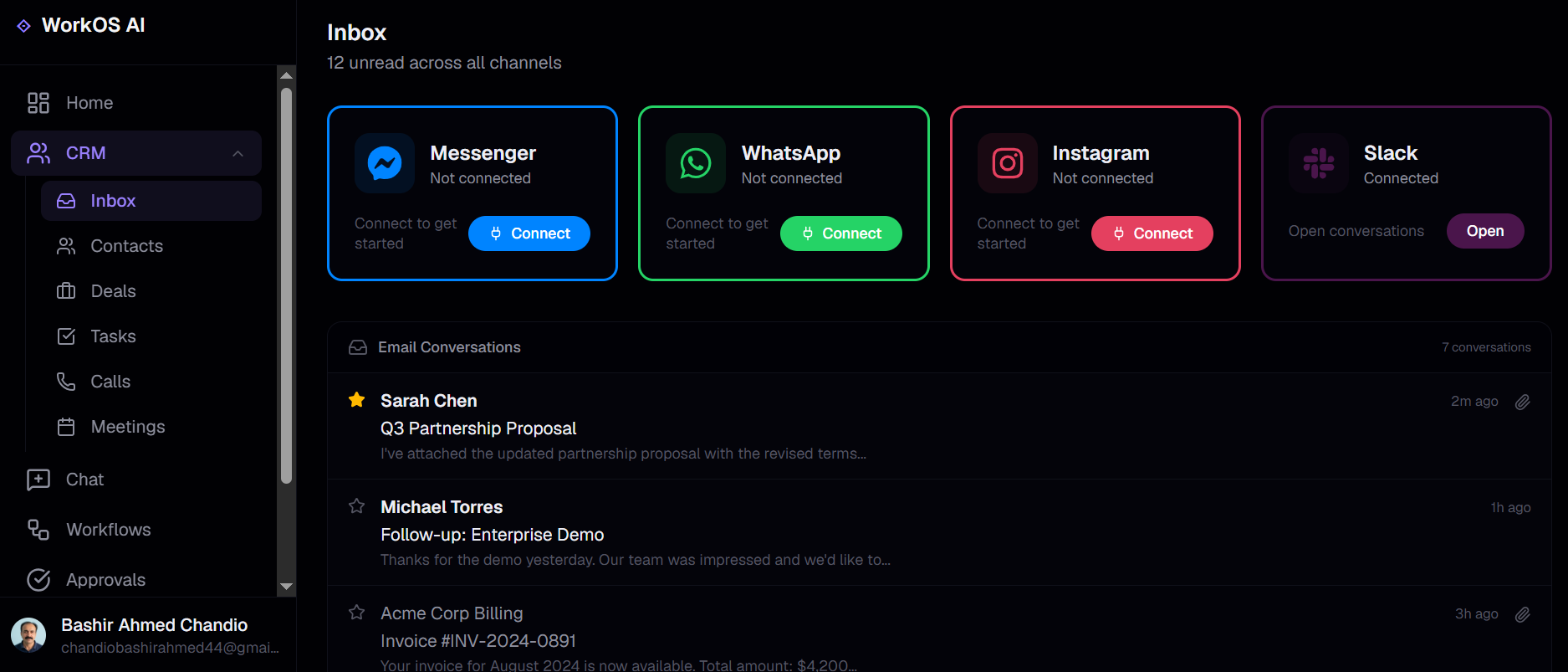
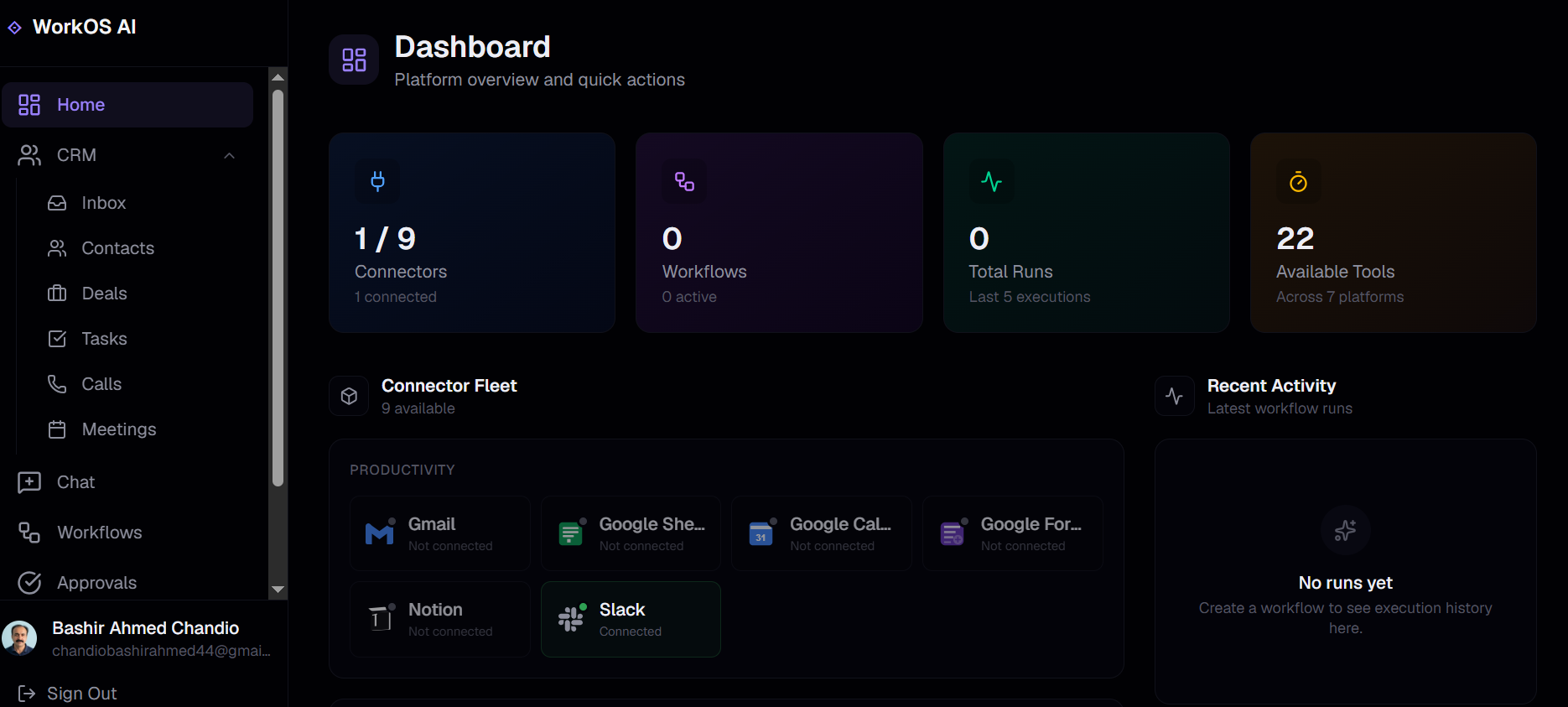
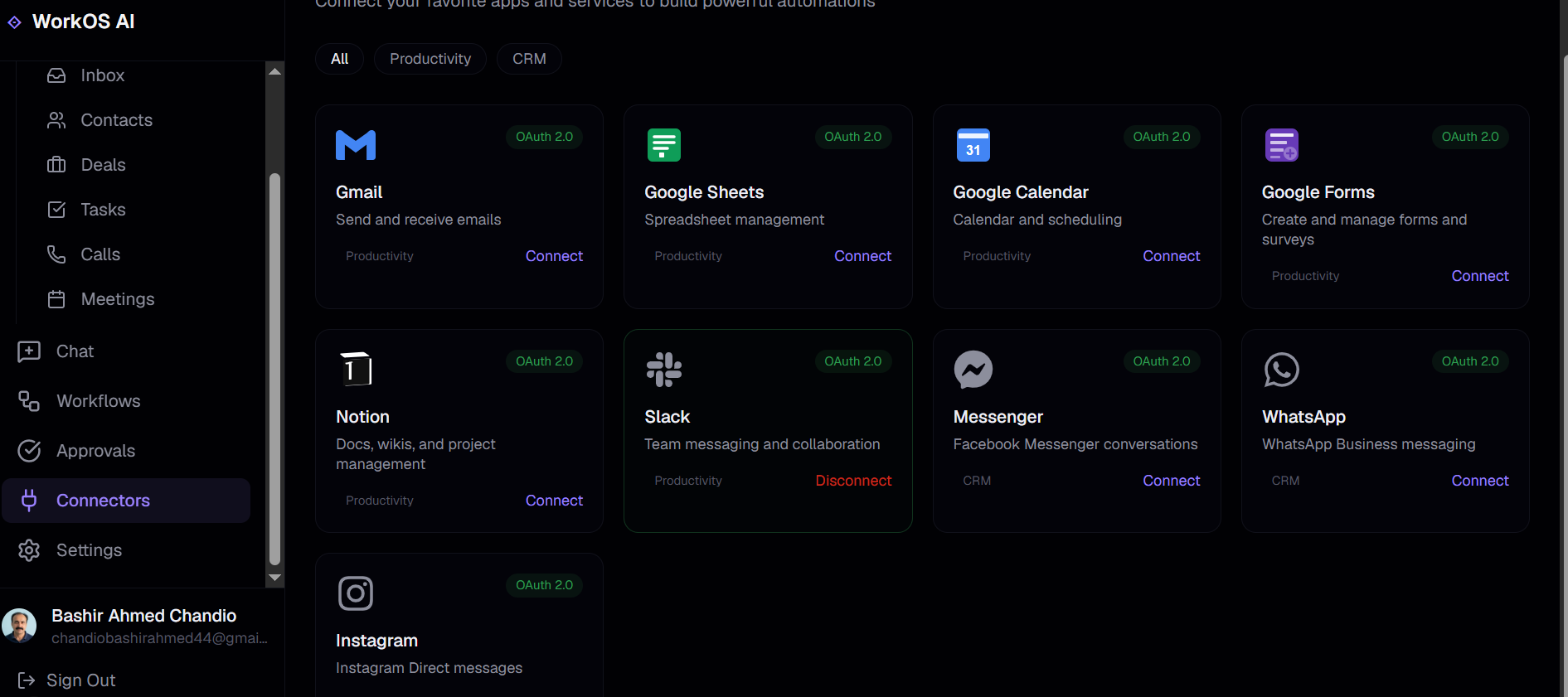
Inspiration
Businesses today rely on dozens of SaaS applications—Slack, Gmail, HubSpot, Notion, Google Sheets, Stripe, and many more. While automation platforms like Zapier, Make, and n8n help connect these tools, they still require users to think like workflow engineers by manually configuring triggers, actions, conditions, and data mappings.
We asked a simple question:
What if users never had to build workflows at all?
Instead of dragging blocks on a canvas, they should be able to describe what they want in plain English, and an AI agent should understand, plan, and execute the entire workflow.
That idea became WorkOS AI.
What We Built
WorkOS AI is an AI Operating System for business automation.
Users simply describe a task, for example:
"When a customer submits a contact form, qualify the lead, create a HubSpot contact, notify our sales team on Slack, generate a personalized follow-up email, and remind me if they don't reply within three days."
Instead of asking the user to manually build the workflow, WorkOS AI:
Understands the request using OpenAI's reasoning models. Breaks it into executable steps. Selects the appropriate integrations. Maps parameters between applications. Requests approval when necessary. Executes the workflow. Monitors execution and learns from previous runs.
Our vision is to make AI an autonomous coworker rather than just an assistant.
How We Built It
The platform is built with a modern AI-native architecture:
Frontend Next.js React TypeScript Tailwind CSS React Flow Clerk Authentication Backend FastAPI PostgreSQL Redis Celery APScheduler AI Layer
OpenAI models are responsible for:
Intent understanding Workflow planning Tool selection Parameter mapping Content generation Multi-step reasoning Human approval conversations Workflow adaptation
Instead of relying on predefined templates, the AI dynamically generates execution plans from natural language.
Challenges We Faced
The biggest challenge wasn't connecting APIs—it was teaching an AI to think like an automation engineer.
Some of the key challenges included:
Converting ambiguous user requests into deterministic execution plans. Designing workflows that are flexible while remaining reliable. Mapping outputs from one application to inputs of another automatically. Keeping humans involved through approval checkpoints without interrupting automation. Building an architecture that can support hundreds of future integrations.
Balancing AI autonomy with user trust has been one of the most interesting engineering problems in the project.
What We Learned
Building WorkOS AI reinforced that AI should do more than generate text—it should reason about work.
We learned how important structured planning, tool orchestration, and human-in-the-loop design are for creating dependable AI systems. We also gained experience designing scalable agent architectures that combine reasoning, execution, and monitoring into a cohesive workflow.
Built With
- gmail
- linear
- messenger
- next.js
- notion
- openai
- python
- qdrant
- rag
- react
- typescript

Log in or sign up for Devpost to join the conversation.