-
-
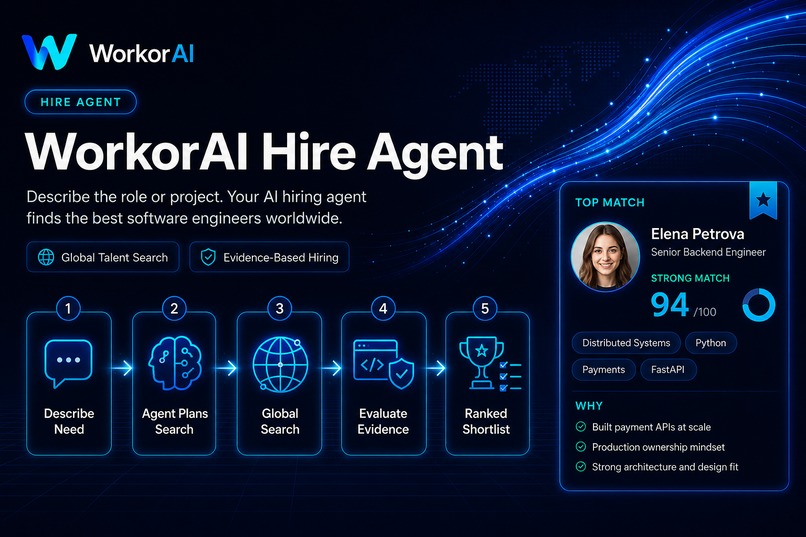
From a hiring need to a ranked shortlist: WorkorAI searches, evaluates, and recommends the strongest engineers for the job.
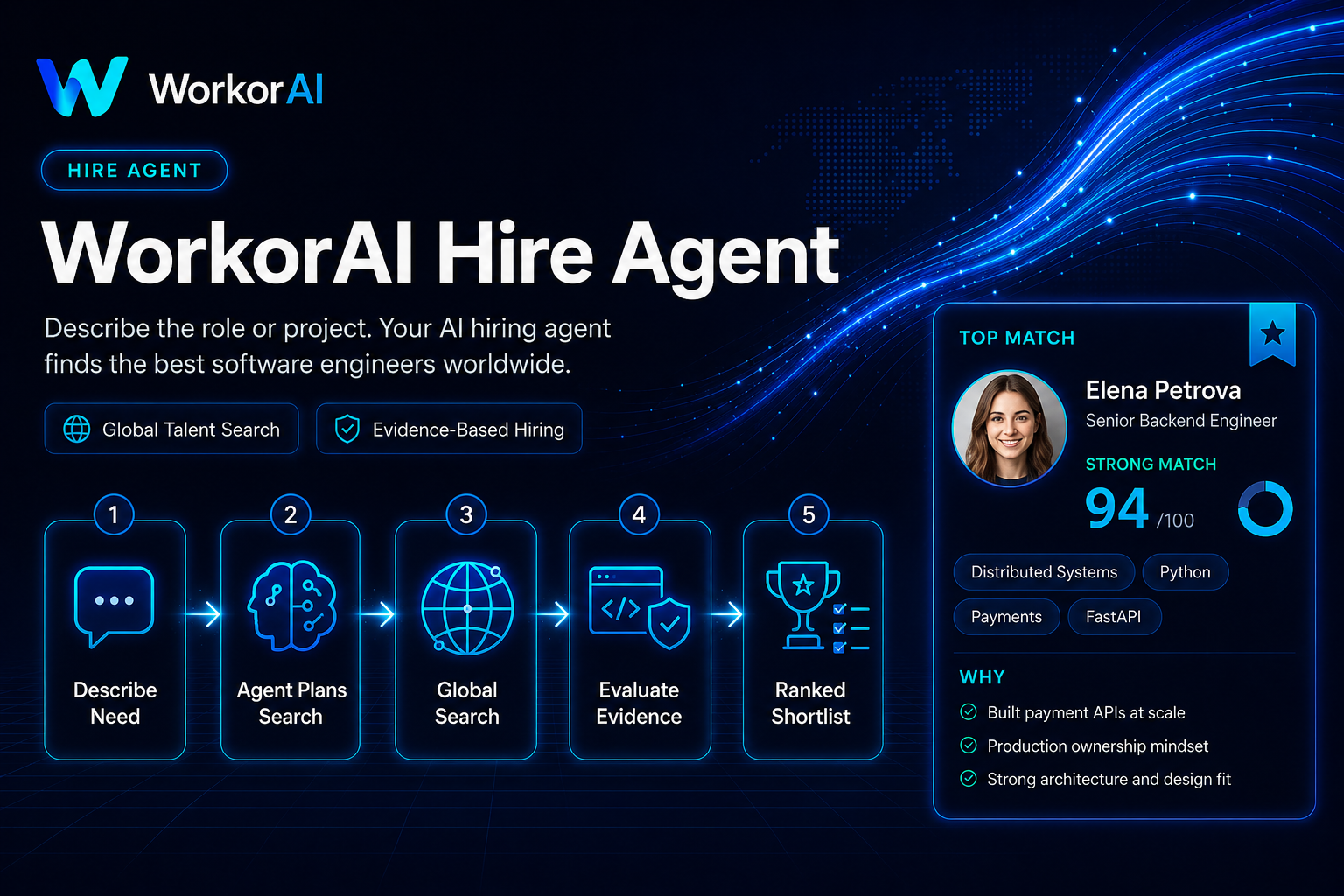
WorkorAI — The AI Hiring Agent for Software Engineers
Inspiration
Hiring software engineers is still built around an outdated assumption: companies should wait for people to apply, collect hundreds of CVs, and then manually figure out who might actually be good.
But the best engineer for your company may never apply.
They may be somewhere else in the world, working on a similar problem right now.
We asked a different question:
What if a company could simply describe what it is building, and an AI hiring agent could search the global talent market and find the engineers most likely to succeed in that role?
That became WorkorAI Hire Agent.
Tell WorkorAI what you are building. The agent searches for engineers, studies what they have actually built, evaluates their technical experience, ranks the strongest matches, explains why they fit, and helps move the best candidates toward an introduction.
The goal is simple:
Stop searching through CVs. Start with the engineers most likely to do the job.
What we built
During the hackathon, we built a new employer-facing WorkorAI Hire Agent.
Instead of starting with a traditional job posting, filters, or an ATS workflow, the employer starts with a conversation.
For example:
“We need a senior backend engineer to own our payments infrastructure.”
or:
“We are building an AI product and need someone who can take it from prototype to production.”
The agent interprets the request, identifies what matters for the role, searches the available engineering talent, evaluates relevant evidence, and returns a ranked shortlist with clear reasoning.
Each recommendation answers questions such as:
- Why is this engineer a strong match?
- What have they actually built?
- Which parts of their experience are relevant to this exact problem?
- What evidence supports the recommendation?
- What are the risks or missing signals?
- Who should the employer speak with first?
The result is not another list of profiles.
It is a hiring decision that the employer can understand and act on.
From resumes to real engineering work
A resume tells you what someone claims to know.
We wanted WorkorAI to go deeper.
The system can use multiple sources of engineering evidence, including:
- CV and structured career history
- GitHub and LinkedIn signals
- projects and production experience
- targeted technical questions
- live AI interview evidence
- technical reasoning and architecture discussions
- availability and practical role fit
Instead of asking only:
“Does this candidate have Python on their CV?”
WorkorAI tries to answer:
“Has this engineer actually solved problems similar to the one this company needs solved?”
That changes the object of search from job titles and keywords to demonstrated engineering capability.
How the agent works
The WorkorAI workflow combines several specialized stages.
1. Understand the hiring need
The employer describes the role, project, or engineering problem in natural language.
The Hire Agent converts that request into a structured understanding of:
- the job to be done
- required technical capabilities
- relevant production experience
- level of ownership
- company and project context
- practical constraints
2. Search engineering profiles
The agent searches structured and semantically indexed developer profiles rather than relying only on incoming applications.
This allows the employer to search beyond the people who happened to submit a CV.
3. Gather and evaluate evidence
Candidate information can be enriched through CV parsing, GitHub and LinkedIn analysis, and AI interview results.
Technical interview questions are generated from claims in the candidate's real experience rather than from a generic question bank.
4. Match and rank
WorkorAI combines semantic retrieval with structured matching and scoring to identify the strongest candidates for the specific hiring need.
5. Explain the recommendation
The employer sees more than a match score.
WorkorAI shows:
- why the candidate fits
- relevant engineering evidence
- strengths
- risks and gaps
- what still needs to be verified
- the recommended next step
6. Move toward an introduction
Once the employer finds a strong candidate, the agent helps move the process from search to shortlist and introduction.
The human remains responsible for the final hiring decision, while the agent removes as much of the repetitive recruiting work as possible.
Agentic architecture
WorkorAI uses a modular agentic architecture in which different components are responsible for different parts of the hiring workflow.
The underlying system includes:
- Gemini 3.5 Flash for resume and job parsing
- Gemini 3.1 Pro for interview-question generation and interview evaluation
- Gemini Live for real-time conversational voice interviews
- Gemini Embeddings for semantic candidate and role retrieval
- Vertex AI for Google model access and AI execution
- RAG + pgvector for semantic search
- WorkorAI MCP for exposing hiring capabilities as tools to agents
- deterministic matching and scoring for candidate-role ranking
The existing WorkorAI infrastructure provides the candidate evidence, interview, matching, and tool layer.
The new work created during the hackathon is the employer-facing Hire Agent and the agentic workflow that turns a natural-language hiring need into an actionable ranked search experience.
This allowed us to build on an existing technical foundation while creating a fundamentally new way for an employer to interact with the hiring system.
Challenges we faced
Turning an ambiguous request into a useful search
Employers do not always know the exact title of the person they need.
Someone may say:
“Our backend is becoming a bottleneck and we need someone who can own it.”
The difficult part is not extracting keywords.
The difficult part is understanding which engineering experience would actually change the ranking.
We learned that an agent should not ask questions just because information is missing.
It should ask a clarification only when the answer is likely to materially change the shortlist.
Avoiding false confidence
Hiring recommendations are high-stakes.
A mysterious “94% match” is not enough.
We therefore focused on explainability:
claim → evidence → confidence → risk → recommended action
The agent should be able to say not only why someone matches, but also what it does not know.
We found that exposing uncertainty can create more trust than pretending every recommendation is perfect.
Combining different types of evidence
CV data, semantic similarity, GitHub activity, production experience, and interview evidence are very different signals.
A major challenge was building a workflow where these signals support one another rather than collapsing everything into a single opaque AI score.
Our approach separates evidence gathering from deterministic ranking and uses AI where reasoning and interpretation are most valuable.
What we learned
The biggest lesson was that AI hiring should not be about generating more recruiting activity.
It should remove recruiting activity.
Most recruiting software helps humans manage a workflow:
source → screen → interview → compare → coordinate
An agent can compress that workflow.
The employer should increasingly be responsible only for the decisions that genuinely require human judgement.
The future interaction can become:
Describe what you are building → Meet the strongest engineers for it.
We also learned that the most valuable hiring signal is often not a technology keyword or number of years of experience.
It is evidence that someone has already solved a comparable engineering problem.
What's next
Our long-term goal is to build a global search layer for engineering capability.
GitHub made code searchable.
LinkedIn made professional identities searchable.
We believe WorkorAI can make proven engineering capability searchable.
A company should eventually be able to ask:
“Find someone who has migrated a monolith to microservices without downtime.”
“Find an engineer who has scaled a Python API to tens of millions of requests.”
“Find someone who has taken an AI product from prototype to production.”
And the hiring agent should search globally, evaluate the evidence, explain the trade-offs, and bring back the people most likely to succeed.
Great companies are built by exceptional talent. Our goal is to make finding that talent anywhere in the world as simple as getting an Uber.
Built With
- ai-agents
- gemini
- gemini-3.5
- gemini-embeddings
- gemini-live
- google-cloud
- mcp
- pgvector
- rag
- semantic-search
- vertex-ai
- voice-ai


Log in or sign up for Devpost to join the conversation.