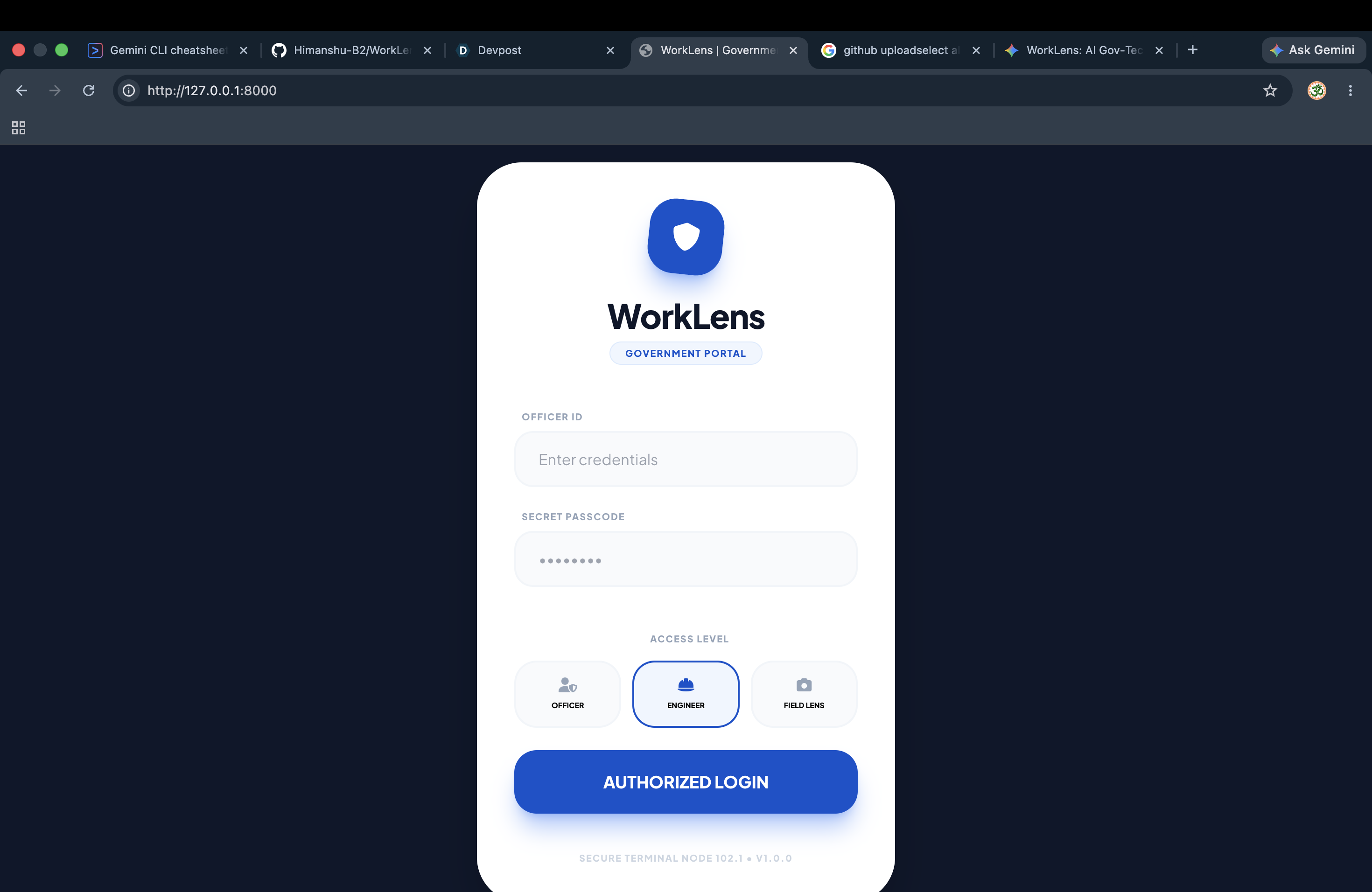
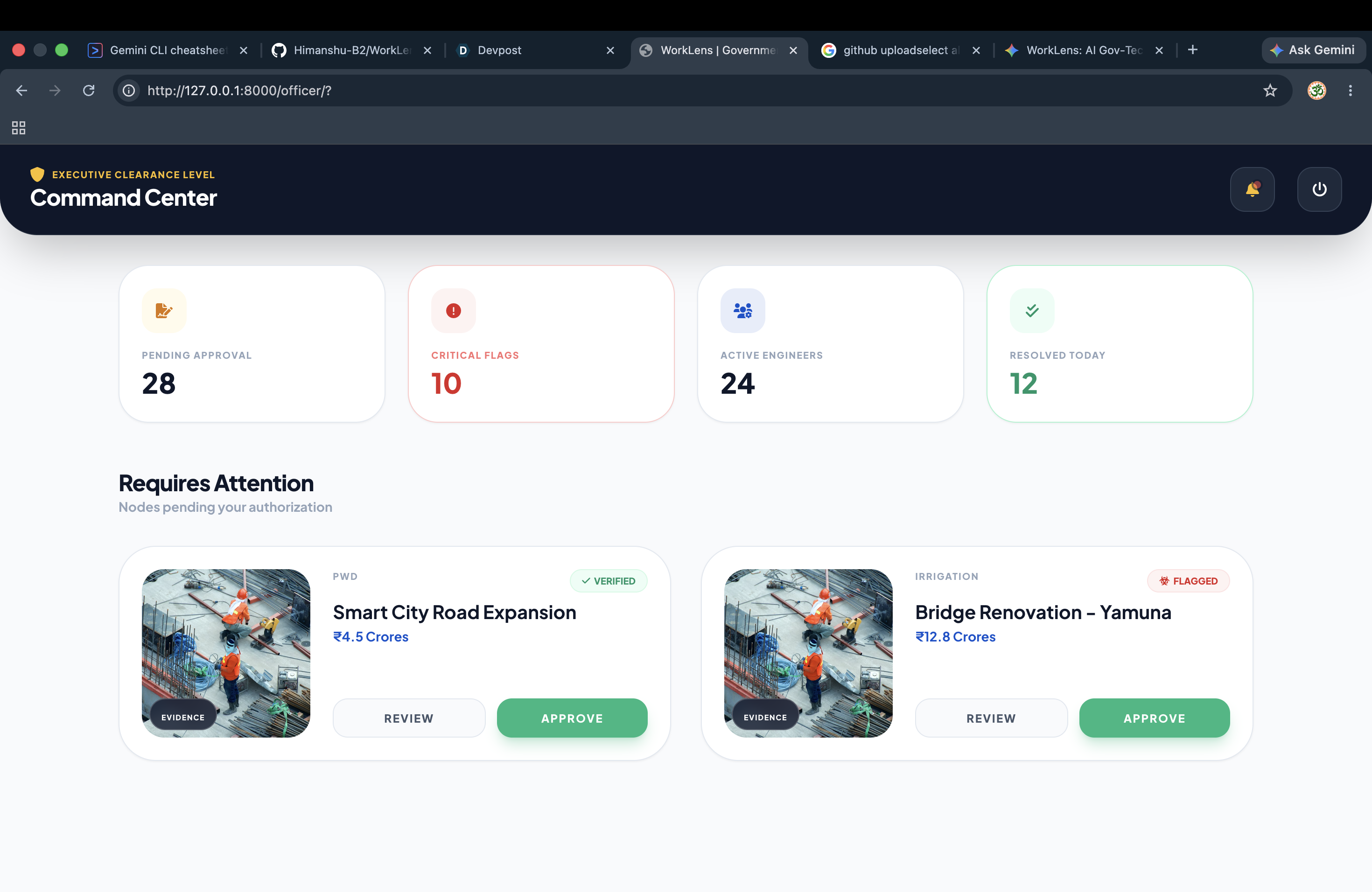
Inspiration Public infrastructure projects often suffer from delays, ghost-workers, and "paper-only" progress. We noticed how difficult it is for government officers to audit remote construction sites efficiently, leading to misallocated taxpayer funds. We wanted to build a bulletproof transparency tool—giving administrative officers an uncompromisable, AI-powered "eye in the sky" to track real-world progress without needing to be physically present at every site.
What it does WorkLens is a comprehensive gov-tech monitoring ecosystem that brings radical transparency to public works.
Real-Time Tracking: Field workers submit photo updates of construction progress.
Image Authenticity & Anti-Fraud: The built-in AI detects if images are altered, recycled from old projects, or grabbed from the internet.
Geofenced Verification: Every upload is cross-referenced with real-time GPS metadata to ensure the worker is actually standing on the specific infrastructure site.
Streamlined Approvals: High-level officers can view a centralized dashboard, track milestones, and digitally approve or reject project phases instantly.
How we built it We engineered WorkLens using a robust backend and a highly responsive dashboard architecture.
Backend Framework: Built using Python and Django to handle complex user roles (Field Workers, Verification Officers, and Admin Panel), managing relational data integrity across multiple active project sites.
Database & Verification: Integrated structured data storage to securely log project milestones, geofences, and time-stamped inspection reports.
AI & Security Layer: Implemented computer vision and metadata analysis scripts to parse image EXIF data for GPS mismatch detection and verify physical structural progress.
Frontend: Designed a clean, distraction-free HTML/CSS interface focused on glanceable data visualization for quick administrative decision-making.
Challenges we ran into Handling Spoofed GPS Data: One major hurdle was preventing users from bypassing the system by spoofing their location data or uploading pre-saved images. We had to implement strict server-side validation to strip and verify EXIF metadata and enforce live-camera capture.
Database State Locking: Managing concurrent status updates—where an approval from an officer must immediately trigger budget releases or next-phase unlock codes without creating race conditions or database integrity errors—required precise transaction handling.
Designing for the Field: Building a user experience that works flawlessly for field workers in low-connectivity zones meant optimizing image compression and queuing requests locally before syncing to the main database.
Accomplishments that we're proud of Bulletproof Anti-Tampering: Successfully built a verification pipeline that catches mismatched coordinates and prevents common fraud methods.
Role-Based Execution: Creating a fluid, secure flow where data transitions seamlessly from a smartphone camera in the field to a high-ranking officer's desktop dashboard.
Clean Data Architecture: Structuring a highly scalable relational database schema that can support thousands of concurrent public works projects without slowing down.
What we learned Gov-Tech Needs Simplicity: We realized that while the backend tech can be highly complex, the frontend interface must be incredibly straightforward for non-technical government officials and field workers to adopt.
Data Integrity is Everything: When dealing with public funds and structural safety, edge cases in database fields (like handling null values during partial profile updates) can break the entire trust chain. Clean, defensive coding is mandatory.
What's next for WorkLens Automated AI Cost Estimation: Integrating deep learning models to analyze construction images and automatically estimate if the materials used match the allocated budget invoices.
Offline-First Capabilities: Enhancing the mobile client to support full offline database syncing for remote rural infrastructure projects with zero cellular network coverage.
Public Transparency Dashboards: Creating a read-only citizen portal where taxpayers can view verified project timelines, fostering complete civic trust.

Log in or sign up for Devpost to join the conversation.