-
-
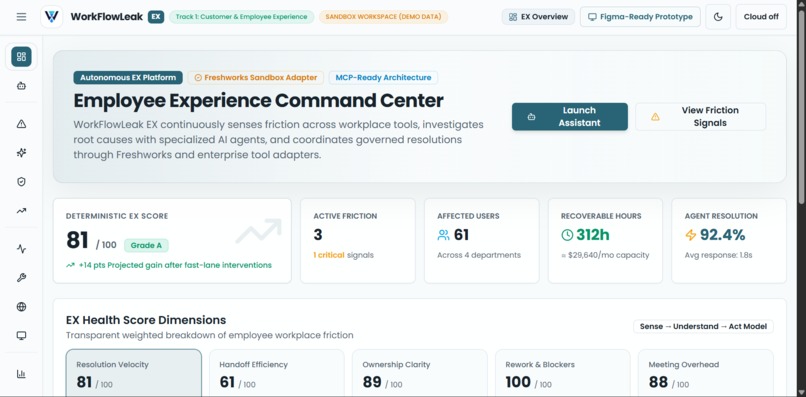
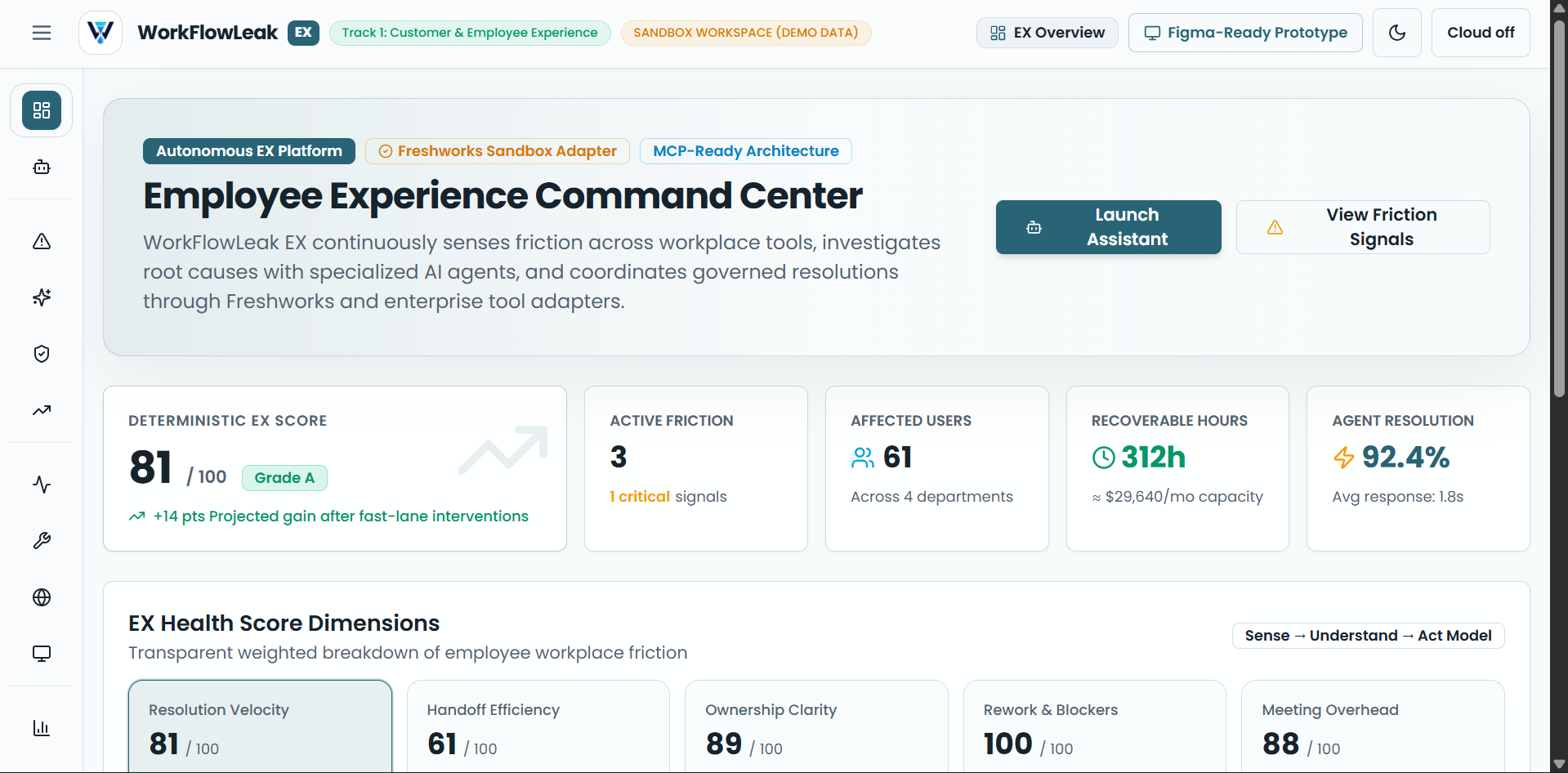
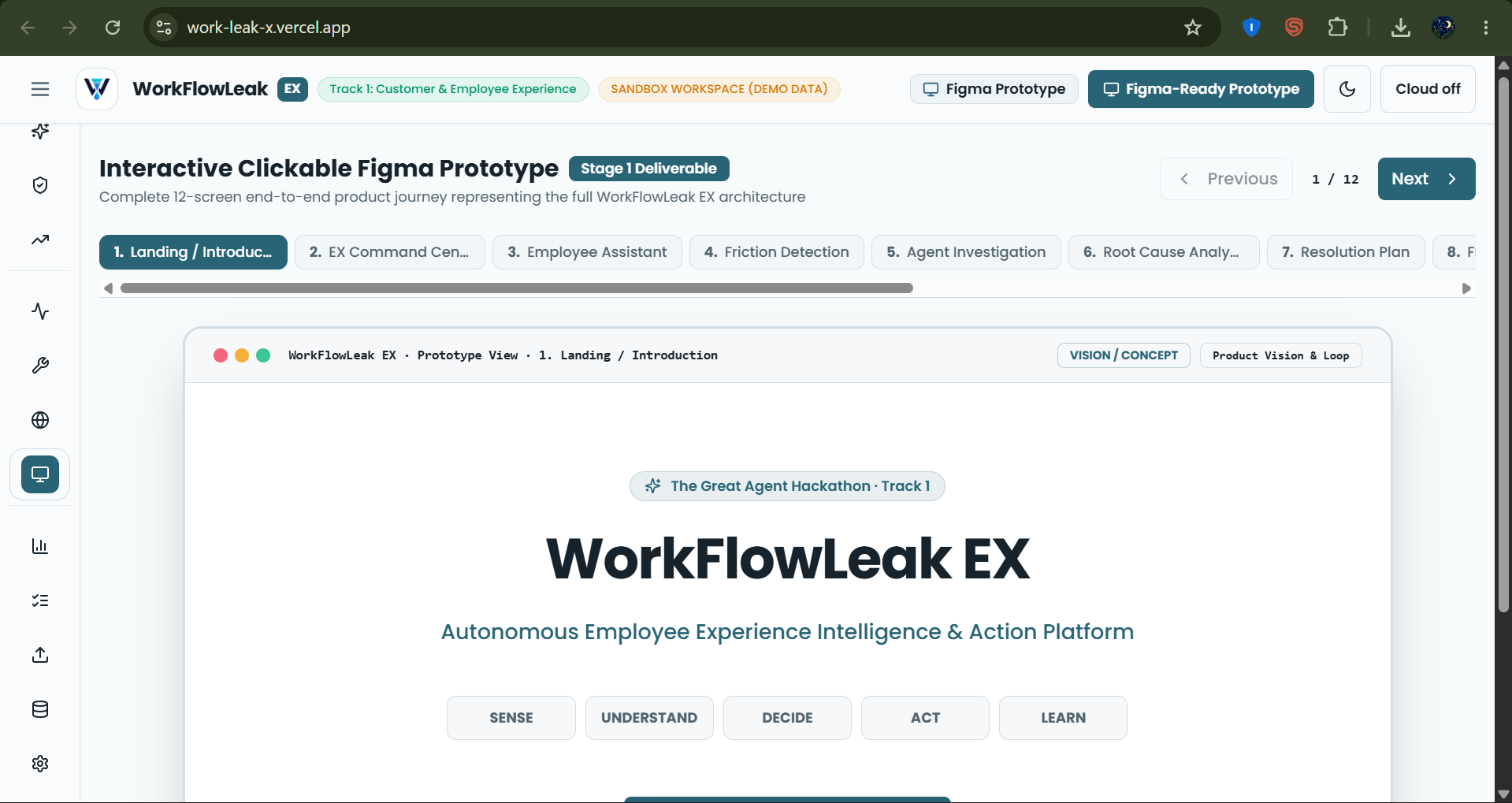
Turn hidden employee friction into intelligent action.
-
The Command Center provides a centralized overview of the organization's current workflow health.
-
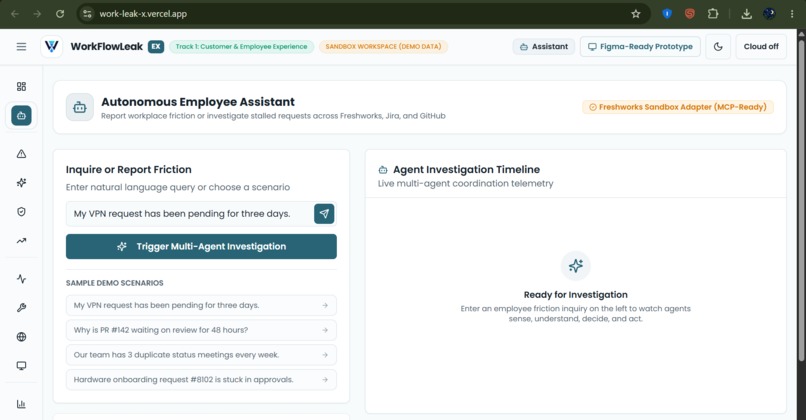
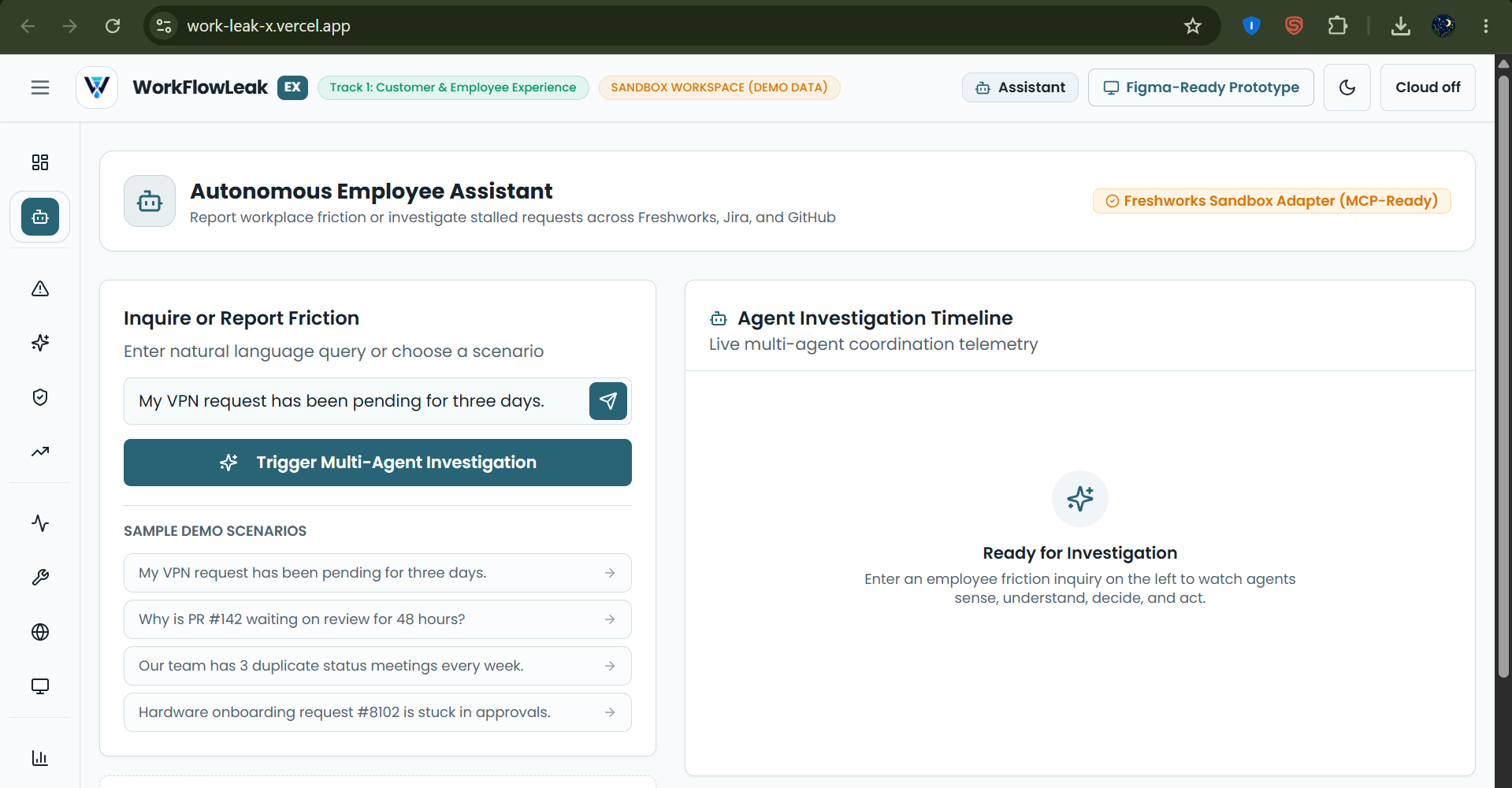
Provide an employee-facing interface for reporting and understanding workflow problems.
-
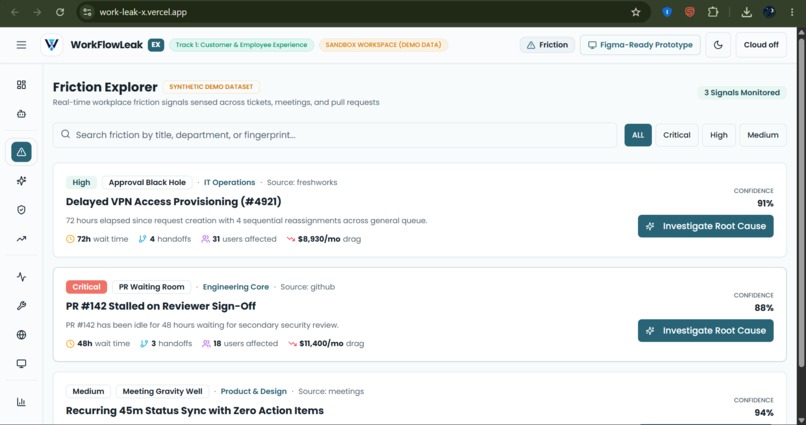
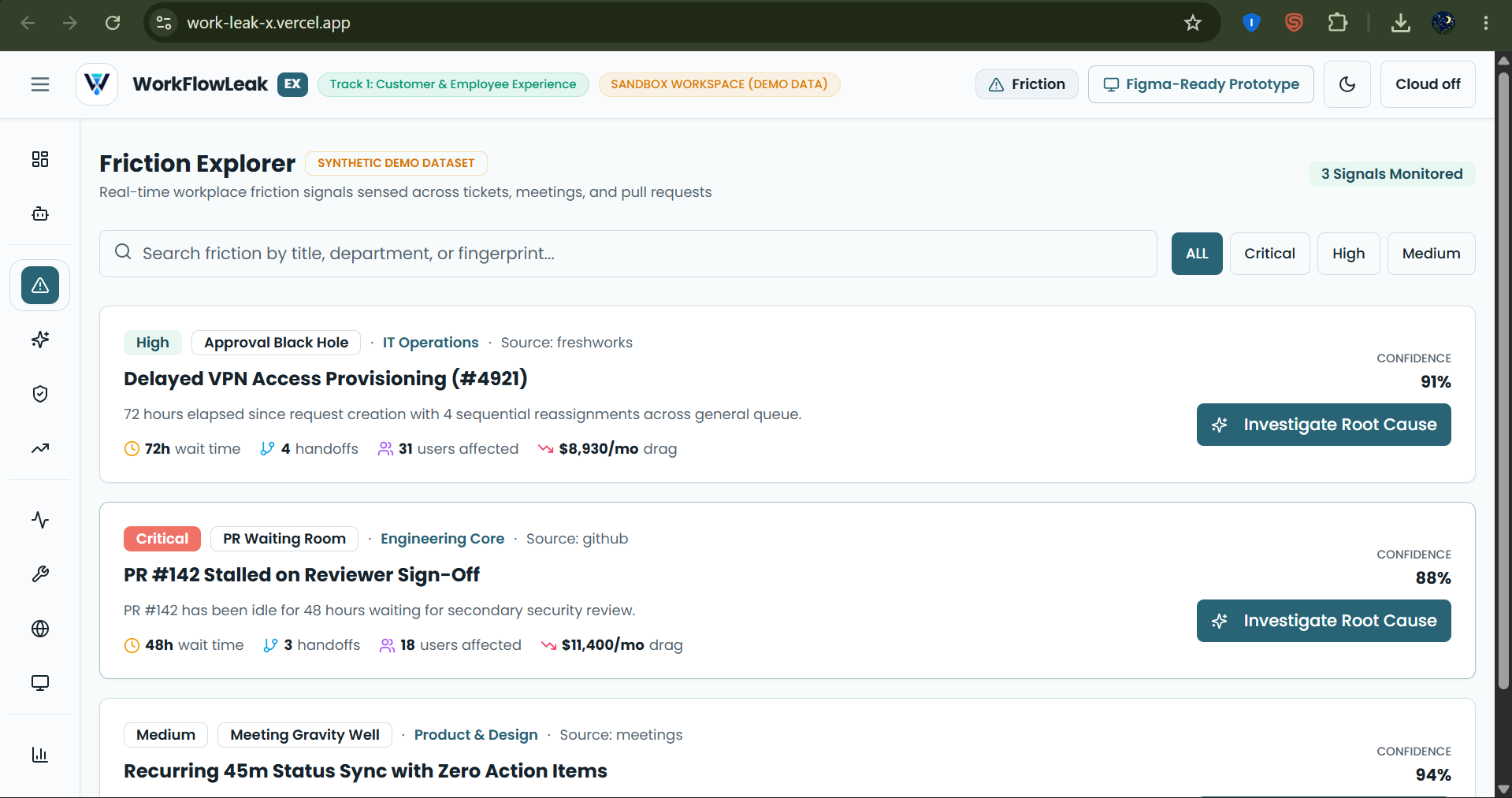
Show how WorkLeak identifies hidden employee-work friction.
-
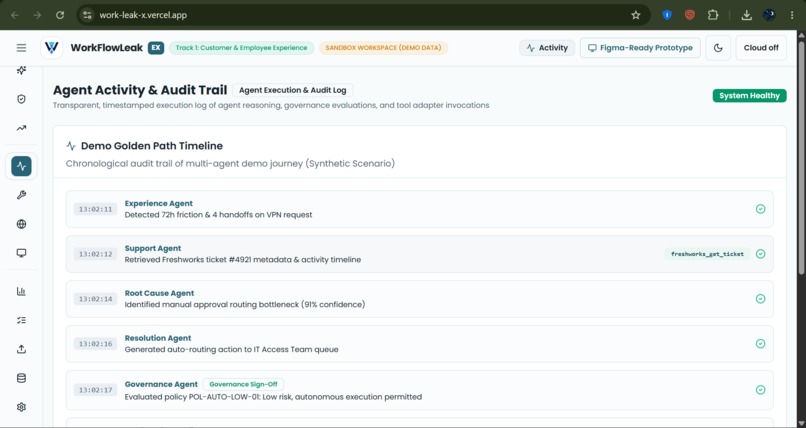
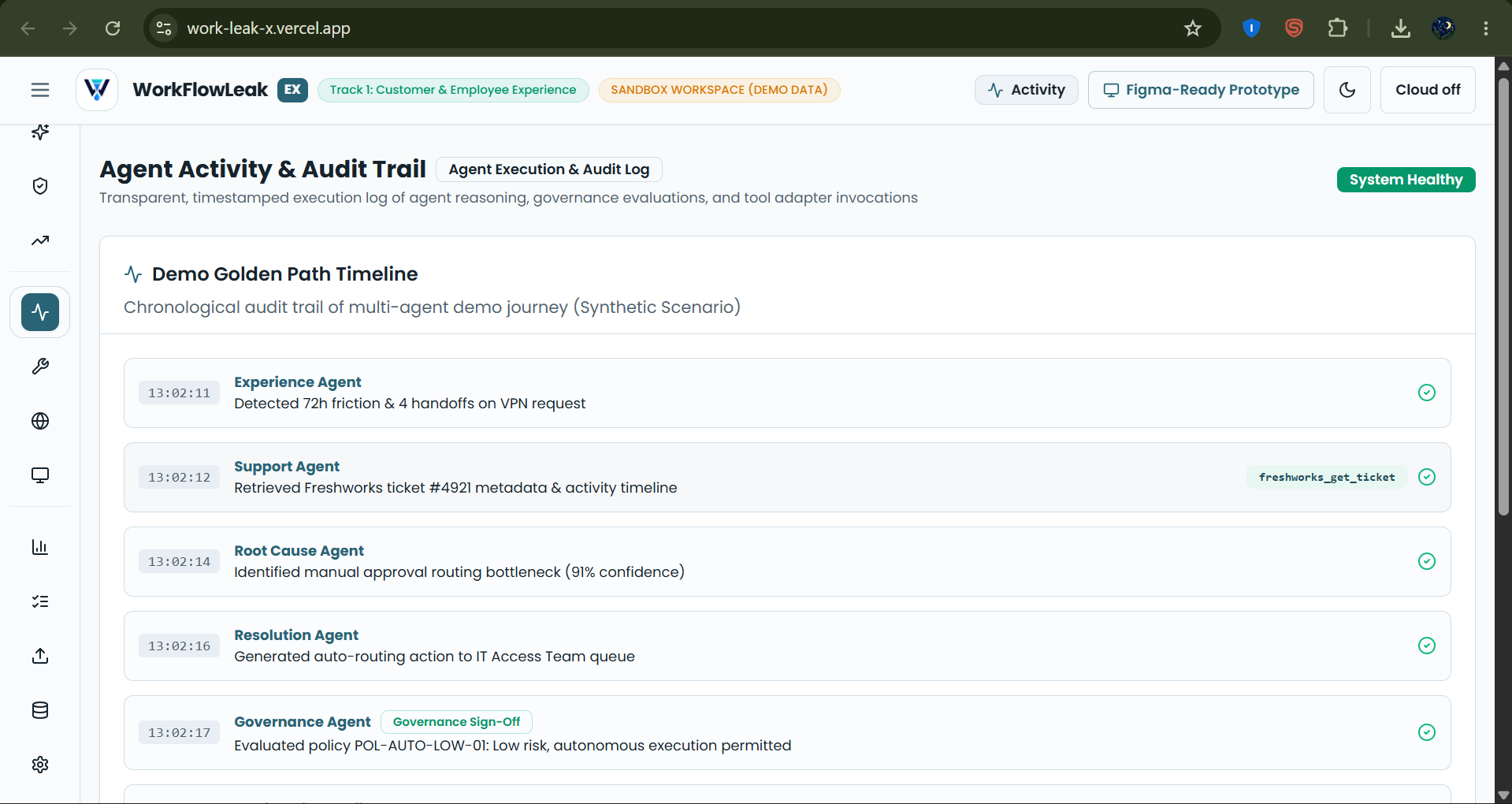
Demonstrate the multi-agent reasoning process.
-
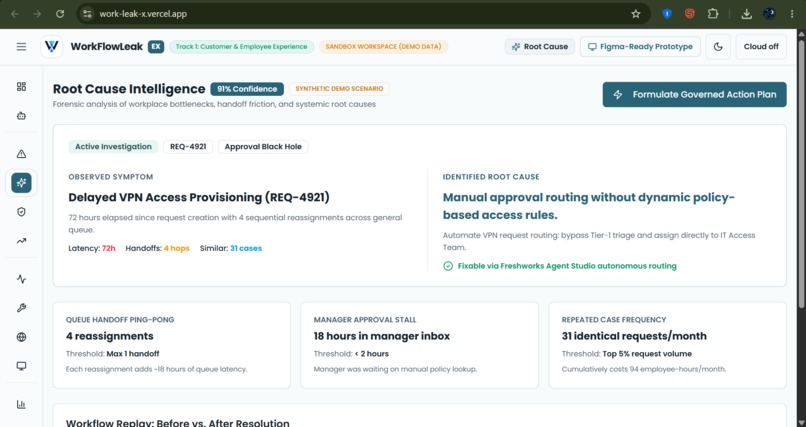
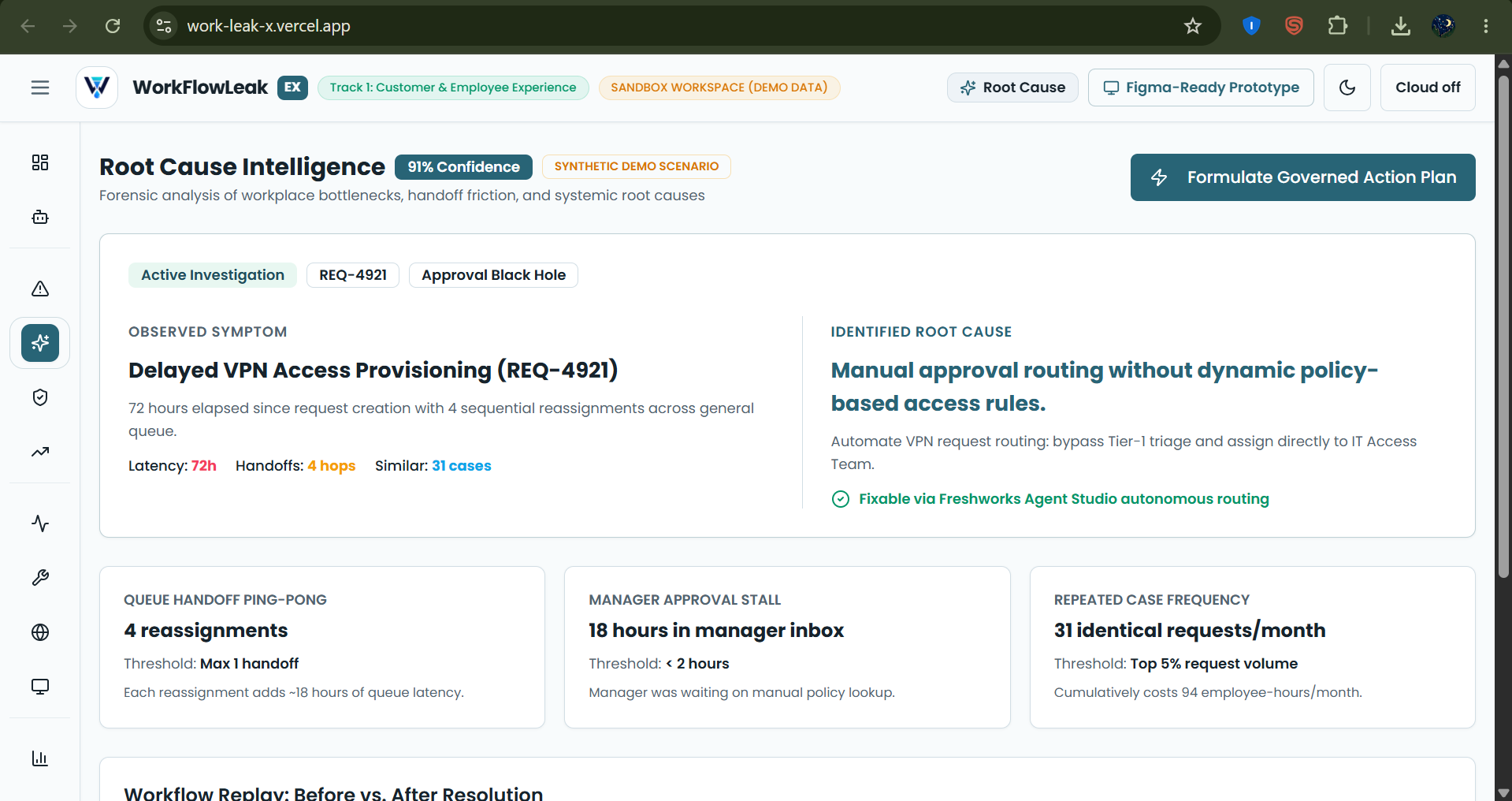
Explain WHY the employee is experiencing friction.
-
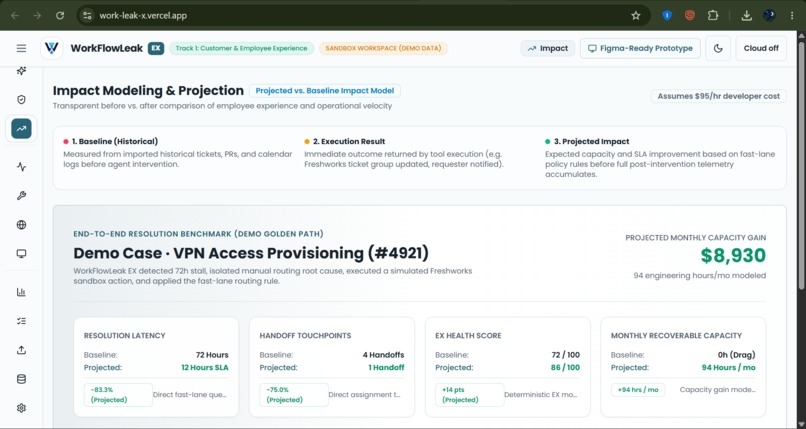
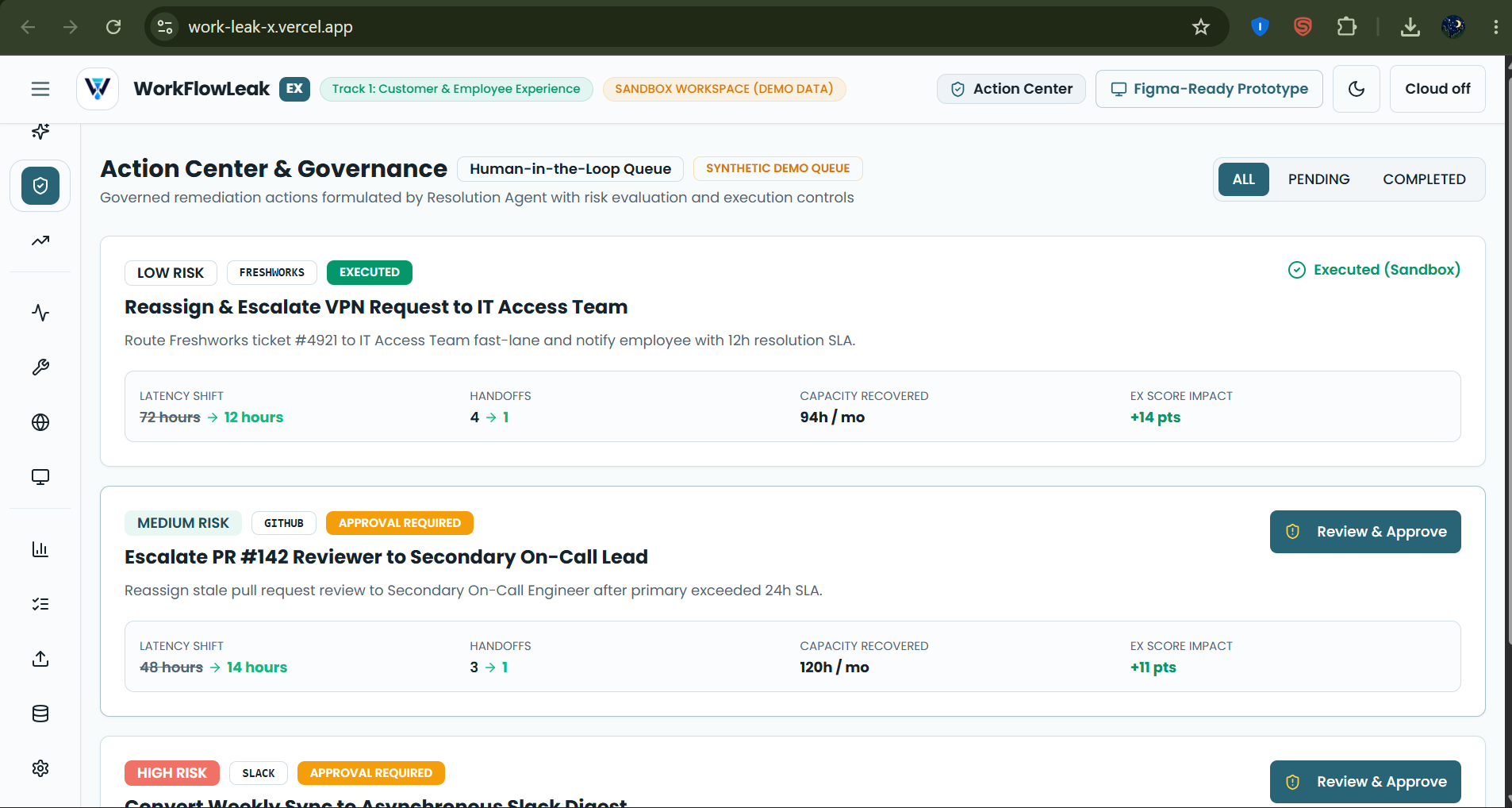
Turn root-cause intelligence into an actionable solution.
-
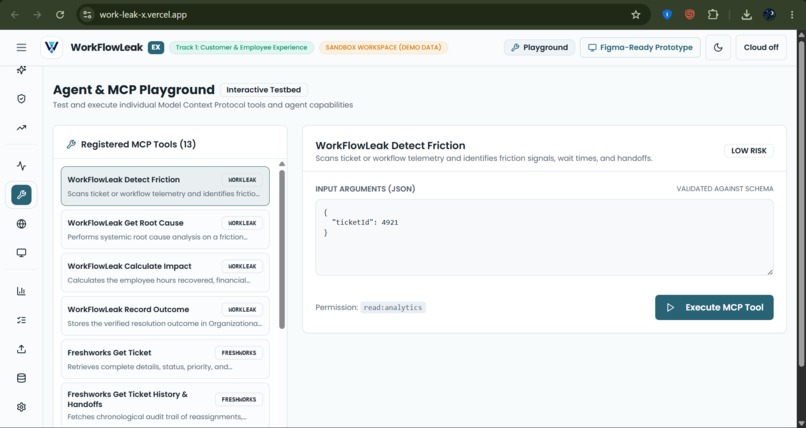
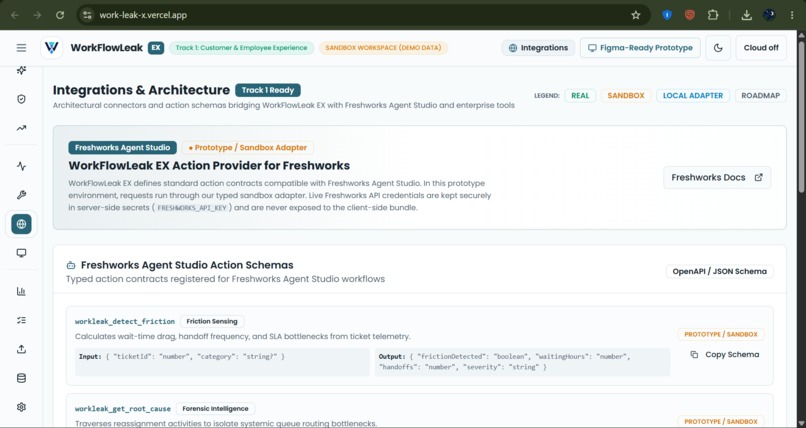
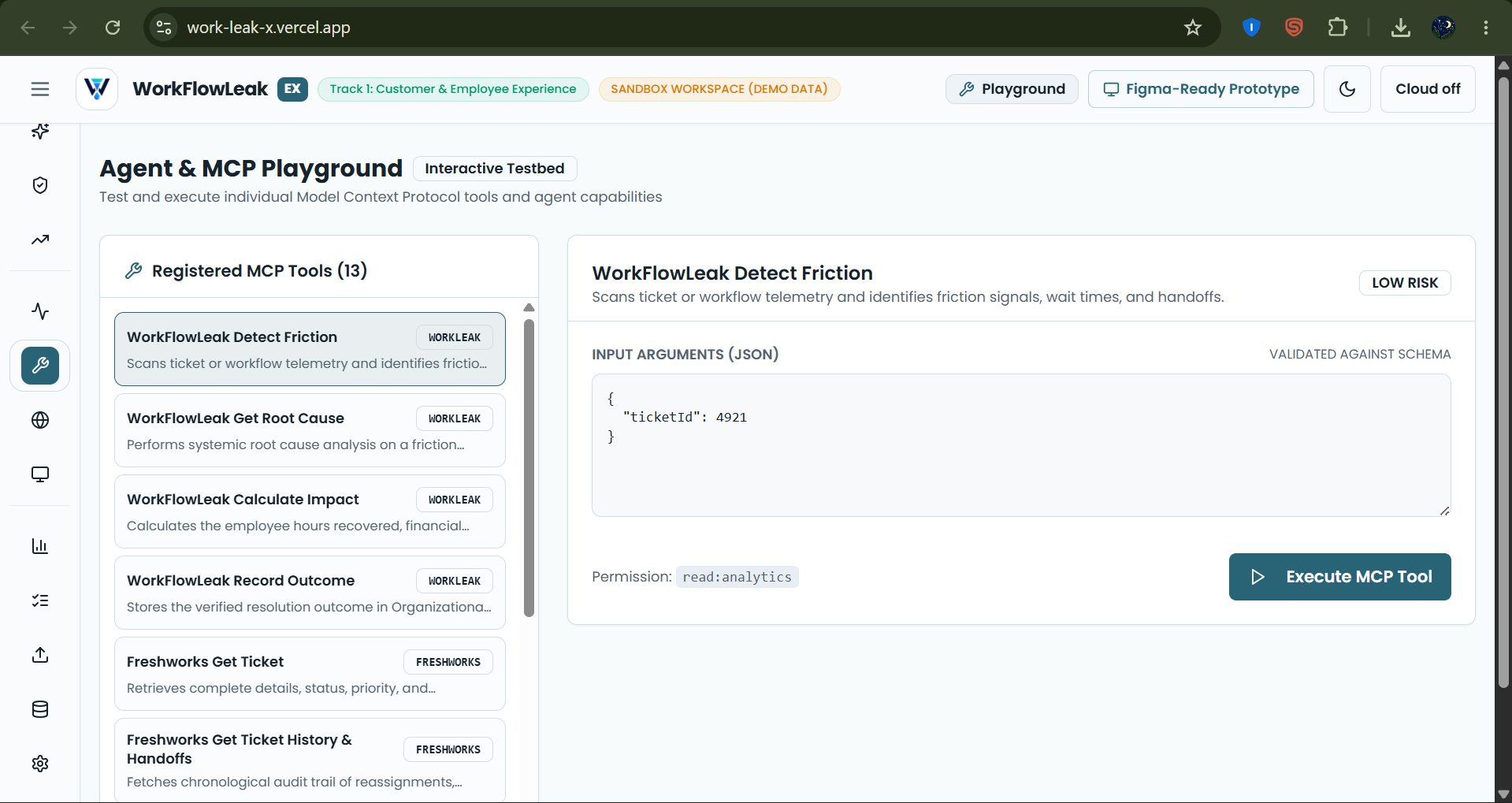
Demonstrate how an agent can interact with enterprise tools.
-
Show the employee-facing result after the resolution workflow.
-
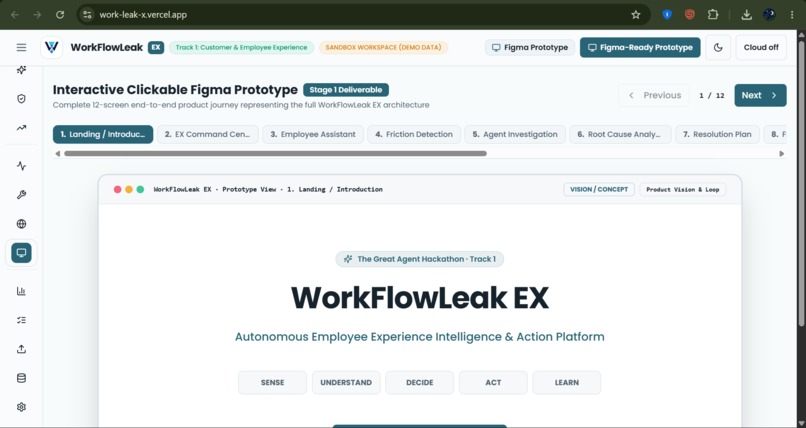
demo page for the figma page to demo
-
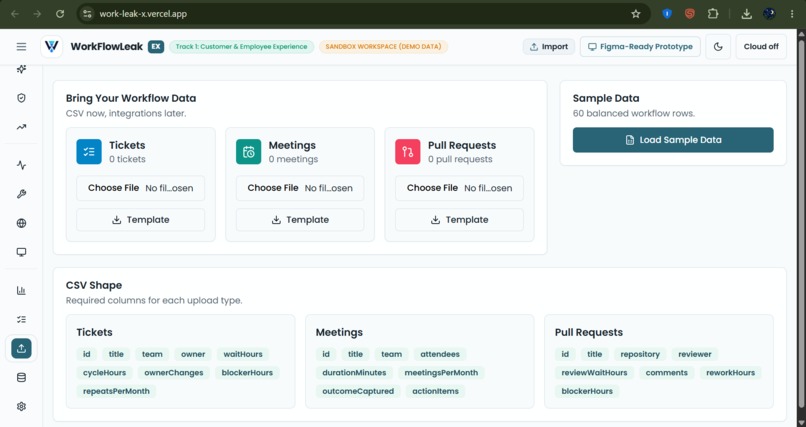
Instead of leaving the employee with an internal workflow process, WorkLeak EX communicates the resolution clearly.
-
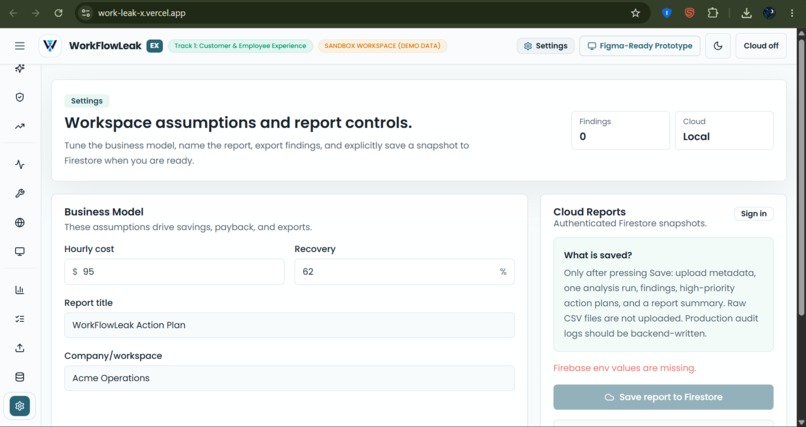
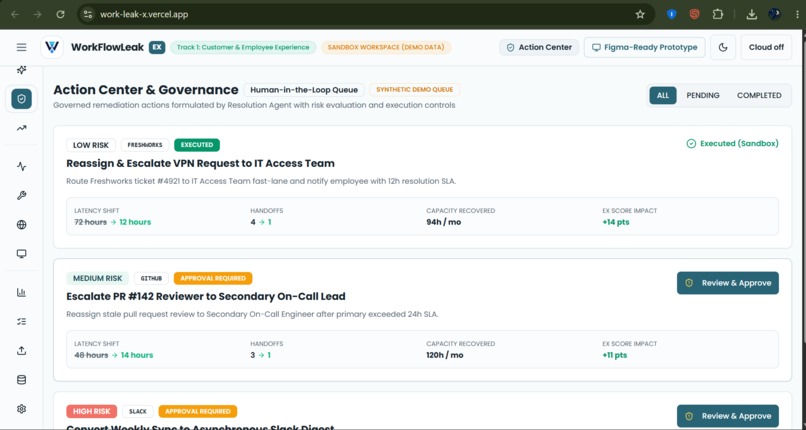
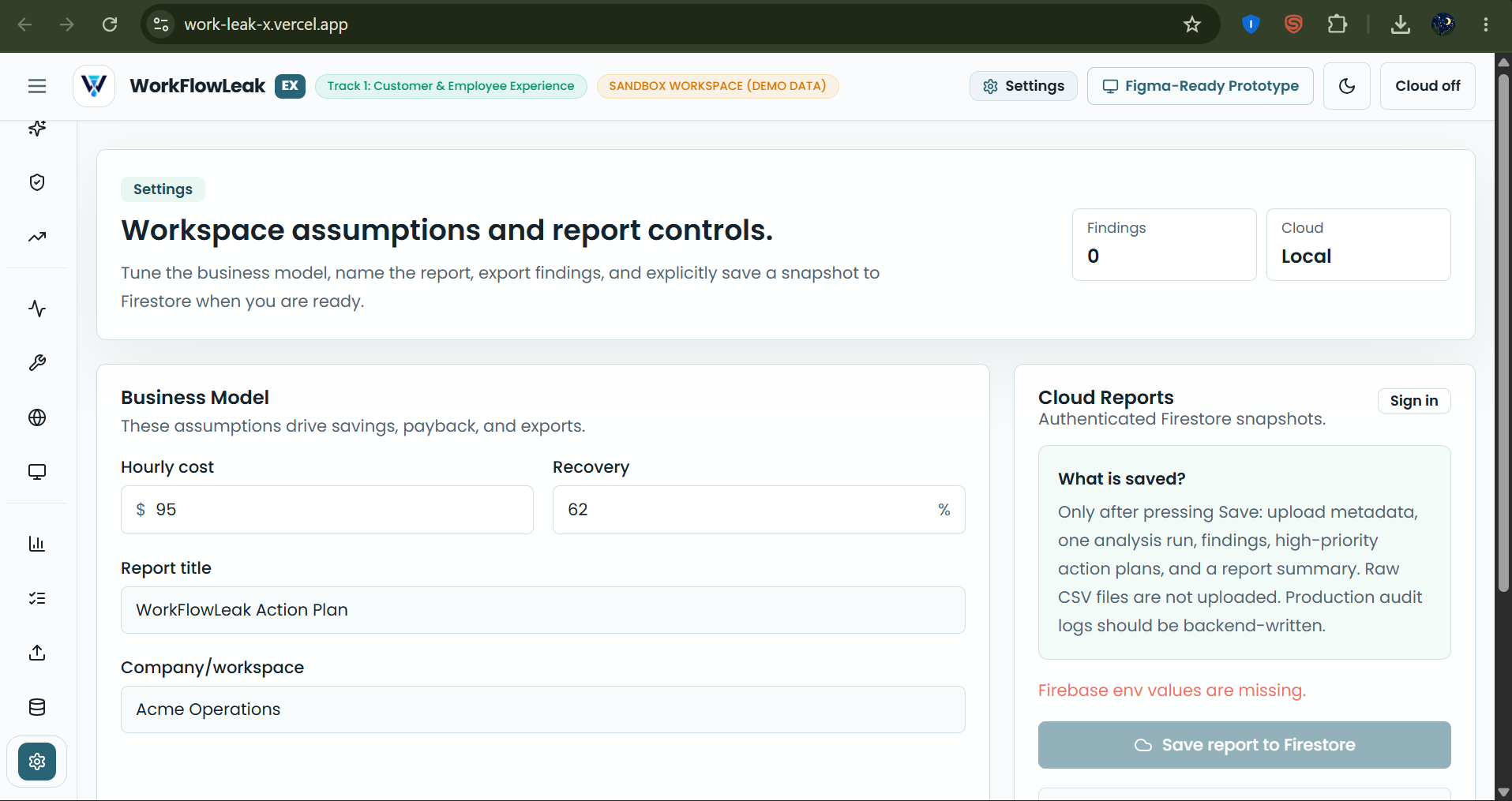
Give authorized users control over agent-generated actions. This is where humans can review actions that require approval.
Inspiration
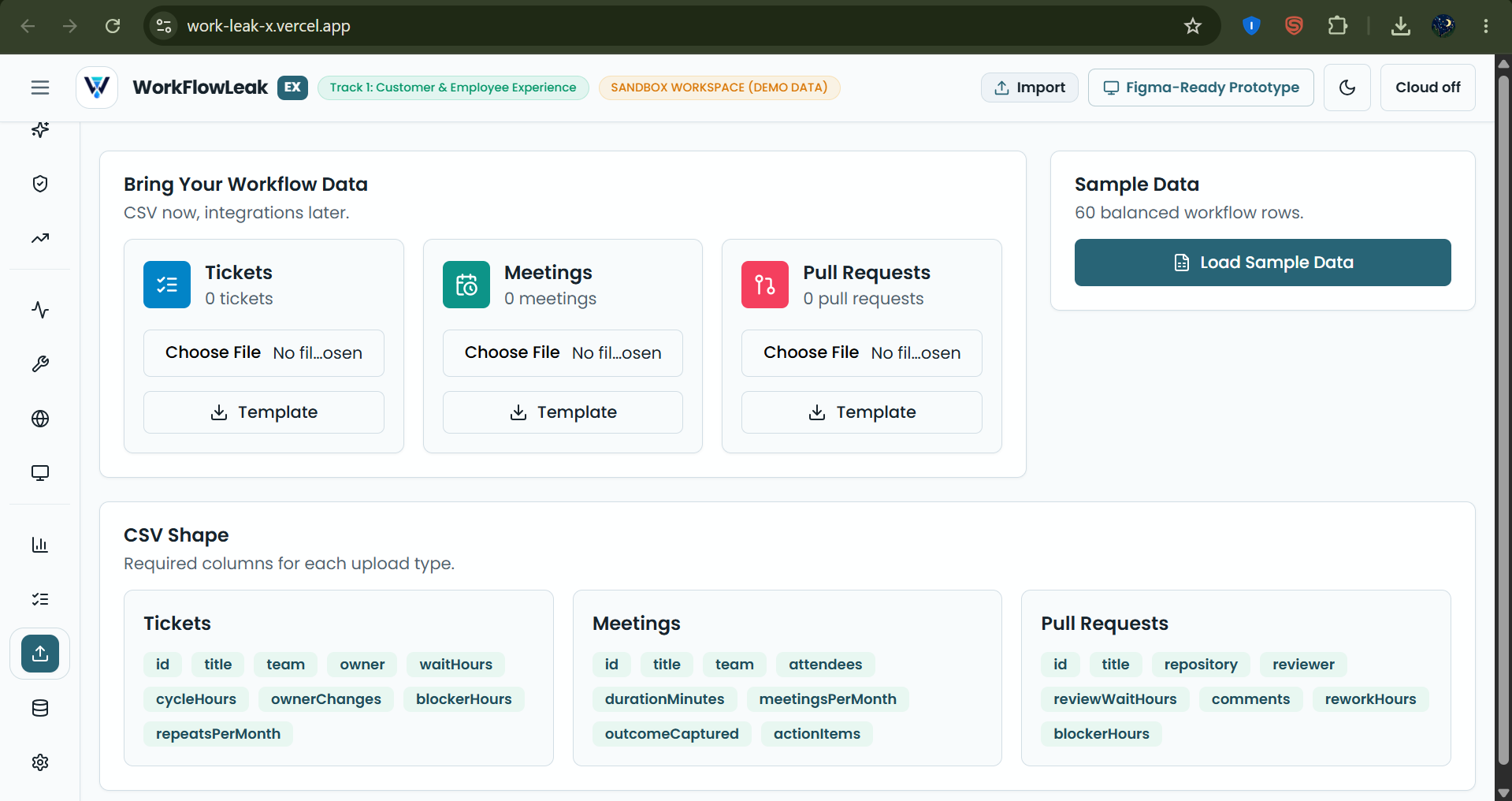
Modern organizations collect huge amounts of workplace data, but identifying that an employee is struggling with a workflow is very different from actually helping resolve the problem.
We were inspired by a simple question:
What if an AI system could detect where employees are losing time, understand why it is happening, and intelligently help resolve the friction?
Existing dashboards can reveal delays, bottlenecks, repeated work, and excessive handoffs, but they often stop at visualization. We wanted to move beyond “Here is the problem” toward “Here is why it happened, what we can do about it, and how we can verify the outcome.”
This led us to build WorkLeak EX — an Employee Experience Intelligence & Action Platform that combines WorkLeak's workflow intelligence with specialized AI agents.
Our core idea became:
Detect → Understand → Decide → Act → Verify → Improve
🚀 What it does
WorkLeak EX detects hidden employee-work friction and transforms those signals into governed, actionable resolutions.
The underlying WorkLeak intelligence identifies patterns such as:
Excessive handoffs Delayed requests Blocked work Repetitive tasks Ownership ambiguity Workflow bottlenecks Long resolution times
WorkLeak EX then uses a multi-agent architecture to investigate and respond to those signals.
🤖 Multi-Agent System
Experience Agent Detects employee friction signals from available workflow data.
Root Cause Agent Investigates evidence and identifies the likely causes behind the friction.
Resolution Agent Creates actionable resolution recommendations.
Governance Agent Evaluates risk and decides whether an action should be allowed, require human approval, or be denied.
Experience Orchestrator Coordinates the complete multi-agent workflow.
🔄 Core Workflow
Employee Problem ↓ Friction Detection ↓ Agent Investigation ↓ Root Cause Analysis ↓ Resolution Recommendation ↓ Governance & Human Approval ↓ Enterprise Tool Action ↓ Verification ↓ Impact Measurement
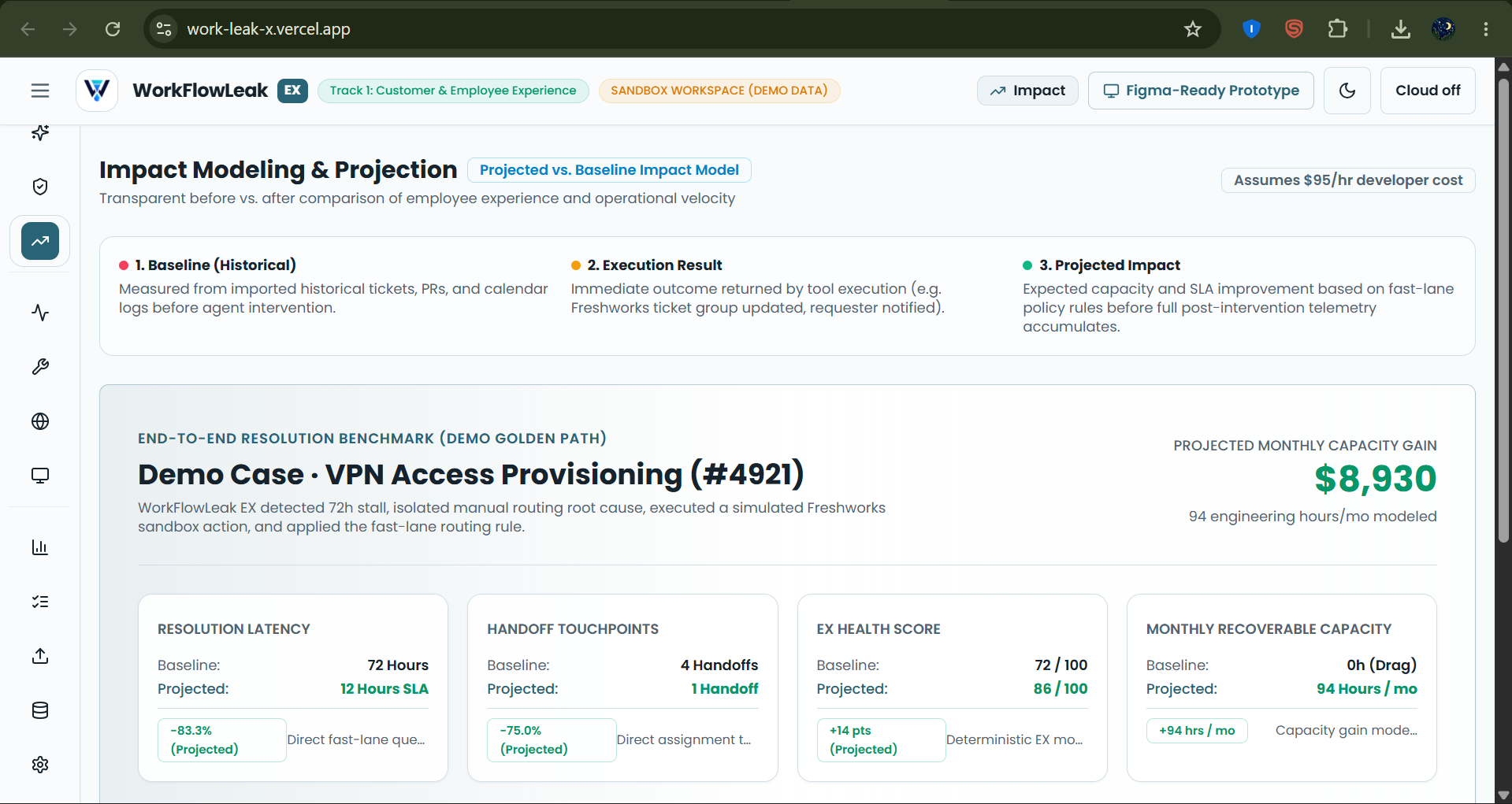
The platform also provides an explainable Employee Experience (EX) Score, agent execution logs, governance records, and a distinction between projected and measured impact.
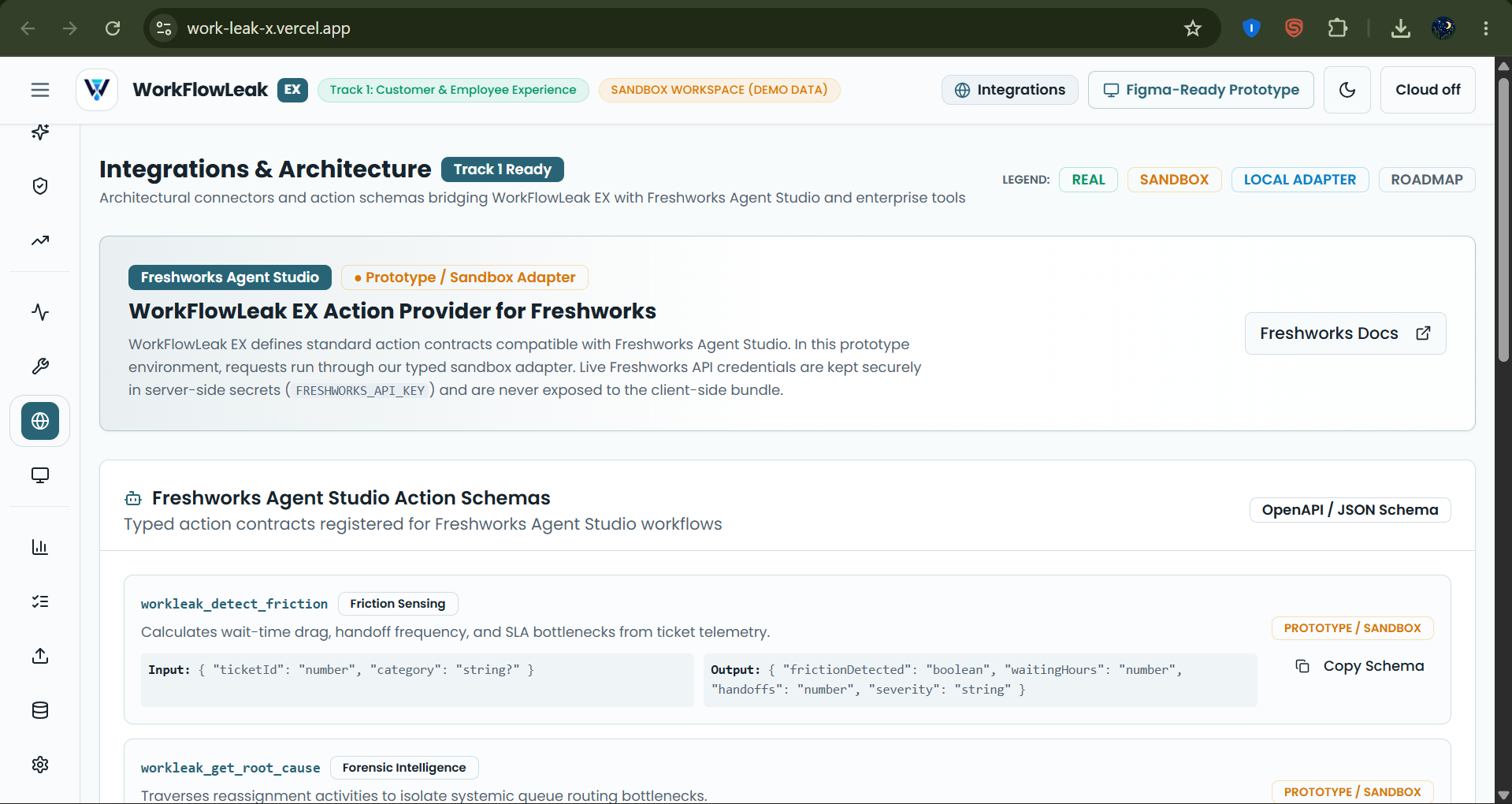
The current prototype demonstrates enterprise-tool interaction through a Freshworks Sandbox Adapter and an MCP-ready tool architecture.
🛠️ How we built it
WorkLeak EX was built as an agentic layer on top of the existing WorkLeak intelligence engine.
Architecture WORKLEAK EX │ ▼ EXPERIENCE ORCHESTRATOR │ ┌──────────────┼──────────────┐ ▼ ▼ ▼ EXPERIENCE ROOT CAUSE RESOLUTION AGENT AGENT AGENT └──────────────┼──────────────┘ ▼ GOVERNANCE AGENT │ ┌──────────┴──────────┐ ▼ ▼ ALLOW REQUIRE APPROVAL │ │ │ HUMAN APPROVAL │ │ └──────────┬──────────┘ ▼ TOOL ADAPTER LAYER │ ▼ FRESHWORKS SANDBOX │ ▼ VERIFICATION │ ▼ PROJECTED / MEASURED IMPACT Key technologies and concepts AI / LLM-based reasoning Multi-agent orchestration WorkLeak workflow intelligence Employee Experience analytics Typed enterprise tool adapters MCP-ready architecture Freshworks Sandbox integration Human-in-the-loop governance Deterministic EX scoring Audit and execution logging Structured AI outputs Projected vs measured impact modeling Modern web application architecture
We intentionally separated implemented capabilities, sandbox functionality, projected results, and future roadmap items so that the prototype remains technically transparent.
⚡ Challenges we ran into
Building an agentic system was more challenging than simply connecting an LLM to a dashboard.
- Turning analytics into actions
WorkLeak could identify workflow friction, but we needed to determine how an agent could safely move from:
“We found a problem”
to:
“Here is an appropriate action.”
We solved this by introducing specialized agents with clearly defined responsibilities.
- Preventing uncontrolled AI actions
An autonomous agent should not automatically execute every action it generates.
We introduced a governance layer:
ALLOW → REQUIRE APPROVAL → DENY
This gives the system a controlled path from AI recommendation to execution.
- Separating projected and measured impact
It was tempting to immediately show an estimated improvement after an action.
Instead, we separated:
Projected Impact
from:
Measured Impact
so the platform does not present an expected result as a verified result.
- Enterprise integration complexity
Enterprise platforms have authentication, permissions, API limitations, and different tool interfaces.
Rather than creating fake production integrations, we designed a typed adapter architecture with a Freshworks Sandbox Adapter and an MCP-ready tool layer.
- Making multi-agent reasoning explainable
We wanted judges and users to understand why an agent made a recommendation.
Therefore, agent runs, tool calls, evidence, governance decisions, and outcomes are represented through execution and audit information.
🏆 Accomplishments that we're proud of
We are proud that WorkLeak EX goes beyond being another AI chatbot or analytics dashboard.
🤖 A genuine multi-agent workflow
Different agents have different responsibilities instead of using one general-purpose AI prompt for everything.
🛡️ Governed agentic automation
AI recommendations pass through a governance layer before actions can be executed.
📊 Explainable EX Score
The Employee Experience Score uses deterministic components rather than allowing an LLM to arbitrarily generate a score.
🔍 From detection to action
WorkLeak's existing intelligence is connected to an agentic decision-making layer.
🔄 Projected vs measured impact
The platform explicitly distinguishes expected outcomes from evidence-based measurements.
🔗 Enterprise-ready architecture
The typed tool-adapter approach provides a foundation for connecting enterprise systems while keeping sandbox and production capabilities separate.
🎯 Strong hackathon alignment
The project directly addresses Track 1 — Customer & Employee Experience through AI agents, orchestration, enterprise tools, governance, and employee workflow intelligence.
📚 What we learned
Building WorkLeak EX taught us that creating an agentic system is not simply about making an LLM autonomous.
We learned that a useful enterprise agent needs:
Context → Tools → Reasoning → Governance → Execution → Verification
We also learned the importance of:
Giving each agent a clear responsibility Validating AI-generated outputs Using structured tool contracts Keeping humans involved in high-risk decisions Recording agent and tool activity Separating simulated and real integrations Never presenting projected results as measured results Designing for failure instead of assuming every tool call succeeds
Most importantly, we learned that trust is as important as intelligence when building AI systems that can influence real workflows.
🔮 What's next for WorkLeak EX
The current prototype establishes the foundation for a broader Employee Experience intelligence platform.
Next steps include:
Live Freshworks Integration Connect the server-side Freshworks adapter to real enterprise workflows.
Real MCP Server & Client Integration Extend the MCP-ready tool architecture into a verified MCP implementation.
Continuous Experience Monitoring Monitor employee workflow signals continuously rather than relying primarily on existing datasets.
Real Post-Action Measurement Compare actual post-action results against baseline metrics to produce verified impact measurements.
More Enterprise Systems Expand the adapter architecture toward systems such as Jira, GitHub, Slack, Microsoft 365, and other workplace platforms.
Personalized Employee Experience Intelligence Move from organization-level insights toward context-aware workflow assistance while maintaining privacy and governance.
Predictive Friction Detection Identify potential workflow bottlenecks before they significantly affect employees.
Customer Experience Expansion Extend the same intelligence architecture from Employee Experience toward Customer Experience workflows.
Built With
- agents
- ai
- artificial
- freshworks
- gemini
- generative
- intelligence
- llm
- multi-agent
- react
- typescript


Log in or sign up for Devpost to join the conversation.