Inspiration
Modern teams lose countless hours to hidden workflow inefficiencies — delayed approvals, endless meetings, blocked pull requests, duplicated reports, and manual follow-ups. These problems often feel “normal,” but over time they create massive operational waste.
We created WorkLeak to make invisible workflow friction visible. Our goal was to help teams identify where time and money are leaking across daily operations and turn those insights into actionable improvements.
The inspiration came from real experiences where teams worked hard but still struggled with delays, communication gaps, and repetitive manual processes. We wanted to build an AI-powered system that not only detects these issues but also estimates their real business impact.
What it does
WorkLeak is an AI-powered operational intelligence platform that analyzes workflow data from tickets, meetings, and pull requests to uncover productivity leaks inside teams.
The platform can detect:
Long wait times Excessive handoffs Blocked pull requests Repeated manual work Duplicate meetings and reports Workflow bottlenecks Review delays
WorkLeak then:
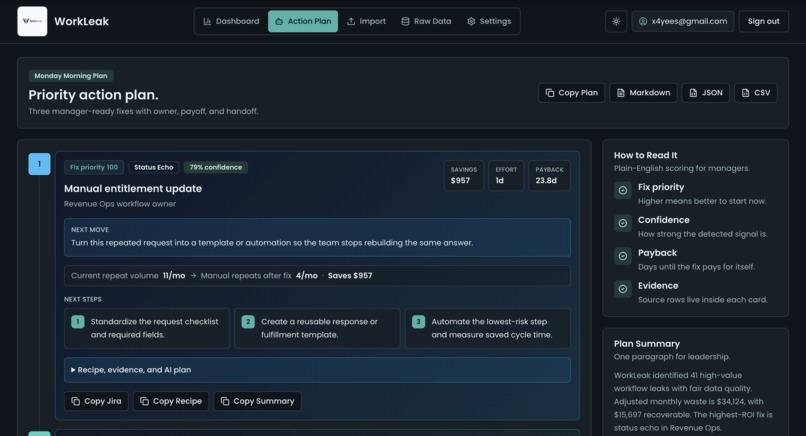
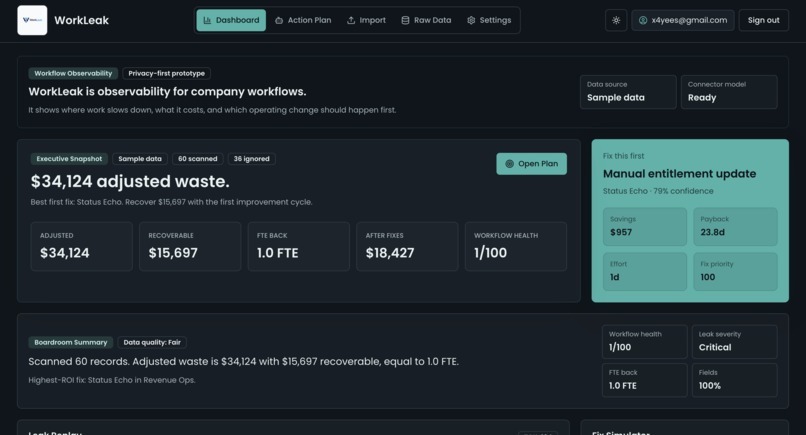
Estimates business impact and productivity loss Calculates recoverable savings Prioritizes the highest-ROI fixes Generates actionable improvement plans Creates Jira-ready tickets and automation suggestions Provides executive-level workflow health insights
The goal is simple:
Help organizations know what to fix first.
How we built it
We built WorkLeak using a modern full-stack web architecture focused on speed, usability, and AI-driven insights.
Frontend React TypeScript Vite Tailwind CSS Recharts for analytics visualization Backend & Services Firebase Authentication Cloud Firestore Gemini API through Vercel serverless functions Core Features CSV workflow data import AI-powered workflow analysis Leak fingerprint detection Business cost estimation engine Action plan generation Workflow health scoring Report persistence using Firestore
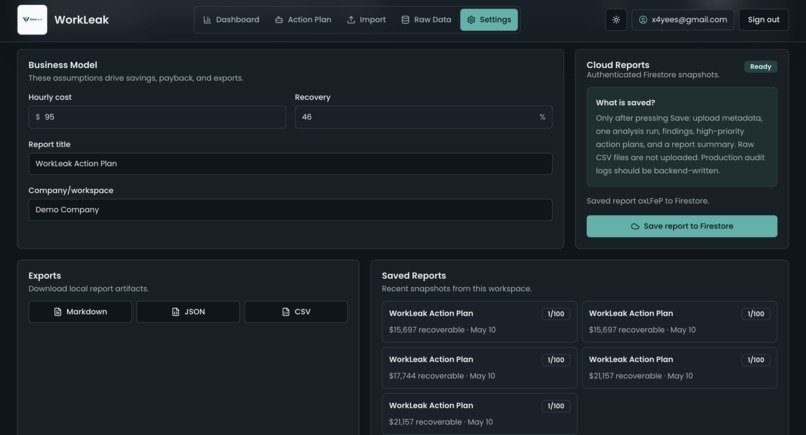
We also designed the system to keep raw uploaded CSV data local in the browser for better privacy during the prototype stage.
Challenges we ran into
One of the biggest challenges was converting vague workflow frustration into measurable business intelligence.
It is easy to say:
“This process feels slow.”
But it is much harder to estimate:
How many hours are being lost What the financial impact is Which problem should be fixed first
Another major challenge was avoiding inflated impact calculations. A single workflow issue can trigger multiple leak signals, so we had to carefully design adjusted waste calculations to avoid double-counting productivity loss.
We also faced challenges balancing:
Product realism Data privacy AI explainability Actionable recommendations
Making recommendations genuinely useful — instead of generic AI advice — required careful system design.
Accomplishments that we're proud of
We are proud that WorkLeak goes beyond simple analytics dashboards and actually helps teams make operational decisions.
Some accomplishments include:
Building a complete end-to-end operational intelligence platform Creating measurable workflow cost estimation Designing leak fingerprint detection systems Generating actionable AI-powered recommendations Implementing private report persistence with Firestore Creating a clean executive-level analytics experience Successfully transforming workflow data into business insights
Most importantly, we built a system that turns hidden operational inefficiencies into clear opportunities for improvement.
What we learned
Through this project, we learned:
How difficult operational analytics can be in real-world environments The importance of explainable AI recommendations How to balance privacy with intelligent automation Techniques for analyzing messy workflow data How business metrics influence technical decisions The importance of prioritization in productivity systems
We also learned that small workflow inefficiencies, when repeated across teams and time, can create surprisingly large business costs.
What's next for WorkLeak
We plan to continue expanding WorkLeak into a full operational intelligence ecosystem.
Future improvements include:
Real Jira, GitHub, Slack, and Google Calendar integrations Multi-team collaboration workspaces Scheduled weekly AI workflow reports Historical trend tracking One-click automation deployment Enterprise-grade security and access control Department benchmarking Real-time operational alerts AI-generated workflow optimization strategies Advanced predictive bottleneck detection
Long-term, we envision WorkLeak becoming:
A continuous operational improvement system that constantly monitors workflows, identifies inefficiencies, and helps organizations recover time before productivity is lost.
Built With
- ai-powered
- analytics
- api
- authentication
- cloud
- components
- css
- csv
- engine
- firebase
- firestore
- functions
- gemini
- intelligence
- javascript
- localstorage
- processing
- react
- recharts
- serverless
- shadcn/ui
- tailwind
- typescript
- vercel
- vite
- workflow

Log in or sign up for Devpost to join the conversation.