-
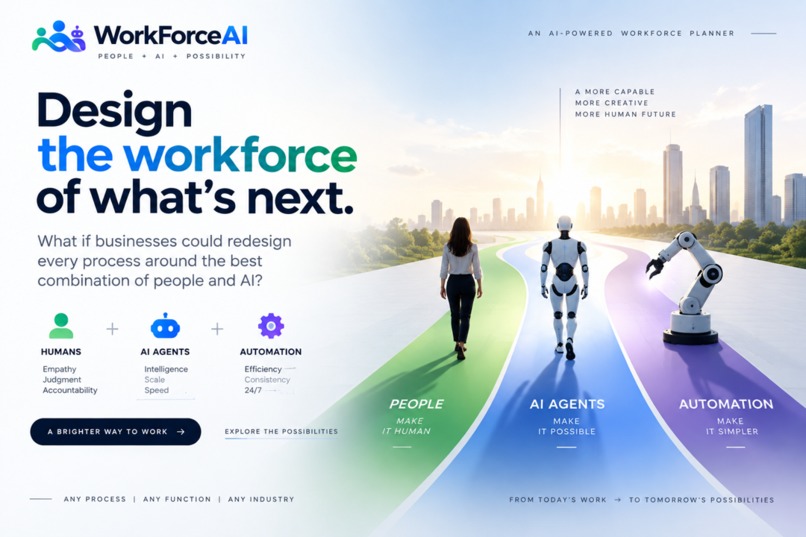
WorkForceAI - Why - The Vision
-
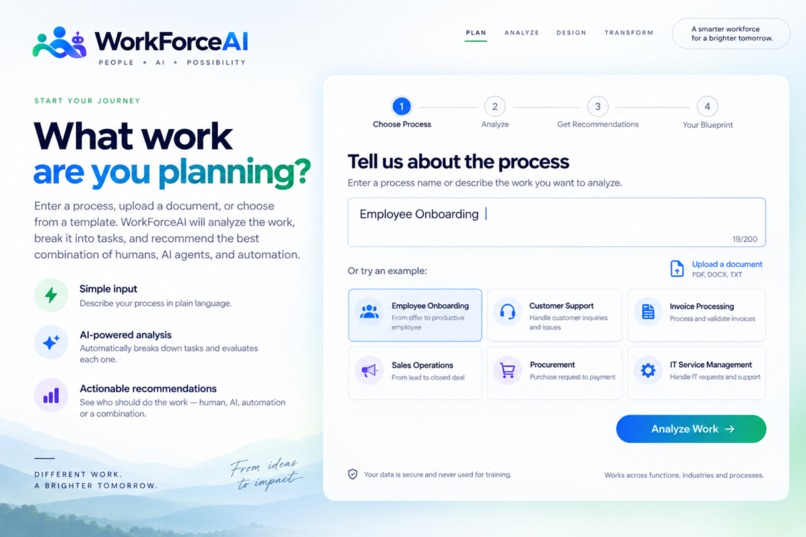
WorkForceAI - What - Start With Any Process
-
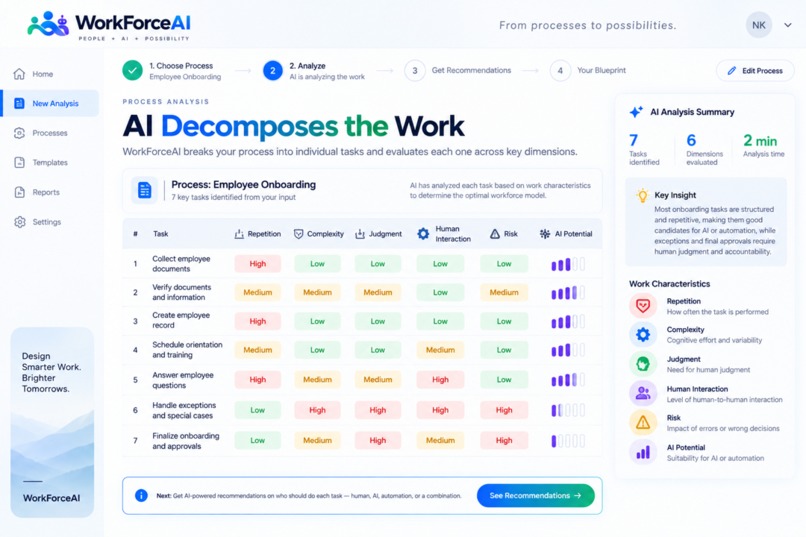
WorkForceAI - How - AI Decomposes the Work
-
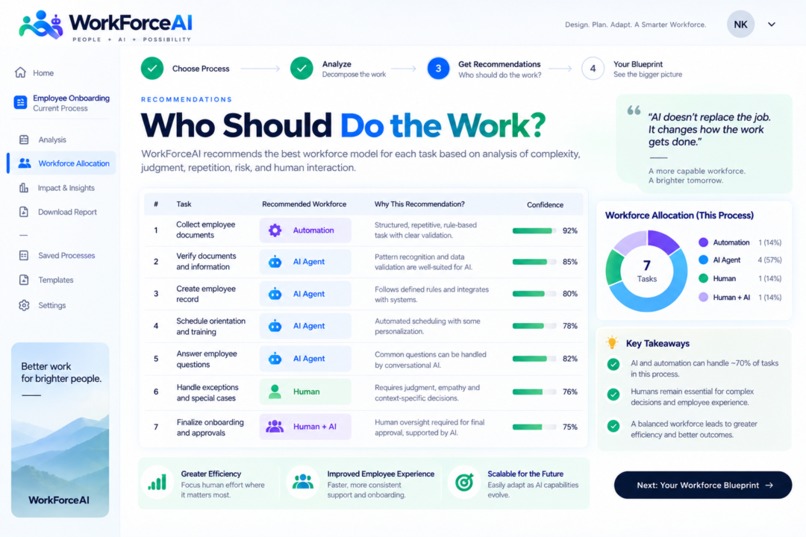
WorkForceAI - Who - Workforce Allocation
-
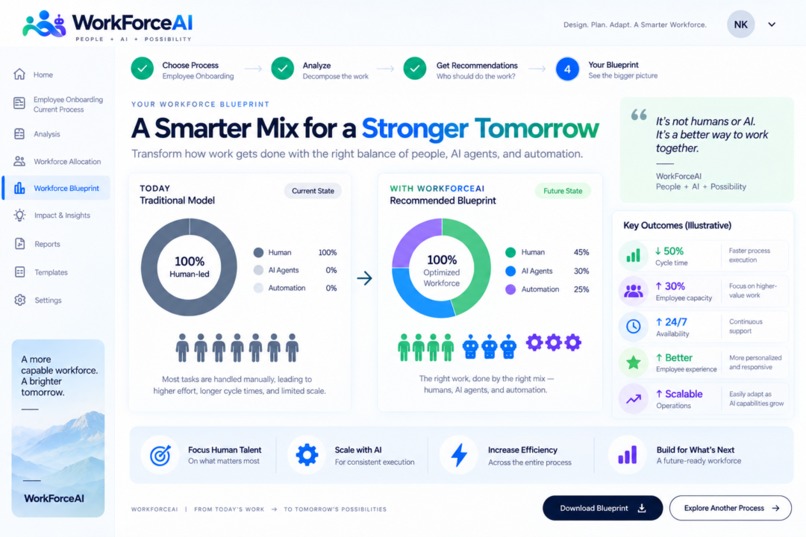
WorkForceAI - What Next - The Workforce BluePrint
-
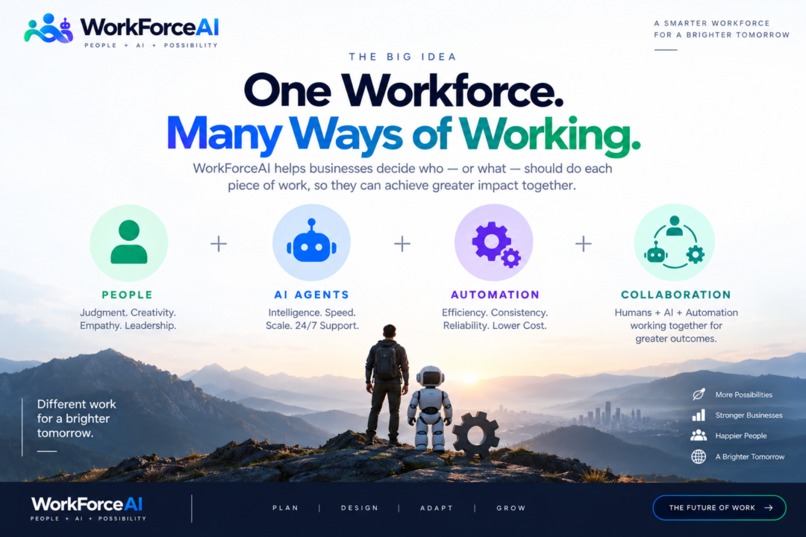
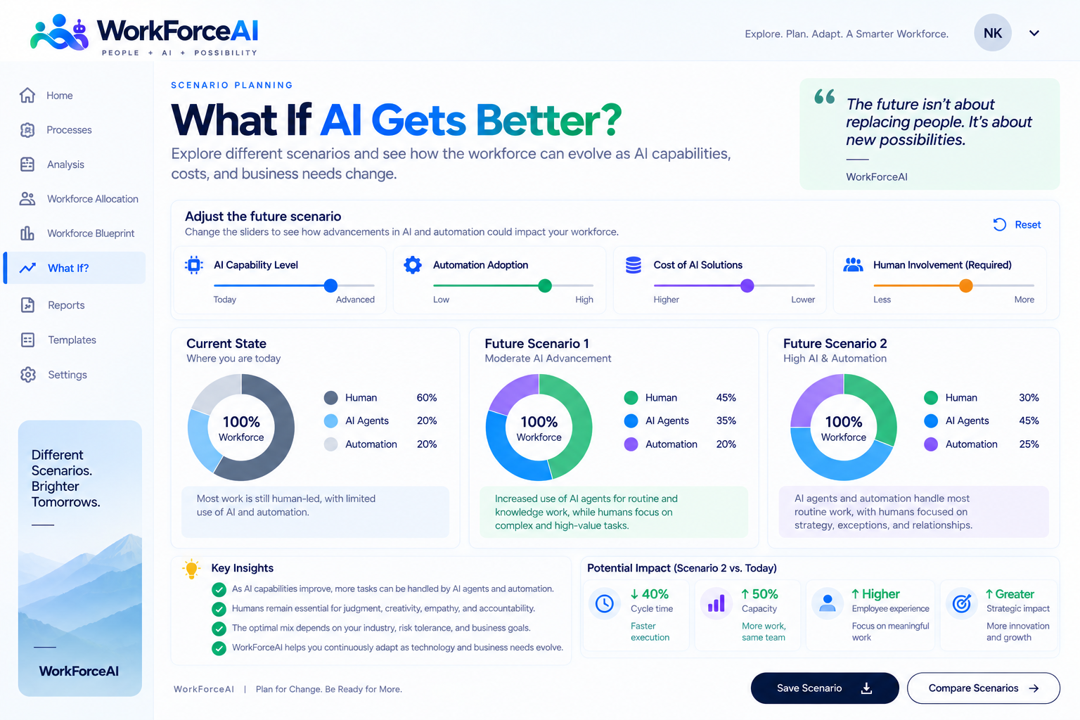
WorkForceAI - When - What If
-
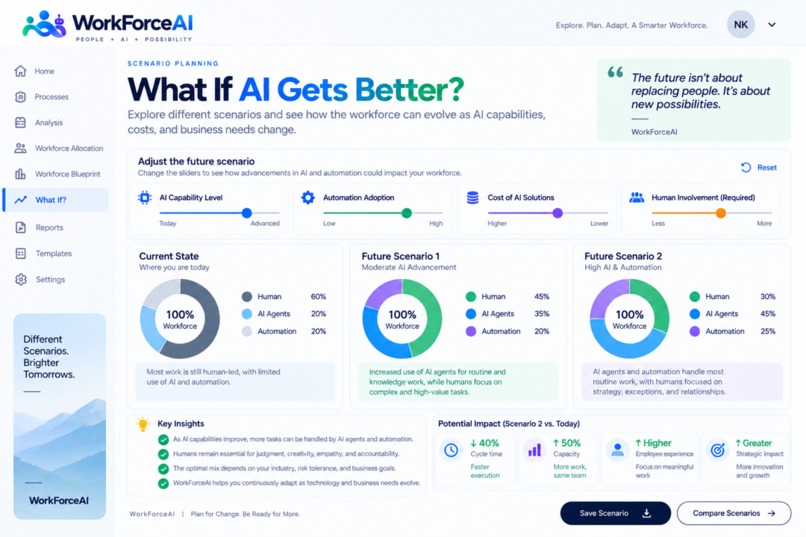
WorkForceAI - Why it Matters - The Big Idea
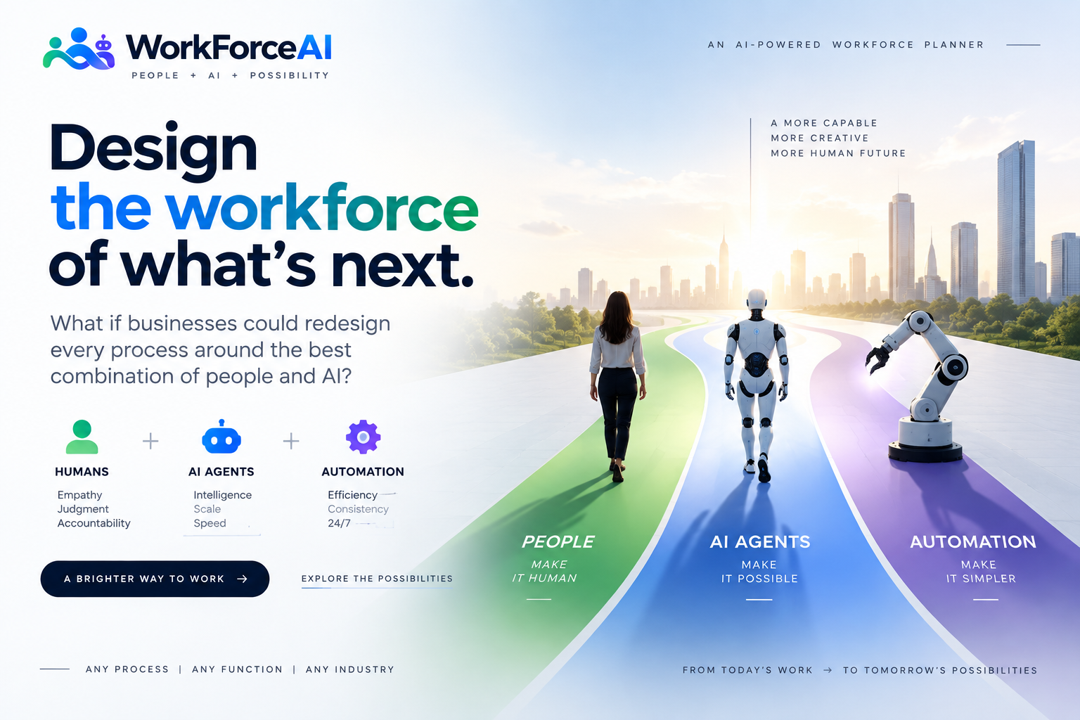
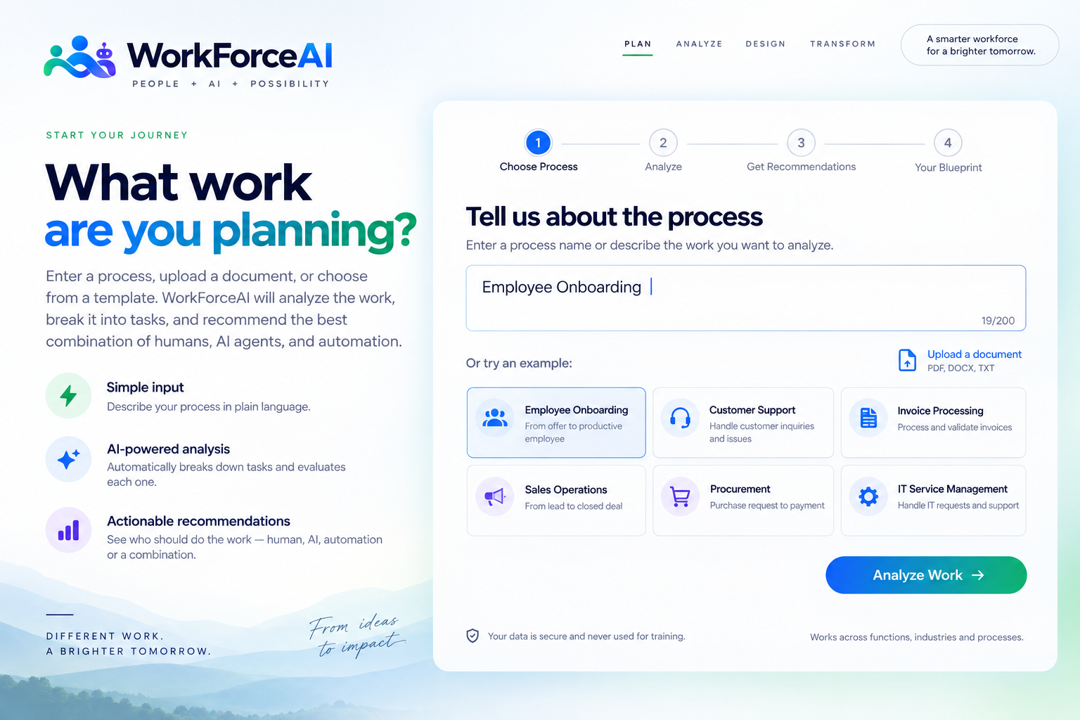
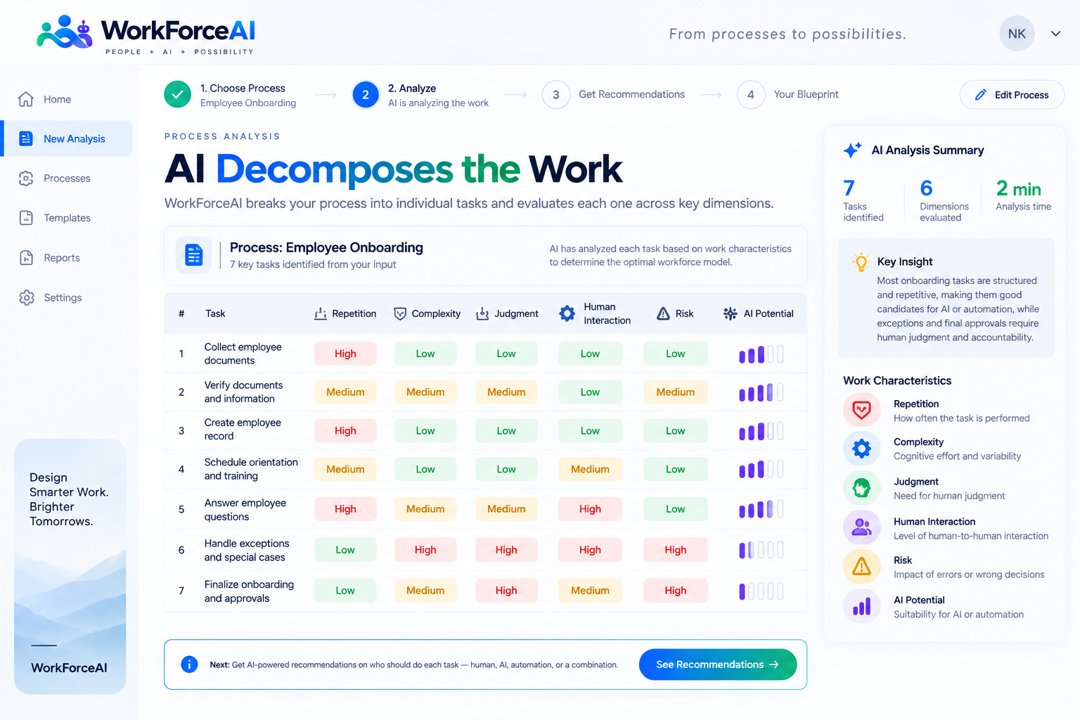
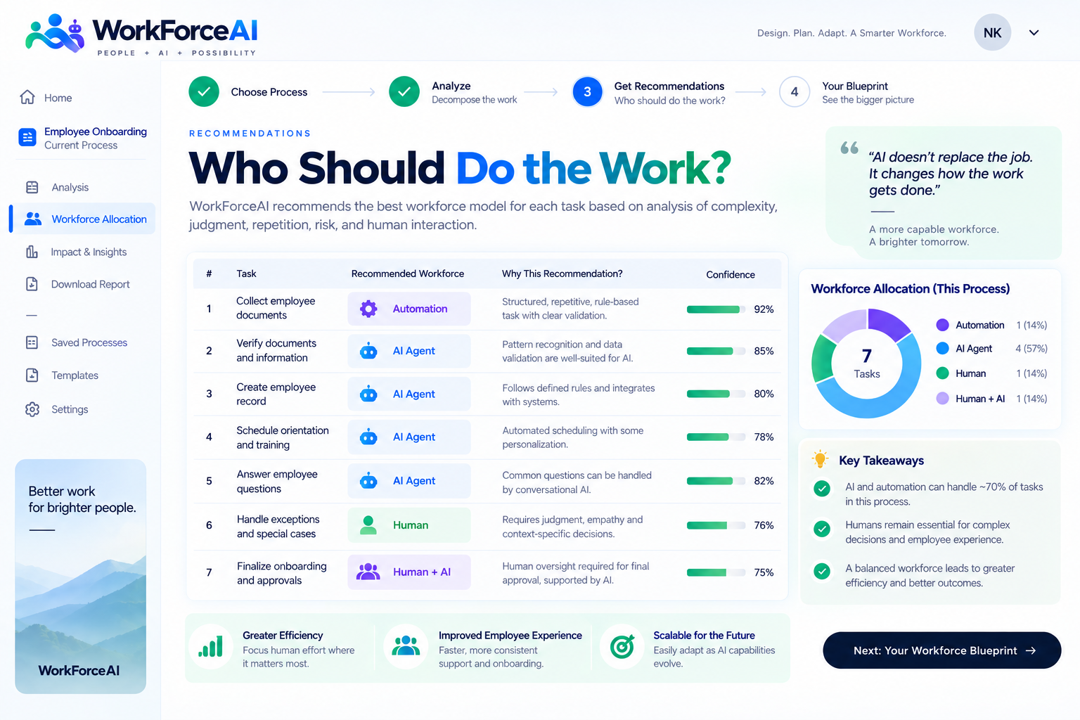
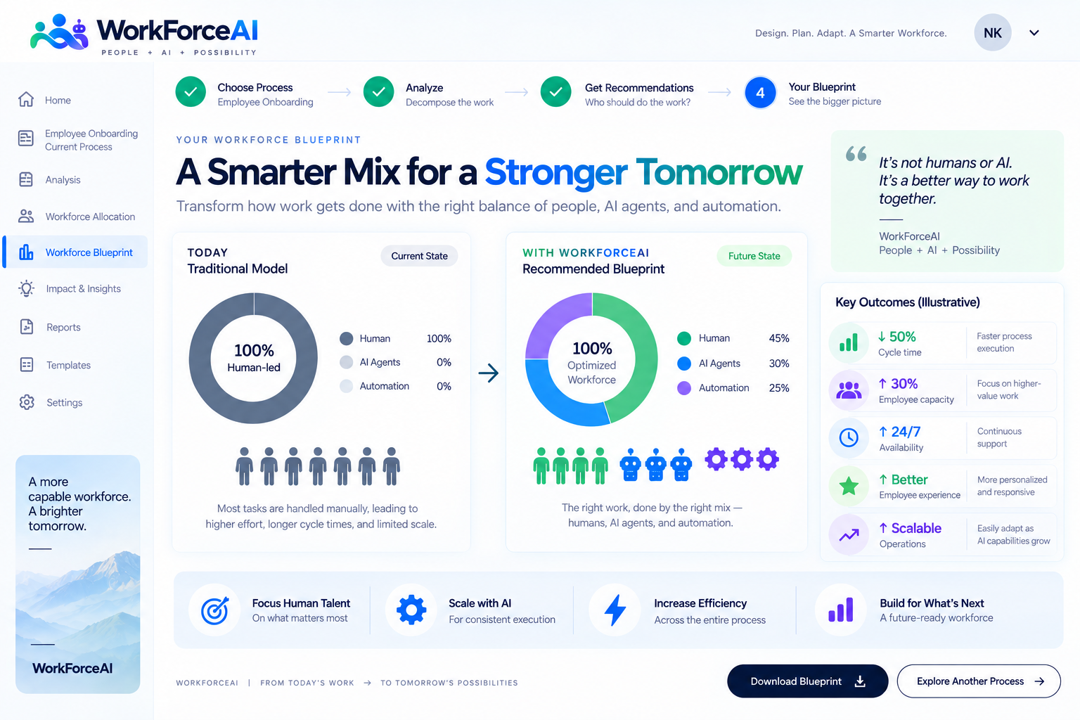
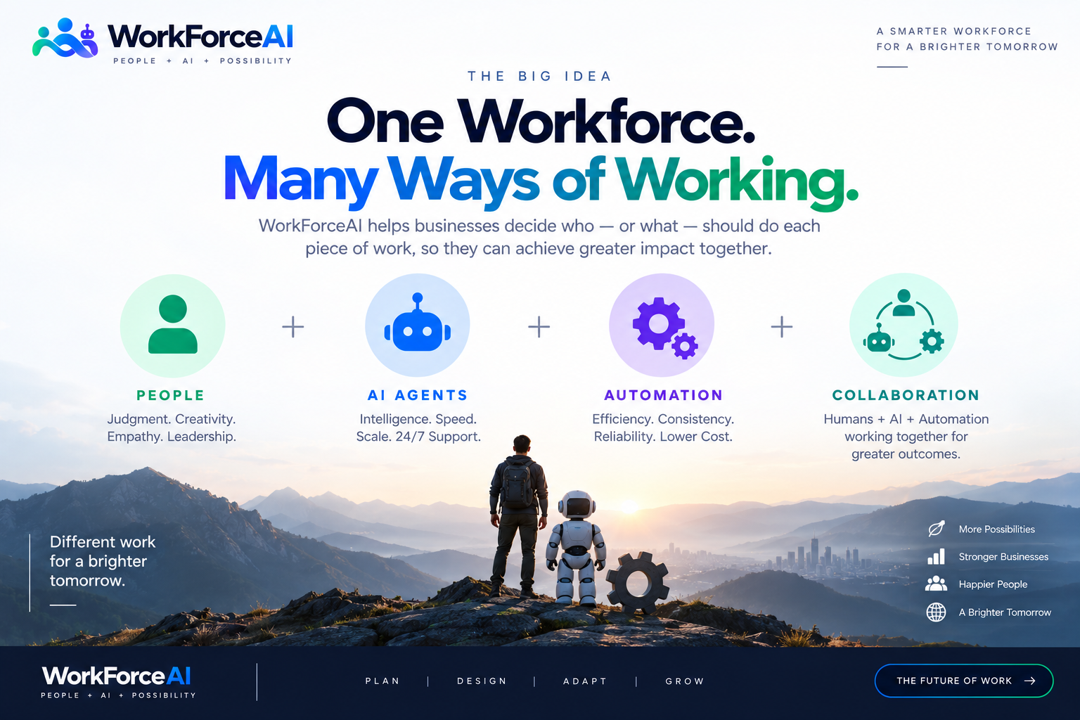
Why WorkForceAI?
There are already products that help organizations with workforce planning, workforce intelligence, automation, and AI-agent management.
So why build another one?
Because we believe the next workforce problem is not simply "How many people do we need?"
It is:
"What is the most economically valuable way to perform each piece of work?"
WorkForceAI approaches the problem from the task upward, rather than from the employee or job downward.
Our Differentiation
1. Work-first, not job-first
Instead of starting with roles and headcount, WorkForceAI starts with the actual work being performed.
A single job can contain dozens of tasks—and those tasks may have very different automation, AI, and human requirements.
2. Human + AI + Automation in one decision
WorkForceAI does not assume that AI is always the answer.
For every task, it considers four possibilities:
Human | AI Agent | Automation | Human + AI
This makes the objective optimal work allocation, not maximum automation.
3. Economics built into the decision
An AI agent may be technically capable of performing a task but still be economically inefficient.
WorkForceAI therefore envisions evaluating the cost of intelligence alongside the value created.
As AI agents become more widespread, token consumption, model calls, tool usage, and other operating costs become part of the economics of work. Industry research increasingly highlights the need to connect AI consumption with business outcomes rather than optimizing tokens in isolation.
This creates an important question:
Is this task worth using an AI agent for?
If a simple automation can complete the task more cheaply, use automation.
If the task requires judgment, keep a human involved.
If an AI agent can deliver significantly greater value at an acceptable cost, use AI.
The goal is not to maximize AI usage.
The goal is to maximize value per unit of work.
4. What-if workforce design
WorkForceAI is designed to explore scenarios rather than produce a static workforce plan.
For example:
What happens if an AI agent takes over these tasks?
What happens if the cost of AI falls?
What happens if the process volume doubles?
What happens if human review is required for high-risk tasks?
The workforce blueprint can change as assumptions change.
5. Designed to be horizontal
The framework is not tied to one industry or job family.
The same approach can analyze healthcare, finance, education, customer service, HR, retail, logistics, government, and other business processes.
The industry changes.
The fundamental question does not:
Who—or what—should do this work?
The Economic Advantage
We don't want WorkForceAI to recommend AI simply because AI is available.
We want it to recommend the lowest-cost, highest-value workforce configuration that meets the required quality, risk, and human-accountability thresholds.
This creates the foundation for a future AI Workforce ROI Engine.
Instead of measuring:
"How many AI tasks did we automate?"
WorkForceAI could measure:
Cost per task → Value per task → Human capacity released → AI cost → Automation cost → Expected ROI
This is where we believe the concept can become more than workforce planning.
It becomes workforce economics.
Our Position
WorkForceAI is not trying to replace existing HR systems, workforce-management platforms, or AI-agent platforms.
It sits above them as a work-design and decision layer.
It asks a question that becomes increasingly important as AI capabilities expand:
Before deploying another AI agent, should this task actually be performed by an AI agent?
That is the decision WorkForceAI is designed to help businesses make.
Built With
- ai
- business-innovation
- business-strategy
- future-of-work
- generative-ai
- human-ai-collaboration
- human-in-loop
- natural-language-processing
- python
- visual-studio
- workforce-innovation

Log in or sign up for Devpost to join the conversation.