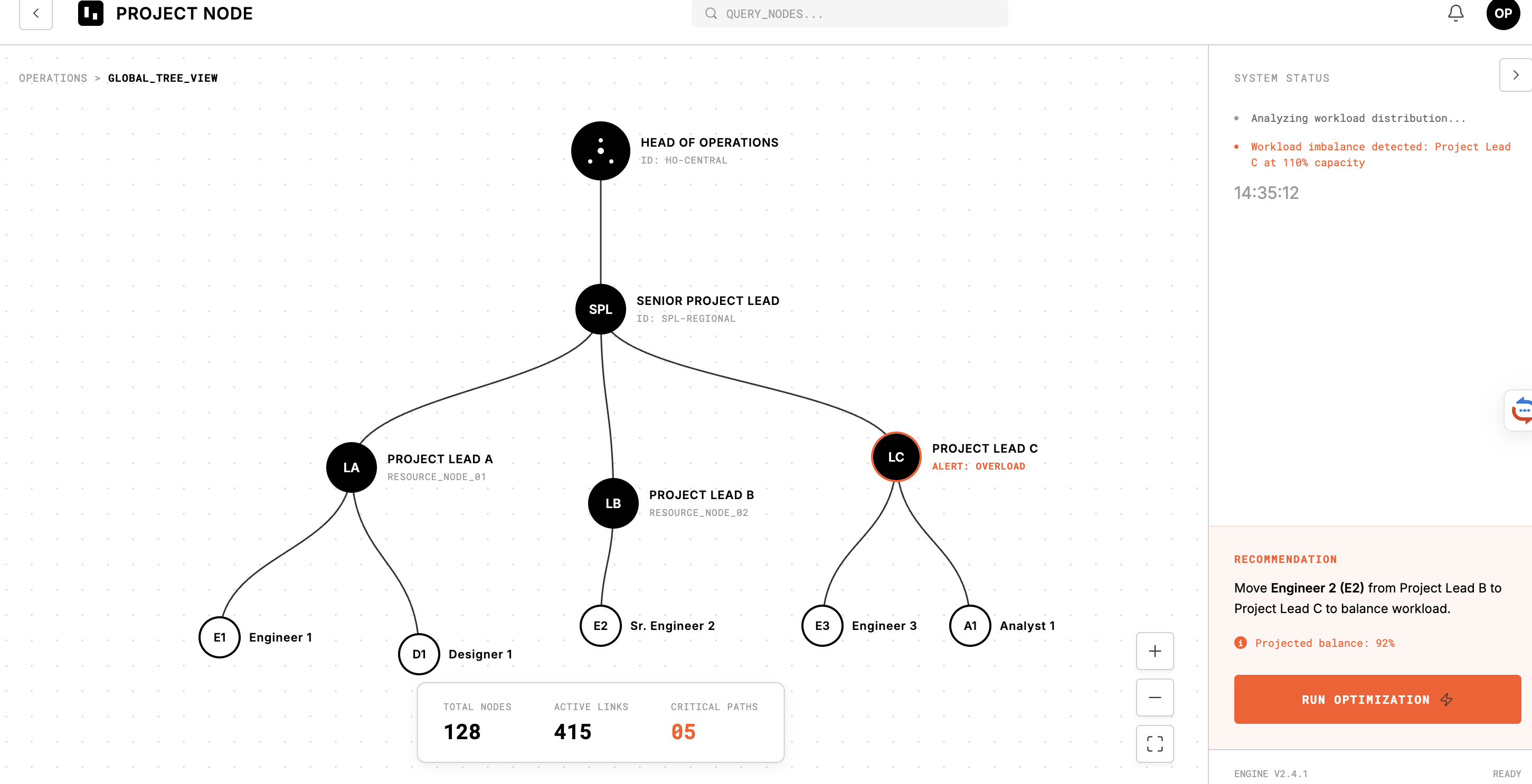
Here is your project rearranged and polished for the hackathon submission. This version balances the technical "flex" (for the data engineers) with the business value of risk mitigation.
Inspiration Most companies manage their most expensive asset—their people—using static spreadsheets. We realized that these tools create a massive allocation blind spot. When a key employee leaves, leadership is left guessing. We wanted to build a "Google Maps" for organizations: a system that doesn't just list names, but understands the network of relationships between skills, budgets, and project stability.
What it does Workforce Optimizer is a Dynamic Knowledge Graph that turns workforce planning into a proactive risk mitigation strategy. It allows managers to:
Simulate Departures: Instantly calculate the "Blast Radius" of a resignation.
Mitigate Risk: Identify which projects are most "brittle" and at risk of failure.
Optimize Allocation: Automatically find the mathematically "best fit" to fill a gap, balancing skill proficiency, project priority, and strict budget constraints.
How we built it We combined graph theory with modern AI orchestration:
The Logic Layer: Built a Python backend using Google OR-Tools and NetworkX to solve the Bipartite Matching problem—optimizing the flow of manpower to project needs.
The Intelligence: Used Vector Embeddings (Cosine Similarity) to match employee expertise to project requirements, finding "hidden fits" that traditional searches miss.
The Orchestrator: Integrated a LangChain Agent to translate raw mathematical optimization data into a human-readable, actionable succession plan.
The Frontend: A React-based dashboard that visualizes the "Blast Radius" and proposed org-structure changes.
Challenges we ran into The hardest part was quantifying the "invisible." We had to figure out how to turn vague human traits into strict numerical weights that an optimization algorithm could process. Solving the multi-constraint problem—where you have to satisfy budget, hours, and skill levels simultaneously without breaking the graph—required several iterations of our Python solver logic.
Accomplishments that we're proud of We successfully moved beyond "AI as a chatbot." We are proud of building a hybrid architecture where the LLM doesn't just guess; it acts as a translator for a robust, deterministic mathematical engine. Seeing the system propose a succession plan that was both budget-compliant and skill-accurate was our "Eureka" moment.
What we learned We learned that in enterprise HR, data engineers are skeptical of LLM hallucinations. This pushed us to ground our AI in Operations Research (OR). We discovered that Graph Data Structures are significantly more resilient for modeling organizational data than traditional relational tables.
What's next for Workforce Optimizer Our Phase 2 roadmap includes:
Link Prediction: Using Graph Neural Networks (GNNs) to predict which employees will work well together based on past collaboration patterns.
Real-time Integration: Connecting to Slack and GitHub APIs to automatically update "Skill Nodes" and "Connection Edges" based on actual work output.
Predictive Attrition: Using graph topology to identify "at-risk" employees before they resign.
Built With
- fastapi
- react.js


Log in or sign up for Devpost to join the conversation.