-
-
-
scenes Golden Demo
-
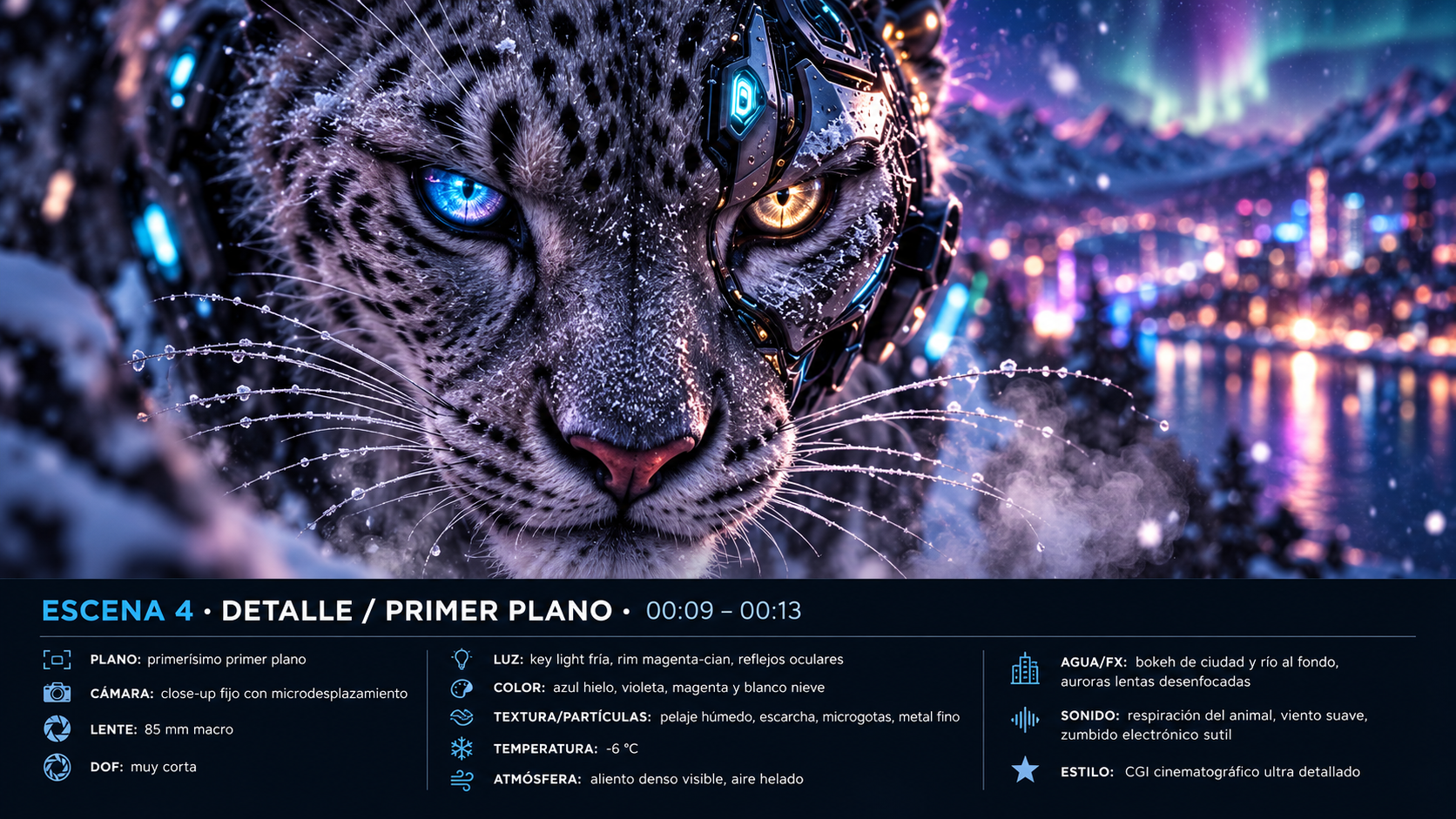
heterochromia cyan and yellow eyes
Workflow Finder Audiovisual
Inspiration
Generative video tools can already create impressive individual shots. The harder problem appears when those shots need to belong to the same production.
Across a sequence, small inconsistencies can quickly become expensive production problems: a character's eye colour changes, a prosthetic moves to the wrong side, camera rules drift, a location no longer matches the established world, or a creative decision gets lost between iterations.
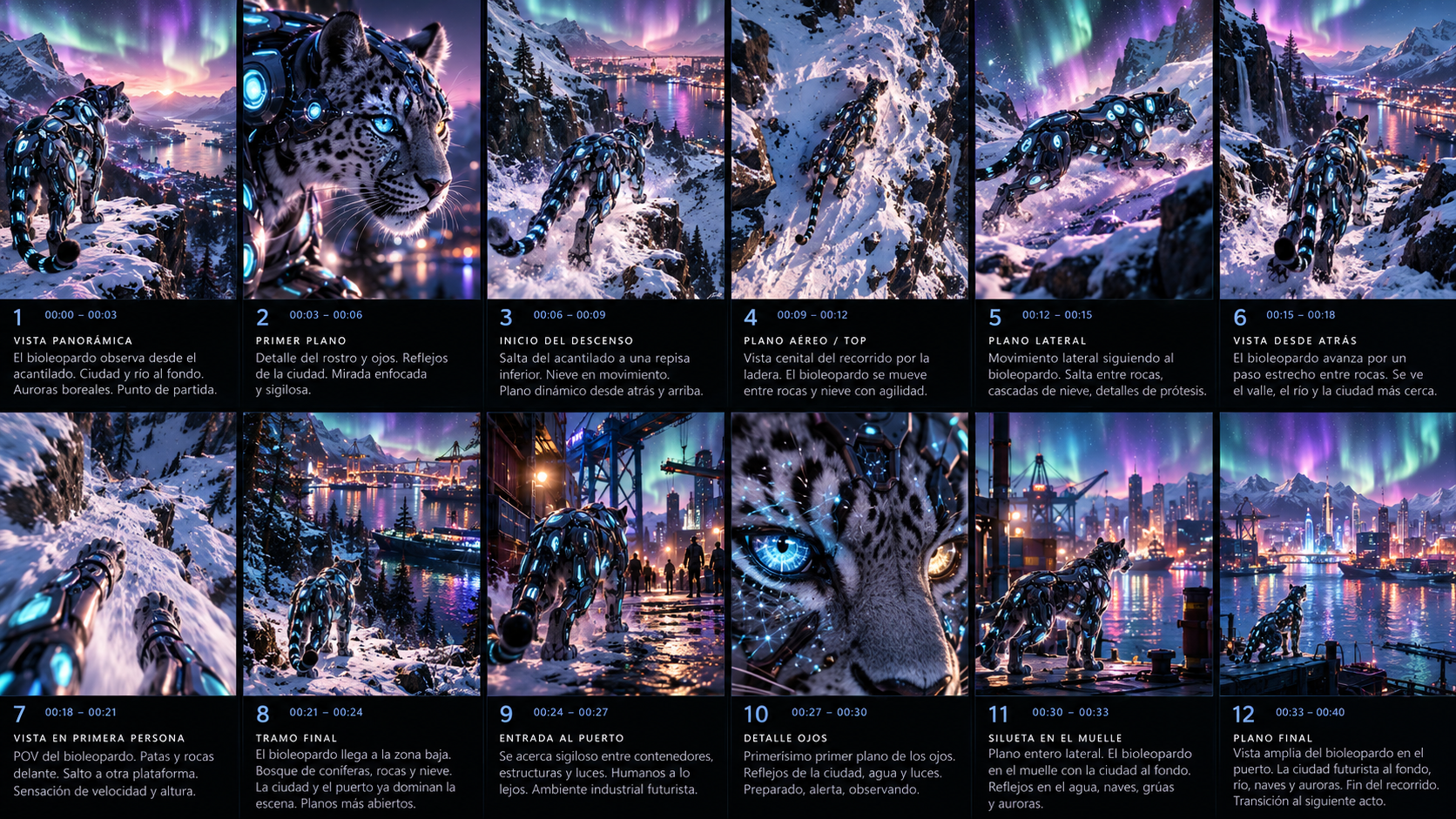
We experienced this directly while developing an AI-assisted audiovisual sequence around a biomechanical snow leopard. The individual images worked, but maintaining the same character identity, world, camera language and production constraints across multiple shots required constant manual checking.
That led to a different question:
What if AI helped structure and protect the production decisions before generation instead of simply generating more content?
Workflow Finder Audiovisual was built to explore that problem.
What it does
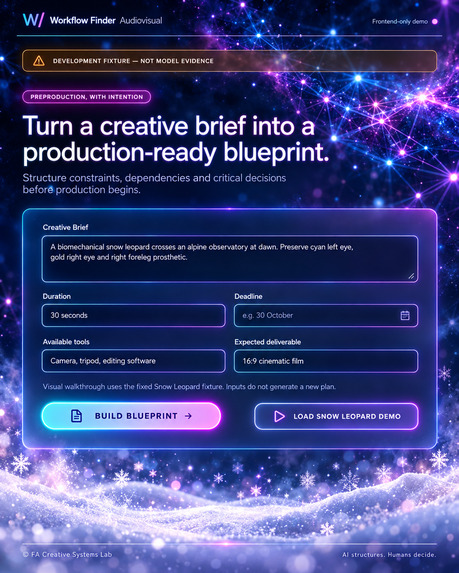
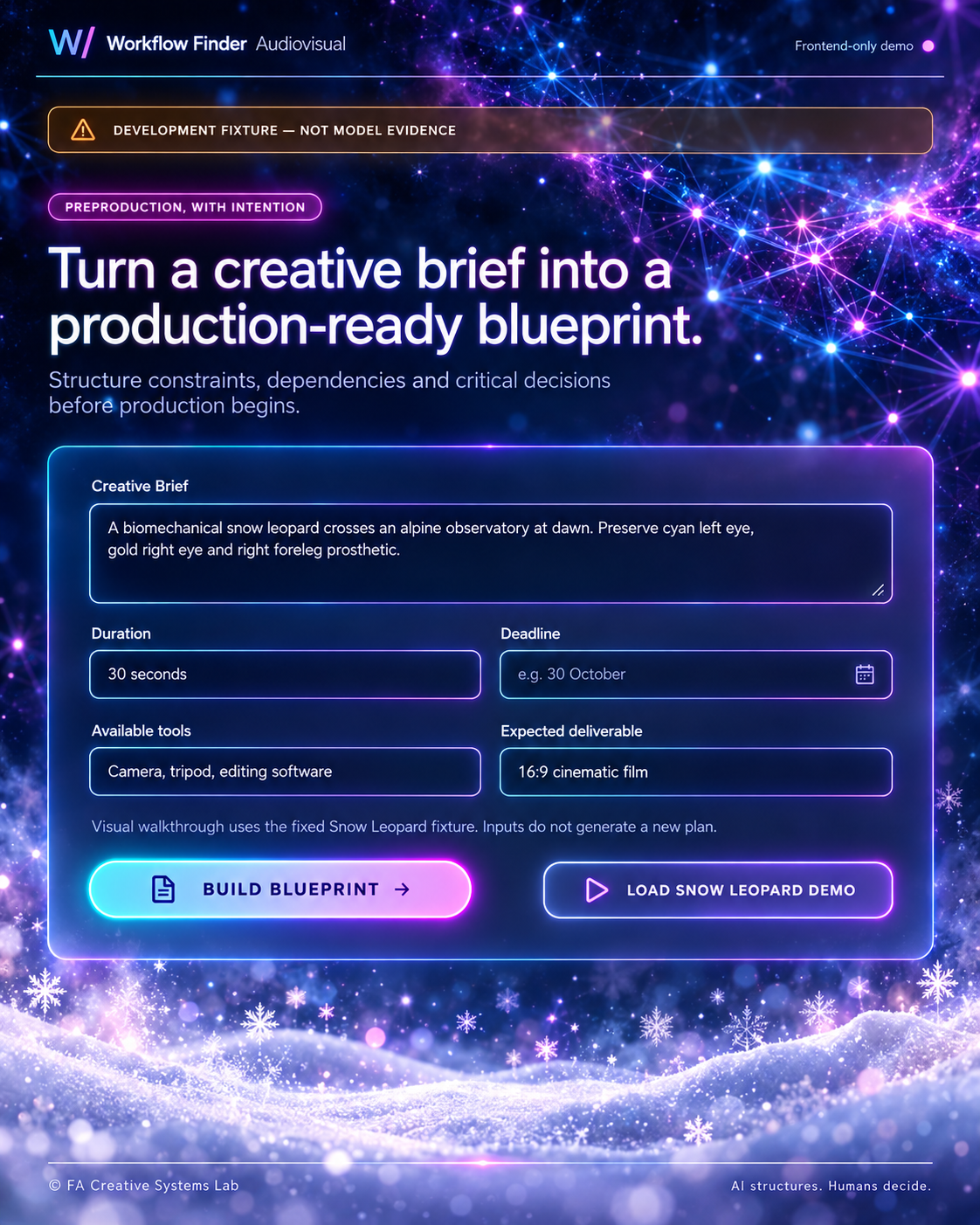
Workflow Finder Audiovisual is an AI-assisted preproduction tool that transforms an unstructured creative brief into a structured production Blueprint.
The workflow is:
Creative Brief → Preproduction Blueprint → Conflict Detection → Human Decision → Revised Blueprint
The Blueprint can organize:
- creative objective
- production constraints
- character requirements
- world and location requirements
- scenes
- shot planning
- camera directions
- dependencies
- conflicts
- approval gates
- next production steps
When the system detects a contradiction, it does not silently make the creative decision.
Instead, it surfaces the conflict and asks the human director to approve how it should be resolved.
AI structures. Humans decide.
Golden Demo
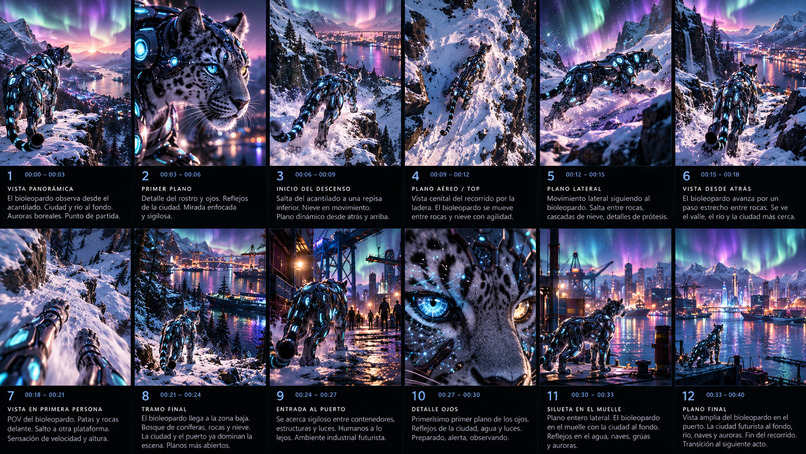
Our Golden Demo uses a biomechanical snow leopard moving from a high alpine environment toward an industrial waterfront.
The character has strict continuity requirements, including:
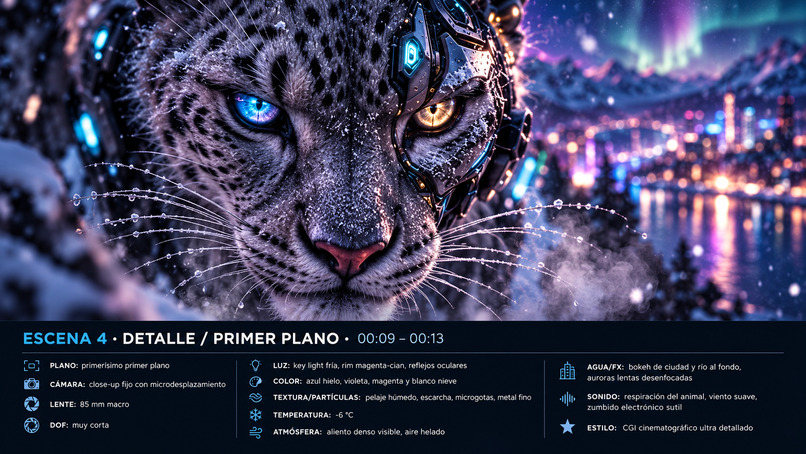
- left eye: icy blue/cyan
- right eye: golden yellow
- fixed biomechanical prosthetic placement
- stable luminous modules and armour architecture
- consistent world geography
- controlled cinematic camera rules
This makes the demo intentionally difficult.
If a proposed shot reverses the eye colours, changes the prosthetic side, breaks the established camera language or places the character in an inconsistent location, the system can surface that contradiction before the production moves downstream.
The Snow Leopard is only the demonstration case. The same workflow can begin from a completely different audiovisual brief.
How we built it
The backend is a stateless Node.js and TypeScript service connected to NVIDIA Nemotron 3 Super 120B through Nebius Token Factory.
Nemotron interprets the creative brief and produces structured audiovisual information that is validated against a predefined JSON schema.
The main API flow contains two operations:
- Generate — transforms the Creative Brief into a structured Preproduction Blueprint.
- Revise — receives the current Blueprint plus a human decision and returns an updated Blueprint together with the changes that were applied.
The frontend is a lightweight one-page experience built around the production workflow rather than a traditional chatbot interface.
It visualizes the Blueprint, dependencies, conflicts, approval requirements and revisions while keeping implementation details such as prompts, raw model output and internal logs out of the user experience.
Challenges
One major challenge was defining the right scope.
It would have been easy to expand the project into character generation, storyboarding, video generation, sound, editing and full production automation.
We deliberately did not do that.
Instead, we focused on one specific layer:
Creative Brief → Preproduction Blueprint.
Another challenge was continuity itself. Our audiovisual experiments showed that visual identity can drift subtly between generated shots: luminous modules change position, mechanical structures mutate, proportions shift and asymmetric character features can accidentally reverse.
Those failures became useful test cases for the product.
We also had to design around real-world model and infrastructure behaviour, including structured-output validation, error states and temporary upstream inference failures, without fabricating responses or weakening the validation pipeline.
What we learned
The most useful role for AI in this workflow is not replacing the director.
It is turning a large amount of creative information into something structured enough for the director to inspect, challenge and approve.
We also learned that continuity is not only a visual-generation problem. It is a decision-management problem.
If character identity, camera rules, locations and production dependencies are explicit before generation begins, downstream tools can work from a much clearer production specification.
What's next
The current project is intentionally a focused open-source MVP.
Future commercial versions could extend the same concept with project persistence, collaborative approvals, production templates, advanced continuity systems and integrations with image, video, 3D and editing tools.
For this hackathon, however, the goal is intentionally smaller:
make audiovisual preproduction clearer, detect contradictions earlier, and keep critical creative decisions under human control.
Built With
- ajv
- css3
- html5
- javascript
- json
- nebius
- node.js
- typescript
- vite

Log in or sign up for Devpost to join the conversation.