Inspiration
India’s informal and gig workforce is over 450 million strong — delivery riders, construction workers, domestic staff, and daily-wage earners who keep the country running. Progressive labour codes exist (Code on Wages 2019, Code on Social Security 2020, OSH Code, Rajasthan Platform Based Gig Workers Act 2023, Karnataka Gig Workers Bill), yet the accessibility gap is devastating:
- Legal jargon is impenetrable
- Most notifications are in English
- Platform deactivations and wage theft happen without due process
- Filing a proper grievance before the Assistant Labour Commissioner or DLSA requires structured petitions that workers cannot draft alone
We asked: what if a delivery rider in Mumbai could simply speak his problem in natural Hinglish and walk away with a court-ready PDF petition, statutory wage calculation, and verified legal rights — in seconds, with zero typing and full privacy?
That question became WorkerSaathi.
What it does
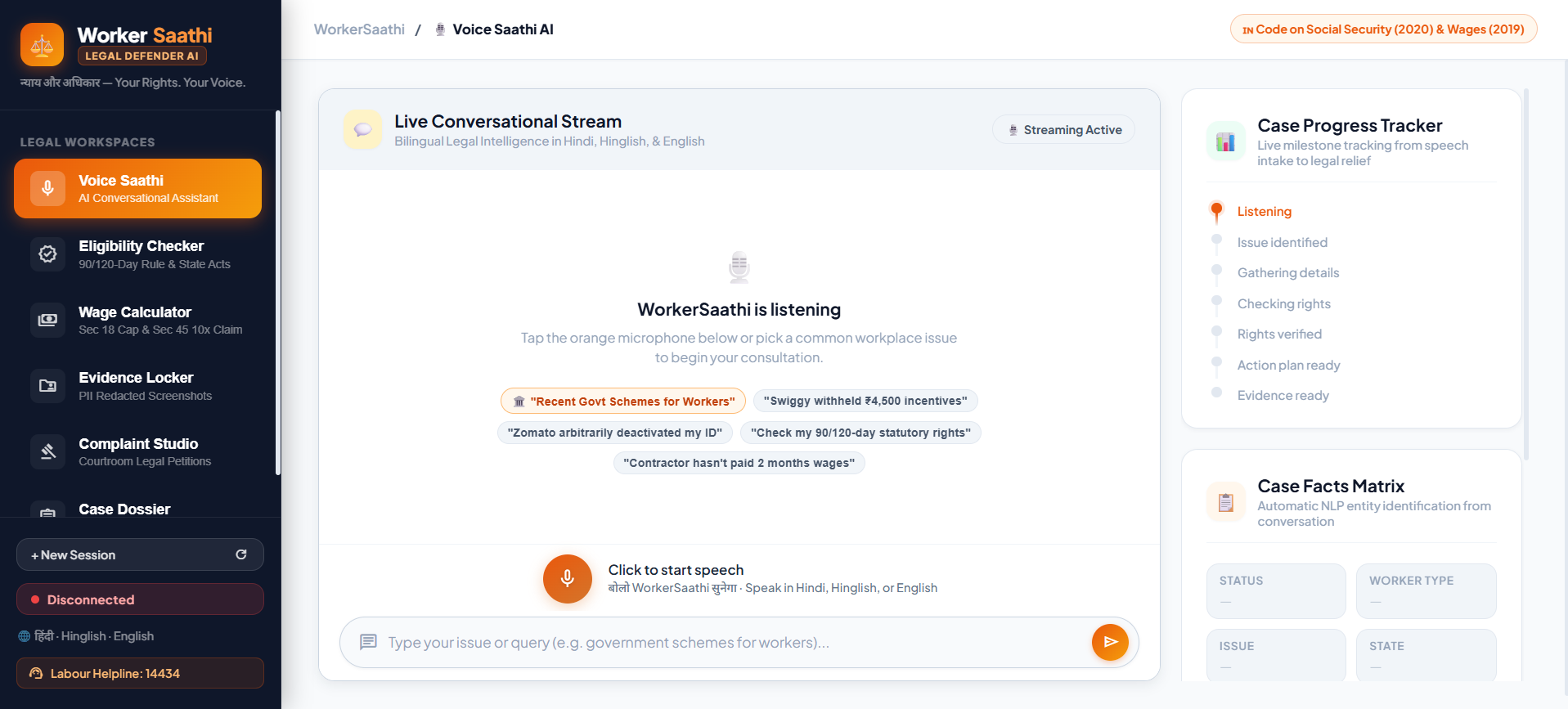
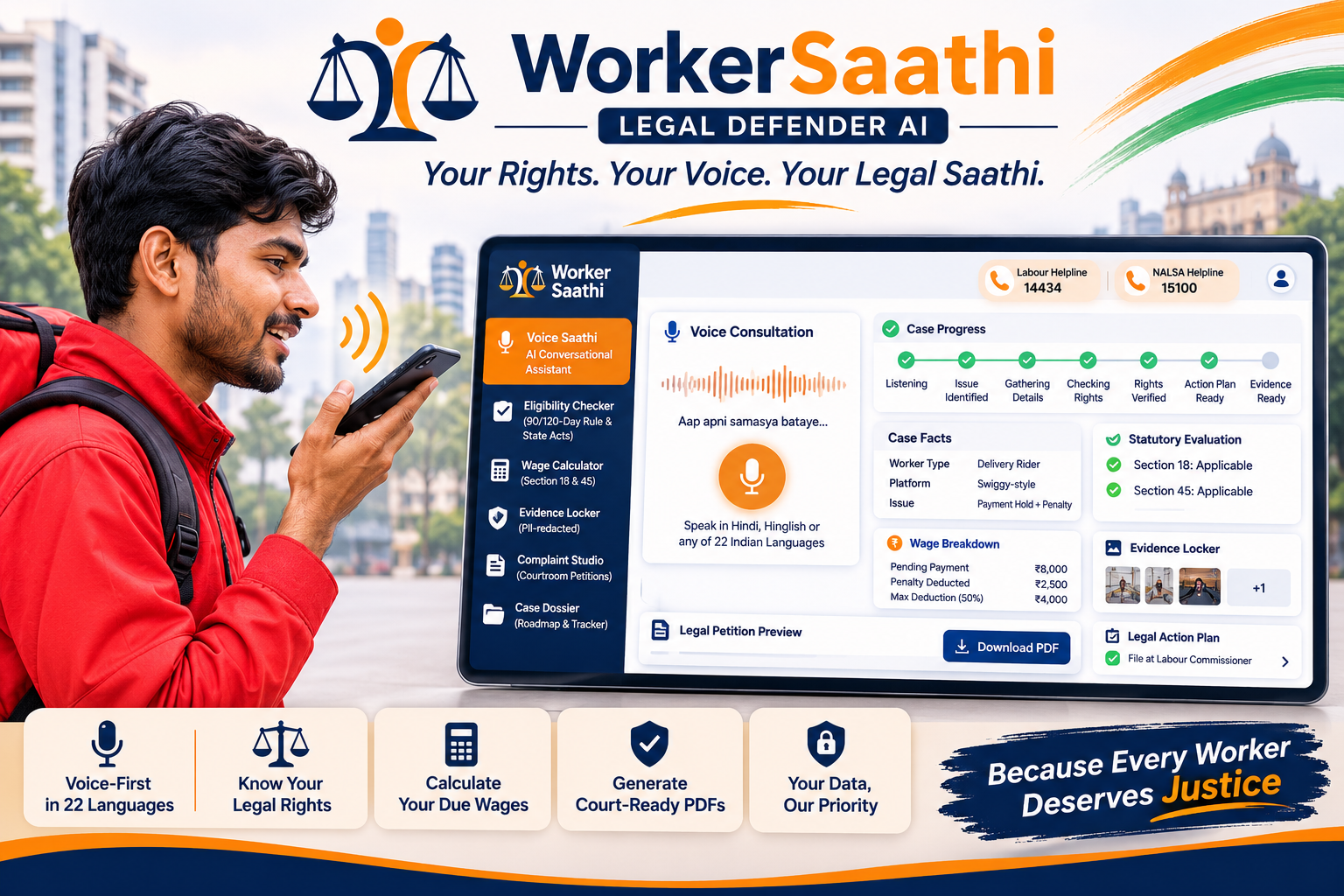
WorkerSaathi is a zero-barrier, voice-first AI legal champion that turns natural spoken grievances into actionable statutory remedies:
- Speak in any of 22 Indic languages or conversational Hinglish (Sarvam AI Saaras v4 STT + Bulbul v3 TTS)
- 11-stage deterministic state machine that asks only one clear question at a time
- 7-stage Hybrid RAG (Qdrant dense + BM25 sparse → RRF k=60 → Authority Reranker) that cites only verified Central & State legislation
- Statutory wage & penalty engine enforcing Section 18 (50% deduction cap) and Section 45 (up to 10× compensation)
- 90/120-day eligibility engine under the Code on Social Security 2020 + State Gig Worker Acts
- Automatic DPDP Act 2023-compliant PII redaction (Aadhaar, bank accounts, OTPs, phone numbers)
- Instant generation of multi-authority court-ready complaint PDFs (Labour Commissioner, Aggregator Nodal Officer, DLSA, Welfare Board) via pure-Python fpdf2
- Emergency override that immediately surfaces 112 / 1098 / labour helplines on any mention of injury, violence, trafficking or child labour
Real example
“Main Swiggy mein delivery karta hoon Mumbai mein. Pichle 25 din se mera ₹8,000 ka payment atka hua hai aur unhone bina bataye ₹2,500 penalty kaat li.”
WorkerSaathi's response:
→ Classifies dispute → runs Section 18 test → verifies rights → redacts any screenshots → generates formal notice + downloadable PDF.
How we built it
Strict architectural decoupling:
- Voice layer: Sarvam AI Saaras v4 (codemix mode, domain keyterm boosting for Swiggy/Zomato/Uber etc.) + Bulbul v3 (Shubh/Meera personas)
- Orchestrator: Groq Llama 3.1 8B Instant with schema-validated tool calling + permission-gated tool registry
- State machine: 11 deterministic statuses that guarantee the backend (not the LLM) controls legal workflow
- Hybrid RAG: Dense embeddings + BM25 → Reciprocal Rank Fusion (k=60) → custom Authority Reranker (Primary Act = 1.0 > Gov Rules = 0.7 > FAQs = 0.4) → Coverage classifier (FULL / PARTIAL / GAP / CONFLICT / NONE)
- Statutory engines: Pure Python calculators for wages, eligibility, evidence timelines, and multi-authority PDF generation
- Privacy: Regex-based redaction before any storage or LLM call; no audio retention; ephemeral sessions
- Frontend: Zero-build pure HTML/CSS/JS Legal Hub with six interactive workspaces (Voice Saathi, Eligibility Checker, Wage Calculator, Evidence Locker, Complaint Studio, Case Dossier)
- Persistence: SQLite WAL mode for cases, audit events, evidence and action plans
Everything is production-ready, fully tested (100% passing legal + API suites), Docker-deployable, and MIT-licensed.
Challenges we ran into
- Making Hybrid RAG zero-hallucination for legal content (solved with strict authority hierarchy + coverage classification that refuses to invent rights)
- Handling heavy Hinglish code-mixing and noisy mobile audio while keeping latency low
- Enforcing that the LLM can never call tools outside the current case status (permission matrix + schema validation)
- Generating professional, bilingual, court-ready PDFs with correct statutory citations without any external dependencies
- Balancing deterministic legal math with natural conversational flow
Accomplishments that we're proud of
- True voice-first experience in 22 Indic languages + Hinglish with zero typing
- Deterministic statutory engines that correctly enforce Section 18 caps and Section 45 10× claims
- Coverage classifier that honestly says “GAP” or “CONFLICT” instead of hallucinating
- Full DPDP Act 2023 compliance with automatic PII redaction
- 100% passing test suites for both legal logic and end-to-end API
- Complete interactive Legal Hub that feels like a professional operations center for workers
- National Hackathon 2026 Finalist-level polish and documentation
What we learned
- Legal AI must be deterministic first, generative second
- Hybrid retrieval (dense + sparse + authority reranking) is essential for high-stakes domains
- A well-designed state machine + tool registry prevents LLM drift better than prompt engineering alone
- Privacy-by-design (redact before store) is non-negotiable when serving vulnerable users
- Zero-build frontend + FastAPI static serving dramatically lowers the barrier for deployment and demo
What's next for WorkerSaathi
- On-device / offline-first mode for low-connectivity areas
- Deeper integration with e-Shram, Samadhan, and State Welfare Board portals
- WhatsApp / IVR channel for workers without smartphones
- Multilingual PDF generation with regional language support beyond Hindi/English
- Partnership with DLSAs and trade unions for last-mile delivery of petitions
- Continuous legislative radar that auto-ingests new gazette notifications
