Project Story — Workday Resilience AI
🌍 Inspiration: A silent crisis hiding in everyday work
Workday Resilience AI was inspired by a simple observation: modern work environments quietly create long-term health damage, yet most people normalize it until it becomes a serious problem.
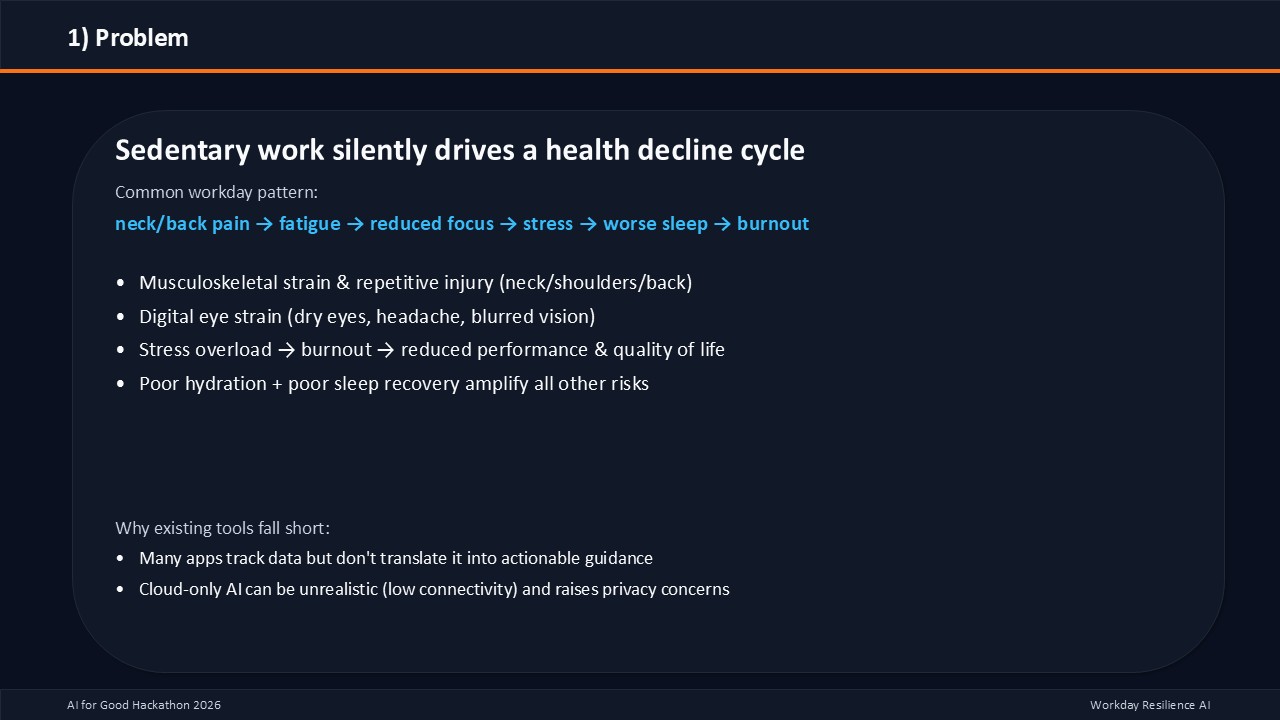
Sedentary routines, long screen exposure, constant deadlines, poor hydration habits, and chronic stress often lead to a predictable cycle:
neck/back pain → fatigue → reduced focus → stress → poor sleep → burnout → chronic health risk.
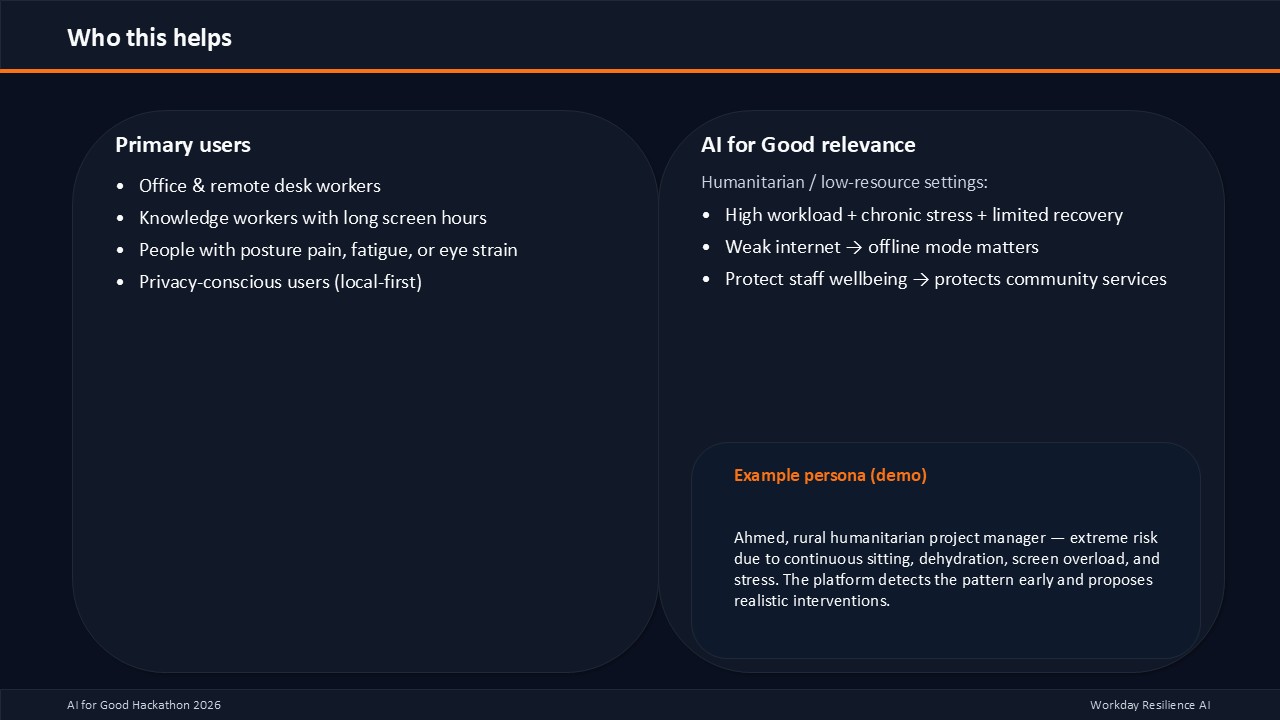
As a public health professional working in demanding environments, I have seen how health decline does not always come from major diseases—sometimes it starts from small daily behaviors that accumulate over months and years. This is especially true for high-pressure professionals such as managers, healthcare workers, and humanitarian staff who operate under stress and limited recovery time.
I wanted to build a tool that does not just “track health data,” but actually turns daily workplace signals into preventive decisions.
🎯 The problem we focused on
Many existing wellness apps:
- focus only on tracking,
- lack meaningful interpretation,
- do not connect multiple risk factors together,
- and often rely on cloud-based AI processing that raises privacy concerns.
In real-world settings (especially low-resource and humanitarian environments), internet is unreliable and users cannot always trust uploading sensitive health information.
This created a clear gap:
a need for a privacy-first, offline-capable, reasoning-based workplace health assistant.
💡 The solution: Workday Resilience AI
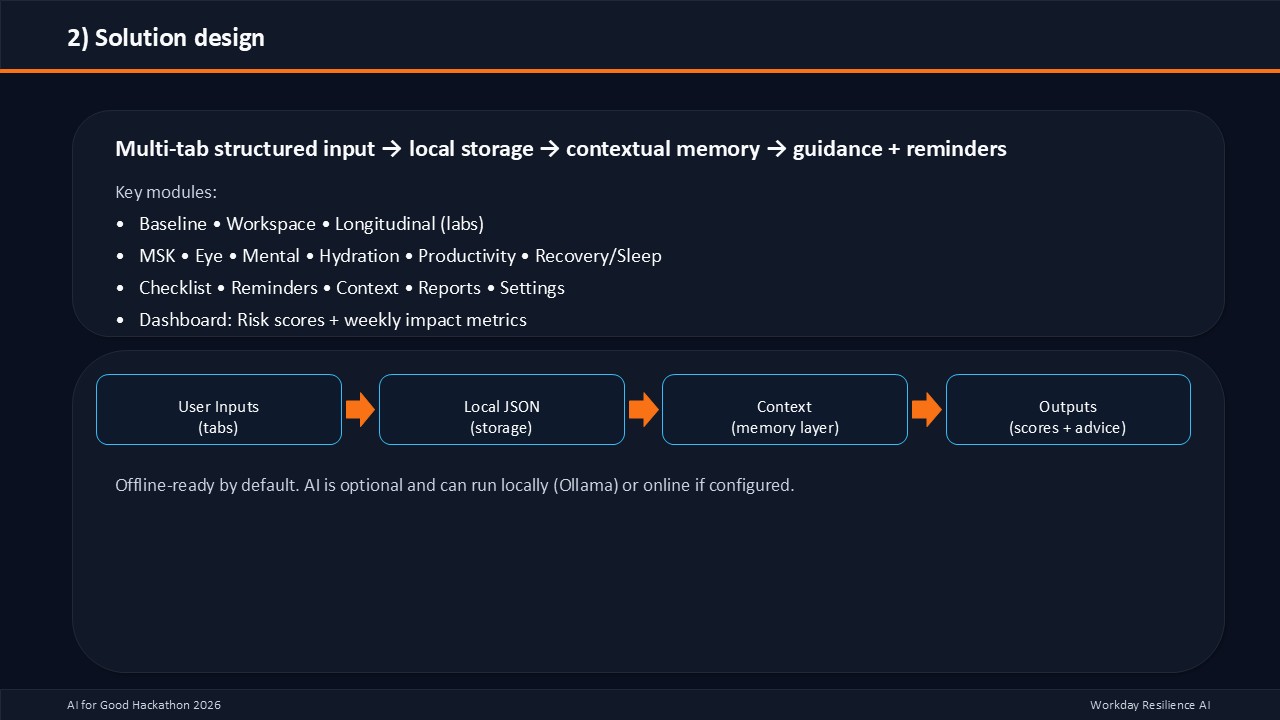
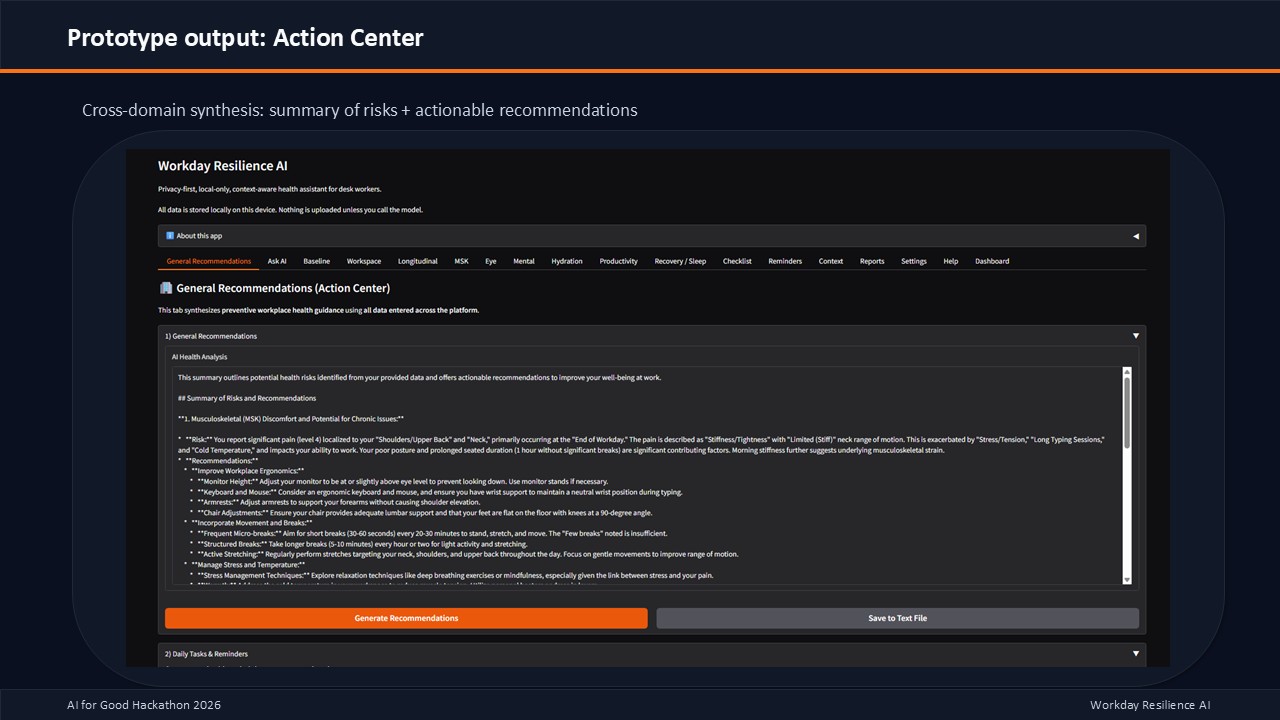
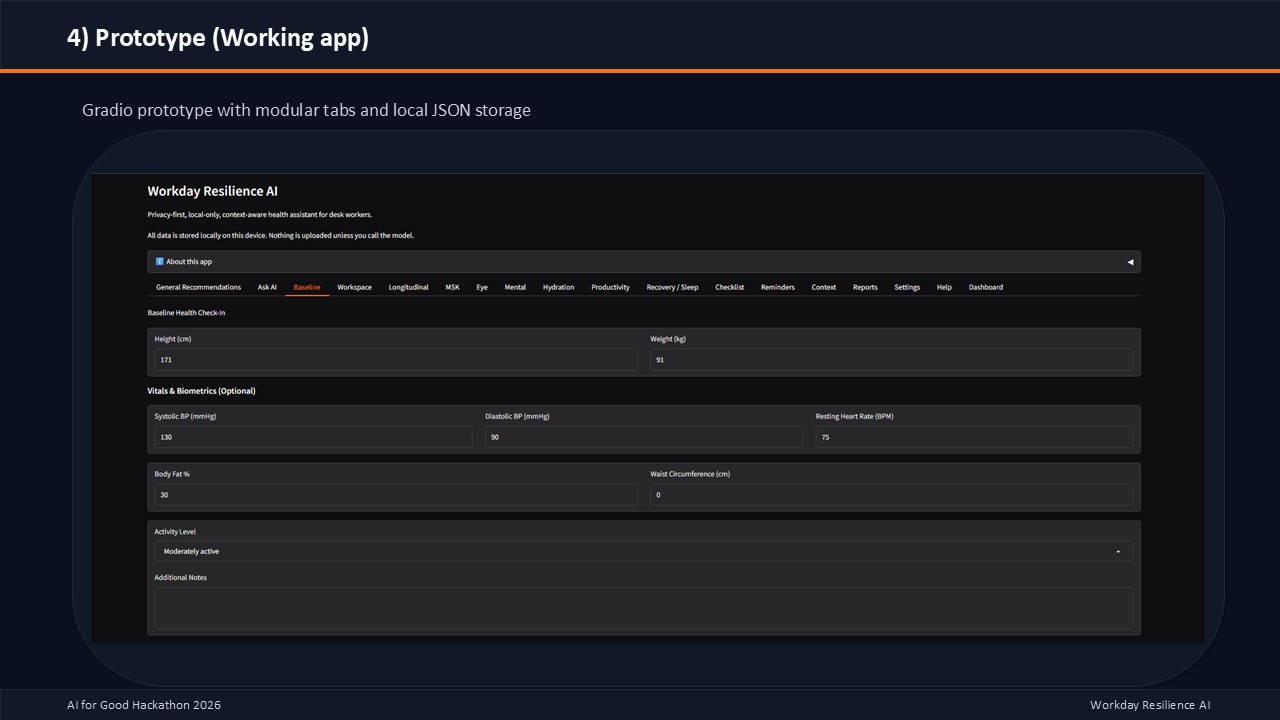
Workday Resilience AI is a structured, multi-tab health reasoning platform designed for desk workers and high-pressure professionals.
Instead of asking users to describe everything in free text, the platform collects structured inputs across multiple workplace health domains:
- Baseline biometrics and vitals
- Workspace ergonomics
- Longitudinal lab tracking
- Musculoskeletal symptoms (MSK)
- Eye strain and screen fatigue
- Mental stress and burnout patterns
- Hydration behavior
- Productivity patterns
- Recovery and sleep indicators
- Checklist and reminders
The system then builds a shared context across all domains and produces:
- non-diagnostic preventive recommendations
- safety warnings for high-risk patterns
- daily tasks and reminders
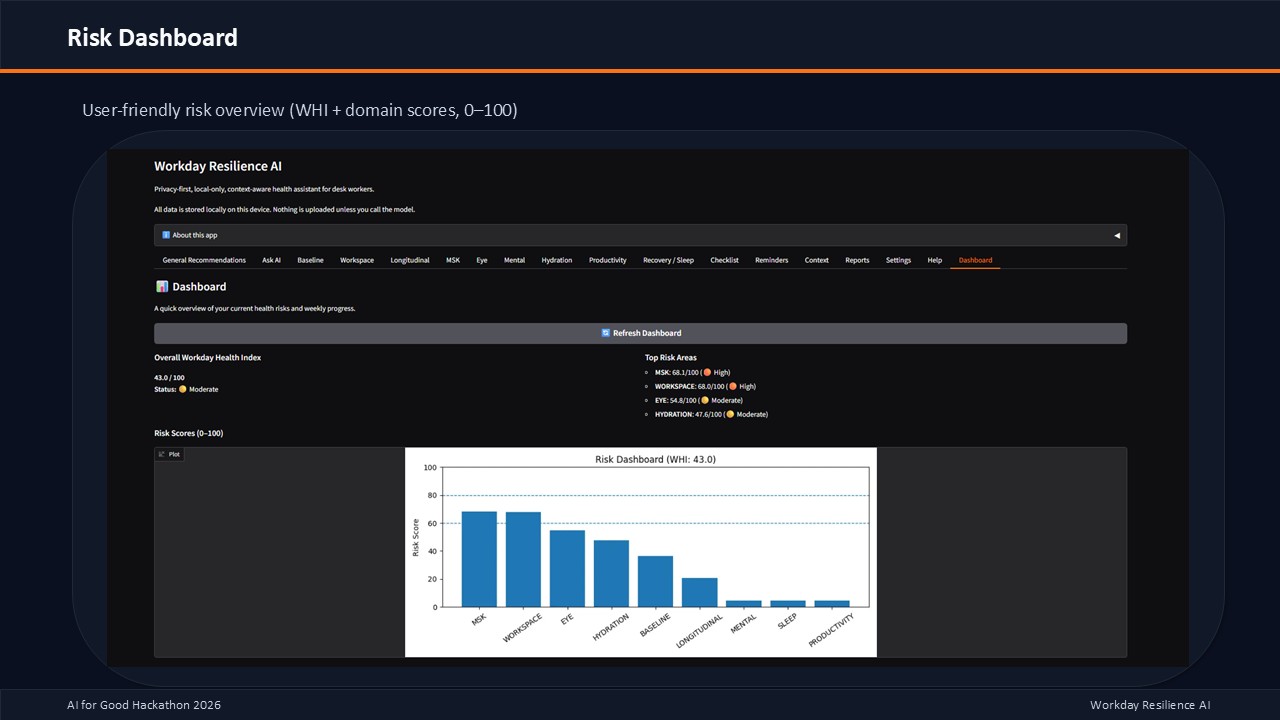
- an overall Workday Health Index (WHI) score
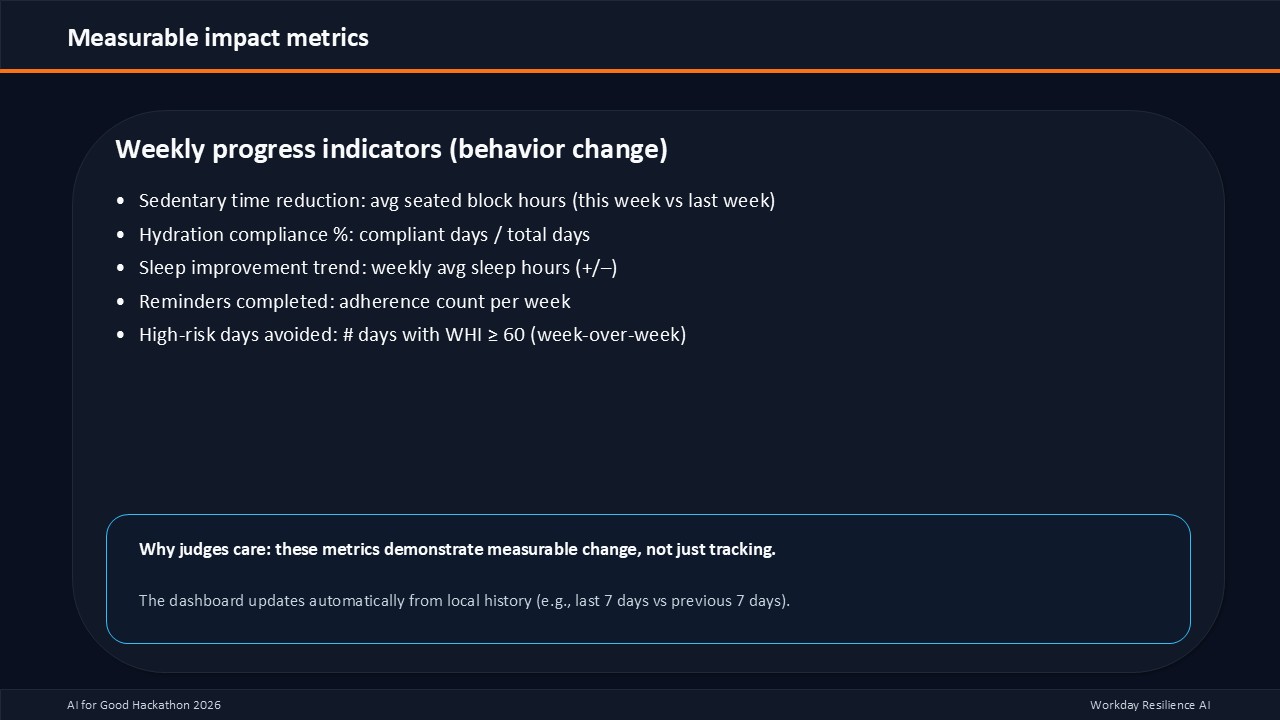
- measurable weekly impact metrics (hydration compliance, sedentary time reduction, reminder completion, high-risk days avoided)
The goal is not diagnosis, but early detection and prevention, with a strong focus on clarity and usability.
🤖 How AI is used (hybrid and responsible)
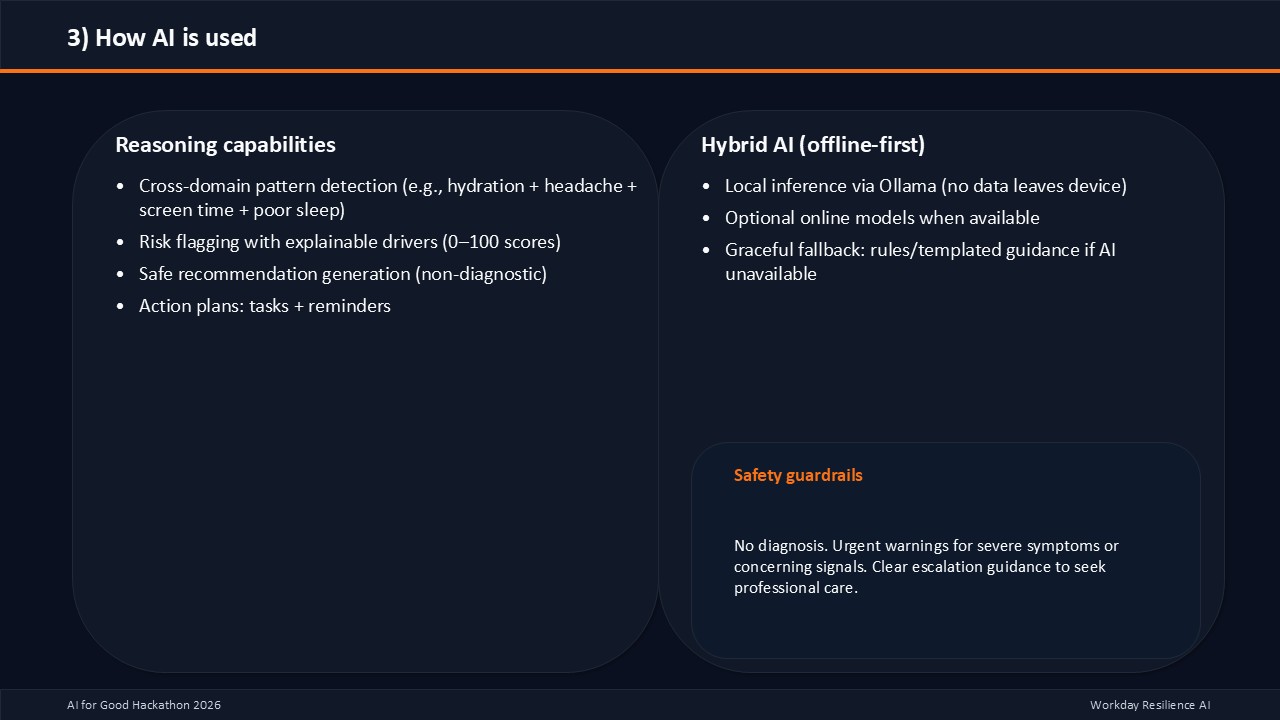
The platform uses AI as a reasoning and synthesis layer:
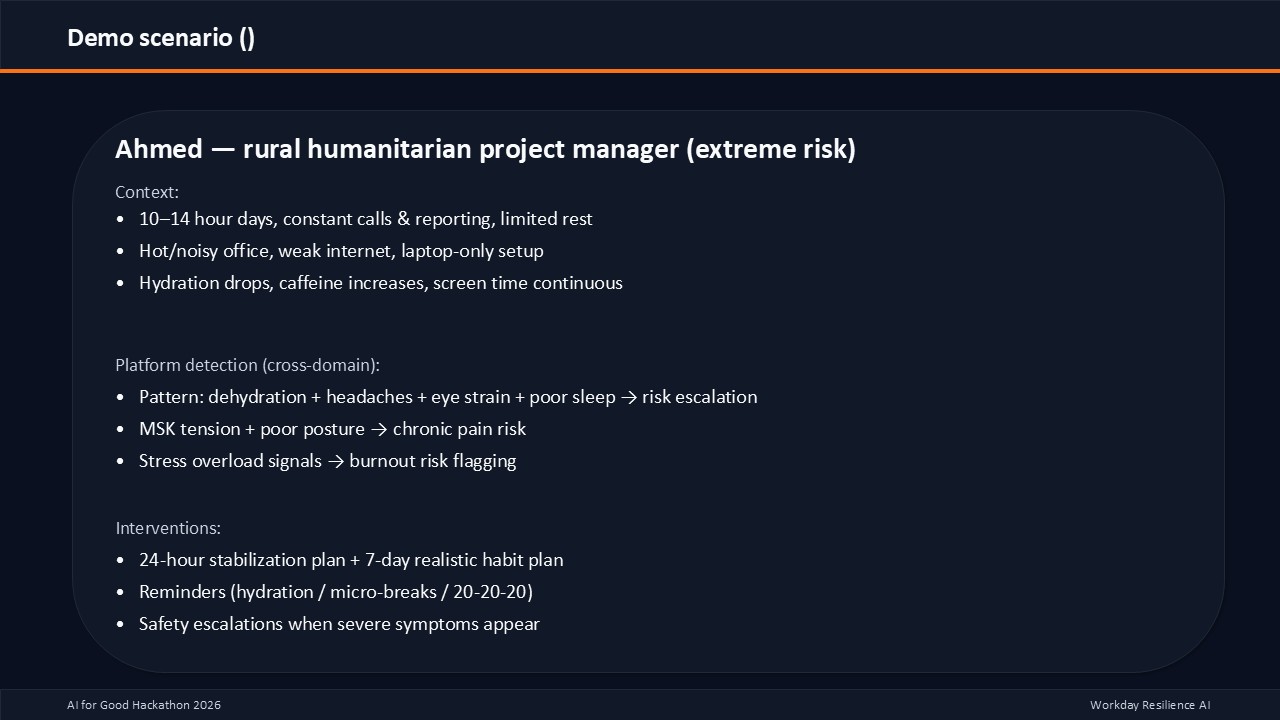
- cross-domain pattern recognition (e.g., dehydration + headache + screen exposure + poor sleep)
- recommendation generation based on context
- summarization and structured outputs
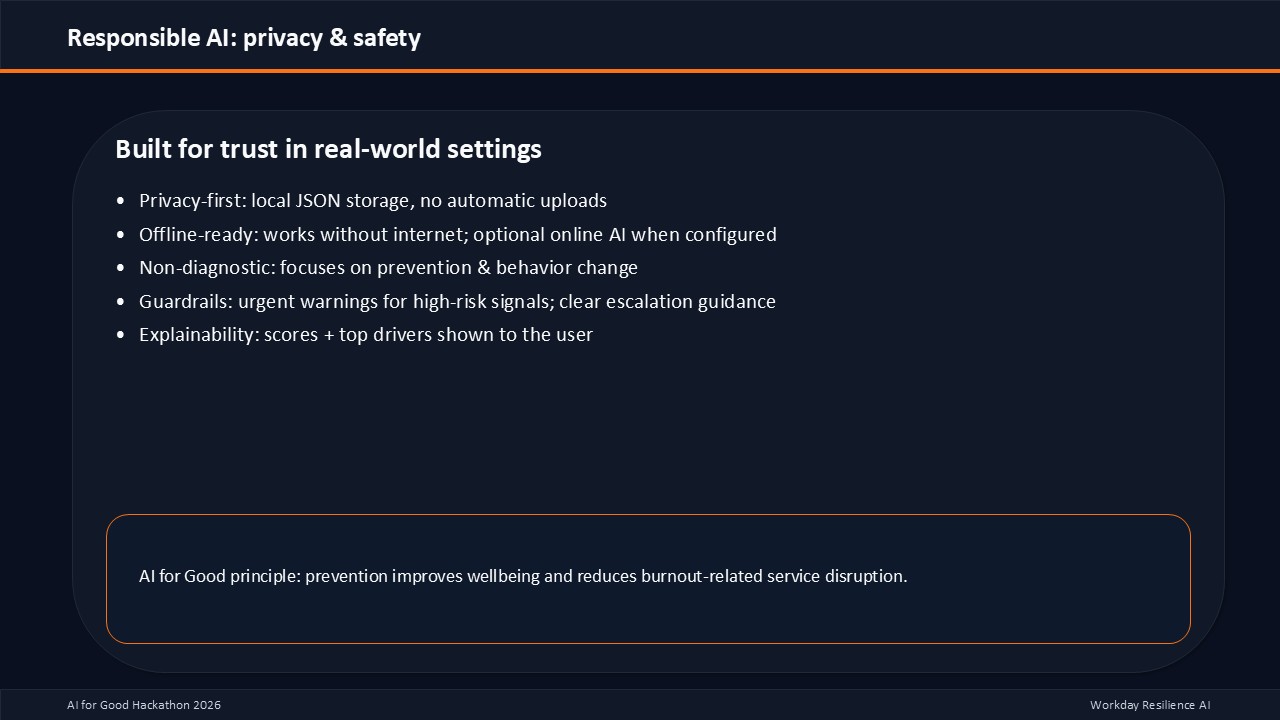
- safety guardrails and urgent warning triggers
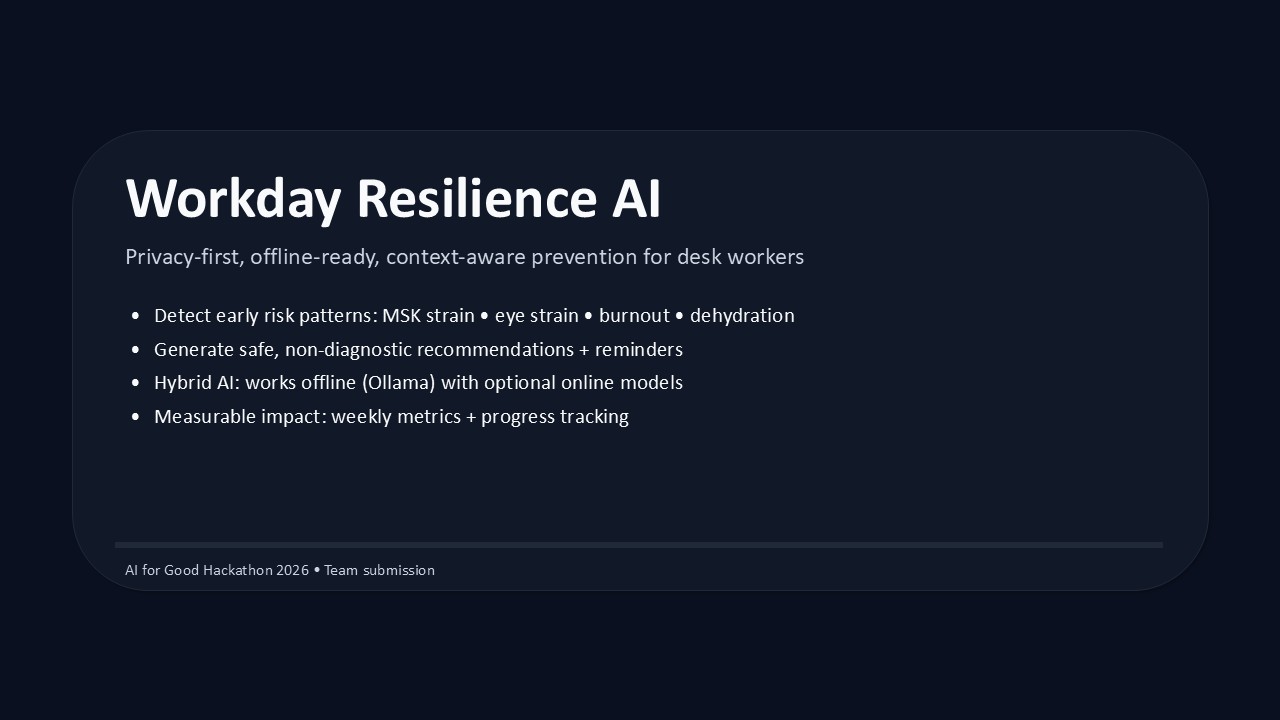
To ensure responsible deployment, the platform is designed as offline-first with a hybrid AI approach:
- it works fully offline using local scoring and fallback logic
- it can optionally connect to local LLMs (Ollama)
- it can optionally connect to online models when available
This design makes the system usable even in low-connectivity environments while keeping privacy as the default.
🛠️ How we built it
Workday Resilience AI was built as a working prototype using:
- Python
- Gradio (multi-tab user interface)
- JSON-based local storage
- Matplotlib visualizations
- Modular scoring and impact metrics engines
- Optional AI integration (offline or online)
A major design choice was building the platform as a structured reasoning system, not just a chatbot.
This allowed the assistant to generate consistent recommendations and compute risk scores that can be measured and tracked over time.
📊 What we learned during development
Building this project reinforced several key lessons:
- structured inputs are more reliable than free-text for preventive health reasoning
- risk scoring dramatically improves explainability and user trust
- measurable impact metrics are essential to demonstrate real-world value
- privacy-first design is not optional—it is a requirement for adoption in many environments
- AI is most useful when combined with clear guardrails and deterministic logic
⚡ Challenges we faced
This project came with several technical and design challenges:
- designing scoring tables that feel realistic and explainable
- handling cumulative JSON history without slowing performance
- building an AI system that works both online and offline
- ensuring safety language (non-diagnostic, escalation warnings)
- balancing usability for non-medical users while still being evidence-aligned
Another challenge was designing the dashboard to look like a real user-facing product rather than a developer output. We improved the interface by converting raw outputs into a user-friendly Risk Dashboard + Impact Metrics view with clear summaries and visual charts.
🌱 Future vision
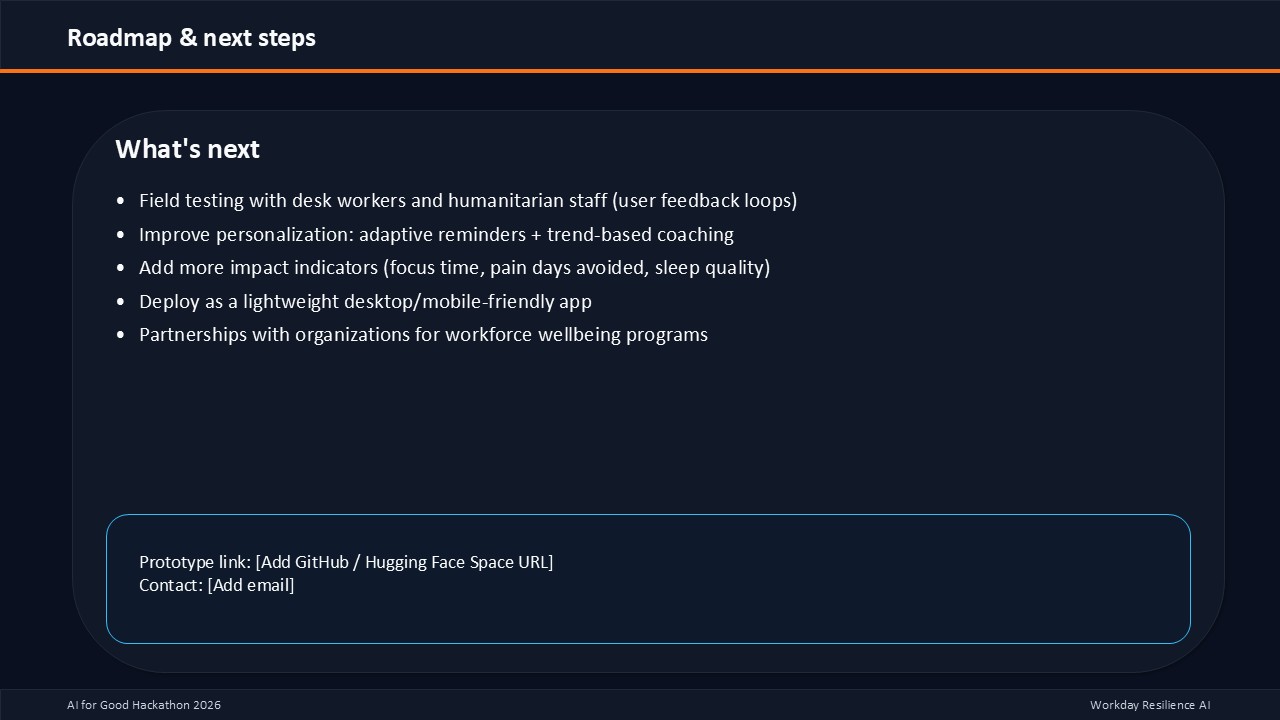
This prototype is only the beginning.
Workday Resilience AI can grow into a scalable platform that supports:
- humanitarian and field professionals
- healthcare workers
- shift workers and high-burden roles
- organizations that want to protect staff wellbeing
The long-term vision is to create a tool that helps individuals and teams build resilience through small daily interventions, while maintaining privacy and usability.
🌍 Why this is AI for Good
Workplace health is not only an individual issue—it is a productivity and sustainability issue.
When managers, healthcare staff, and humanitarian workers burn out, the impact reaches entire communities.
Supporting resilience is a form of prevention that protects people, systems, and services.
Workday Resilience AI aims to help people stay healthy, productive, and resilient—one workday at a time.
Built With
- gradio
- python

Log in or sign up for Devpost to join the conversation.