Inspiration
I’m a freelance software developer, and Work Woven comes from years of experiencing the friction between doing good work and managing the relationship around it.
Requirements arrive across conversations and files. Casual suggestions become assumed commitments. Professionals struggle to explain why an addition costs more, while clients struggle to understand what they’re paying for. Meanwhile, both sides want visibility, accountability and a trustworthy record of what was agreed.
Freelance platforms provide some of that structure, but their fees and limitations motivated me to build something I would want to use with my own clients.
Work Woven brings that working relationship into one shared space, with AI assistance for both parties and direct payments through PayPal.
What it does
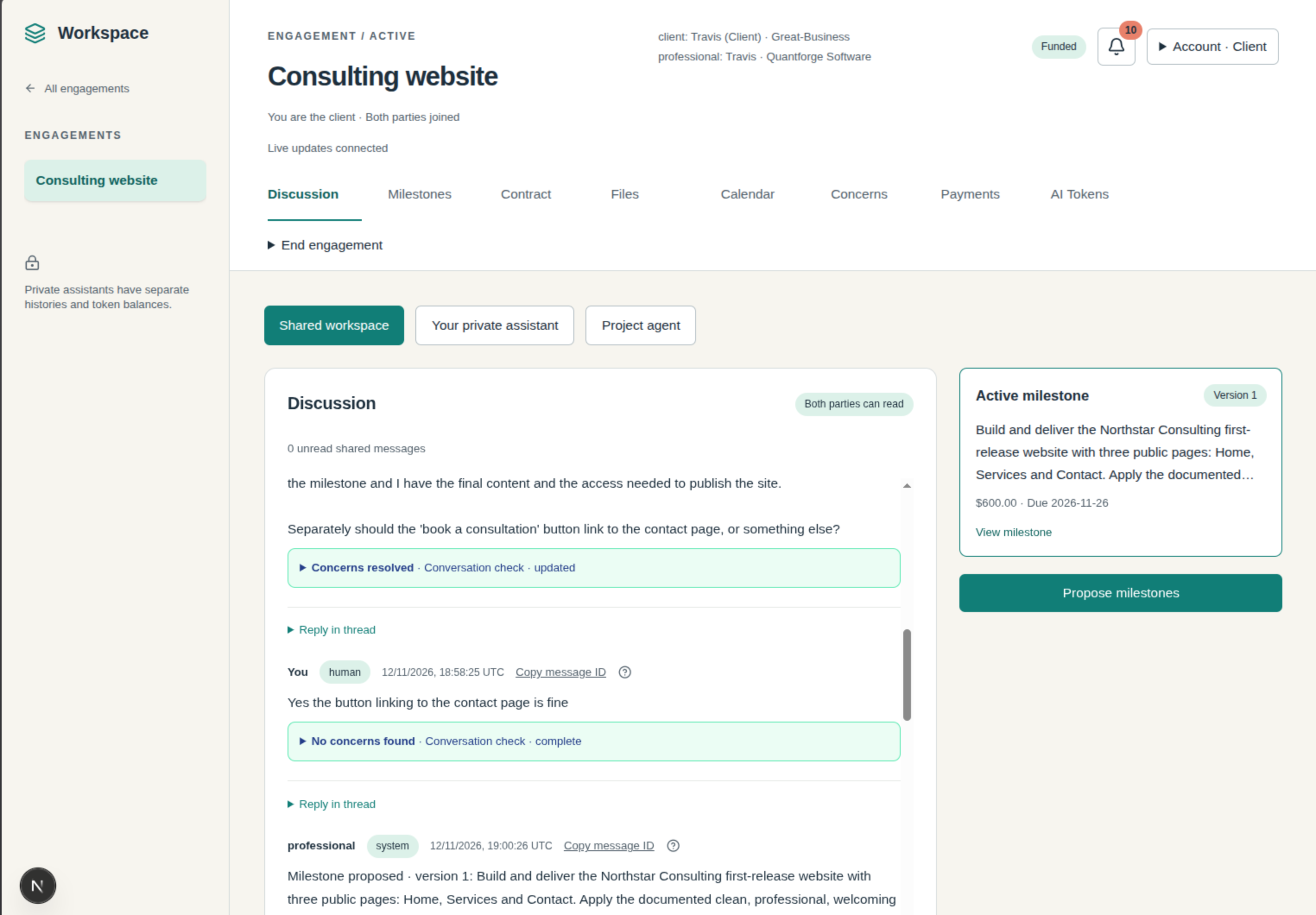
Work Woven gives clients and professionals a shared workspace for discussing, agreeing on and delivering work. Either party can create a project and invite the other.
Each project has three AI agents. The client and professional each have a private assistant to help them think through requirements, questions, estimates and proposals. A shared project agent helps both parties clarify expectations, maintain an overview and navigate changes fairly.
The workspace brings together conversations, files, versioned agreements, milestones, timelines, meeting scheduling and payment records. When a new request arrives, the project agent can compare it with the accepted agreement, identify ambiguity and help prepare a change proposal for both parties to approve.
PayPal enables direct client-to-professional payments linked to the agreed work. Work Woven charges no commission on professional payments, with applicable PayPal fees still applying. Paid AI credits support the platform’s business model.
Two-way reviews and public profiles help clients and professionals build credibility through their working relationships.
How we built it
Work Woven uses Next.js and TypeScript, with Supabase providing authentication, PostgreSQL storage, realtime updates and file storage.
OpenAI powers the three project agents through server-side integrations. Each agent has its own conversation context and access boundaries. Private assistance stays within the relevant party’s space, with an explicit sharing step for bringing selected material into the project discussion.
Bryntum Gantt and Calendar provide the project timeline and meeting views. PayPal’s sandbox supports the payment integration and testing.
I built the application through an agentic development workflow with Codex, defining the product behaviour, reviewing the implementation and testing the experience from both sides of an engagement.
Challenges we ran into
One challenge was distinguishing conversation from commitment. People should be able to explore ideas freely, while knowing exactly which deliverables, prices and dates both parties have accepted. That shaped the versioned agreement and approval workflow.
Another was providing private AI assistance alongside a shared agent. Privacy needs to hold across messages, files and retrieved context, so the access model had to be part of the application’s foundation.
Payments also introduced an important design decision. We initially explored a percentage commission, then simplified the hackathon version around direct payments and paid AI usage. That helped keep the product focused on the working relationship.
Throughout development, the scope itself was a challenge. The idea grew from tracking requirements into supporting an entire engagement, which meant continually prioritising a coherent journey through discussion, agreement, delivery and payment.
Accomplishments that we're proud of
I’m proud of turning a problem from my own professional life into a working product that supports both sides of the relationship.
The three-agent model gives each party room to prepare privately while providing a shared place to reach agreement. The project agent’s ability to recognise work that is already included matters just as much as identifying additional scope.
Connecting agreements, milestones and PayPal payments makes decisions actionable. Two-way reputation also reflects a principle behind the product: clients and professionals both deserve enough information to make informed choices about working together.
What we learned
The project reinforced how much professional friction starts with different assumptions. A client and a professional can agree enthusiastically while imagining very different deliverables.
AI becomes more useful when it can work with a clear record of discussions, proposals and accepted commitments. Its suggestions need evidence, and people need straightforward controls for deciding what becomes an agreement.
We also learned that supporting a professional relationship involves more than managing tasks. Communication, privacy, payment and reputation all influence whether people feel comfortable working together.
What's next for Work Woven
The next step is to use Work Woven in real client engagements and learn where it saves effort, where it creates friction and which assistance people return to.
From there, we want to refine the agents, expand calendar integrations, strengthen delivery-review workflows and support richer professional and company profiles.
We also want to develop reputation that carries useful context, with transparent feedback in both directions and evidence-backed activity records.
The goal is to give people a dependable place to manage independent working relationships, get paid directly and build credibility over time.
Built With
- next.js
- supabase
- typescript
