Inspiration
I have four AI coding agents. Every single morning, all four of them meet me for the first time.
Claude Code knows nothing about what I did in Cursor yesterday. Codex has never heard of the architecture decision I spent two hours making last week. Every session begins with me re-explaining who I am, how I like to work, and what I already tried.
Then I noticed something. The context is not missing. Every one of these tools writes a full transcript to my disk. Months of evidence about how I actually work, sitting there, read by nobody.
What it does
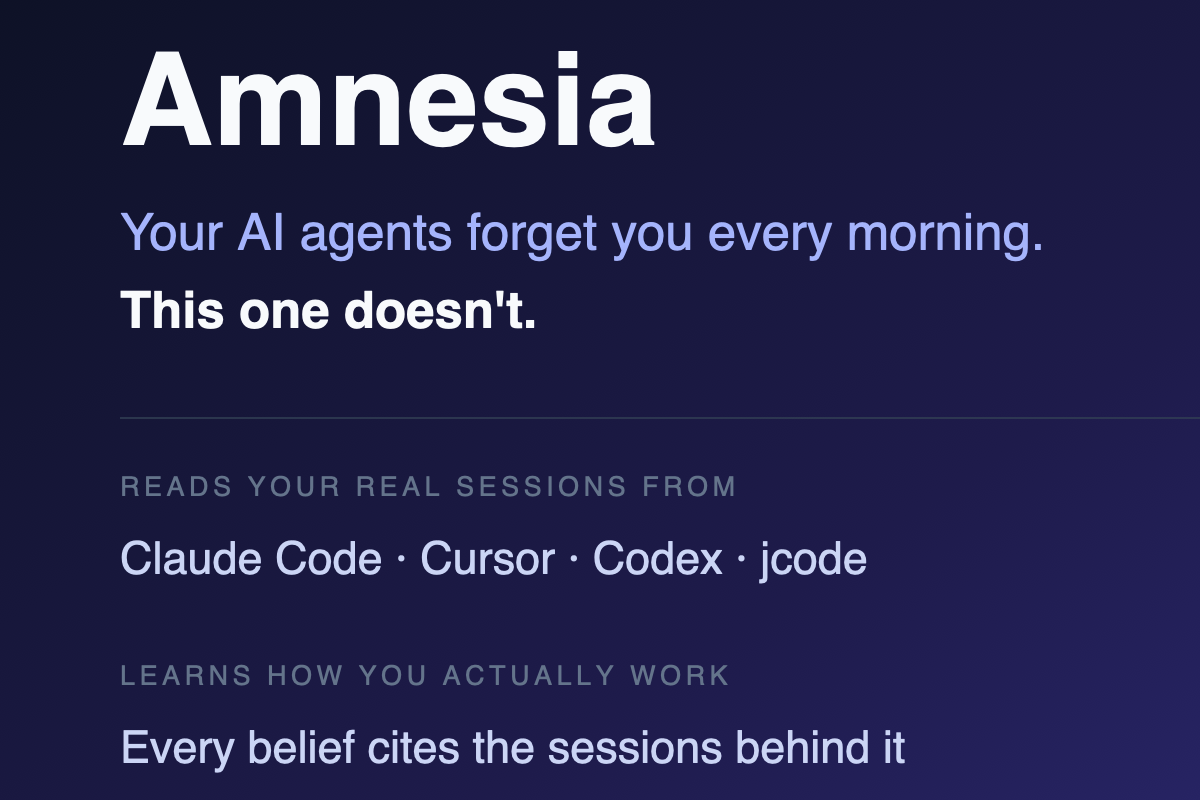
Amnesia is a background agent that reads those transcripts, learns how you actually work, and serves that memory back to every AI client you use.
It arrives already knowing you. Give it an underspecified task and it does not interrogate you from zero. Asked to add rate limiting to my API, it recalled what it knew, asked a single question about my stack, and volunteered a warning that my Node version tends to drift from .nvmrc. It had learned that from my own sessions. I never told it.
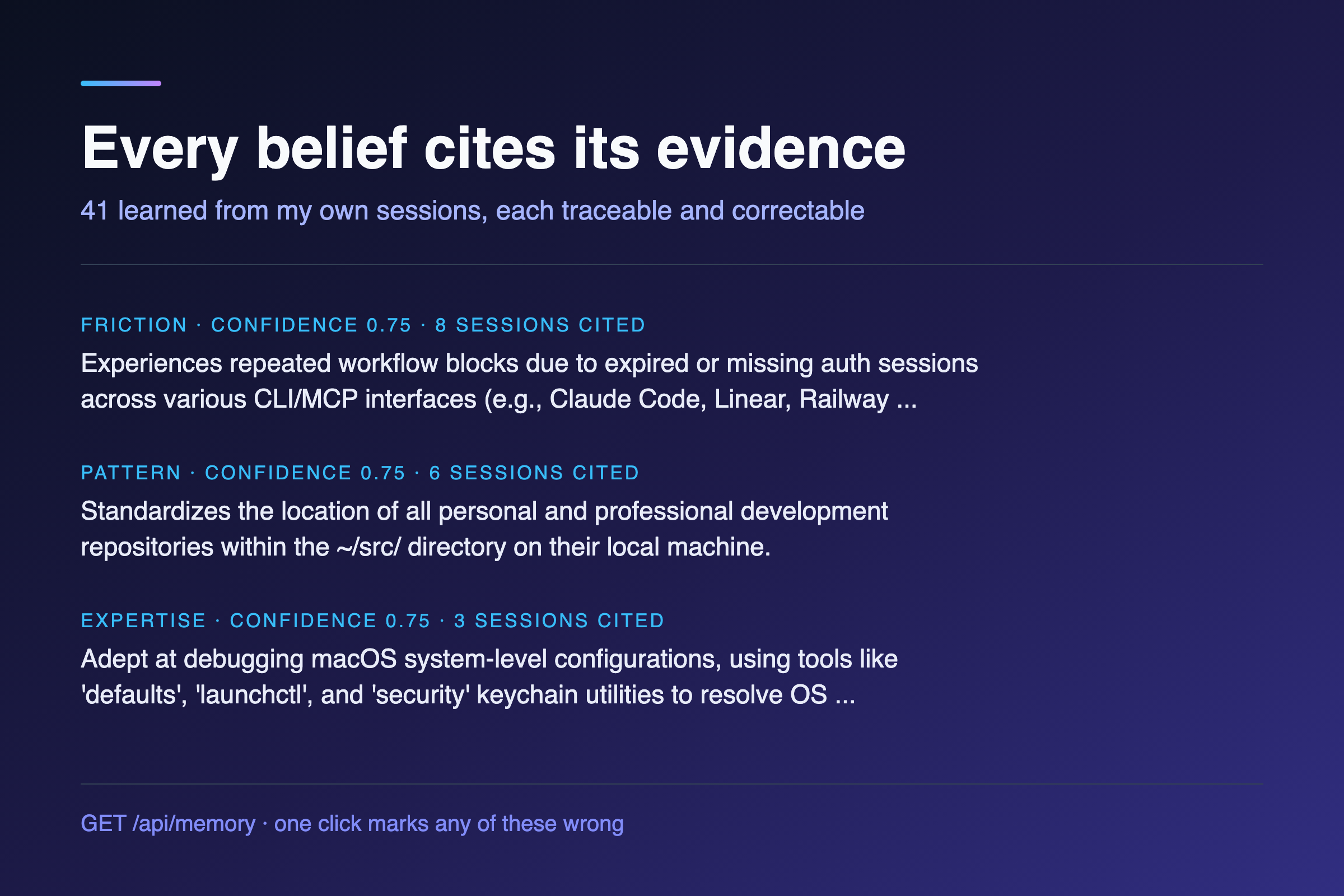
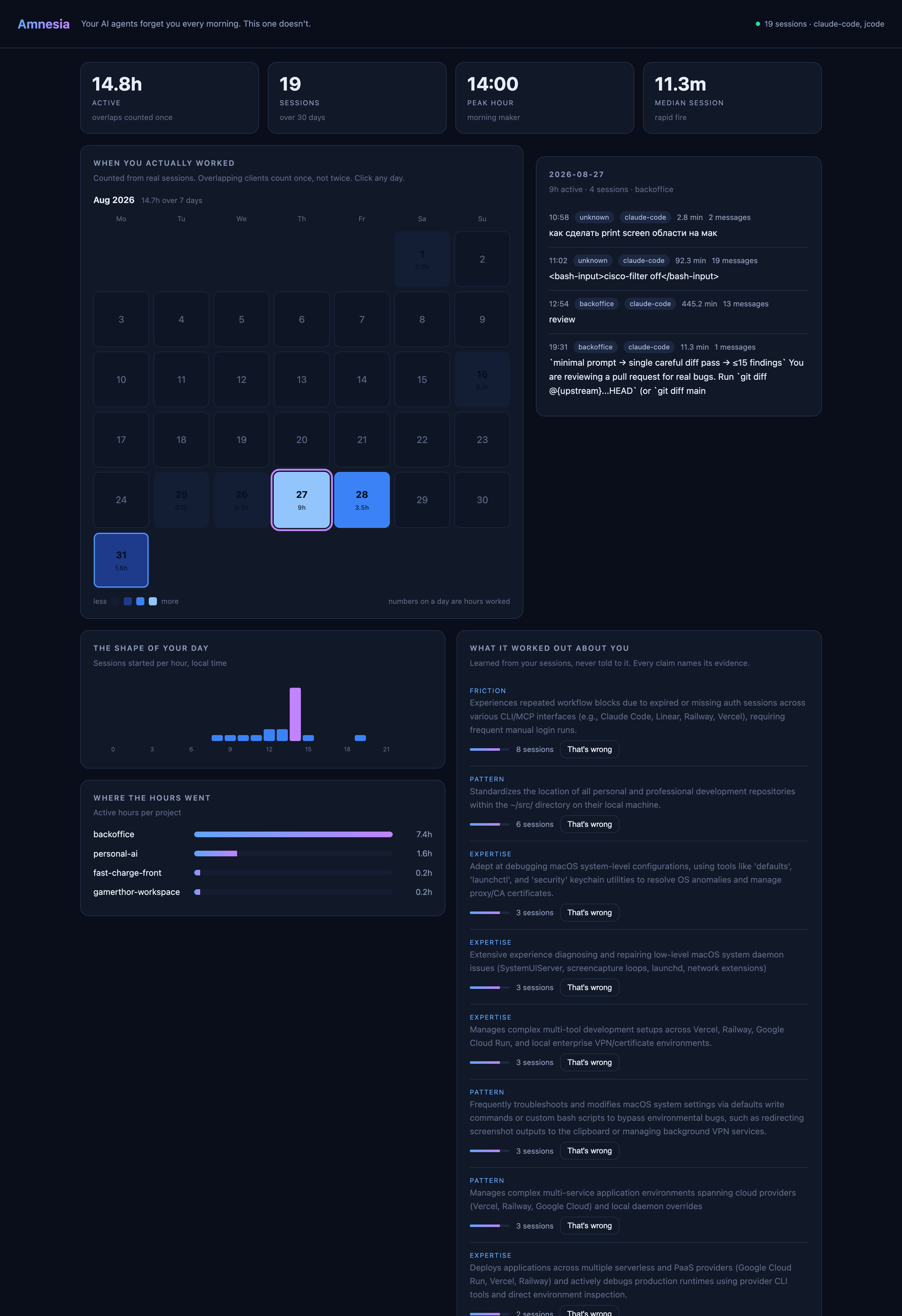
It shows its evidence. Every belief carries the sessions that produced it. Nothing is asserted about you that you cannot trace and overrule in one click, and a correction outranks anything the model inferred, permanently.
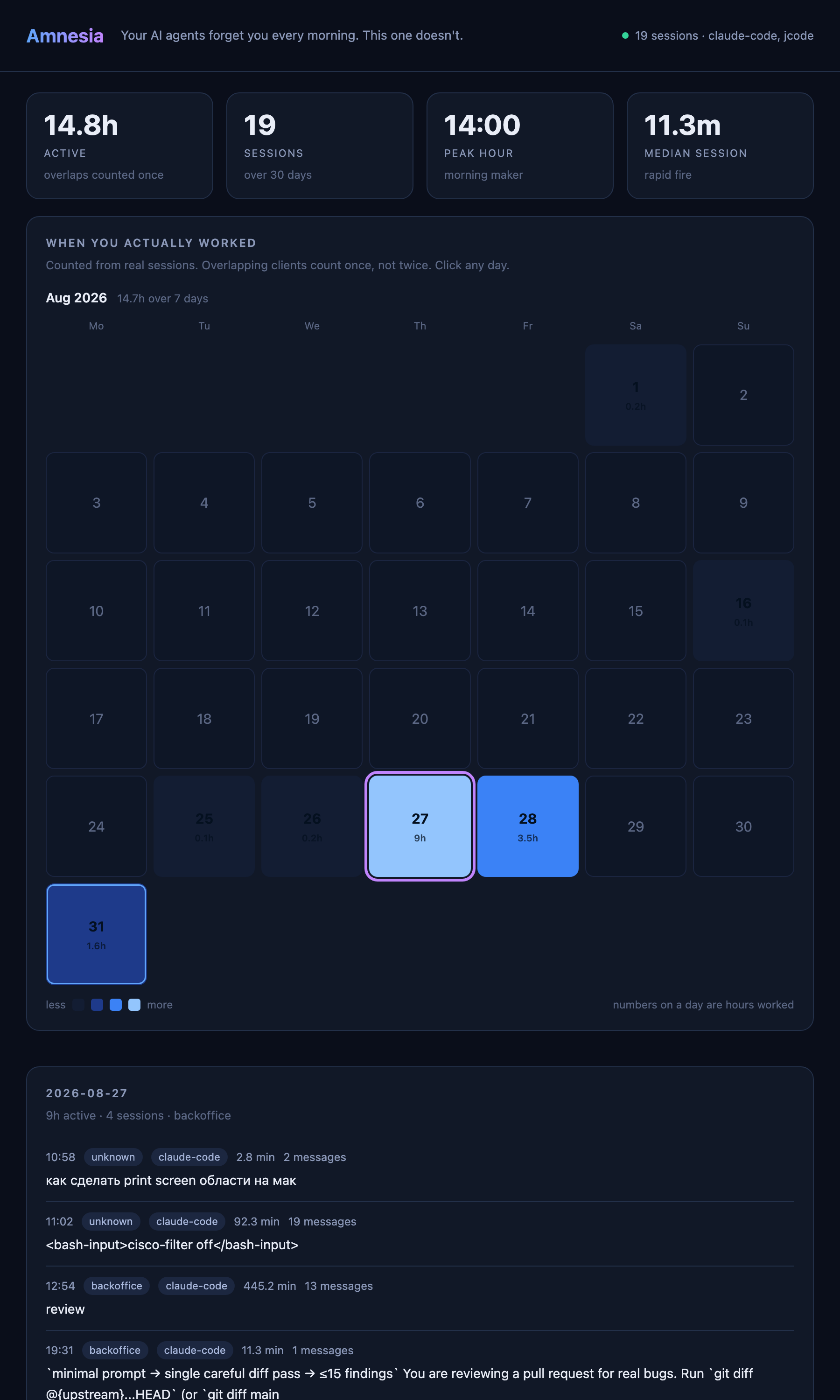
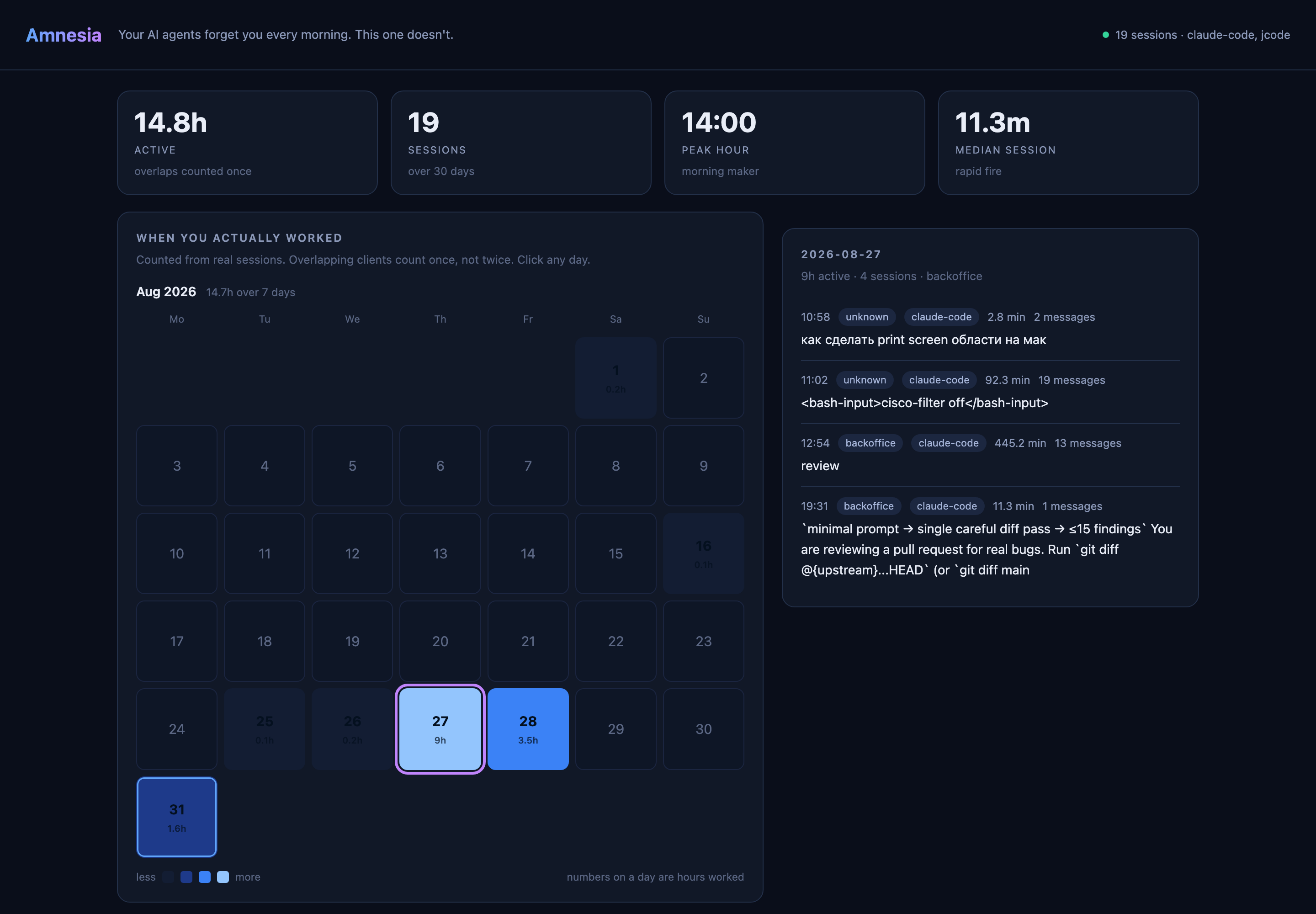
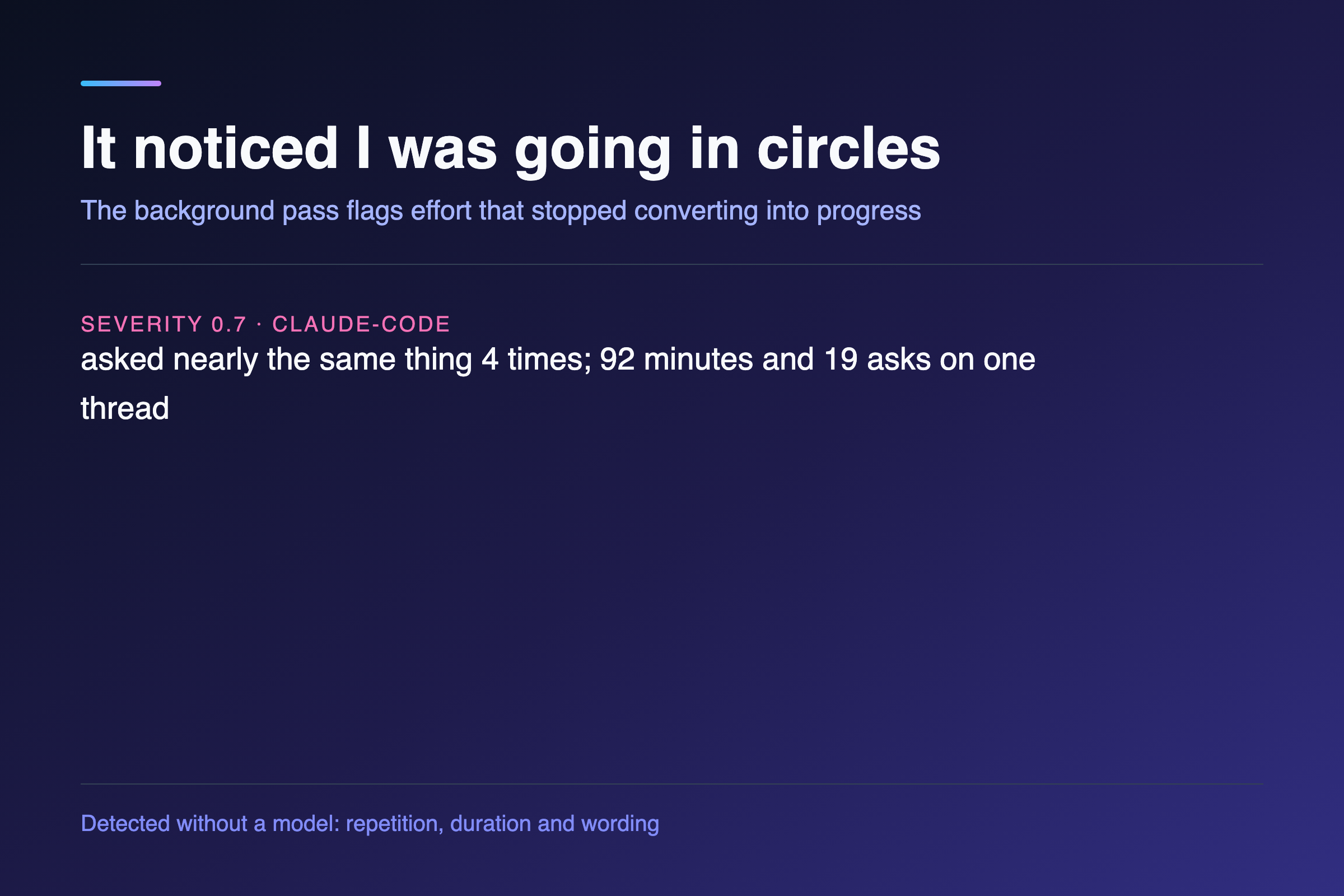
It notices when you are stuck. The hourly background pass looks for sessions where effort stopped converting into progress. On my own history it found a 92-minute session where I asked nearly the same thing four times over 19 asks. Uncomfortable, and correct.
It follows you into your editor. An MCP bridge exposes the same memory to Claude Code and Cursor. State a preference once and every client knows it.
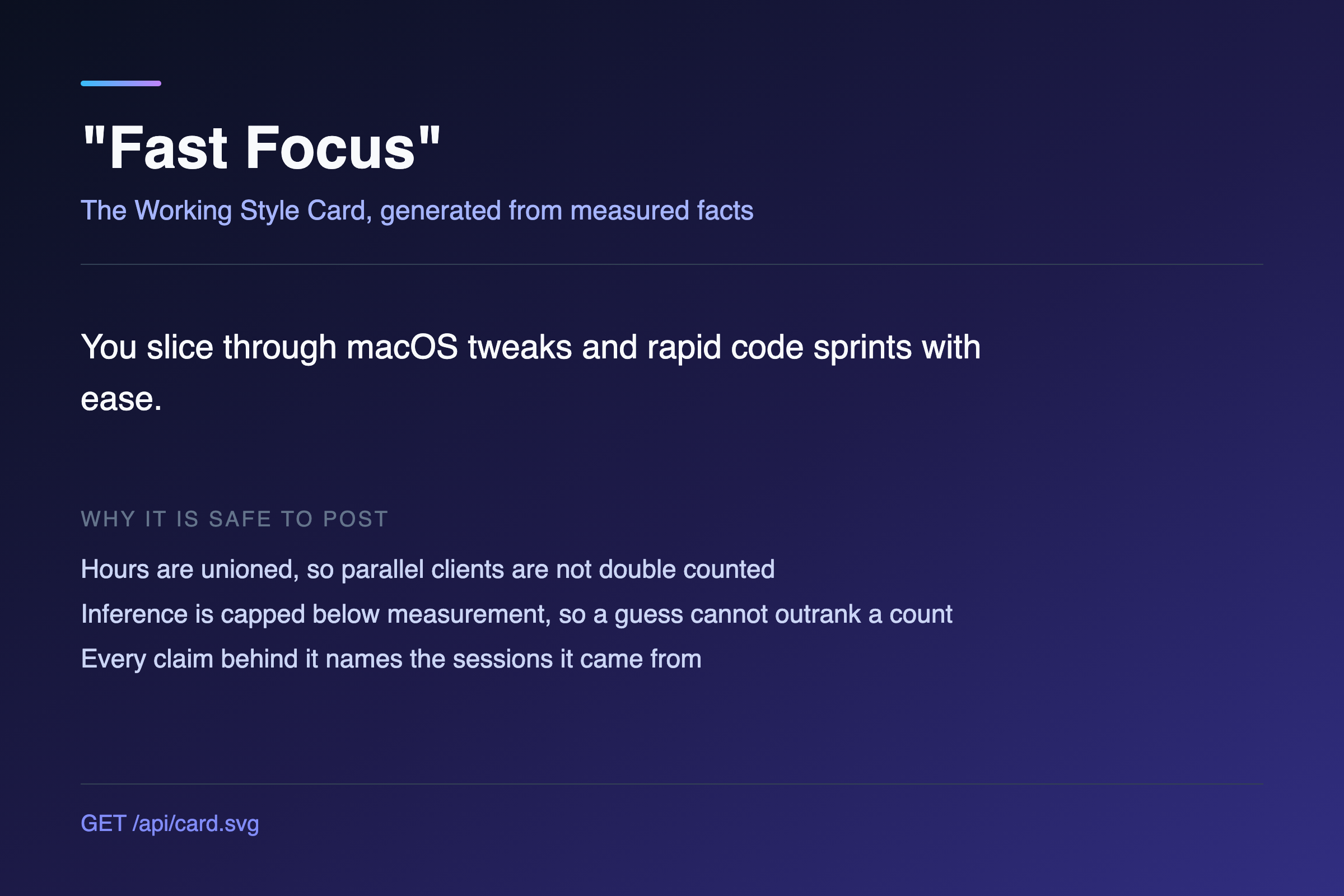
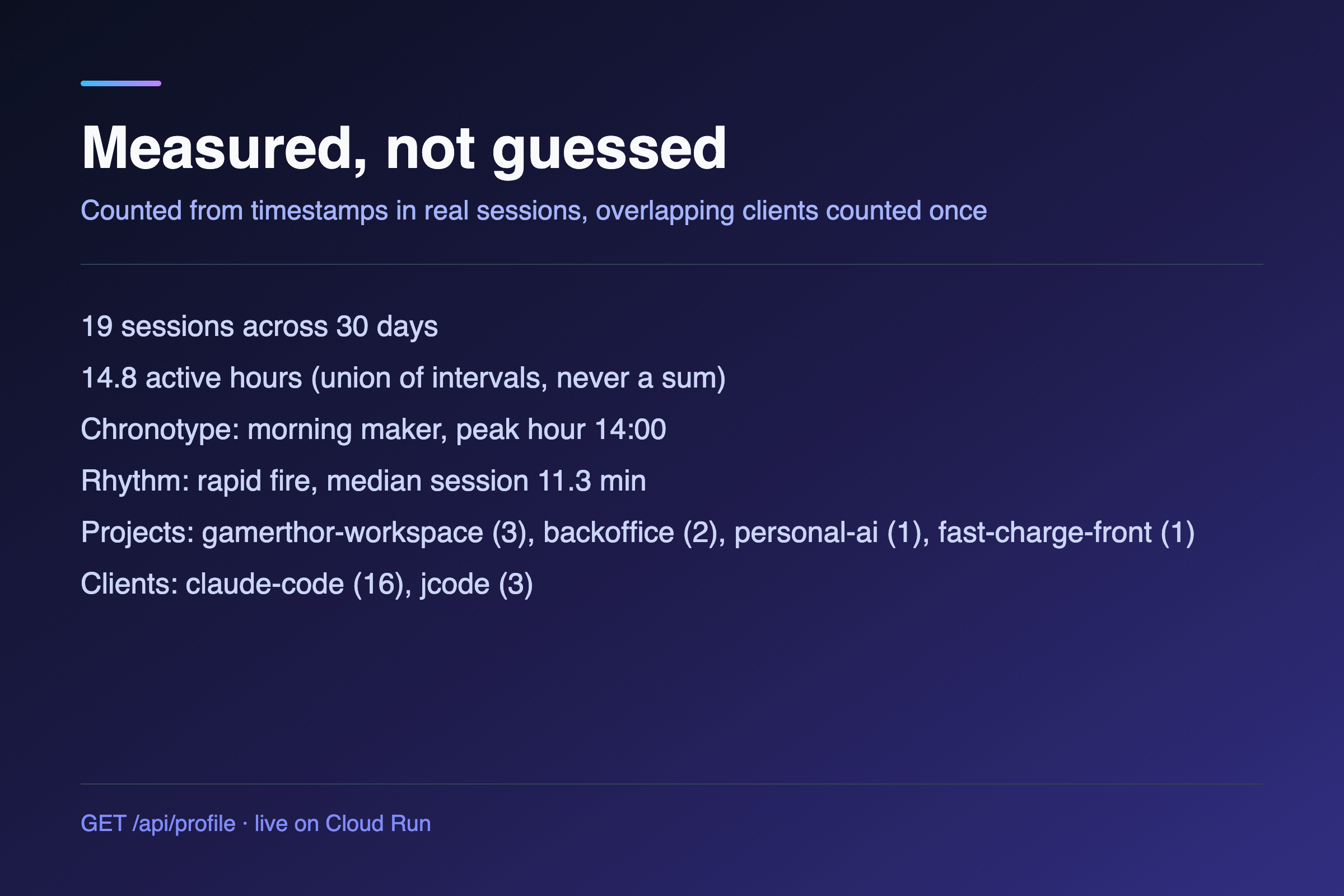
It gives you something to share. A Working Style Card generated from measured facts, not from vibes.
On my own history it read 19 sessions across 30 days, measured 14.8 active hours, and distilled 41 durable beliefs, each citing the sessions behind it.
How we built it
The system splits into four layers, and the split is the point.
Ingestion normalises transcripts from jcode, Claude Code and Codex into one timeline. Each client gets a small adapter that knows only its own layout, so the rest of the system never learns which tool a session came from. Tool output, reasoning traces, file contents and paths are stripped here, before anything is stored or sent.
Measurement counts what can be counted: active hours, chronotype, session rhythm, context switching. Session spans are unioned rather than summed, so two clients open for an hour is one hour of work rather than two. This layer needs no model and no network, which means the agent is never empty on a first run.
Distillation sends batches of sessions to Gemini 3.5 Flash and asks what they mean. Every returned claim must cite session ids that actually exist. Claims citing invented sessions are dropped, because a claim the UI cannot justify is worse than no claim. Inferred confidence is capped at 0.75 while measured facts are uncapped, so a guess can never outrank a count.
The agent is a bounded Gemini tool loop over four tools: recall, remember, correct and check-stuck. Its system prompt is built fresh from current memory and current measurements, so it is grounded before it says a word.
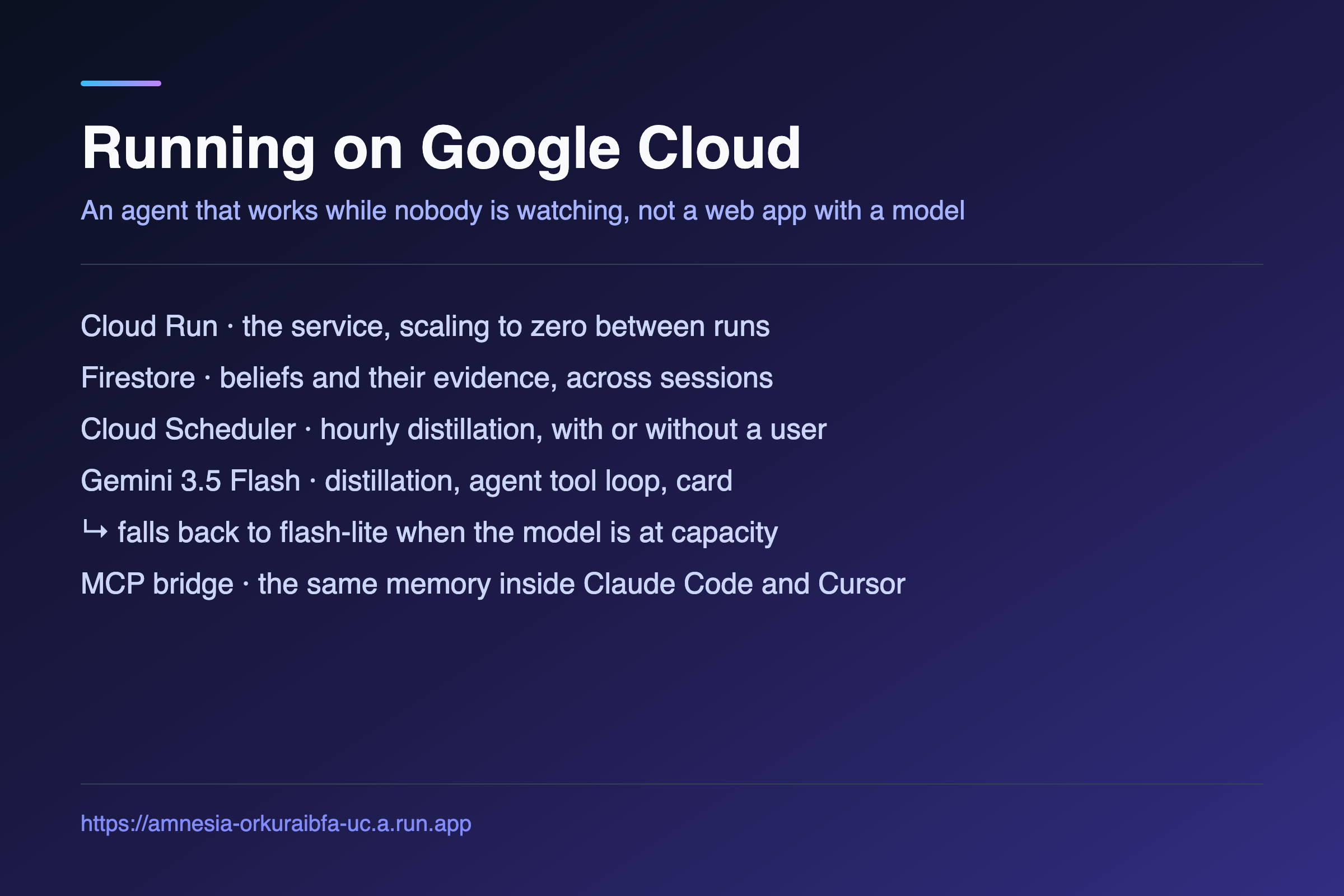
Deployed on Cloud Run with Firestore for cross-session memory and Cloud Scheduler driving the hourly background pass. The service scales to zero between runs, so it costs close to nothing while still being a genuinely asynchronous agent rather than a web app that happens to call a model.
Challenges we ran into
A guess outranking a count. The first version let Gemini assign its own confidence, and inferred beliefs immediately outranked measured facts in ranking. Capping inference below measurement fixed the ordering and, more importantly, made every number defensible enough to put on a card people share.
Three bugs that only exist in the cloud. Cloud Run sets GOOGLE_CLOUD_PROJECT on every service, and passing it alongside an API key makes the Gemini API reject the call outright. The first deployed distill pass failed on exactly that while identical code worked locally. Google's frontend intercepts /healthz before the request reaches the container, so the conventional health path answered 404 from outside. And gemini-3.5-flash returned 503 under load while flash-lite answered in under a second, so capacity failures now fall through to the next model in the same generation. Each is covered by a test.
Summing durations claimed 30 hours in a 24-hour day. Running two agents at once is normal, and every parallel session was being counted twice. Unioning intervals fixed it.
Truncating the wrong end. The outcome of a session is at its end: whether it worked, or whether the person gave up. Early versions clipped the tail and distilled the greeting.
Accomplishments that we're proud of
The agent told me something true about myself that I had not noticed and would not have admitted: that I had spent 92 minutes circling one question across 19 asks. That is the moment this stopped being a demo.
Every number it reports can be defended. Hours are unioned, evidence is cited, inference is capped below measurement, and 72 tests cover the arithmetic and the rules with no network and no cloud account required.
What we learned
The evidence about how we work already exists. Collection was never the hard part. The hard part is that a transcript says what happened, and a person needs to know what it means.
And a memory without provenance cannot be corrected. Once every belief carried its sessions, "that's wrong" became a one-click action with somewhere to put the correction, instead of an argument with a model.
What's next for Amnesia
Browser and ChatGPT web sessions, which no local hook can currently observe. Per-project memory scoping, so a work machine and a side project do not share a profile. And team mode, where a shared Amnesia onboards a new engineer by knowing how the team actually works rather than how the wiki says it does.


Log in or sign up for Devpost to join the conversation.