Inspiration
AI tools made generation cheap. Organization didn’t keep up.
After enough sessions, the real mess wasn’t “I can’t create.” It was drafts, images, audio, scripts, and near-final versions scattered across chats and folders — with no clear map of what belongs together, which version is current, or what referenced what.
Folders store files. They don’t store project sense. WorkBOM started from that gap: a local workspace for AI-era materials, not another generator.
What it does
WorkBOM is a local-first desktop app for organizing AI creative outputs.
It imports .wbom packages that link to files already on disk, then helps you:
- browse assets with project context
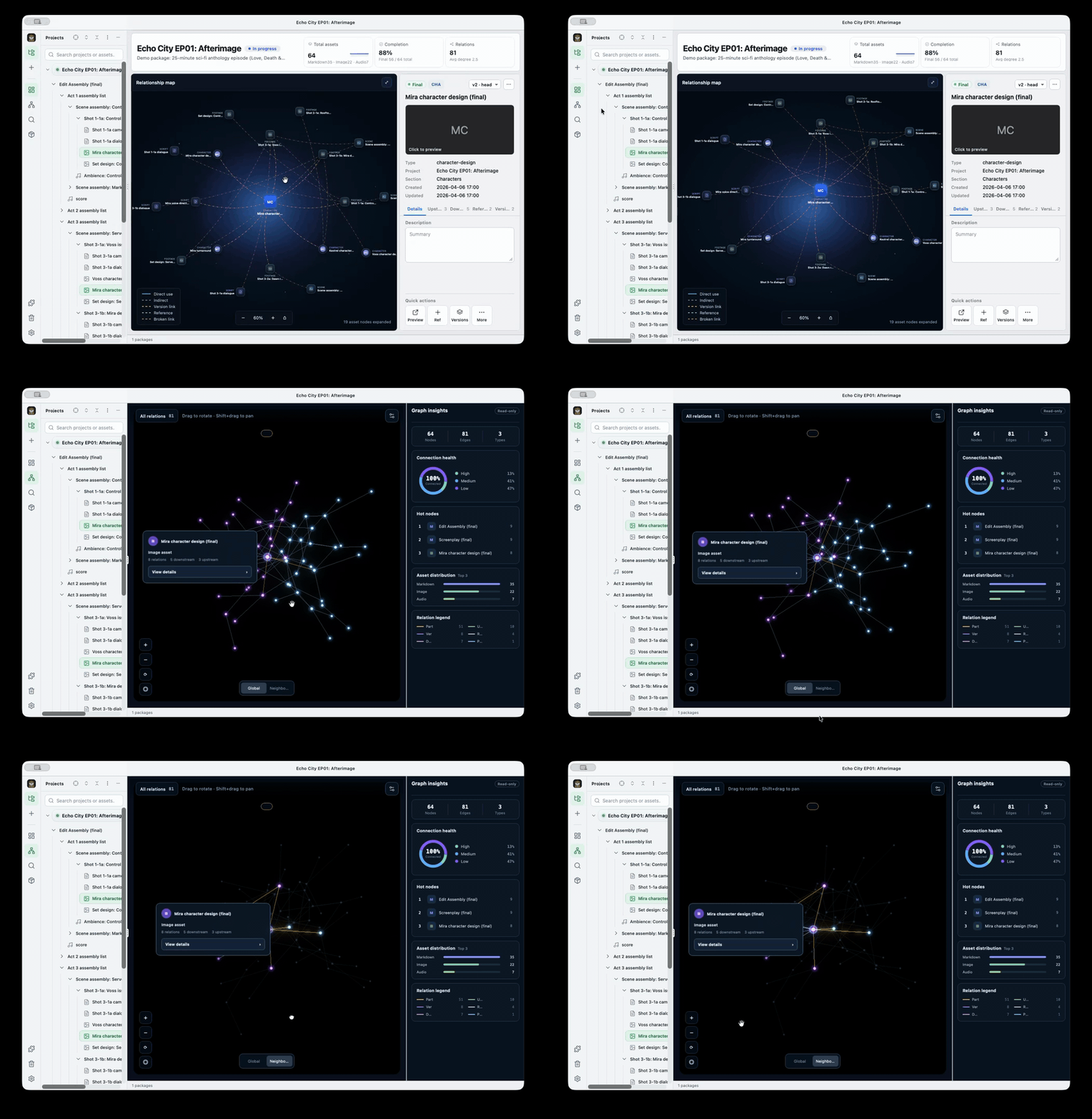
- track relationships (part-of, version, reference, use)
- explore projects in a 3D knowledge graph
- search by text and local semantic meaning
- reconnect moved files and recover soft-deleted assets
No telemetry, no account wall, no uploading source files. The goal is to turn scattered AI output into a navigable project again.
How I built it
WorkBOM is a Tauri desktop app: a React frontend with a Rust backend.
The core idea is package-first. A .wbom directory holds manifests and relationship data, while original files stay in place. On top of that sit the asset cockpit, graph views, local full-text search, and on-device semantic retrieval with a bundled embedding model.
The product focus stayed narrow on purpose: import → relate → search → recover. Features that weren’t ready for real feedback (like Inspiration Board) were kept out of the Early Preview.
Challenges I ran into
The hardest part wasn’t rendering a graph. It was modeling creative work without forcing people to move their files into a new silo.
A few recurring challenges:
- representing versions and references without overcomplicating the data model
- keeping links reliable when users rename or move files
- making dense graphs readable instead of decorative
- shipping a useful Early Preview while resisting feature creep
- balancing “developer-readable package format” with “creator-usable workspace”
Local-first also means you own the hard parts: indexing, reconnect flows, and trust that nothing leaves the machine.
Accomplishments that I'm proud of
- A working Early Preview that covers the real loop: import, relate, graph, search, reconnect, recover
- Keeping source files on disk instead of copying them into an opaque library
- Shipping local semantic search without a cloud dependency
- Making relationship structure a first-class product surface, not an afterthought
- Releasing early enough to get honest workflow feedback instead of polishing in isolation
What I learned
Speed of generation creates a second problem: continuity.
When AI produces faster than people can remember decisions, the scarce resource becomes project memory — what was tried, what was chosen, what still matters. Tools that only store files miss that.
I also learned that demos should show someone else’s concrete scenario, not just the maker’s toolchain. And that local-first only feels real when reconnect, search, and recovery work under messy real-world folders.
What's next for work-boms
- Refine the Early Preview based on real import/graph/search feedback
- Ship clearer sample .wbom packages so new users can feel the workflow in minutes
- Improve relationship editing and version clarity
- Bring Inspiration Board back when it’s strong enough to earn a place in the product
- Keep the privacy boundary: local by default, no telemetry theater
