Inspiration
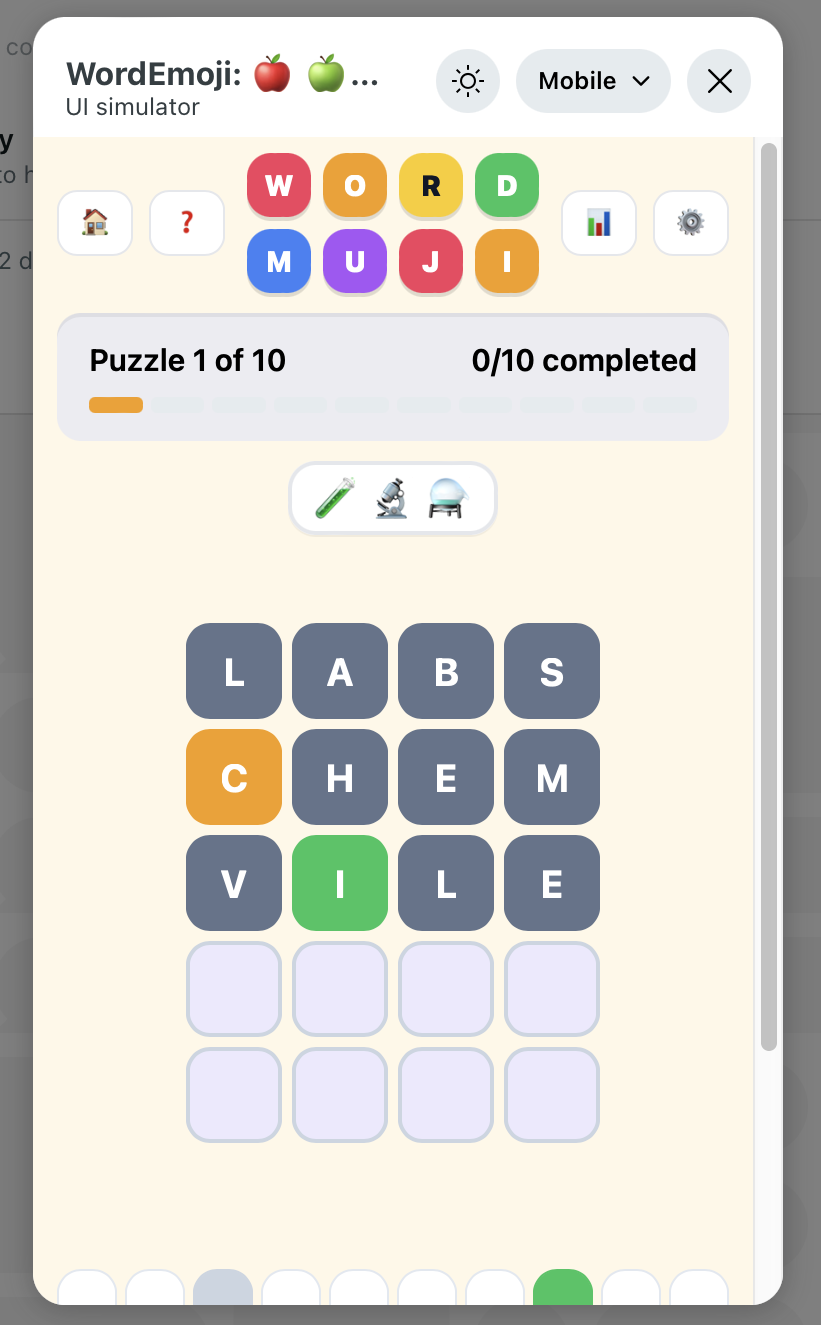
I love how daily puzzles bring people together. Wordle nails the “one more try” loop, but I wanted a friendlier vibe that’s easy to pick up and share in communities. Emojis felt like the perfect hint mechanic: playful, language‑agnostic, and expressive. WordEmoji blends daily Wordle‑style logic with three‑emoji clues and a lightweight, mobile‑first UI—built to live natively inside Reddit via Devvit.
What it does
- 10 daily puzzles, shared globally, with words of length 3–6
- Simple tile feedback (green/yellow/gray) and on‑screen keyboard
- Three‑emoji hint per puzzle (with “❓❓❓” fallback)
- Stats and streaks, guess distribution, and a global top‑10 leaderboard
- Archive to replay past days; “come back tomorrow” gating once you finish
- Smooth UX: confetti on wins, shake on invalid guesses, and a clean, colorful theme
How I built it
- Platform: Devvit (Reddit WebView), split into client and server bundles
- Client: TypeScript + Vite, custom CSS (no frameworks), Google Font “Nunito”
- Server: Express (TypeScript) + Devvit services (Reddit context, Redis)
- Data:
- Client: localStorage for daily progress and personal stats
- Server: Redis for daily archives and leaderboard
- Integration:
- Optional OpenAI (gpt‑4o‑mini) to generate daily word+emoji sets (with caching and validation)
- Fallback deterministic generation to guarantee playability even if the network or model fails
Architecture at a glance
- Client pages:
index.html(game),stats.html,archive.html - Multi‑page build via Vite rollup inputs; assets served through Devvit’s WebView
- API endpoints:
/api/daily,/api/dates,/api/leaderboard,/api/emoji-hint, and simple health/test routes - Scheduler: UTC midnight safety to ensure today’s set exists (when using server‑side generation)
- Auth: Devvit’s
webbit_tokenattached to all/api/*requests, persisted across navigation
Daily challenge mechanics
- If server generation is available, each day is archived once and shared globally.
- Otherwise, a deterministic client fallback ensures the day is playable for everyone.
- Archive lists all previous days (newest first), 4 per page; you can jump directly into any day.
A simple math sketch of the deterministic fallback:
- Use the UTC date key ( d = \text{YYYY-MM-DD} ).
- Hash the seed and drive a shuffle: [ s_0 = h(d), \quad s_{n+1} = \text{XorShift}(s_n), \quad \text{index} = s_n \bmod N ]
- Select the first 10 words after a seeded shuffle, guaranteeing the same set for the same date.
Time‑to‑midnight countdown (local): [ \Delta t = \text{midnight(local, today+1)} - \text{now(local)} ] Displayed as ( h )h ( m )m ( s )s on completion.
Leaderboard and stats
- Leaderboard stores the top 10 daily performers by total time for all 10 puzzles
- Users identified by Reddit username (with a safe fallback to “anonymous”)
- Personal stats stored client‑side: games played/won, streaks, and guess distribution
- Win rate: [ \text{WinRate} = \frac{\text{wins}}{\text{played}} \times 100\% ]
What I learned
- Devvit’s WebView and asset pipeline: building multi‑page apps that feel native to Reddit
- Reliable token propagation: making sure
webbit_tokenis appended to every API request and survives cross‑page navigation - Resilient UX: always provide a deterministic fallback when external services (OpenAI, settings) aren’t available
- Data design for a daily model: archives, no‑repeat logic, and simple, readable Redis structures
- Prompt engineering for balanced puzzle difficulty and consistent emoji quality
Challenges and how I solved them
- Token stability: API calls initially failed with “missing webbit_token.” I added a global fetch wrapper that appends the token as both query param and bearer header, plus persisted it in
sessionStorage/localStorageso it survives navigation. - Devvit settings/secrets and environment drift: Guarded against missing settings, added a “test” panel with explicit status outputs, and allowed a local key header during playtest.
- Redis API differences: When native set ops weren’t available, I switched to JSON‑array backed helpers to emulate sets reliably.
- OpenAI model quirks: Some models reject
max_tokens; swapped togpt‑4o‑mini, adjusted parameters, and cached results—with validation of word length (3–6) and uniqueness. - UI polish on mobile: Tightened spacing, ensured tiles match word length, added safe‑area padding, and removed blocking loaders in favor of immediate gameplay.
Design choices
- Friendly, colorful brand: rainbow tile logo, soft backgrounds, bold typography
- Motion that informs: shake for errors, confetti on win, subtle hover/press states
- Clear affordances: concise messages, distinct “Stats” (red) and “Archive” (purple), disabled “Play” with “come back tomorrow” when finished
What’s next
- Community sharing of daily results with emoji tiles
- Better hint explanations for more challenging words
- Optional accessibility mode (higher contrast and reduced motion)
WordEmoji aims to be a daily ritual that’s approachable, joyful, and built to thrive inside Reddit’s ecosystem—fast, resilient, and fun.
Built With
- css
- devvit
- html5
- javascript
- redis
- ts

Log in or sign up for Devpost to join the conversation.