-
-
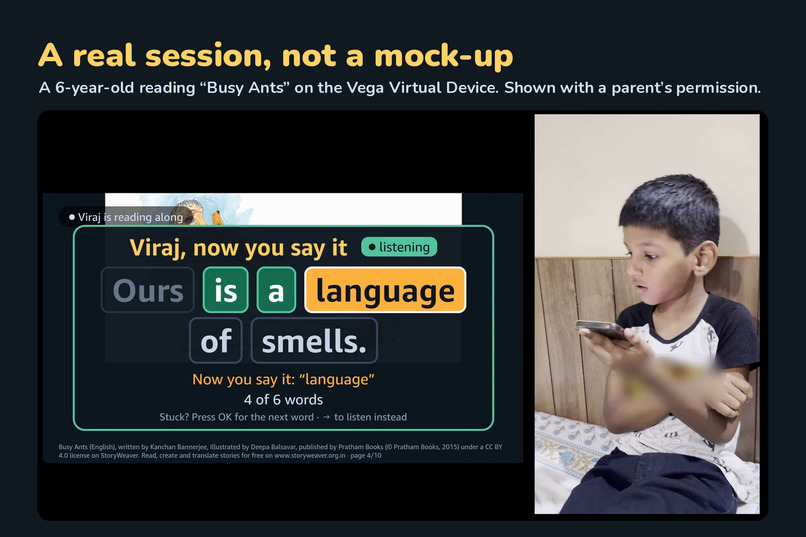
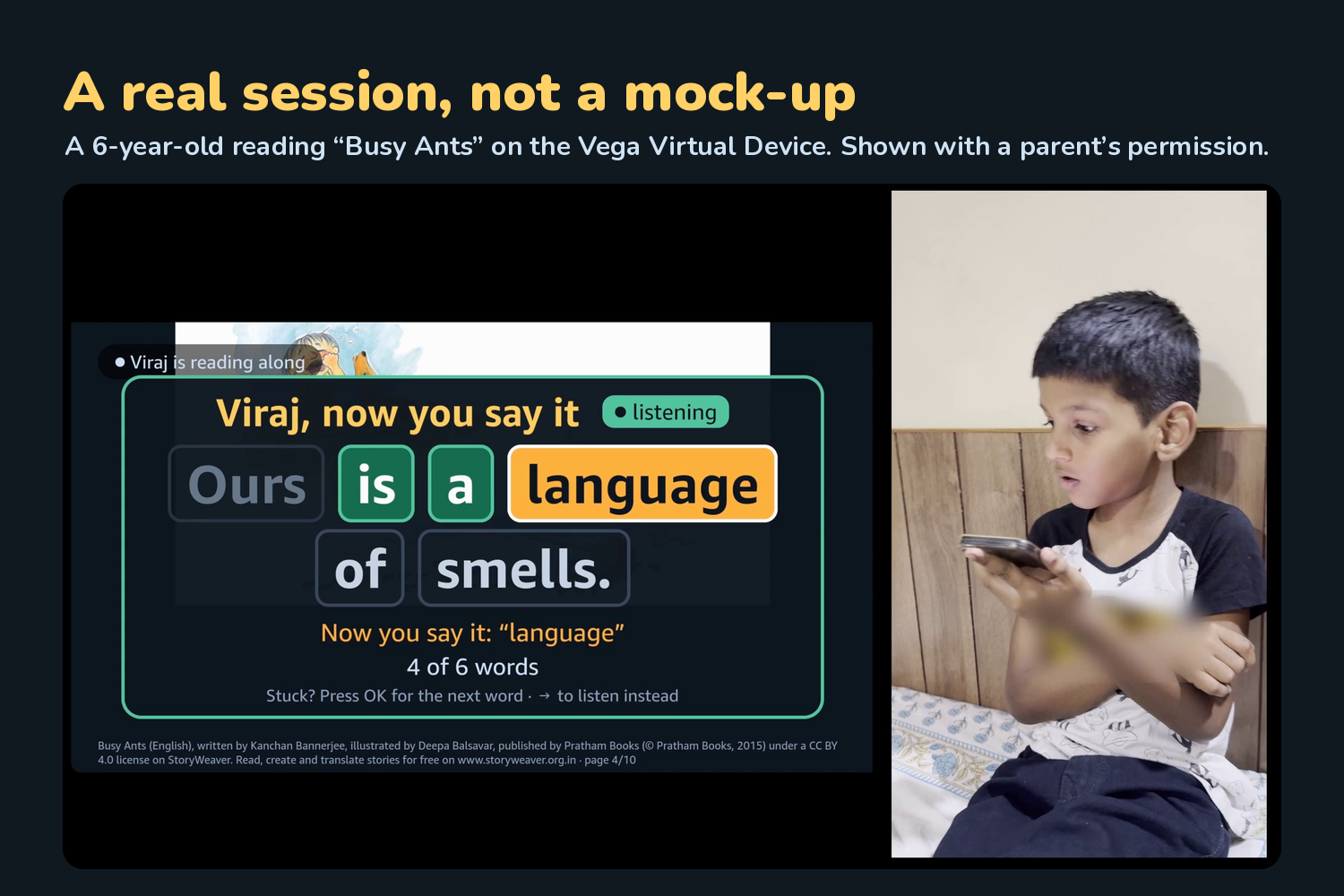
A real session: Viraj reading, logo blurred, with the “parent’s permission” label
-
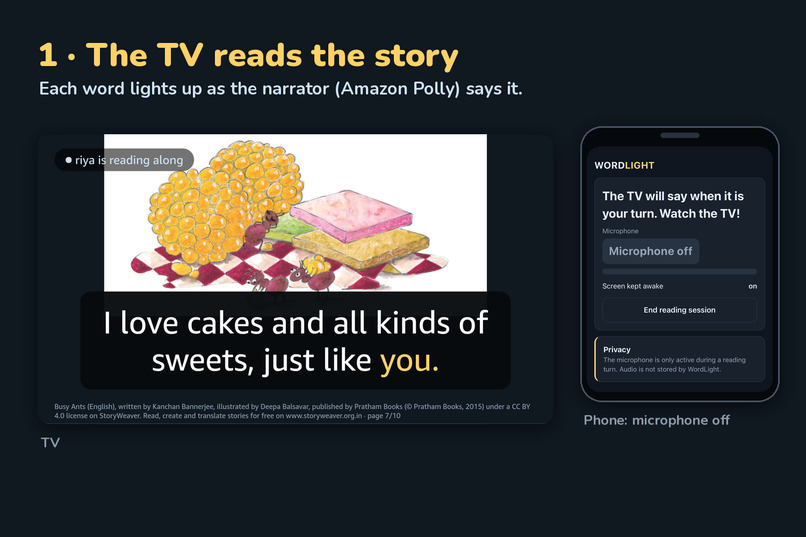
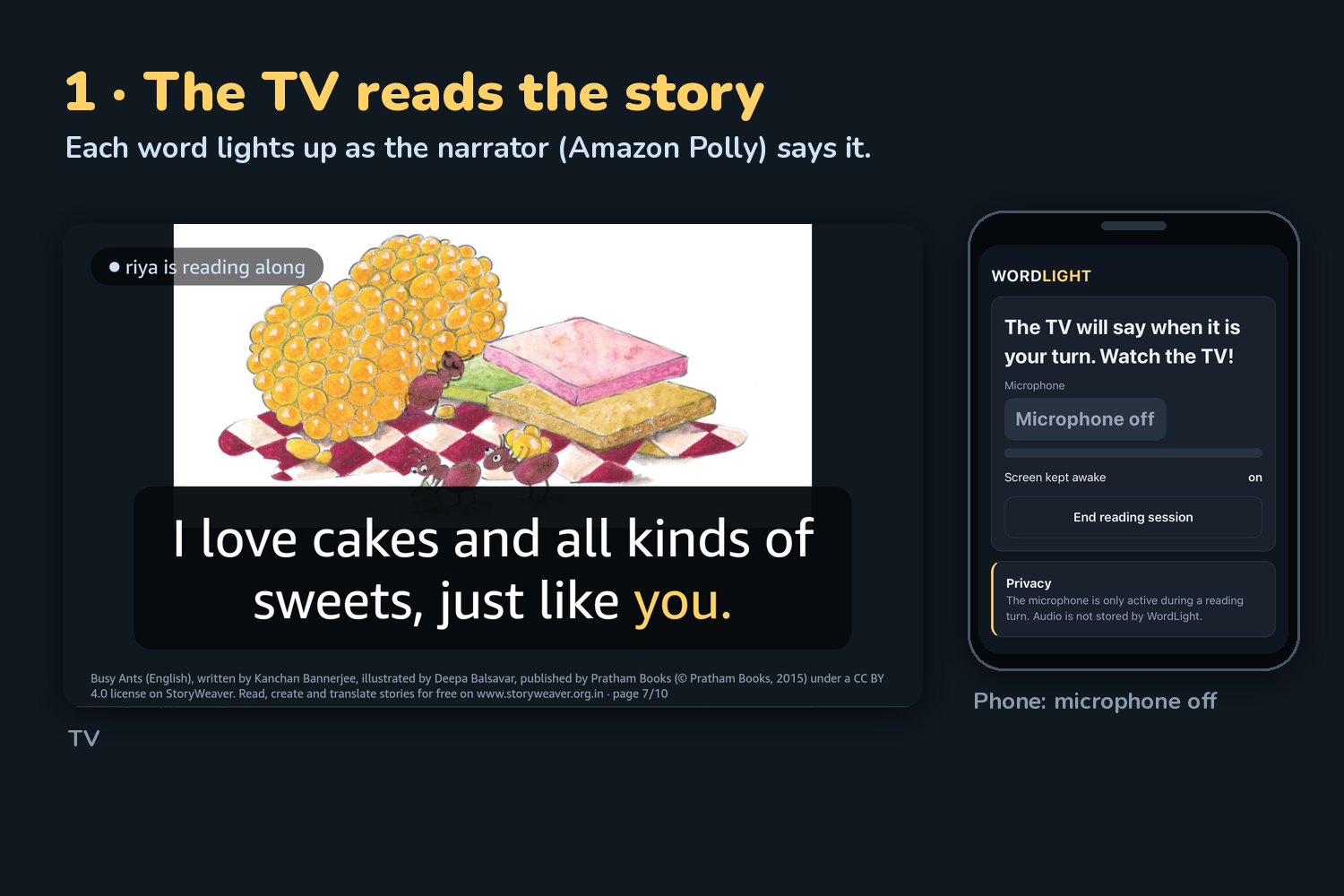
The TV reads the story, with the phone showing the microphone of
-
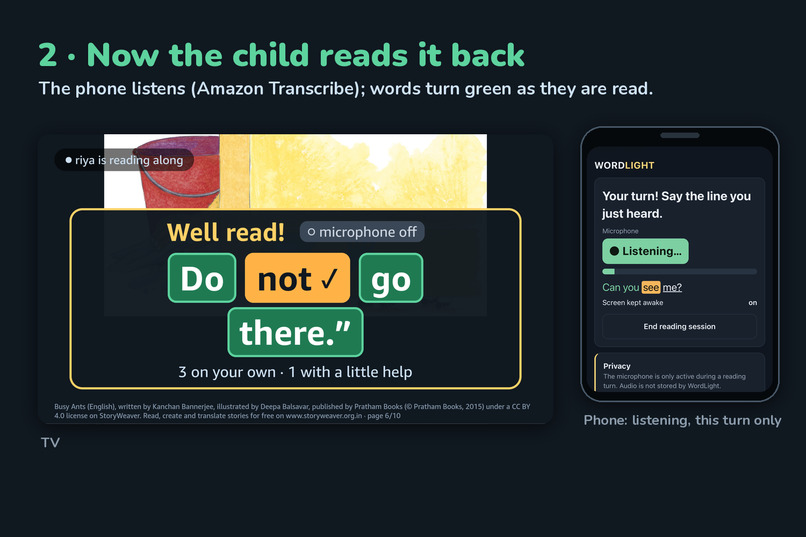
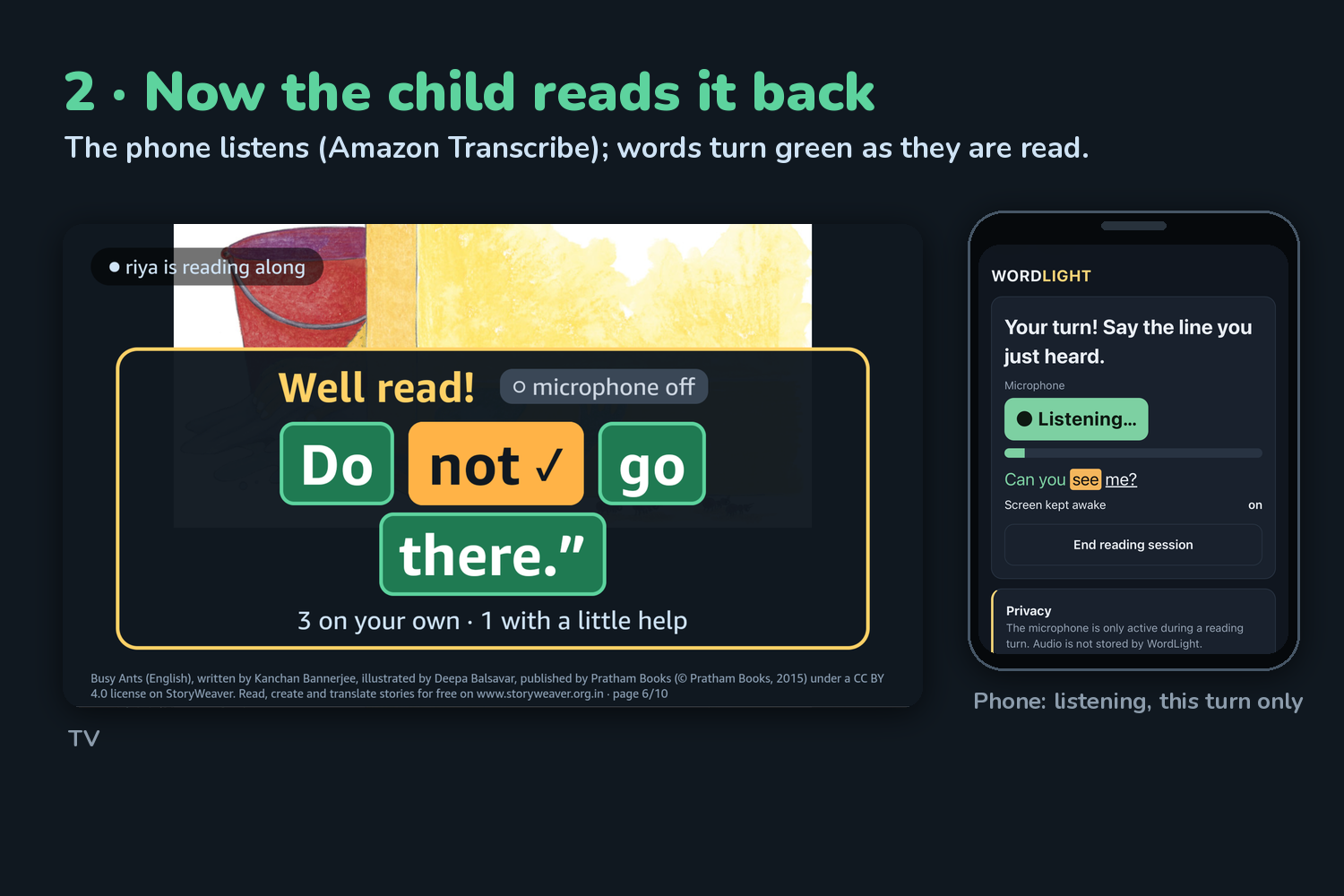
The child reads it back: green words, phone listening
-
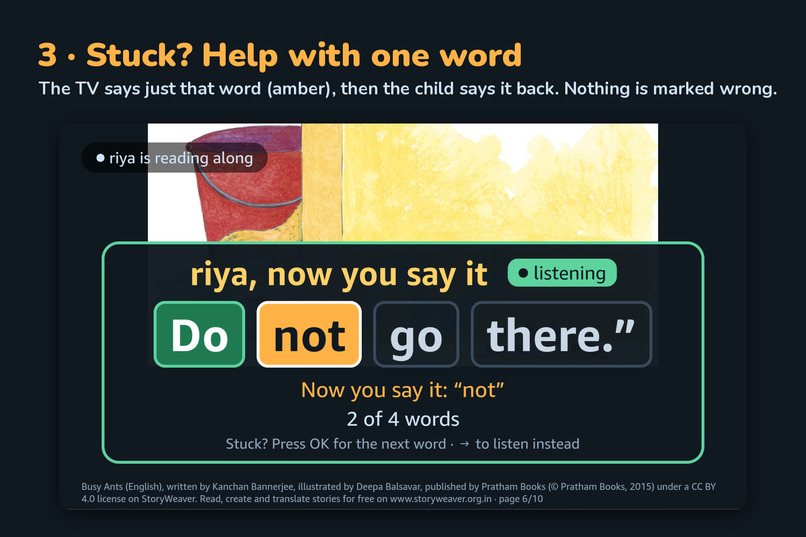
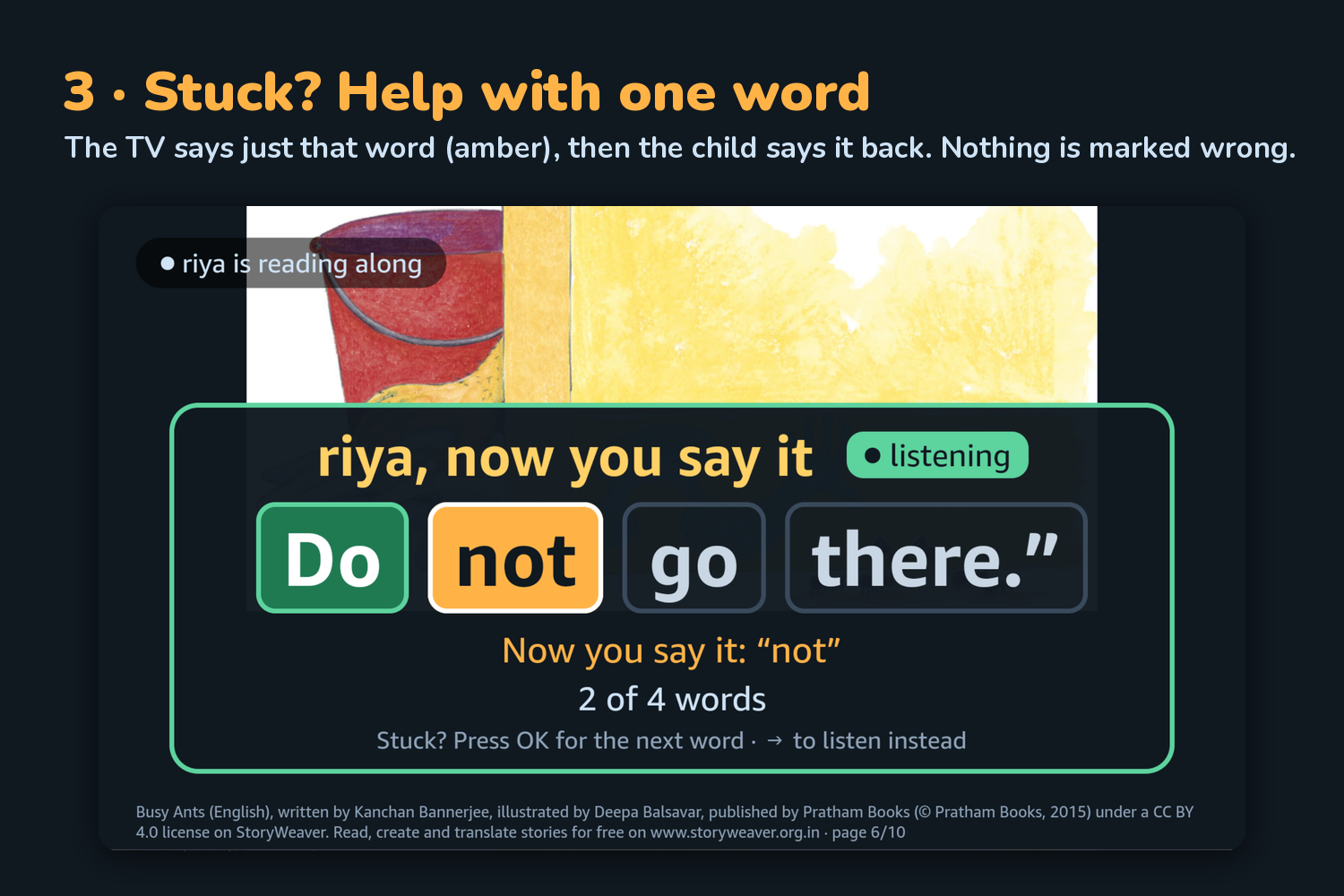
Stuck? Help with one word (amber)
-
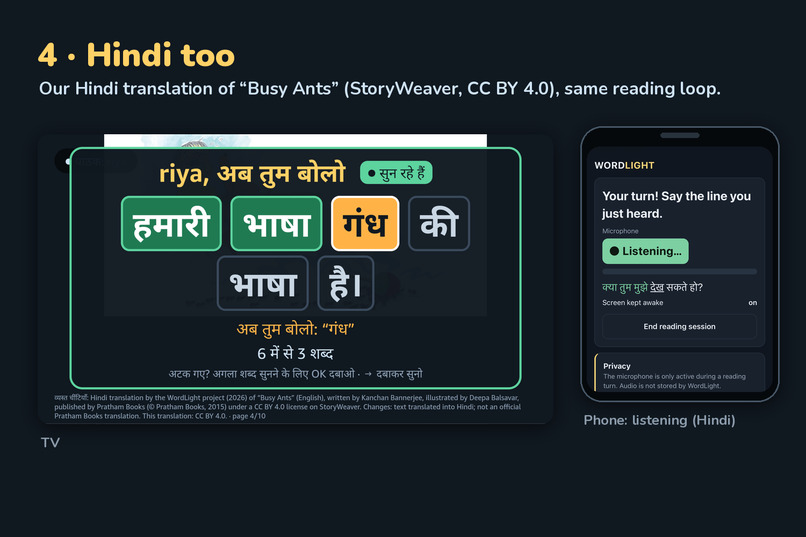
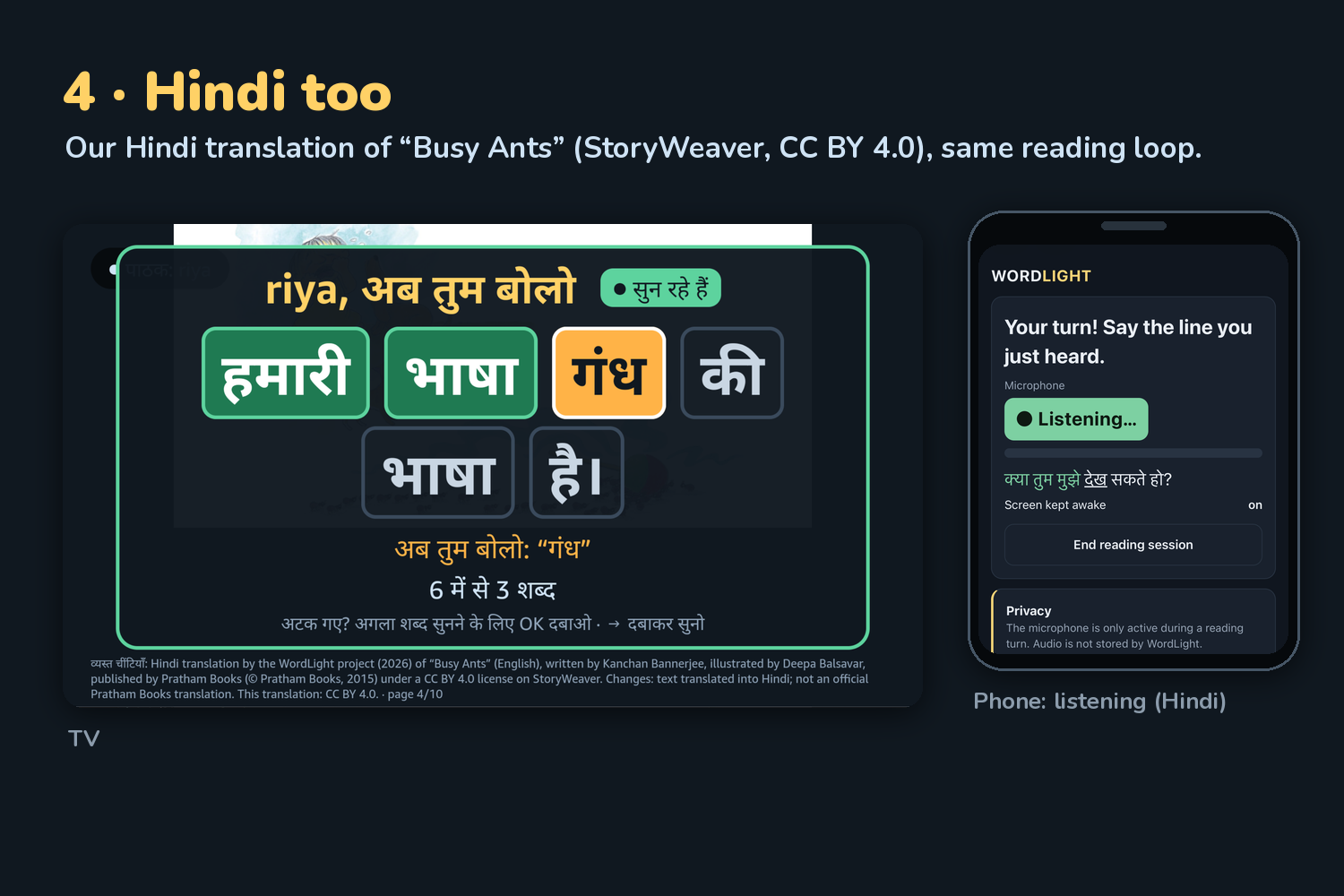
Hindi
-
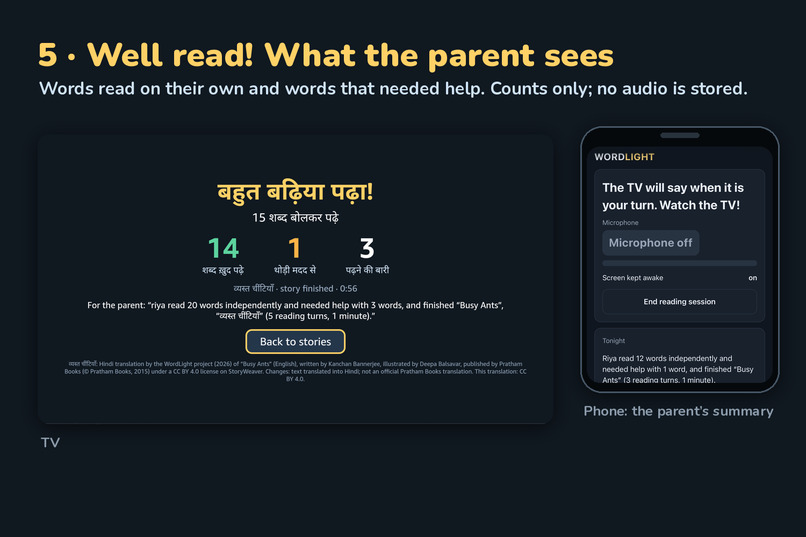
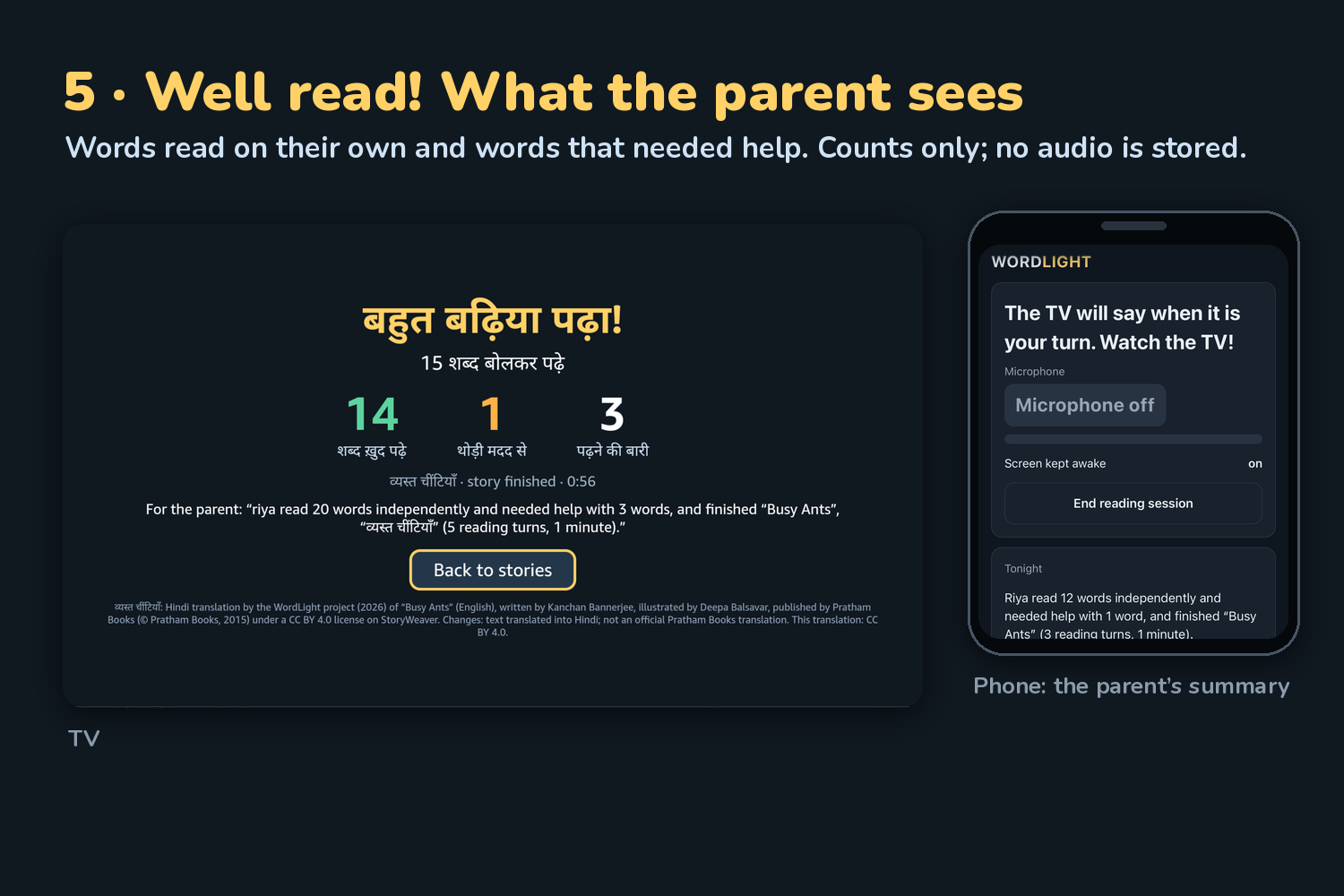
Well read: TV end card and the parent’s summary
-
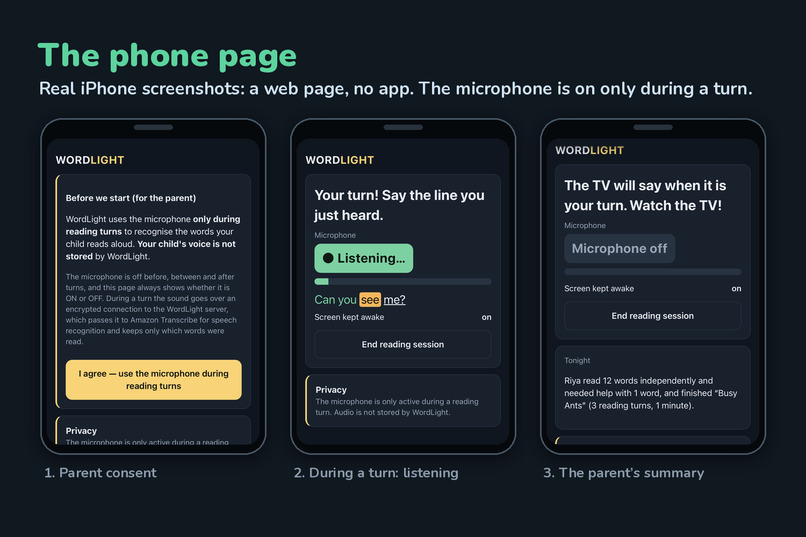
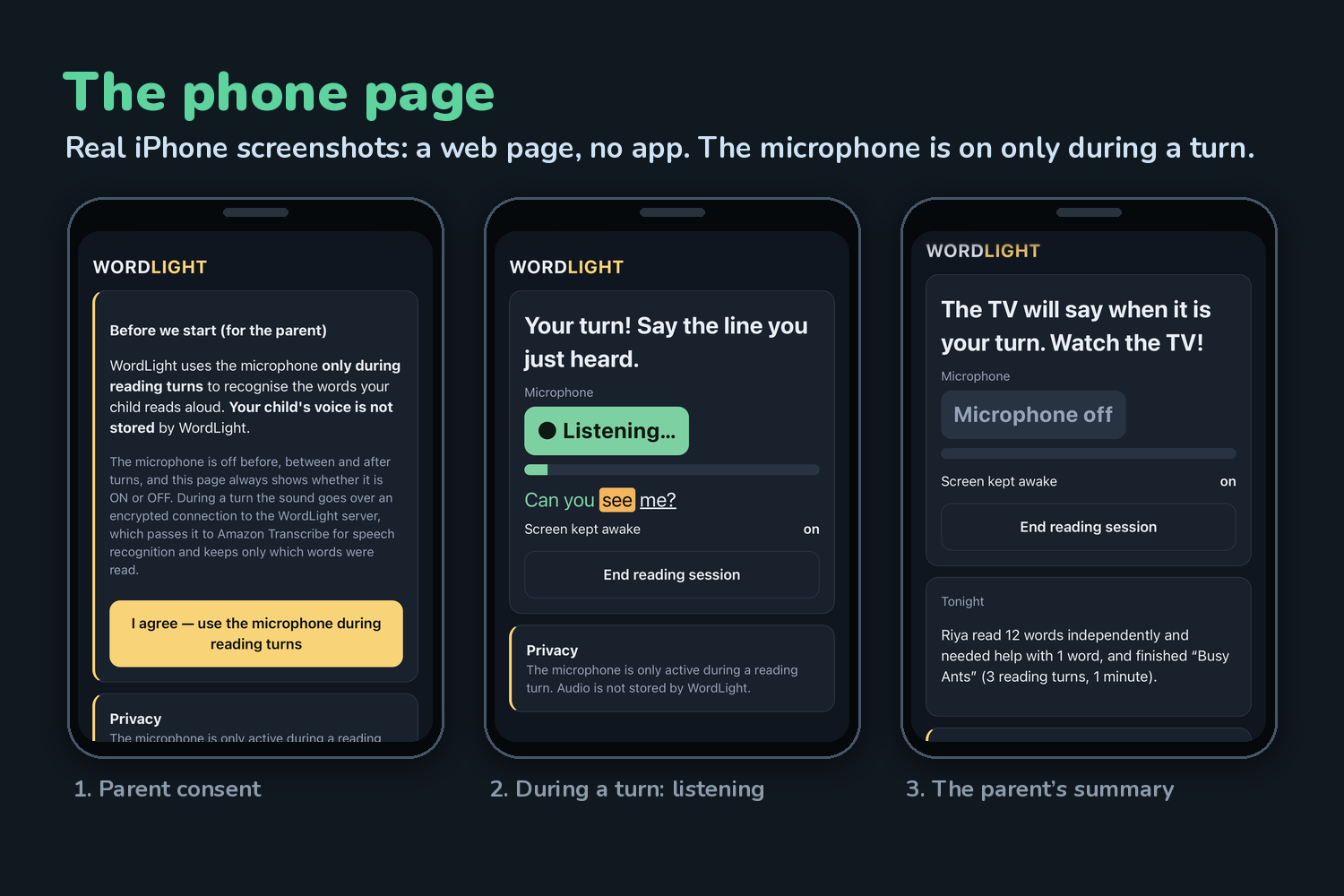
The phone page
-
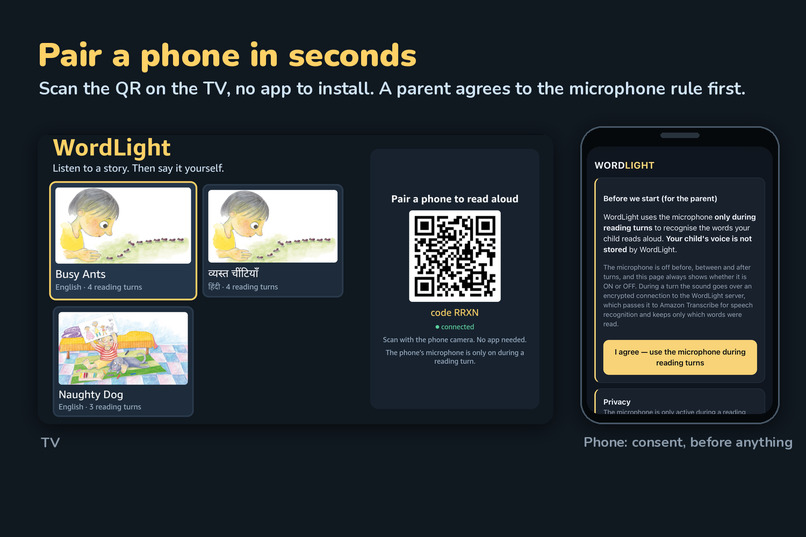
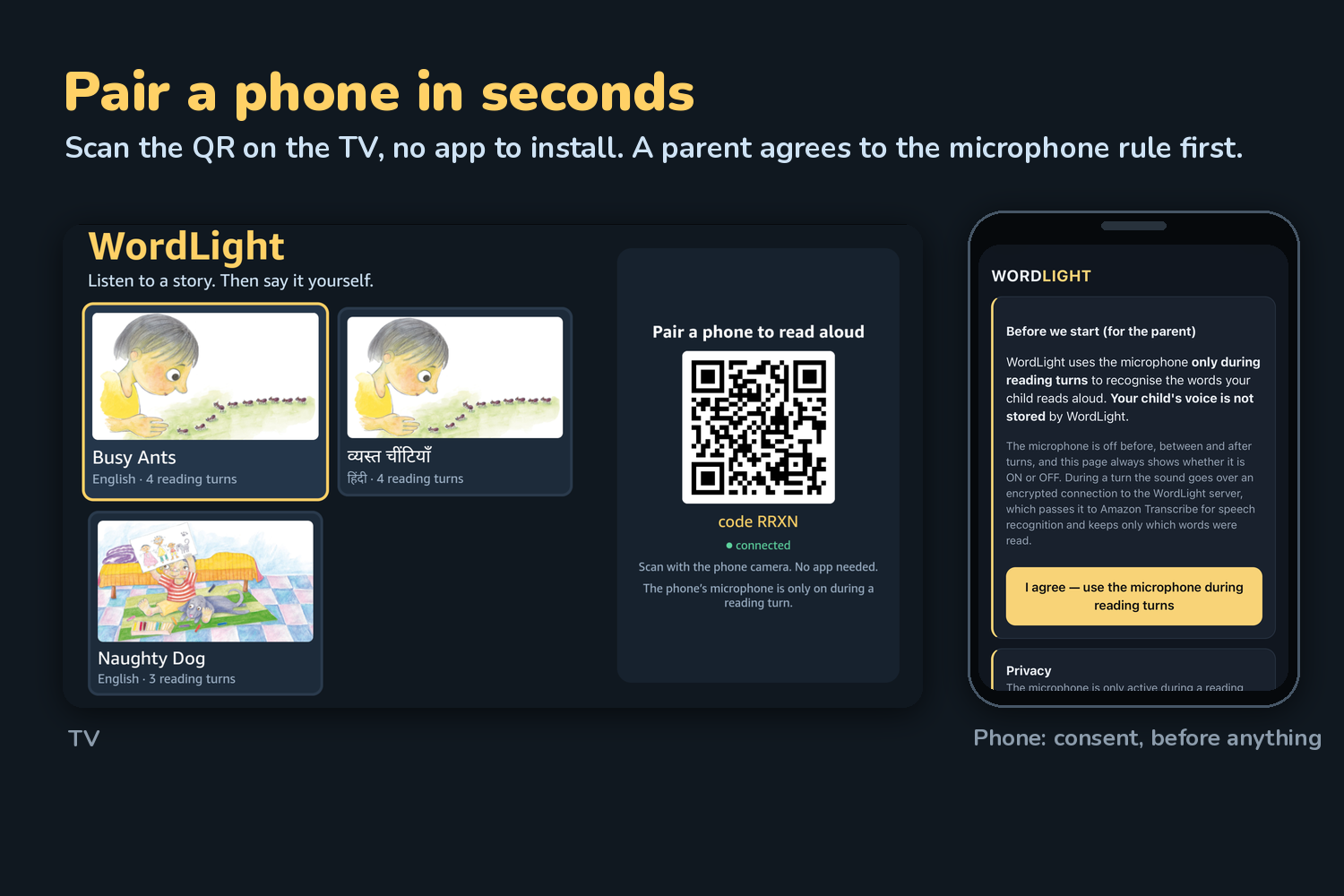
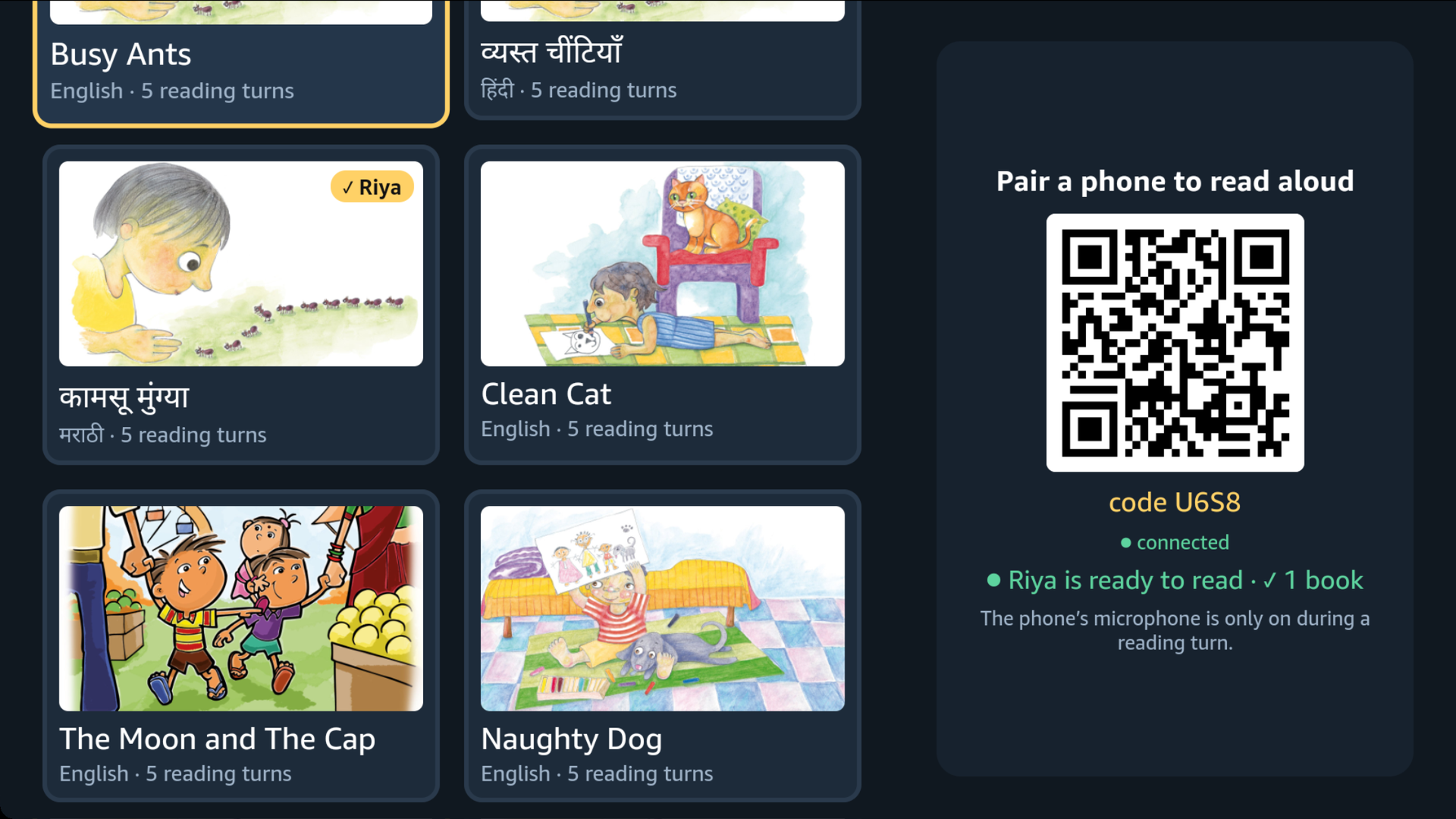
Pair a phone in seconds: the QR code and the consent screen
-
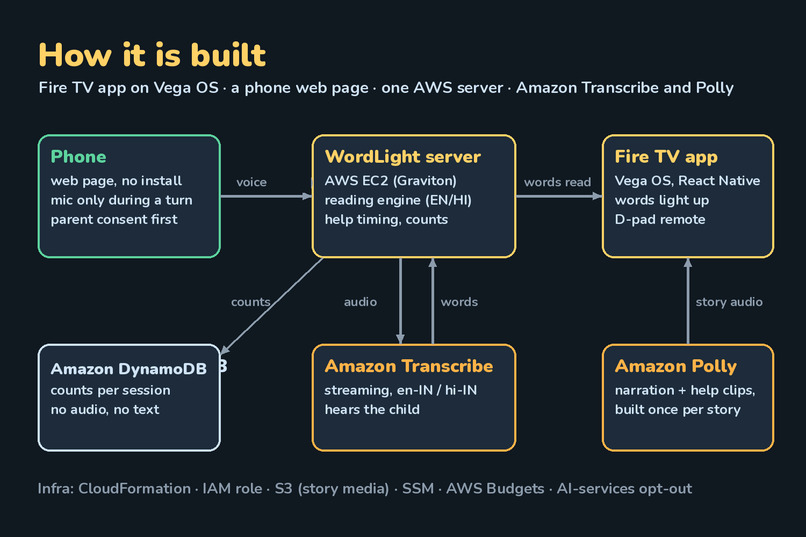
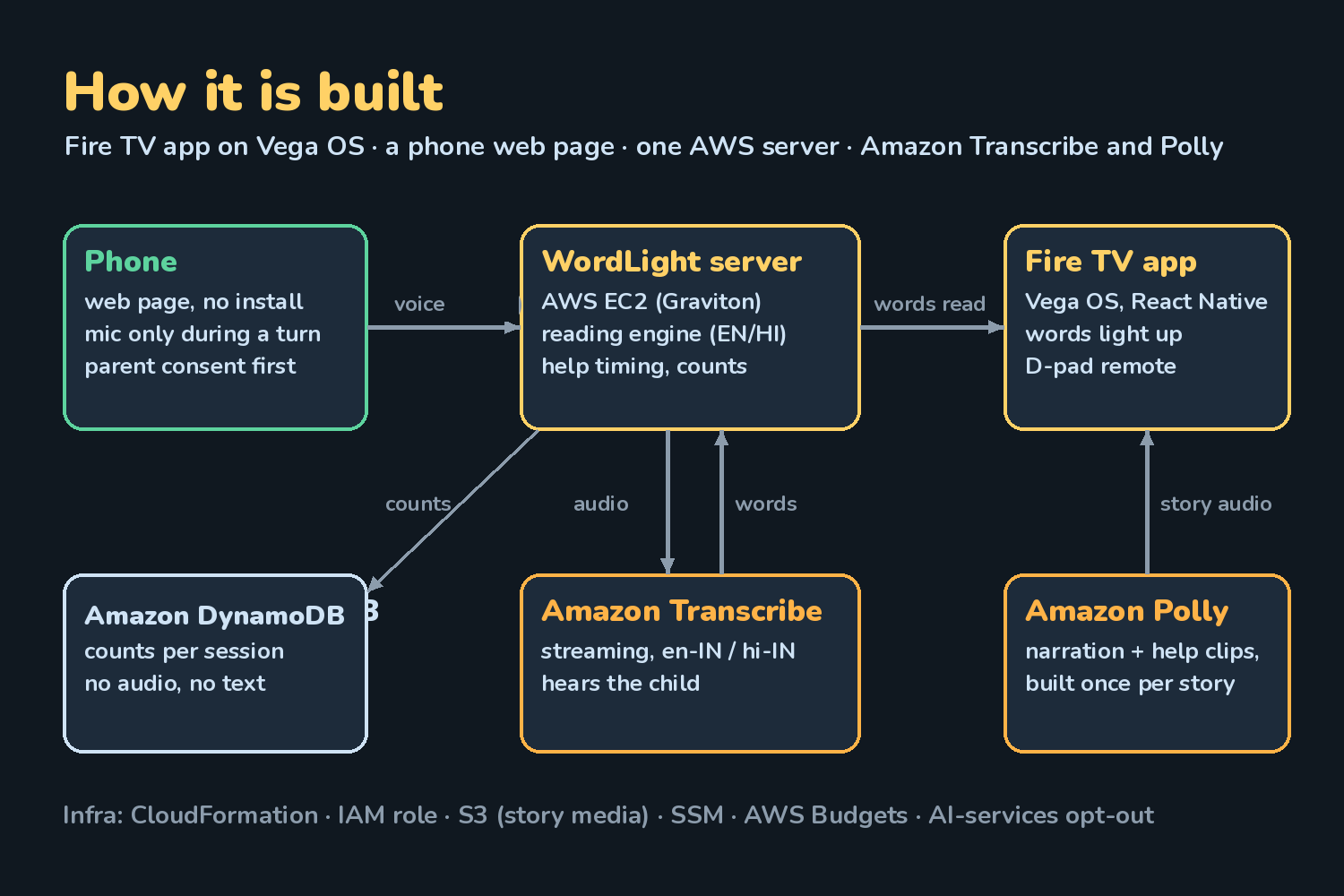
How it’s built: architecture diagram
-
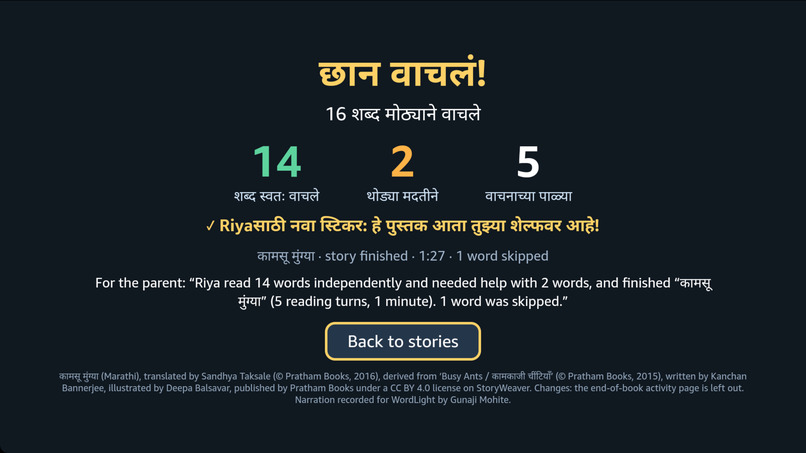
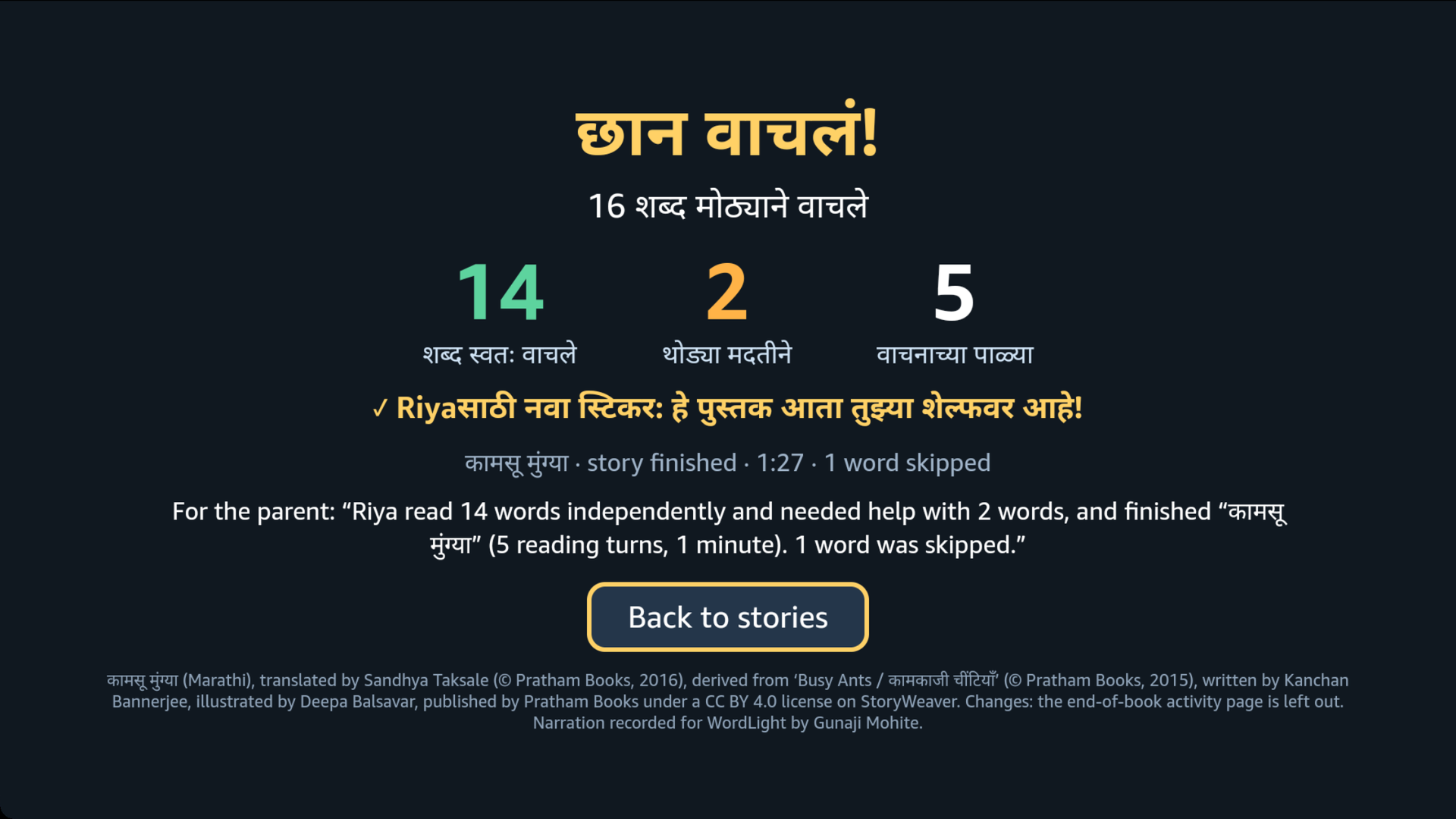
Marathi end card
-
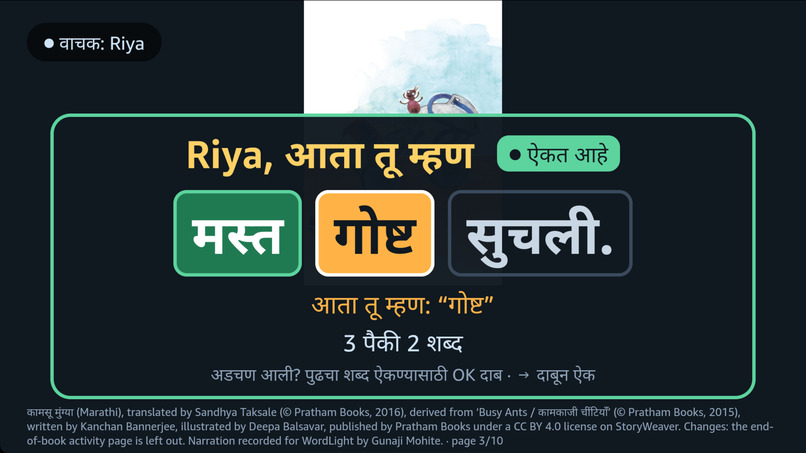
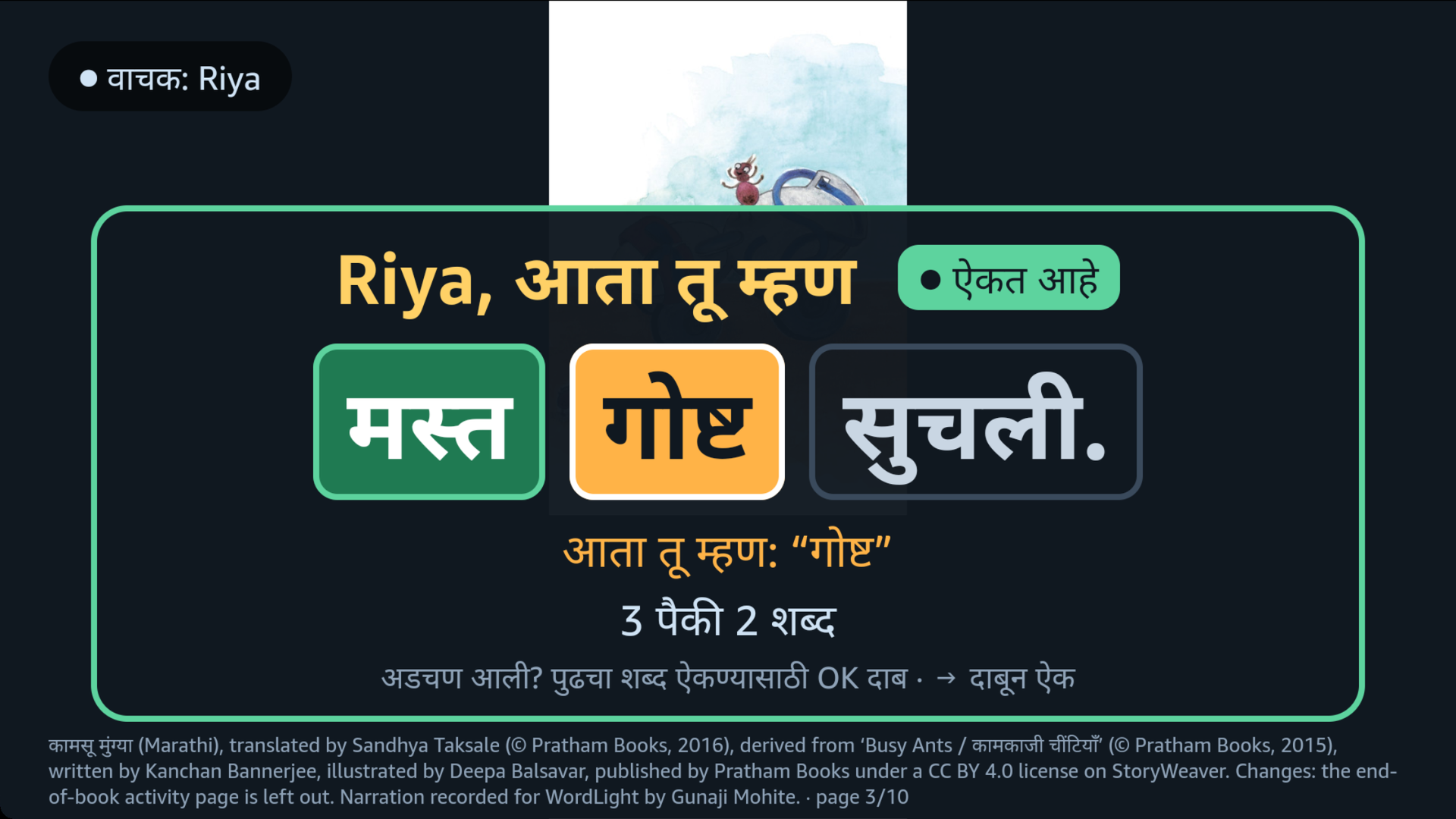
Marathi help
-
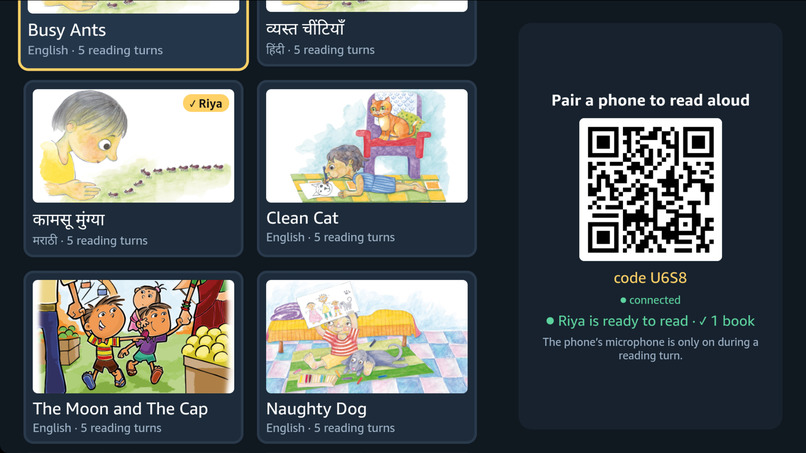
Shelf sticker
Inspiration
In many homes the TV is on every evening, and children see words on it all the time. Lighting each word as it is spoken (same-language subtitling) has been used in literacy programmes in India (UNESCO LitBase). But watching is passive. A child learning to read needs someone who listens: someone who waits when they get stuck, and helps with just one word. Parents can't always be that person every night. So I asked: what if the TV itself stopped and said, "now you say it"?
What it does
WordLight turns the family Fire TV into a read-along partner for children of about 6–10.
- Pair in seconds: the TV shows a QR code. A parent scans it (a web page, no app), agrees to the microphone rule, and adds the reader's first name, age and language.
- Listen: an illustrated picture book plays, read aloud by Amazon Polly, and every word lights up as it is spoken.
- Your turn: the TV reads a line, stops, and says "Riya, now you say it." The child reads the line back into the phone. Amazon Transcribe hears them, and only the words actually read turn green.
- Help, never "wrong": if the child is stuck, the TV waits while they are still trying (a stutter counts as trying). After about 3 seconds of quiet it says just the next word, slowly, marks it amber, and lets the child say it back (✓).
- Turns grow with the child: 5 reading turns at age 5, one more per year, with longer lines for older readers.
- Well read! The TV and the parent's phone show what really happened: words read on their own, and words that needed a little help.
- A sticker, not a score: finishing a book puts the reader's sticker on that book on the TV shelf ("✓ Riya"). There are no points and no streaks to lose.
- Reading diary: the parent's phone also shows the last week of sessions (story, words read on their own, words helped), counts only, kept 30 days.
- In the parent's language: the parent can get that summary on the phone in Hindi, Marathi, Bengali, Gujarati, Kannada, Tamil or Telugu (Amazon Translate; checked in the app in Marathi). The child's name is never sent for translation. The phone page itself (including the microphone consent) can be shown in English, Hindi or Marathi.
- English, Hindi and Marathi: five English picture books from Pratham Books on StoryWeaver (CC BY 4.0): Busy Ants, Naughty Dog, Noisy Crows, Clean Cat and The Moon and The Cap; my Hindi translation of Busy Ants; and StoryWeaver's official Marathi translation, कामसू मुंग्या, read by a human narrator (my own recorded voice), because Amazon Polly has no Marathi voice.
Why the TV, not a tablet
Reading-aloud tutors already exist on phones and tablets. WordLight puts the same idea on the screen a family shares:
- Reading becomes family time. The child reads to the TV with a parent beside them, not alone on one more personal screen.
- Nothing to hand to a 6-year-old. The phone stays with the parent as the microphone; the child follows big words on the TV from the sofa.
- Made for Indian homes. English, Hindi and Marathi stories from StoryWeaver's free library, Hindi and Marathi narrators, and a reading engine that handles Devanagari.
- No new hardware. A Fire TV app plus the phone the family already has.
Languages: built to travel
- Today: the child reads in English, Hindi and Marathi, and the parent's summary comes in 8 languages.
- Adding a language is mostly content, not new code: a free StoryWeaver book, a narrator, and a language Amazon Transcribe can hear live. Marathi proved it: Polly has no Marathi voice, so I recorded the book myself in a browser page the repo generates, and Amazon Transcribe (mr-IN) aligned my recording to the text, the same way it already times Polly's generative voice. The same page would let a parent or teacher record a book (not yet tried by anyone but me).
- The reach: StoryWeaver lists over 60,000 free stories in more than 300 languages, and Amazon Transcribe streams more than 70 languages, 10 of them Indian besides English. The goal is a family TV that becomes a reading partner in the language a child speaks at home. So far English, Hindi and Marathi reading are tested.
How I built it
- Fire TV app on Vega OS: React Native for Vega, the W3C
AudioPlayer, and remote-only navigation. Word timing uses my open-source karaoke-vega (MIT). It turns the player's coarsecurrentTimeinto an accurate playhead and cancels the measured audio latency. - Phone: a plain web page. The microphone opens only during a reading turn, and the page always shows whether it is on or off.
- Server on AWS: one Graviton EC2 instance behind TLS (CloudFormation, an IAM role with no keys on the server, SSM, private S3). For each turn it opens an Amazon Transcribe streaming session (en-IN, hi-IN, mr-IN). At the end, Amazon Translate puts the parent's summary into the parent's language; the child's name is swapped for a placeholder first, and anything unexpected falls back to English.
- The reading engine is deterministic, not a chatbot:
- A misread word does not light, and the cursor never goes backwards.
- Small spelling noise on long words is tolerated; vowel changes (big/bag, कल/काल) are not.
- A voice-activity detector tells "still trying" apart from silence, so help never interrupts.
- Narration with Amazon Polly: the expressive generative Kajal voice for English and neural Kajal for Hindi, plus a slow single-word help clip for every word in a reading line. The generative voice returns no word timings, so Amazon Transcribe listens to the narration and an aligner maps its words onto the known text.
- Privacy by design:
- No audio and no transcript text is stored.
- Amazon DynamoDB keeps only counts.
- Audio goes only to my AWS endpoint, and the AWS AI-services opt-out is on.
- AWS Budgets watches a USD 100 spending ceiling.
What I measured
Every number has its device, sample and method in the repository's MEASURED_RESULTS.md.
- Highlight in sync with the narration: median −1.0 ms, SD 11 ms, over 242 words on the Vega Virtual Device.
- Speech recognition: about 95 % of words recognised, but only 51 % within 1 second (169 test lines). So I redesigned the interaction around Echo Mode: the child hears the line first, then says it.
- The real loop (phone → AWS → Transcribe → TV):
- adult tester: a word lights a median 1.05 s after it is spoken (93 words, 5 sessions);
- children: a median 1.15 s (48 words).
- Children: two children (ages 4 and 6), with a parent present, completed 14 of 14 reading turns. Viraj's mother afterwards: “This app is a really good way for Viraj to learn and revise his reading. Most of the time I am either unavailable or don't comprehend the exact words like the app might, which makes his learning better.”
- The parent's summary in Marathi: worked in the app (one adult session, 14 Oct), after I fixed a translation problem described below.
- Reading in Marathi: in the first Marathi session (one adult, 14 Oct) all 5 turns were completed (14 words on their own, 2 helped), a word lit a median 1.11 s after it was spoken, and the finished book got its sticker.
- Privacy: 0 violations in 1,392 microphone status reports from the phone.
- 236 automated tests, run by GitHub Actions on every push.
- Cost: about USD 0.03 of Transcribe per reading session. Narration costs nothing at play time.
Challenges I ran into
- Recognition takes about a second. "Read first, then light up" felt late, so I measured it, then designed the reading around Echo Mode instead of hiding it.
- Polly speech marks are UTF-8 byte offsets. A Devanagari character is 3 bytes, and SSML shifts the offsets again. The generative voice gives no timings at all.
- Vega surprises:
- The media player silently refuses
http://sources. - The virtual device's clock drifted and broke HTTPS.
- A nested
<Text>background is not drawn. - A focused card is drawn faded. All of these are in my friction log.
- The media player silently refuses
- A brand-new AWS account: services came online one by one, Amazon Bedrock is still not authorised (so the parent's language comes from Amazon Translate instead), and EC2 had no capacity on one restart.
- Amazon Translate spelled my name placeholder in Marathi letters. The child's name is swapped for a placeholder before translation; Hindi kept it, but Marathi turned it into एक्सक्यूझेड, so the app safely fell back to English. Amazon's do-not-translate markup fixed it (friction log W20).
- Real children found real bugs. The 6-year-old found 3–4 turns too easy, which led to the age-based turns. The phone locking itself mid-story led to an automatic reconnect.
Accomplishments that I'm proud of
- A real child reading a whole story with the TV, filmed as it happened, with nothing staged.
- The microphone rule holds: 0 violations, and the mic is off within a quarter of a second of each turn ending.
- A reusable open-source word-timing component for Vega developers.
What I learned
- Measure before designing. One number (51 % within 1 second) changed the whole interaction.
- Encouragement is a design rule, not a tone. No red, no "wrong", and help only when the child has stopped trying.
- Children test differently from adults. Every session with them changed something.
What's next
- A physical Fire TV stick (so far tested on the Vega Virtual Device).
- Stories in more of the languages Transcribe can hear, starting with Indian ones (the parent's summary already comes in eight), recorded by parents and teachers where Polly has no voice.
- Children reading in Marathi (a Marathi teacher has approved the Marathi screens; the book has so far been read only by me).
- More families, always with a parent's permission.
- A Bedrock-written parent summary once my account is authorised. It is built and guarded, and falls back to a template today.
WordLight makes no claim that it improves reading: a few sessions can't show that. What it shows is that a child can read with the TV, and the TV can listen.
Built With
- amazon-dynamodb
- amazon-ec2
- amazon-polly
- amazon-transcribe
- amazon-translate
- amazon-web-services
- aws-budgets
- aws-cloudformation
- aws-iam
- aws-systems-manager
- caddy
- fire-tv
- github-actions
- javascript
- node.js
- react-native
- typescript
- vega-os
- web-audio-api
- websockets
- webvtt

Log in or sign up for Devpost to join the conversation.