-
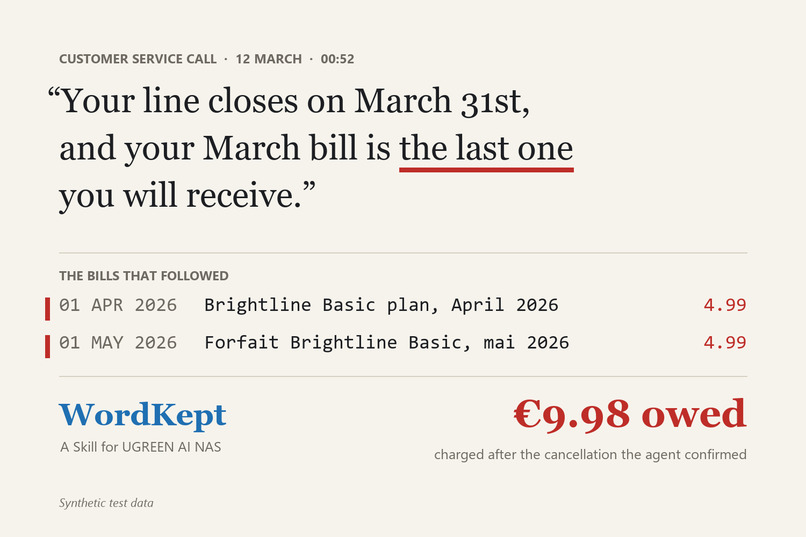
WordKept checks a phone promise against the bills that followed.
-
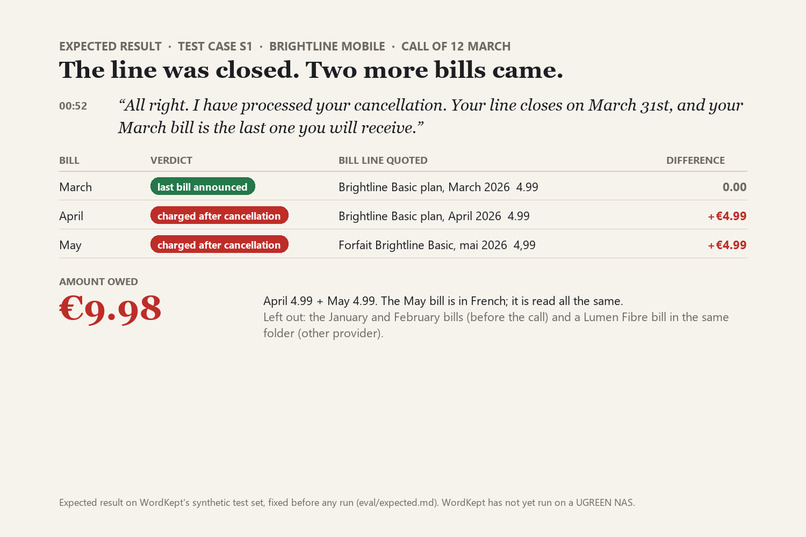
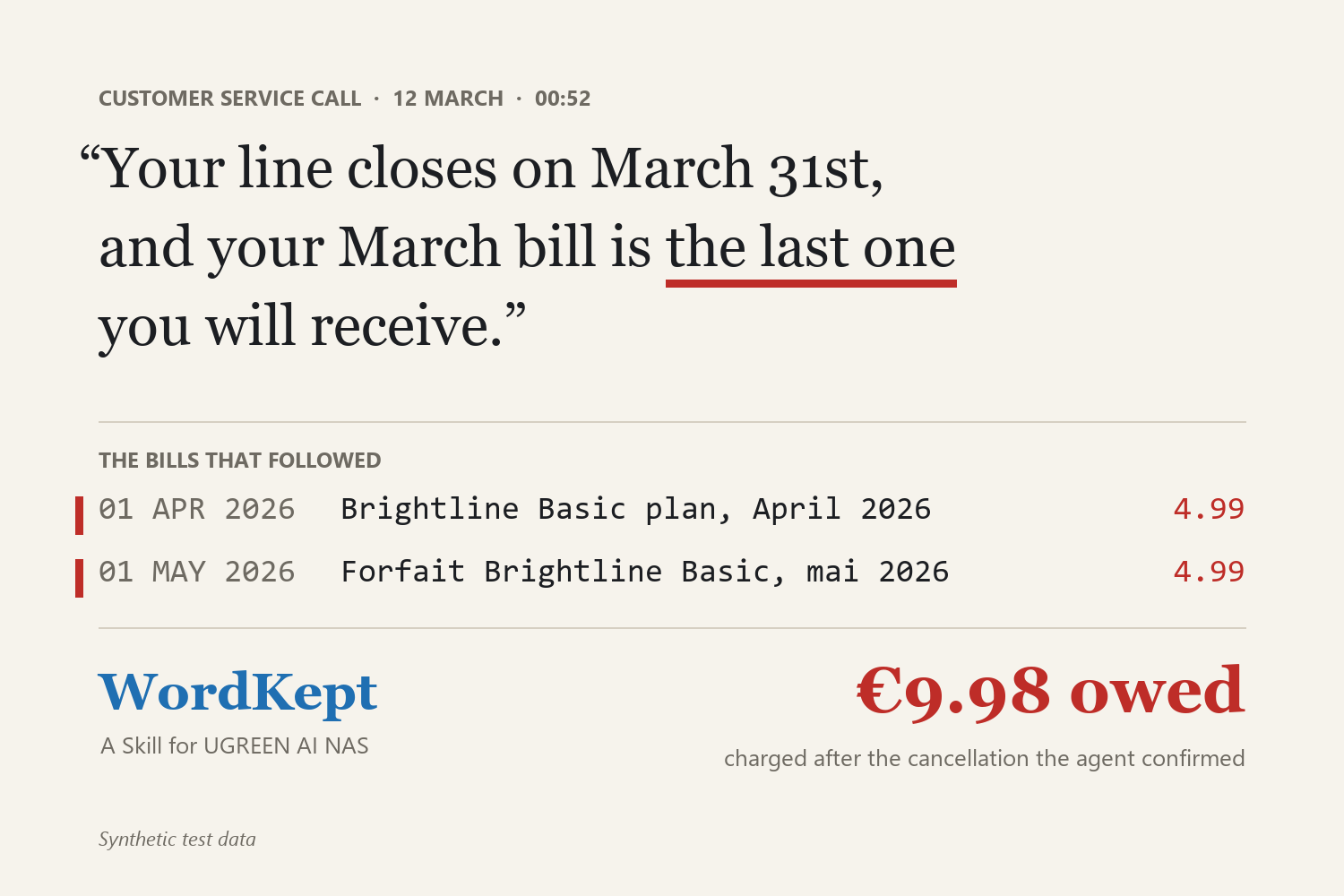
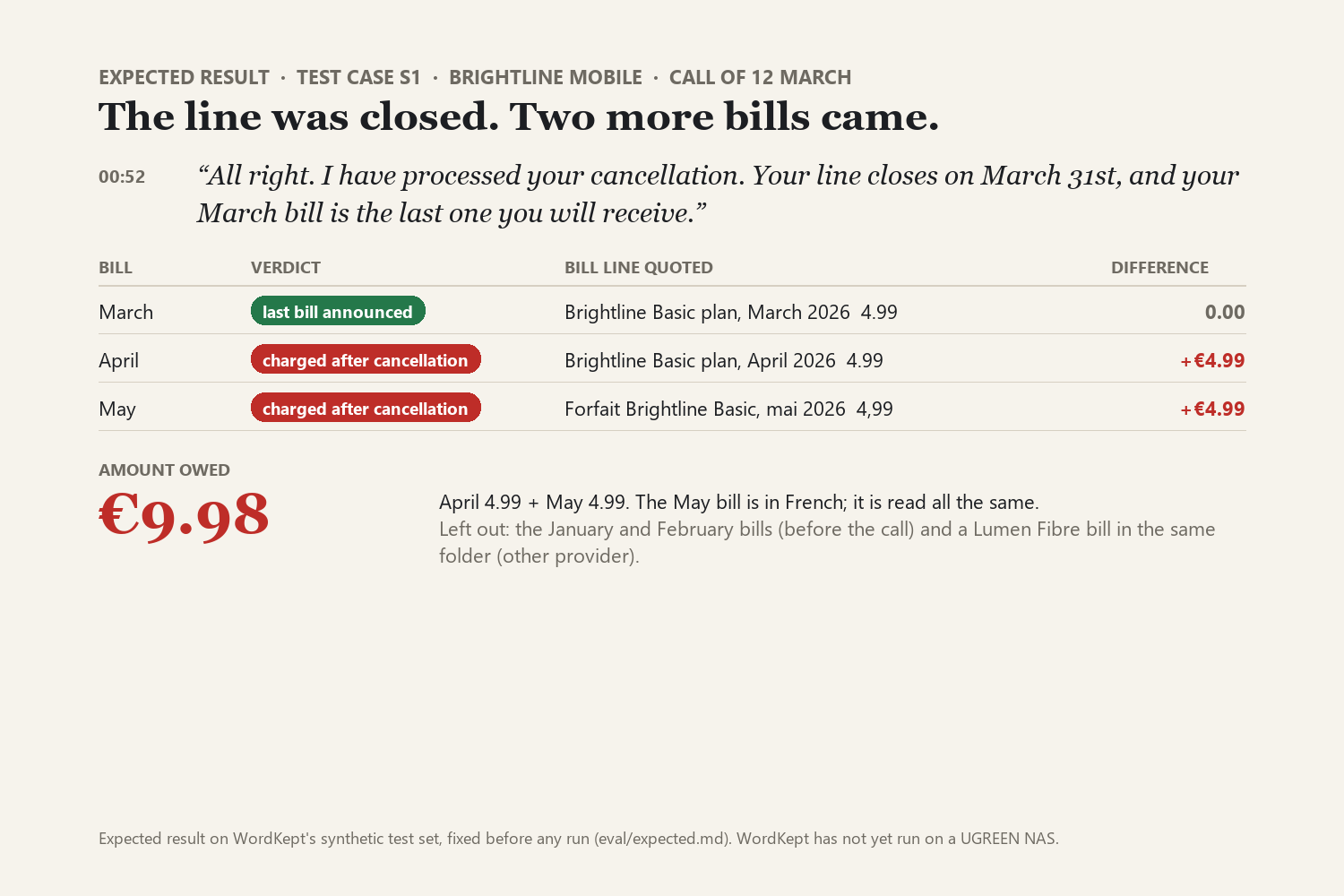
Expected result on test case S1: the agent confirmed the line would close on March 31st, yet April and May were still charged. €9.98 owed.
-
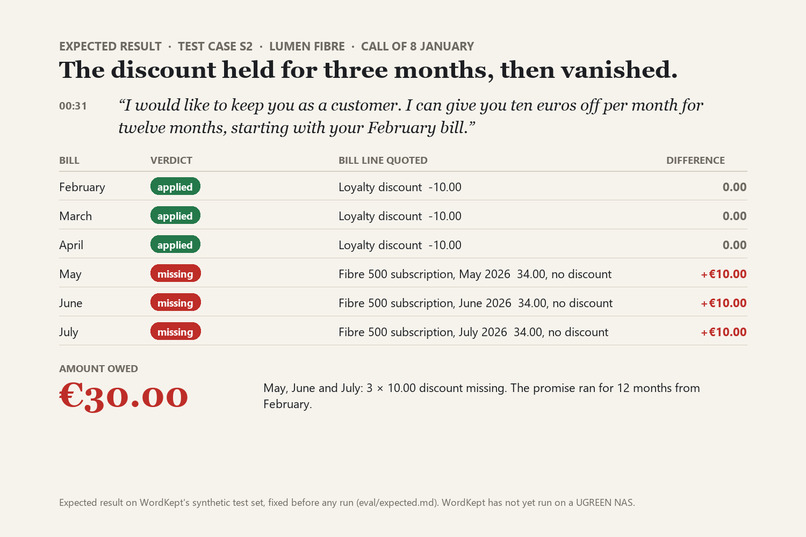
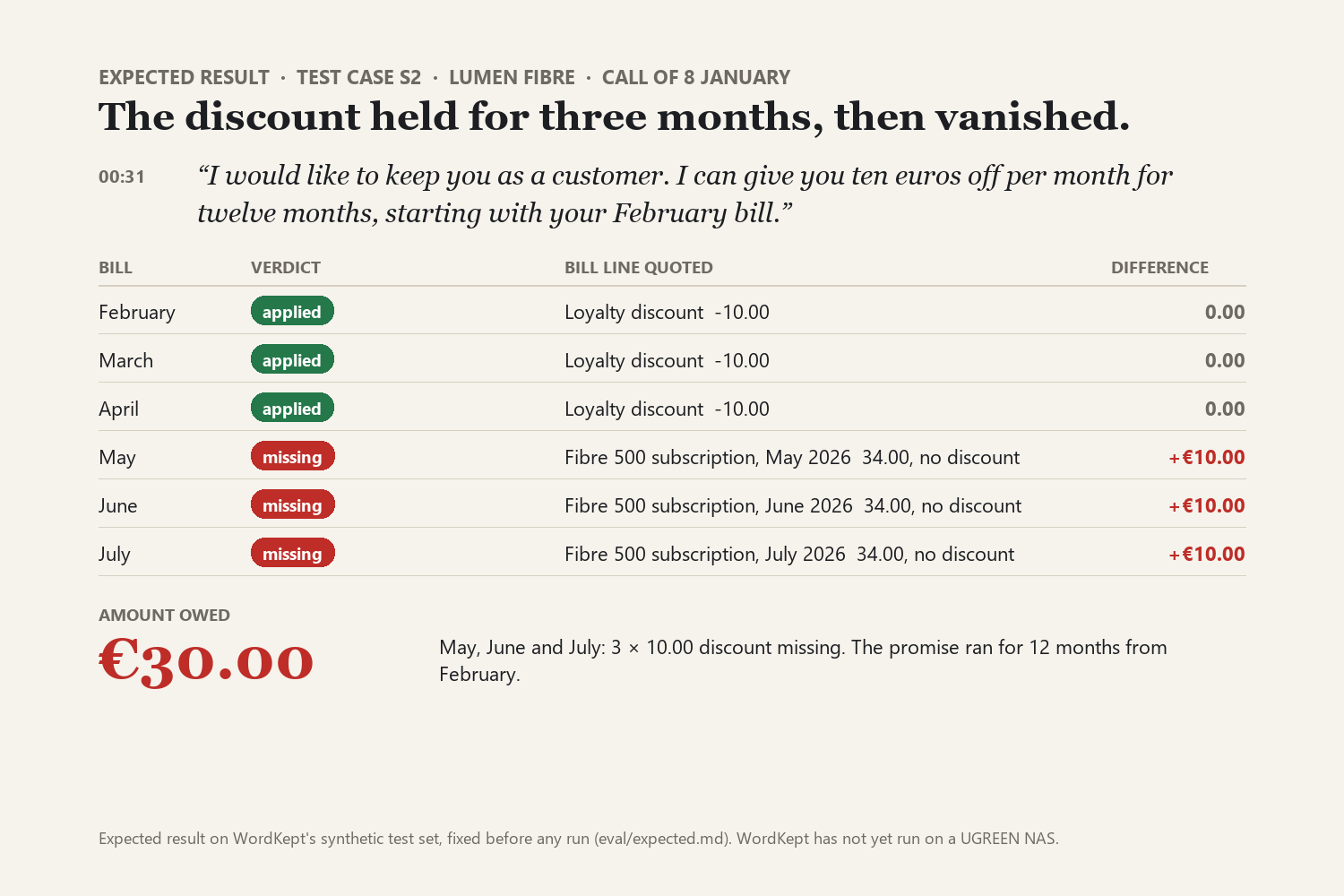
Expected result on test case S2: a €10 monthly discount promised for 12 months was applied for three months, then dropped. €30.00 owed.
-
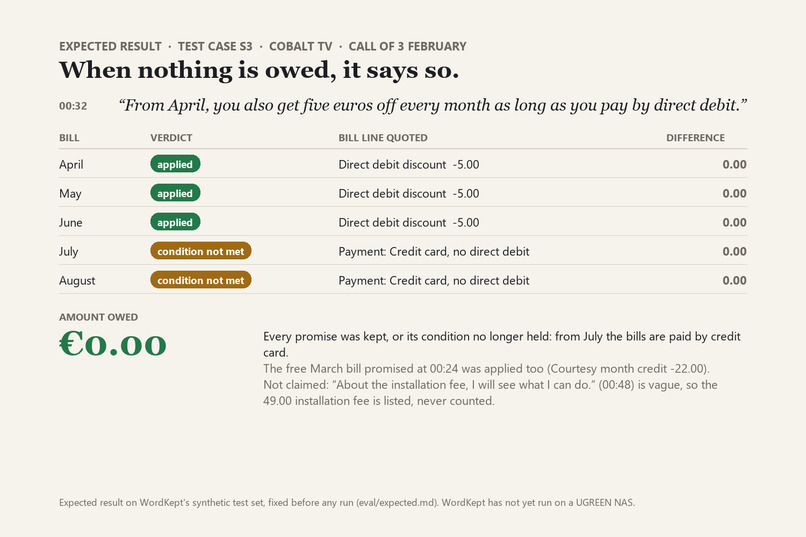
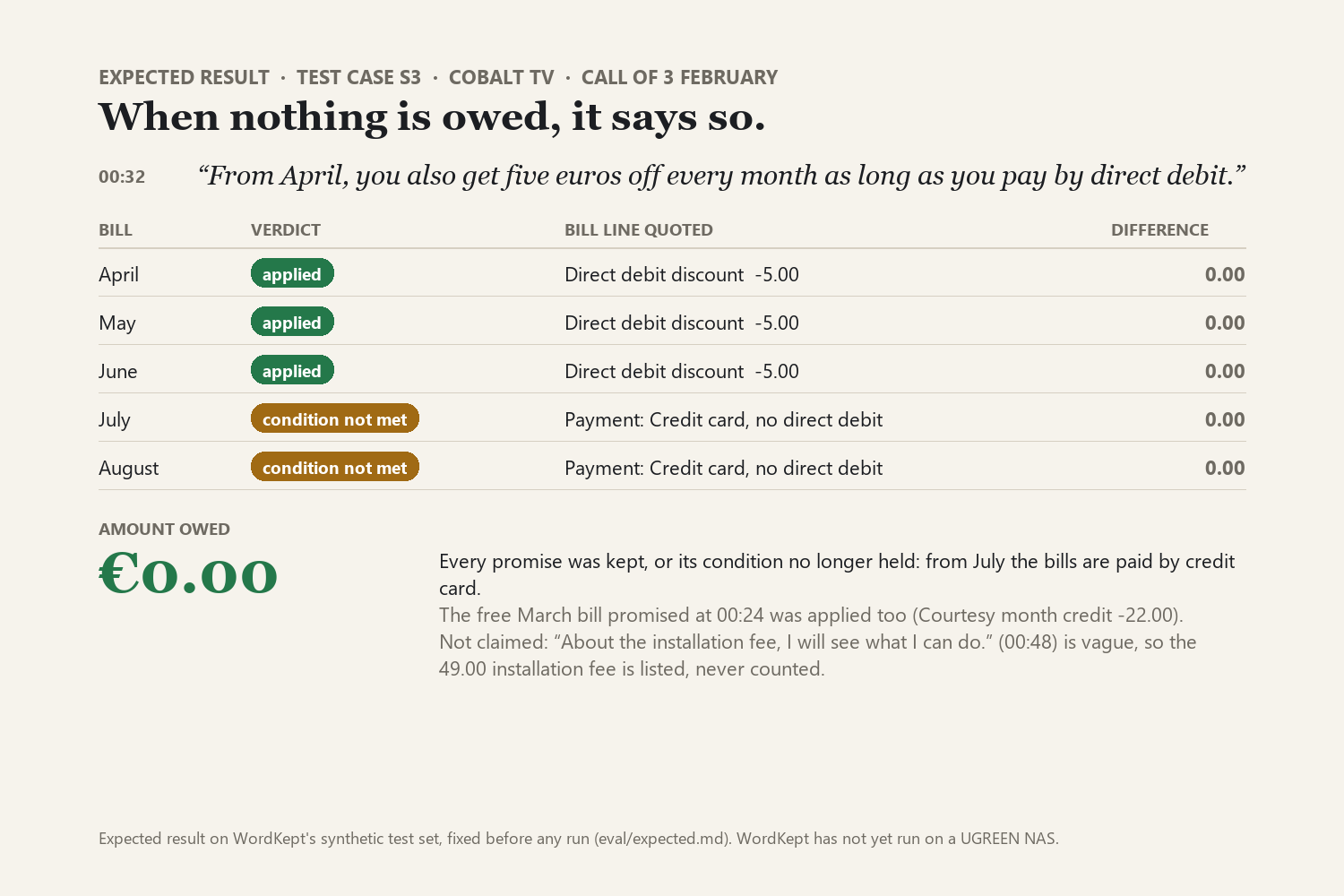
Expected result on case S3: every promise was kept, or its condition stopped holding when payment moved to a credit card. Nothing is owed.
Inspiration
In 2025 I cancelled my mobile plan, by phone and again at an agency. The charges kept coming for two more months, about 100 dirhams, and were never refunded. The agent had said the words. I had no way to show where, when, and how much it cost me.
That problem is not rare. Operator forums and telecom complaint bodies report the same story: a retention discount removed two months later, a free month never credited, an operator unable to find its own recording of the call. A spoken promise leaves no written trace, so a billing error stays unproven.
What it does
WordKept is a Skill for UGREEN AI NAS. It reads a recorded call and the bills that came after it, then shows where the promise held and where it broke.
Other promise checkers compare what was said with files or a contract. WordKept compares it with the money you were actually charged, bill by bill, and tells you how much you are owed.
- It transcribes the call and keeps a timestamp on every line.
- It extracts what the company agent committed to: a cancellation date, a last bill, a discount, a refund or a credit.
- It weighs the wording:
- Firm ("Your line closes on March 31st") is checked on every bill.
- Conditional ("five euros off as long as you pay by direct debit") is checked together with its condition, read from the bill itself.
- Vague ("I will see what I can do") is listed, but never claimed.
- The user confirms or corrects the promises before any bill is read.
- Each bill gets a verdict: applied, missing, partial, charged after cancellation, last bill announced, condition not met or outside period.
- It calculates the amount owed line by line and, on request, drafts a complaint letter that quotes the call timestamps and the bill lines.
A kept promise is reported as clearly as a broken one. If the payment method changed and the discount was removed fairly, WordKept says that nothing is owed.
Why a NAS? The evidence is already there. Phone backups put call recordings on the NAS, and bills arrive as PDFs that people already archive. These files are private: a call with your provider contains your name, address and account number, so they should not be uploaded to a web service just to check a bill. WordKept reads them where they are stored, writes nothing without your approval, and keeps a SHA-256 fingerprint of each file, so you can show later that the recording and the bills were not changed. The Skill calls no outside service, and with a local model in Uliya the whole check stays on the NAS.
How I built it
WordKept is a Markdown orchestration Skill (SKILL.md and three references), built with the official UGOS Skill Creation Tool. It delegates every NAS action to three registered experts:
| Expert | Capability | Used for |
|---|---|---|
| file-agent | ug-filesystem |
listing the recording and bills folders, SHA-256 fingerprints of the evidence |
| knowledge-agent | ug-knowledge |
transcription with speaker separation, saving the transcript and the report |
| document-agent | ug-document |
extracting the promises, reading the bills (invoice schema), verdicts, complaint draft |
Each step uses only the real result of the previous step. Empty results stop the run, unreadable bills get no verdict, and every write (transcript, report) waits for the user's approval. The Skill itself calls no external API. I used Claude Code as a coding assistant for research, drafting and checks.
To test it before getting NAS access, I built a synthetic test set: 6 recorded calls with two synthetic voices, filtered to telephone quality, and 24 invented bills from 5 fictional providers. It covers a cancellation ignored for two months, a discount silently dropped, a condition that stops holding, a notice period that must not be claimed, an amount drowned in line noise, and a call with no commitment at all. The expected verdicts and totals were frozen before any run.
Challenges I ran into
- Keeping the evidence. My first design saved the transcript without its timestamps, which would have made "at 00:52 the agent confirmed the line closes on March 31st" impossible to cite. Transcription and saving now happen in one step that writes one timestamped line per segment.
- Finding the right bills. File dates are download dates, not bill dates, and a March bill can be issued before a call on March 12. Bills are now filtered by their content: the provider, the account number said on the call, and a billing period that ends after the call.
- Not over-claiming. Relative dates ("your next bill"), notice periods, later refunds and conditions all had to be handled so the amount owed is never higher than what the bills support.
- Unknown hardware. Without a NAS, I could only check the Skill statically, so I kept to capabilities listed in the official catalog and wrote down what must be confirmed on the device.
Accomplishments that I'm proud of
- The Skill passes the official checker with 0 errors and 0 warnings.
- The synthetic test set passes 82 of 82 read-back checks, and its expected results were fixed in advance, so the test day measures the Skill rather than my expectations.
- The rule I care most about: WordKept never invents an amount. When the credit amount is covered by line noise, it gives the timestamp and asks the user to listen.
What I learned
The hard part was not reading a bill or transcribing a call. It was deciding what counts as a promise, and making the Skill choose the verdict that claims less whenever the evidence allows two.
What's next for WordKept
- Run the six test scenarios on a real UGREEN AI NAS. I will check transcription on phone-quality audio, speaker separation, and whether invoice extraction returns discount lines and payment methods.
- Support a cancellation spread over several calls.
- Test with more bill layouts and with calls mixing French and English.
