Woop
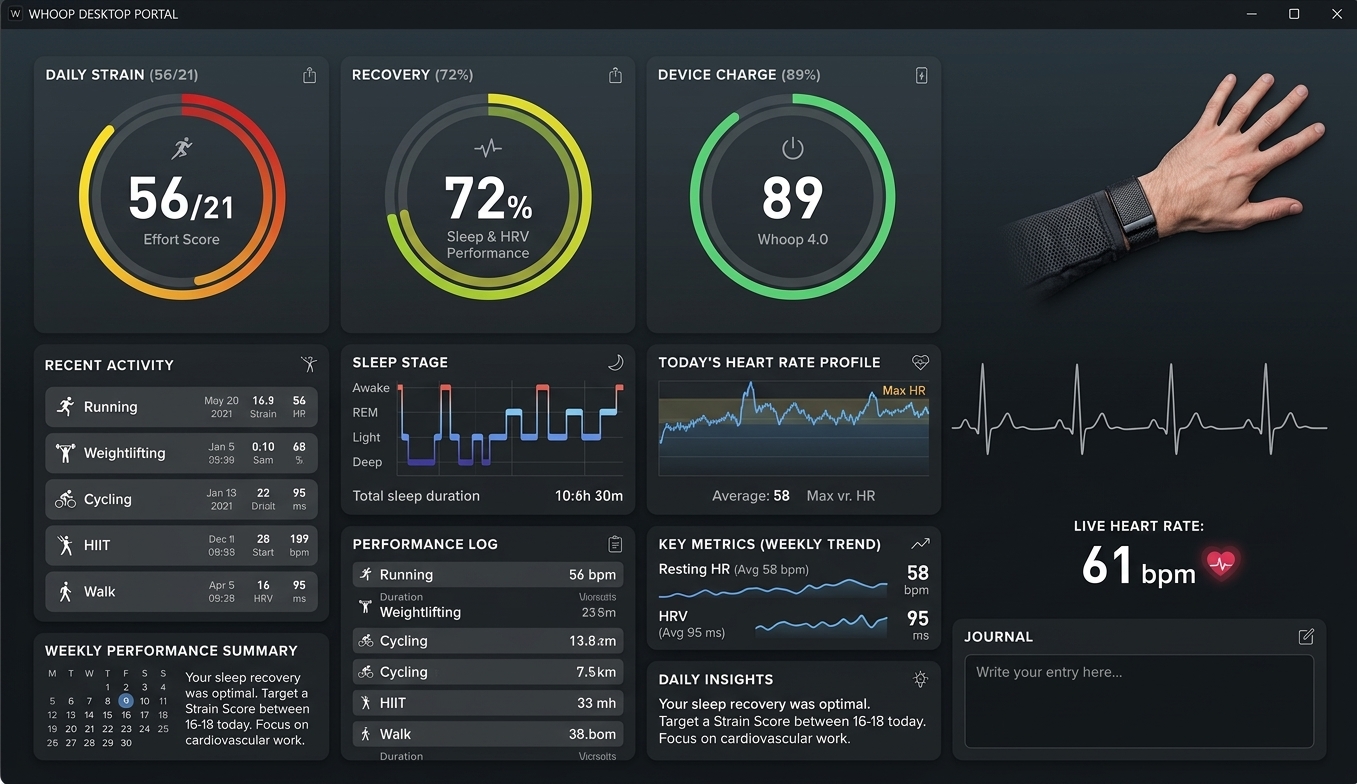
A free, self-hosted alternative to the WHOOP app. Woop connects straight to a WHOOP strap over Bluetooth Low Energy, pulls your data onto your own computer, and turns it into recovery, sleep, and strain scores without a subscription.
Inspiration
I wear a WHOOP, and I really like the data it collects. The catch is that the strap is basically locked behind a monthly subscription, and all of your own body's data lives on someone else's servers. That bugged me. It's my heart rate and my sleep, so why can't I just look at it myself?
I also had zero BLE experience going in, and I figured trying to talk to the strap directly would be a good excuse to learn it properly.
What it does
- Connects to a WHOOP strap over Bluetooth Low Energy without using the official app
- Subscribes to live data from the strap and captures physiological readings as they come in
- Calculates recovery, sleep, and strain scores locally, with no cloud involved
- Stores everything in a local SQLite database so your history stays on your machine
- Shows it all in a desktop app so you can actually look at your own data
How I built it
Woop is a Windows desktop app written in C#.
- Bluetooth: The WHOOP's BLE protocol isn't documented anywhere, so I had to reverse-engineer it. I used the WinRT Bluetooth APIs to connect to the strap, find its GATT services, and subscribe to characteristic notifications. Once I figured out which characteristics were sending what, I could capture live data without the official app.
- Processing: The strap sends raw biometric data, so I wrote offline algorithms in C# to convert it into recovery, sleep, and strain scores.
- Storage: Synced data goes into a local SQLite database.
- UI: The front end is a WPF/XAML desktop client.
The code is split into a generic BLE client that handles the connection stuff, and a strap-specific client that handles the WHOOP protocol itself.
Challenges I ran into
The most annoying problem was the strap going silent on me. If I sent it the wrong information, it wouldn't throw an error or send anything back. It just stopped responding, with no message at all.
That made debugging really confusing. I'd send a message, the strap would go quiet, and I'd assume that message was the broken one. But a lot of the time the real culprit was a different message I'd sent earlier that I thought was fine. The strap just didn't react until later. I ended up having to go back through everything I'd sent, one message at a time, to figure out which one actually caused it.
Also, learning BLE from scratch (services, characteristics, notifications) took a while by itself.
Accomplishments that I'm proud of
It's free! I connected to a device that already exists and works, and I didn't need anyone's permission or subscription to do it. I had to teach myself BLE to make it happen, and now I can track my own data, on my own computer, that's just mine. That's really cool to me.
What I learned
- How BLE actually works: GATT services, characteristics, and notifications
- How to reverse-engineer a protocol that has no documentation
- Debugging a device that fails silently, which means being really careful about what you send and in what order
- How to turn raw sensor data into scores that mean something
Helpful resources
I wasn't the first person to poke at the WHOOP's Bluetooth protocol, and these projects and write-ups helped me understand how the strap works and how it communicates. Big thanks to the people behind them:
- judes.club: WHOOP 5 experiments
- reverse-engineering-whoop-post by bWanShiTong
- noop by ryanbr
What's next for woop
Right now everything gets calculated on the desktop. Next I want to connect Woop to my personal server so the data is sent there, calculated there, and parsed there. That way my data lives in one place I control and I can build more on top of it.

Log in or sign up for Devpost to join the conversation.