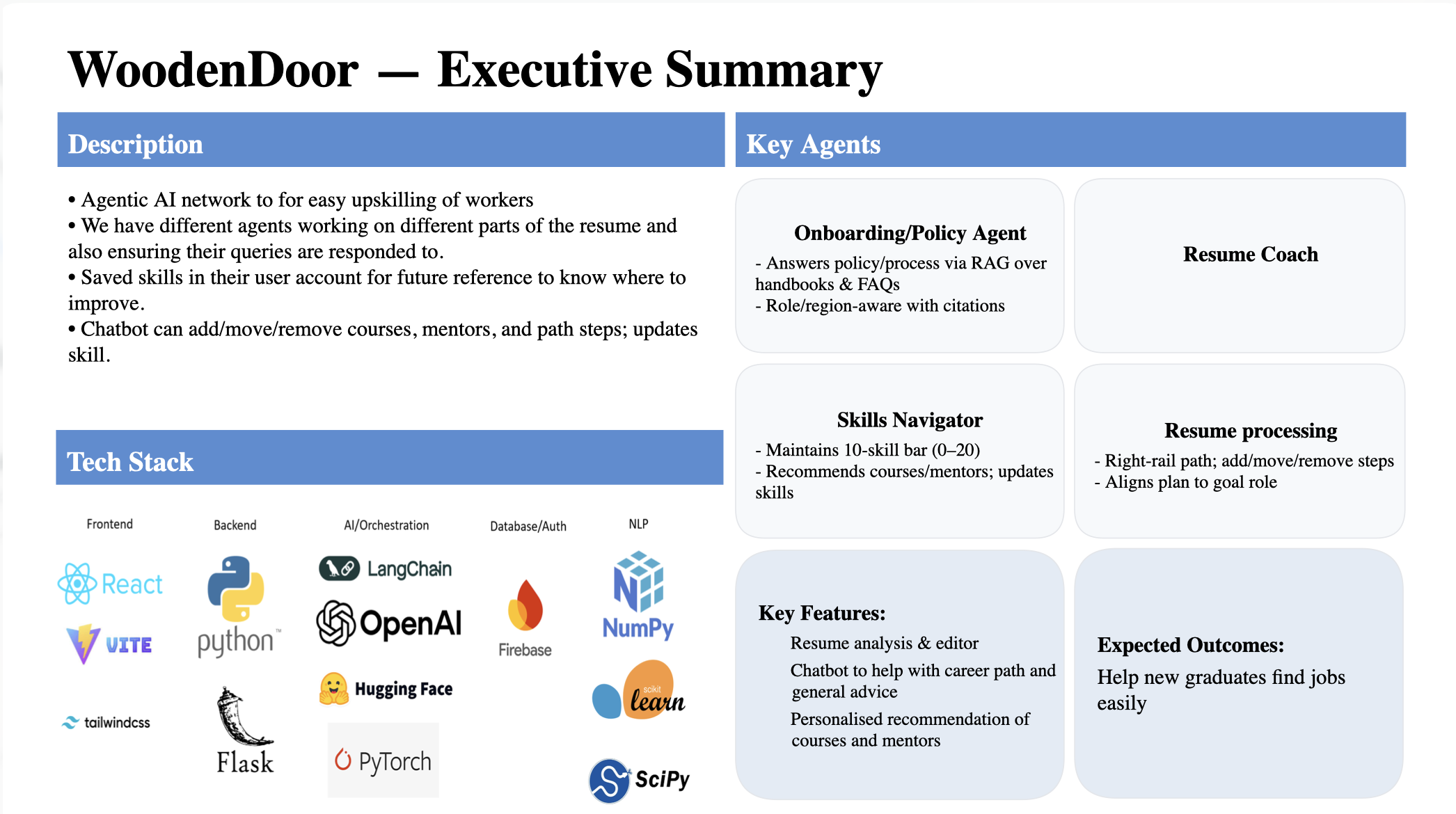
Job boards show thousands of listings, mentors are hard to find, and no one ties it together. We wanted something that takes a student’s resume and turns it into a clear path, with concrete next steps. We built this as a React frontend with a Flask backend and Firestore for storage. The roadmap and skill insights are generated from the user profile and resume data, and then we surface job listings, courses, and mentors that line up with that trajectory. Everything is designed to stay fast and easy to understand.
The hardest parts were the messy realities: quota limits, inconsistent job data, and keeping everything responsive. We ended up adding caching, normalising filters, and trimming features to keep it focused.
In the end, WoodenDoor is about reducing anxiety. It gives early career users a roadmap and tells them what to do next, instead of making them guess.
Technical details: The system is a network of agentic AI with differing responsibilities for different AI. We have a resume processor that uses rag concepts to extract keywords from the resume and score it appropriately and make that score easily quantifiable and accessible by user. Furthermore, we have made use of langchain to interface the chat gpt LLM with tools that it can use on to manipulate the user data. Each career and profile will have an associated skillset and that skillset is basically used in a lot of vector comparisons to identify close matches and recommend next steps to take. Career paths are constructed using these vectors as nodes with a simple djikstra's algorithm to dynamically map out the shortest path to take assuming that its always best to jump job to a close match that brings you closer to the target end goal.


Log in or sign up for Devpost to join the conversation.