Inspiration
Three photographs. A doorman who already knows your name. A single Guest Relations desk. A warm lamp and a glass of water by the bed. No app, no code — just the feeling that someone arranged everything before you had to ask. We had been building the opposite: a travel platform where buying one vacation meant holding ten sub-vouchers, three pending reservations, and a QR code to present at a front desk. Every flow worked. The system had optimized for how the platform settles money, not for how a person experiences a trip. That gap became the project. WondoGo is a bet that discovery is the entry point, a butler is the moat, and booking is just the underlying capability.
What it does
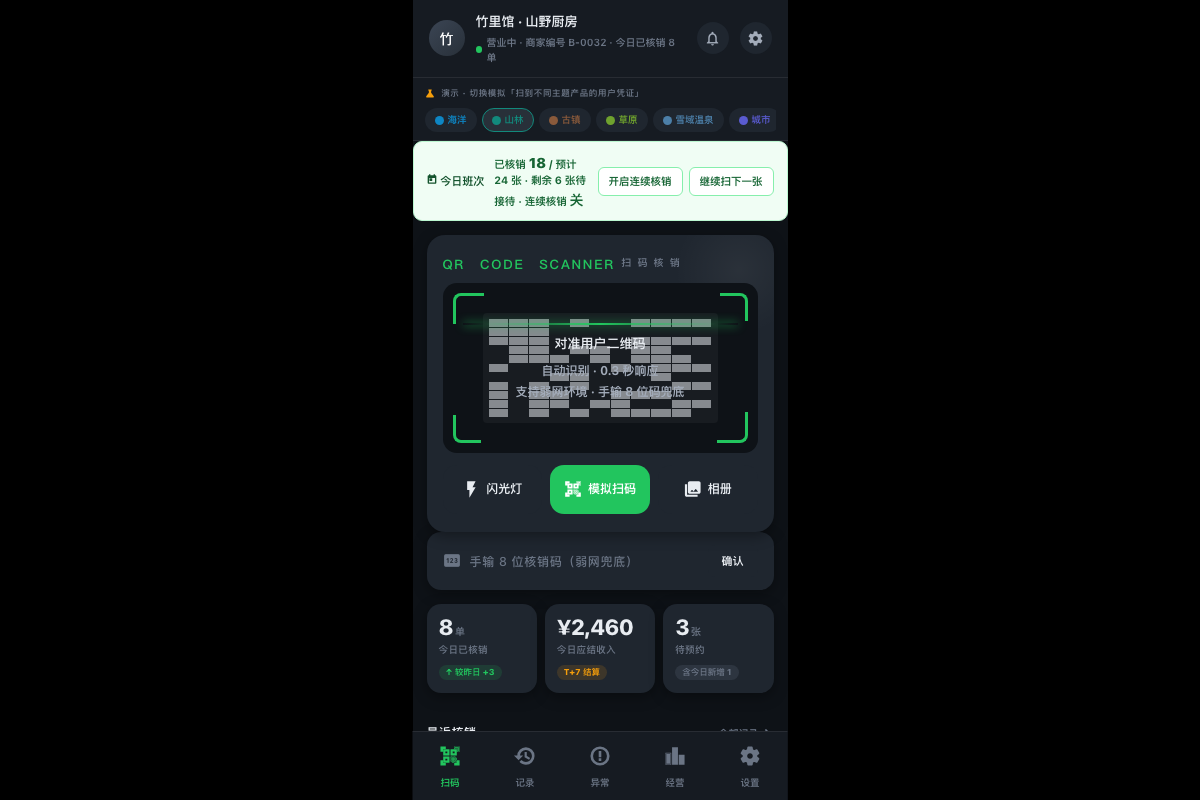
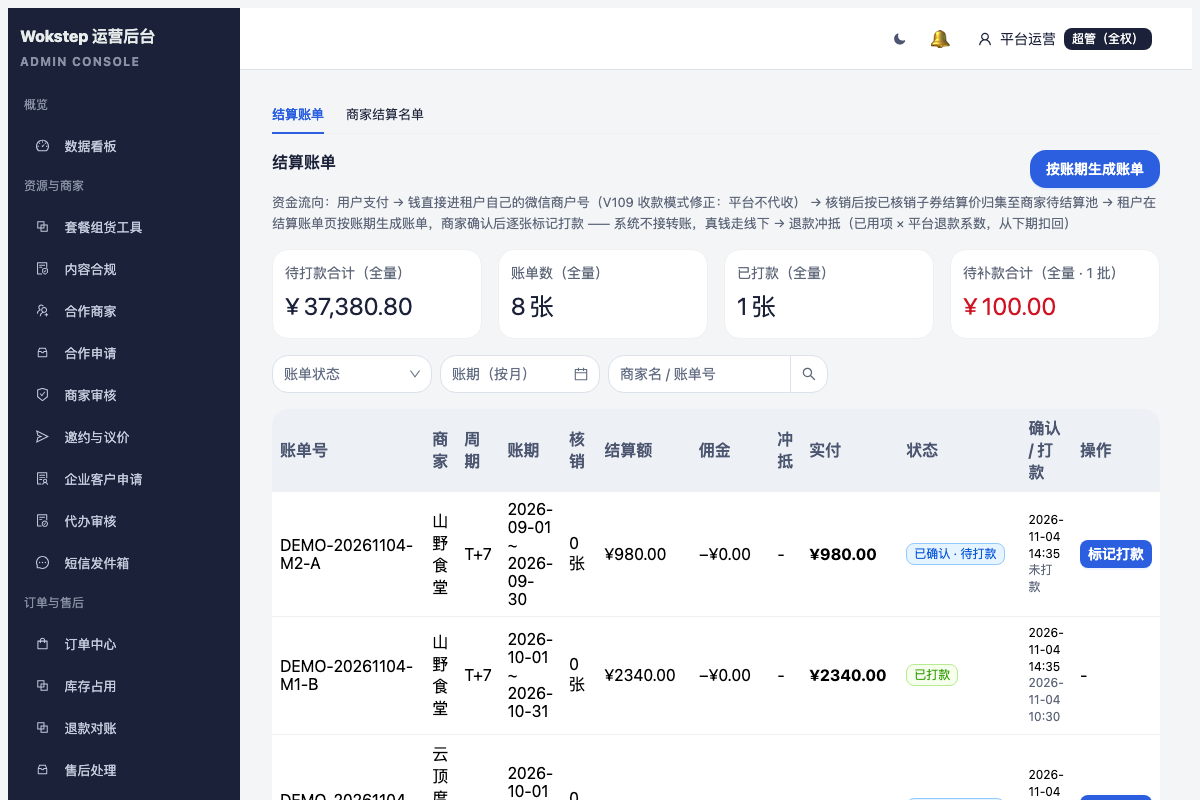
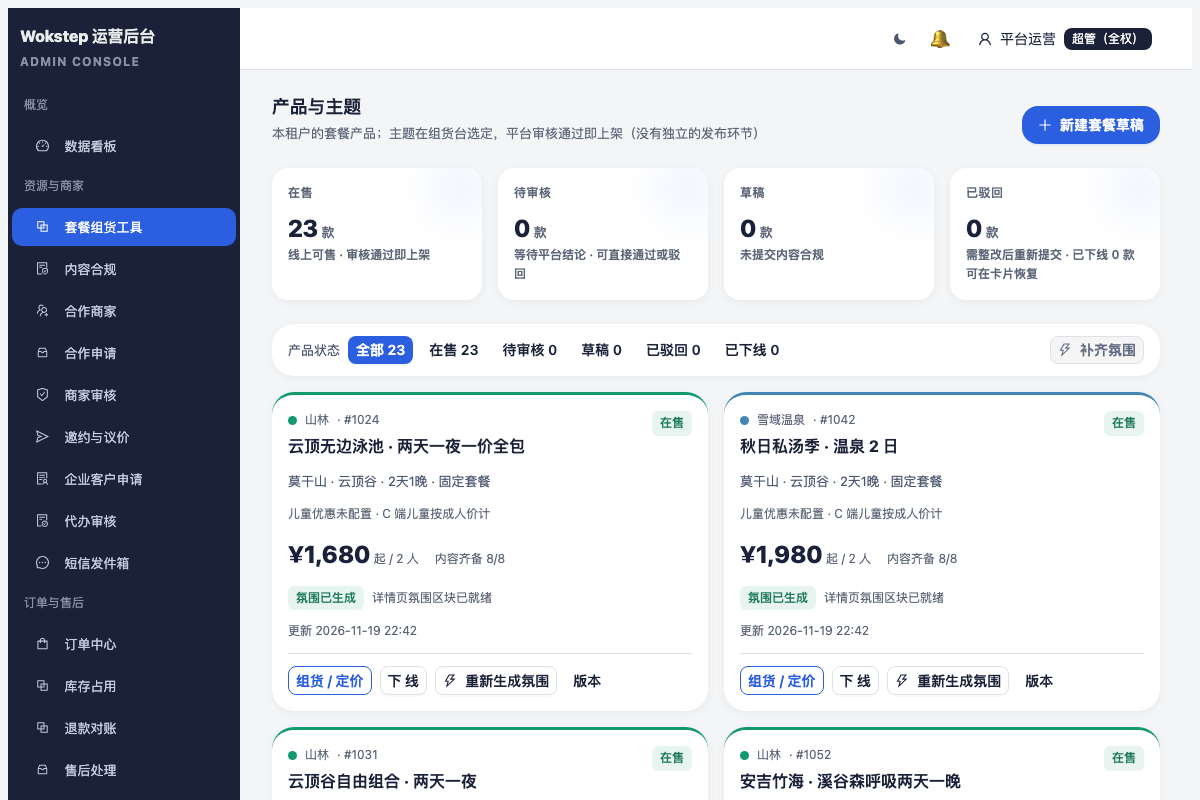
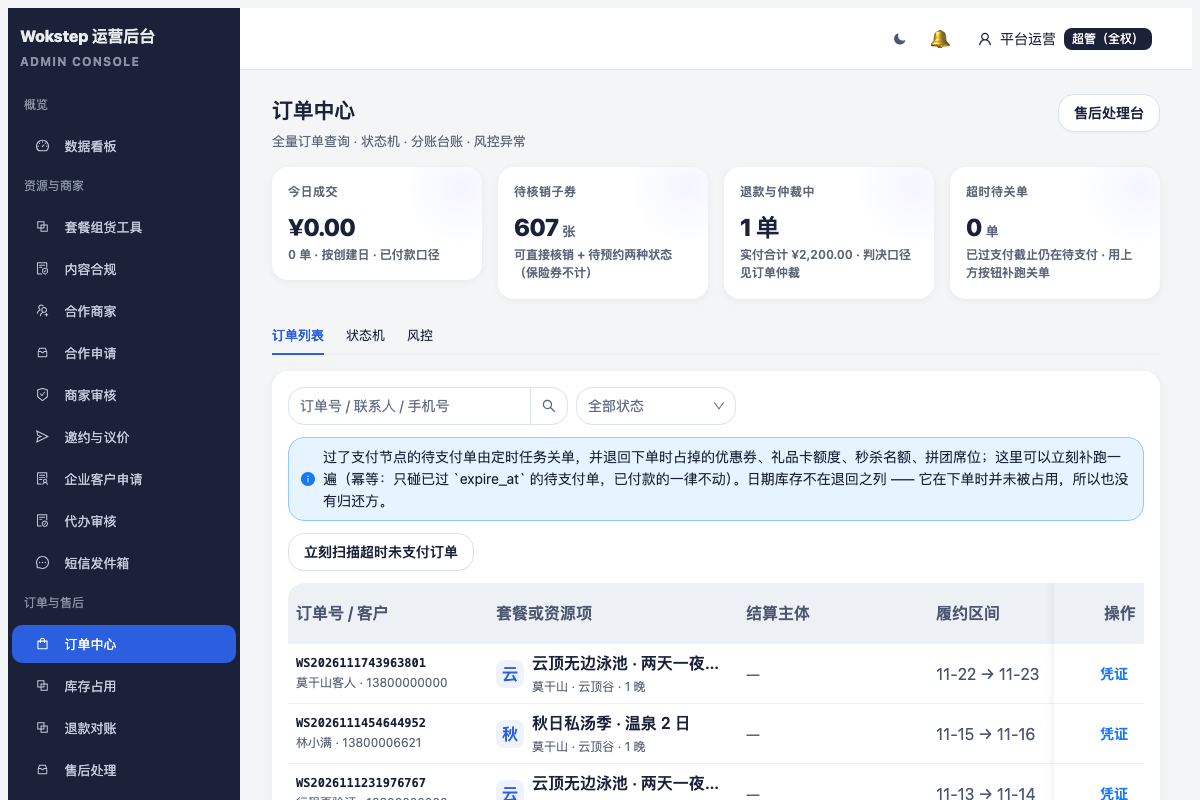
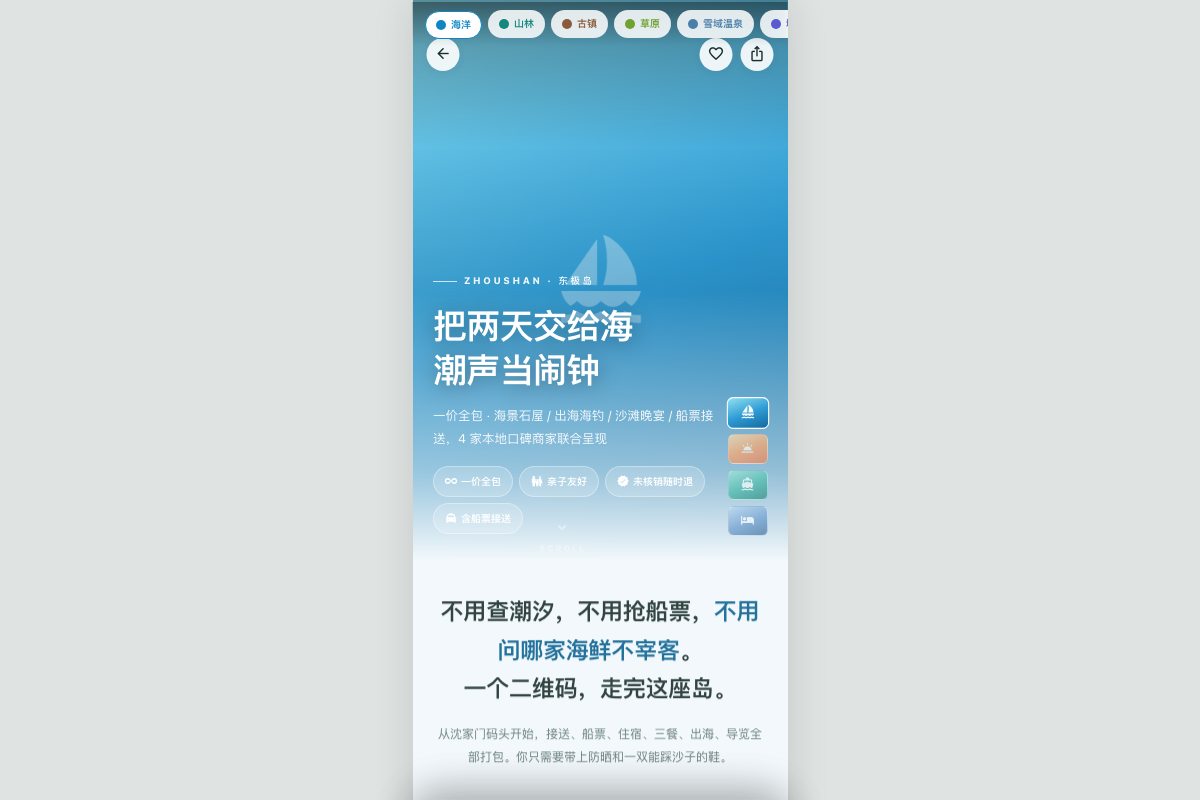
For travelers: one itinerary, not a voucher wallet. A single timeline, one "everything is ready" state, one butler who already has the context — flight, dietary needs, celebration, arrival time. For merchants: a shared inventory pool that makes overselling structurally impossible, plus a dashboard built for a front desk at 2am — large tabular numbers, three-tap verification, a three-step fallback when a code fails. For platform operations: arbitration with the money impact calculated before the ruling, a theme library that adds a destination type without a release, and settlement that reads from a price snapshot rather than live prices.
How we built it
Data model first. Resource item → package → order → sub-voucher, with a shared pool as the single hard constraint: [\sum_{i \in \text{packages}} q_i \;\leq\; Q_{\text{pool}}] Soft quotas per package only warn. A sold-out pool delists every package referencing it — overselling becomes impossible by construction, not by policy. Price locking at payment success. The snapshot is written the moment payment succeeds. Unpaid orders re-price and must pass an explicit "price changed — continue or revise" gate. This closed a real hole where a merchant could change a price mid-checkout and the user would be charged silently. Coupon cost as two dimensions. Scope (package vs. item) sets the allocation range; cost bearer (platform / merchant / proportional) sets who pays. Conflating them makes merchant ROI look artificially high whenever a platform coupon is issued. A design system, not fifty-six patches. Every CSS variable got an explicit fallback after an audit found 58 undefined variables across 27 files. The grassland theme's primary button moved to #C2410C for a contrast ratio of: [\frac{L_1 + 0.05}{L_2 + 0.05} = 5.18 \;\geq\; 4.5 \;\;(\text{WCAG AA})] One portal. Six ends, one index.html: the portal links to the six per-end prototypes. AI embedded, not exhibited. Eight AI prototypes, one source of truth, but each surface exposes only its contextual card — a copilot drawer for travelers, an operations advisor for merchants, an arbitration assistant for the platform desk.
Challenges we ran into
Cross-surface state drift. The hardest bug wasn't technical. Four documents and six screens each held a slightly different version of "what happens after payment." The fix was process: one machine-readable truth file and a validation gate that fails the build when a screen disagrees with it. A corrupted binary masquerading as a page. One enterprise prototype was 25,837 bytes of unprintable data — not HTML, unopenable in any browser, 0.6% printable characters. It was the only screen on that surface. We rebuilt it from spec, aligning every number with the AI proposal and the finance pages so the cross-surface chain held. Numbering collisions. Two screens reused IDs that already belonged to tenant management and corporate transfer. Renumbering was mechanical; catching every downstream reference across seven documents was not. The compliance dead end that wasn't. We spent two rounds saying "blocked on legal." That framing treated one module's regulatory constraint as a precondition for the whole launch. Splitting delivery into three waves let two start immediately.
Accomplishments that we're proud of
56 pages, 11 end-to-end links, zero broken chains. Every cross-surface flow — order to verification to arbitration to settlement — walks through without a dead end. Zero console errors, zero external dependencies. 42 Google Fonts requests and one third-party tracker removed; 295 Material icons replaced with an offline fallback. WCAG AA across all six themes, with an automated contrast validator built into the theme library. A single source of truth that actually holds. 13 machine-readable spec files, zero dangling references, change control documented. Two interchangeable compliance forms sharing one data model — a legal answer flips a config flag, not the architecture.
What we learned
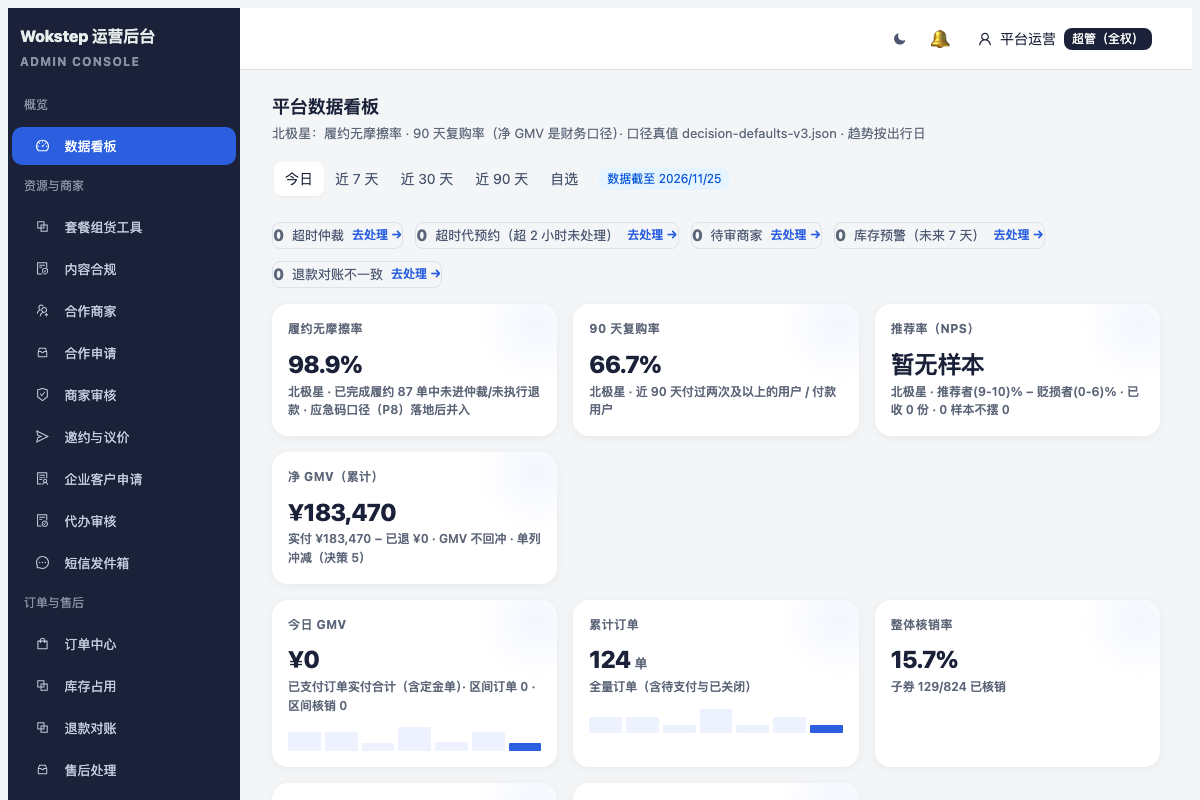
Complexity has an address, and it is not the user's screen. If a user has to understand your settlement structure to complete a purchase, the product is wrong. A single source of truth is a design decision. Every team was locally right and globally wrong until we made the domain model the only place a state could be defined. Subtraction is the harder craft. Every review produced "you should also add…". The discipline that mattered was asking whether it changed the user's experience or only the maintenance surface. Metrics shape behavior more than roadmaps do. GMV as a north star pushes a premium product toward volume and discounting — directly against its own design language. We replaced it with: [\text{Frictionless Rate} = \frac{N_{\text{no manual intervention}}}{N_{\text{fulfilled}}}, \qquad \text{90-day Repurchase} = \frac{N_{\text{returning}}}{N_{\text{cohort}}}]
What's next for WondoGo
Wave 1 and Wave 2 start in parallel — core fulfillment and platform operations. Wave 3 (enterprise benefits) is gated on a legal opinion, but the two forms share one data model, so the answer flips a flag rather than triggering a rewrite. Immediate work: backend integration against the API contract, analytics instrumentation, and the permission matrix. Then the eight P2 polish items — merchant price-change preview, offline verification queue, AI confidence display — post-launch backlog, not blockers. The long-term bet is the supply flywheel: a merchant earnings simulator, fulfillment quality feeding back into pool eligibility, and a platform that can promise "no room on arrival, we pay" because supply is actually controlled.
