-
-
WonderQuest Hero
-
Ready to Explore
-
Mini Lesson and Wonder Map
-
Challenge, Teach-Back, and Clarity Check
-
Understanding Proven and Learning Proof Card
Inspiration
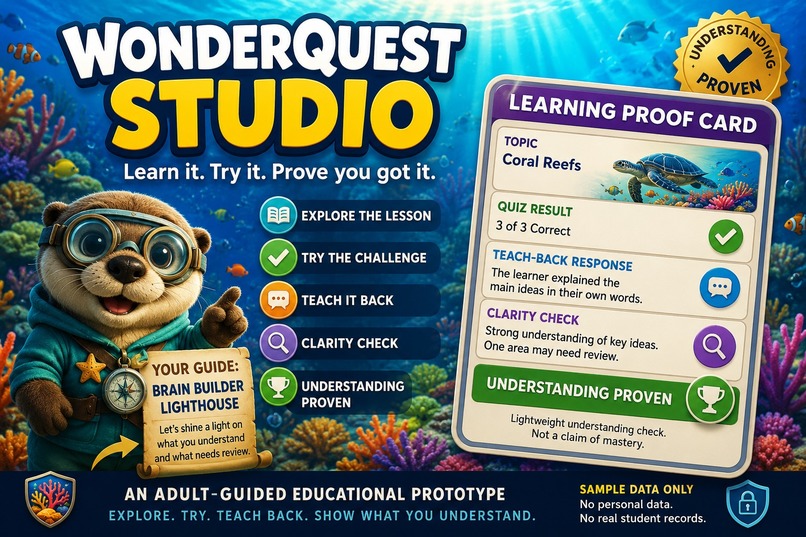
Most AI education tools stop when a lesson is generated. WonderQuest Studio explores a different question: can the learner explain the idea in their own words?
I created WonderQuest Studio for OpenAI Build Week 2026 to demonstrate a learning experience that moves beyond lesson delivery and multiple-choice answers. The goal is not to replace parents, teachers, or human encouragement. The goal is to help turn a big topic into a middle-school-friendly learning path with a clear finish line: understanding that can be checked.
WonderQuest Studio makes learning evidence more visible through exploration, practice, teach-back, reflection, and a final Learning Proof Card.
What it does
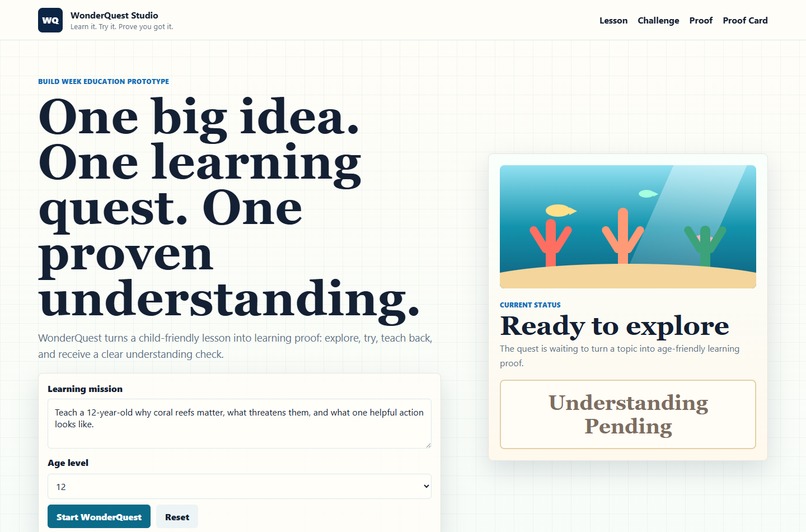
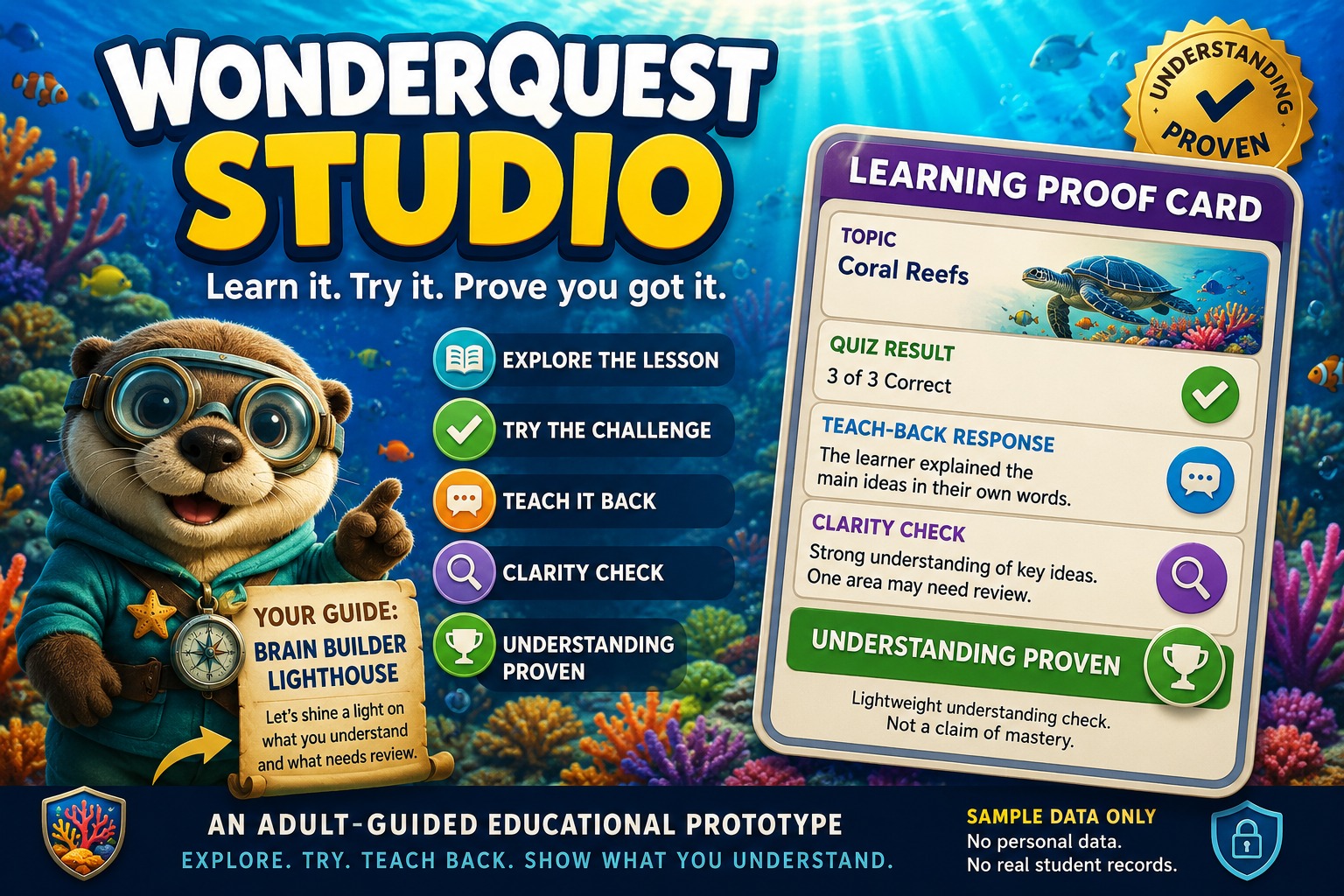
WonderQuest Studio is an adult-guided education prototype for middle-school-level learning. It turns a topic into a short interactive learning flow.
The demo mission is:
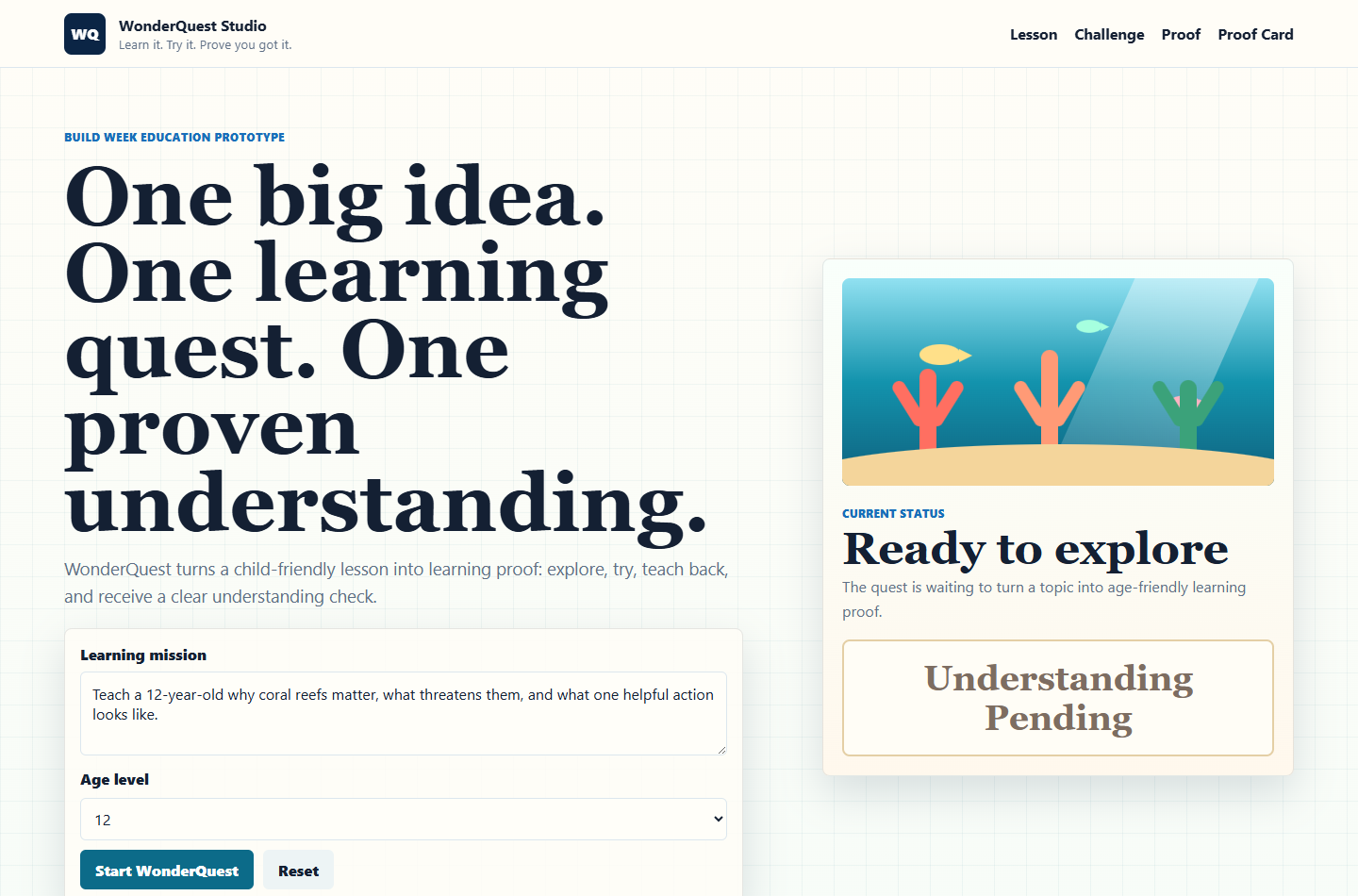
Teach a 12-year-old why coral reefs matter, what threatens them, and what one helpful action looks like.
The workflow moves through:
Topic -> Age Level -> Wonder Map -> Mini Lesson -> Explore Cards -> Try-It Challenge -> Teach Back -> Clarity Check -> Understanding Proven -> Learning Proof Card
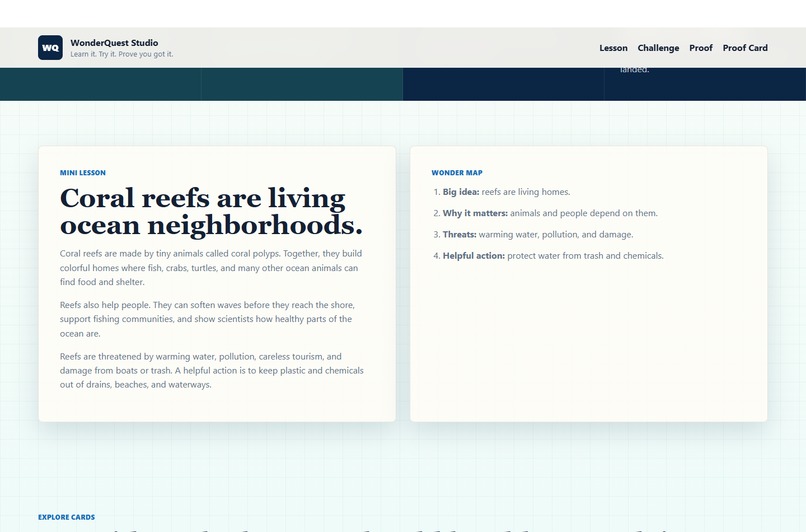
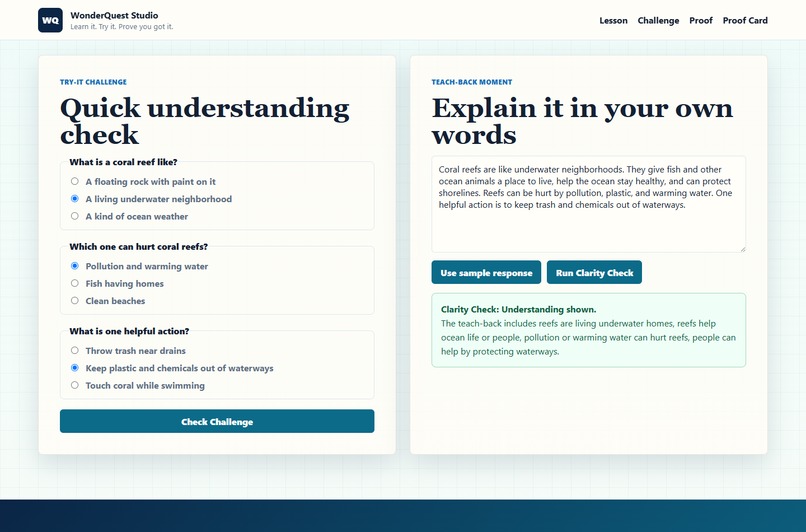
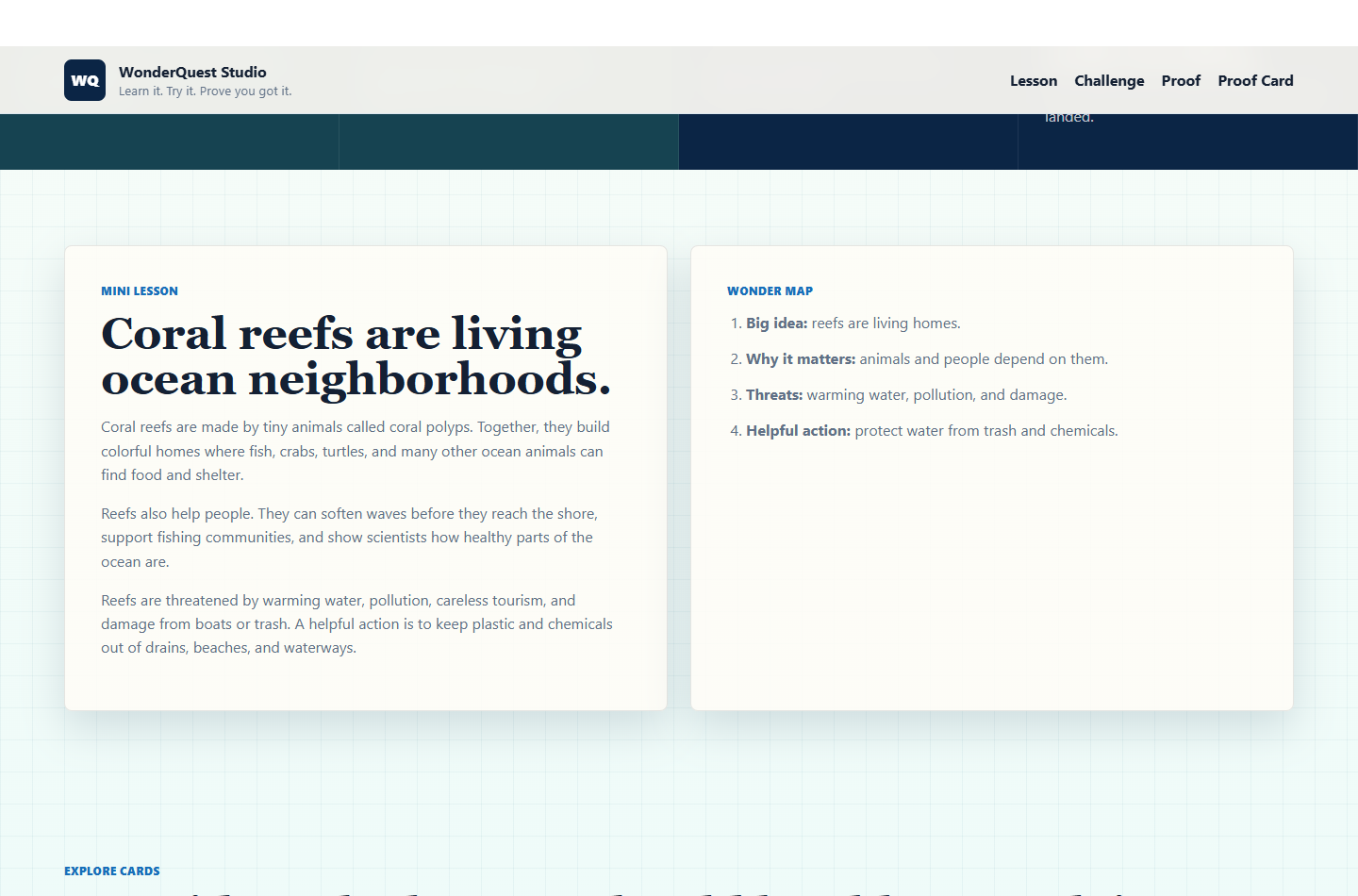
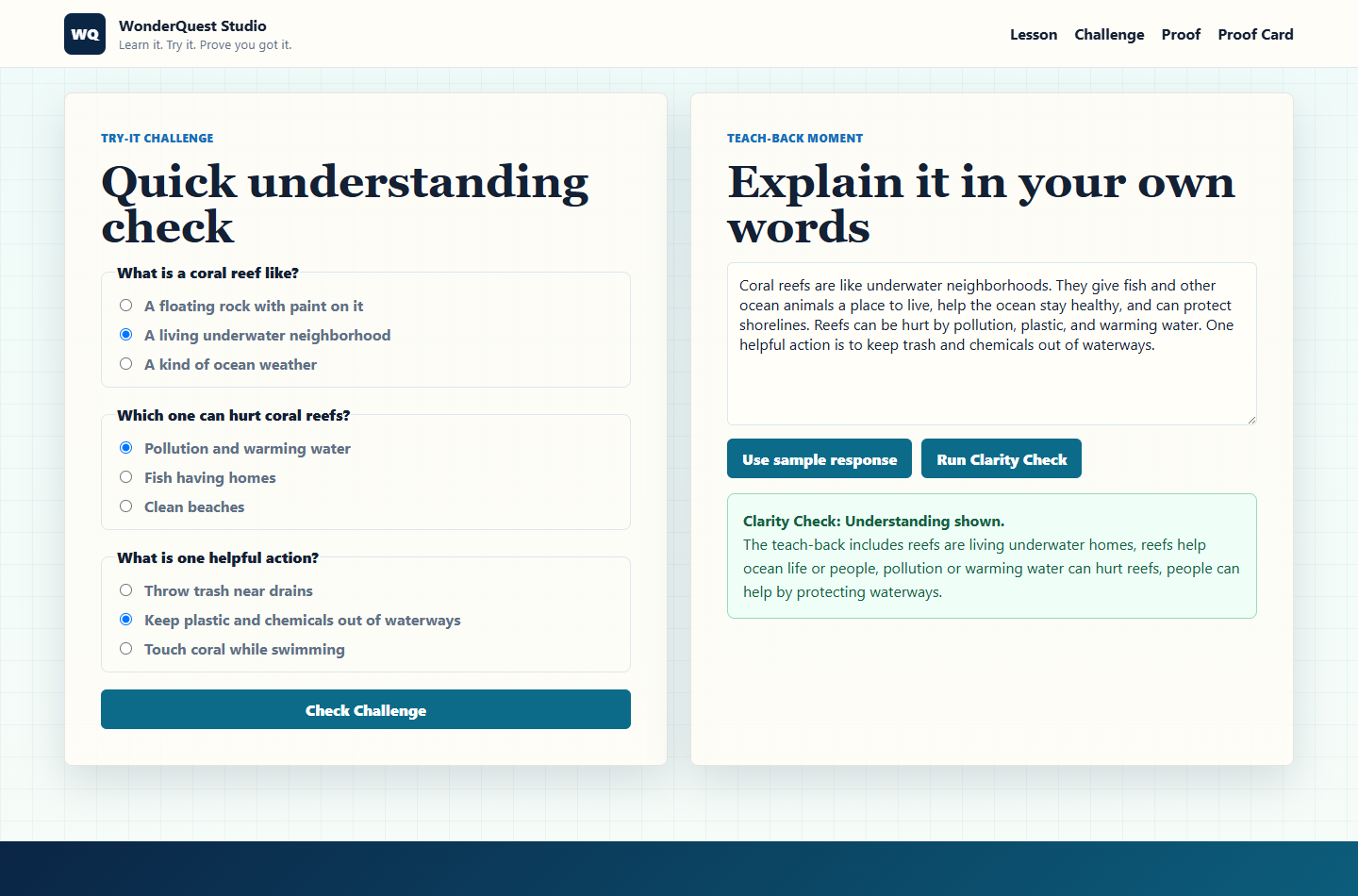
The learner first sees a Wonder Map that names the big idea, why it matters, the threats, and one helpful action. Then the learner reads a mini lesson, reviews explore cards, answers a short challenge, and teaches the idea back in their own words.
The Clarity Check looks for key ideas in the teach-back response. If the challenge and teach-back show enough understanding, the final result changes to:
Understanding Proven
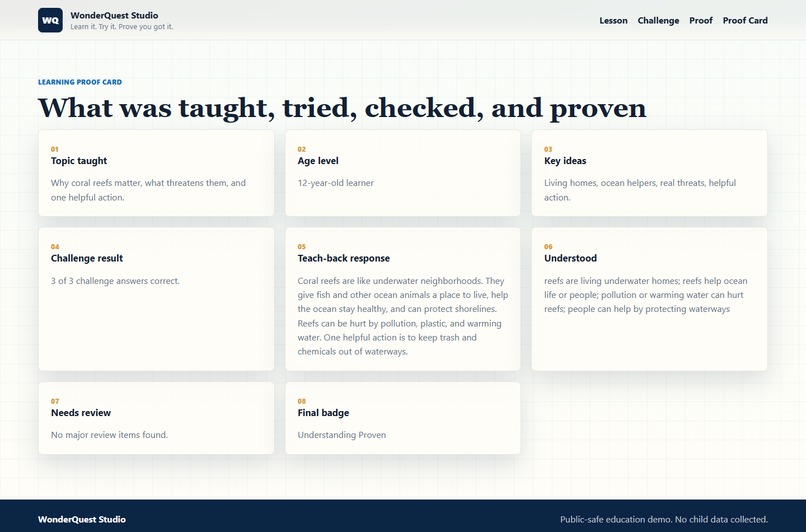
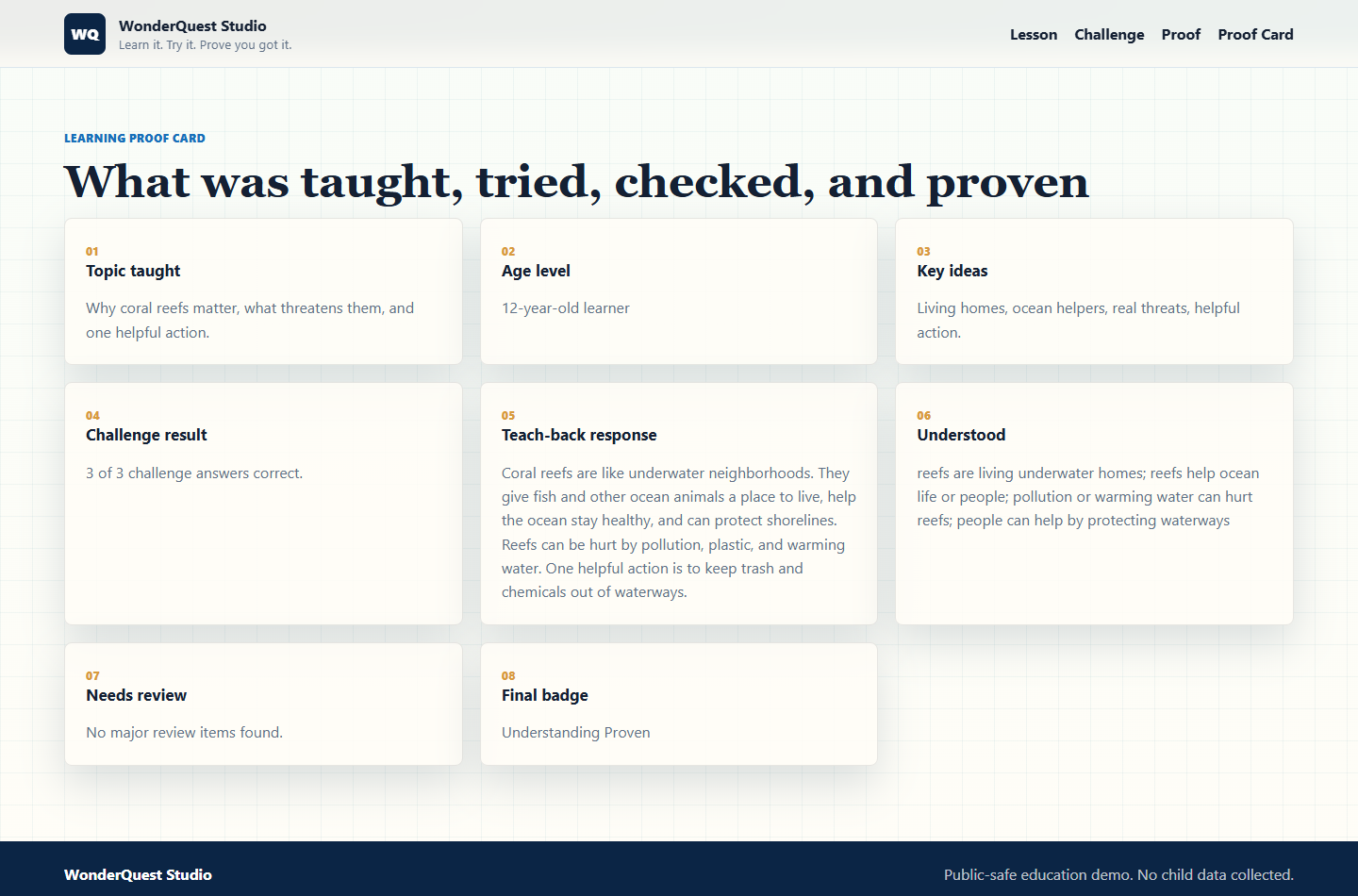
The Learning Proof Card captures the topic, age level, key ideas, quiz result, teach-back response, what was understood, what may need review, and the final Understanding Proven result.
WonderQuest Studio does not claim to prove mastery from a single interaction. Instead, it demonstrates one possible way to make learning evidence more visible.
How I built it
This Build Week prototype was developed as a standalone web application using HTML, CSS, and JavaScript.
GPT-5.6 helped define and refine the product concept, learning mission, age-level framing, lesson structure, success criteria, teach-back rubric, safety boundaries, and product language.
Codex materially helped build, debug, test, polish, verify, and prepare the working prototype for release. This included the interface, interaction logic, quiz scoring, keyword-based Clarity Check, Understanding Proven state, Learning Proof Card, responsive styling, documentation, release checks, screenshots, demo preparation, and submission packaging.
The v1 prototype uses deterministic demo content and a simple keyword-based clarity check. It is not a live autonomous tutoring system, does not collect child data, and does not grade real children.
Challenges I ran into
The biggest challenge was keeping the project both learner-friendly and honest. It would have been easy to frame the project as "AI makes lessons," but that was not the strongest or safest idea.
The stronger idea became:
Understanding Proven
The prototype needed to show that learning is not complete just because content was generated. A learner should try the idea, explain it back, and receive a clear check showing what was understood and what may need review.
Another challenge was child safety. Because this is an education prototype, I kept the demo public-safe: no accounts, no names, no personal data collection, no private chat features, no emotional dependency framing, and no medical, legal, or sensitive advice.
Accomplishments that I'm proud of
I am proud that WonderQuest Studio focuses on learning proof instead of only lesson generation.
The prototype demonstrates a complete journey from topic to age-level learning path, mini lesson, explore cards, challenge, teach-back, Clarity Check, Understanding Proven result, and final Learning Proof Card.
I am especially proud of the Learning Proof Card because it gives the learner, parent, or teacher a clear record:
Here is what was taught.
Here is what was tried.
Here is what the learner explained.
Here is what was understood.
Here is what may need review.
Here is the final result.
What I learned
I learned that education AI needs a different kind of care. It is not enough for the experience to be fun or smart. It must be age-appropriate, privacy-safe, transparent, and clear about the role of adults and teachers.
I also learned that understanding is more powerful when it becomes observable. A lesson can look complete and still miss the learner. The teach-back moment helps reveal whether the idea actually landed.
What's next for WonderQuest Studio
The next step would be to evolve WonderQuest Studio from this v1 demonstration into a more functional mission-based learning system with teacher or parent review, richer rubrics, configurable age levels, broader topic support, accessibility checks, and careful human approval gates.
The long-term vision is simple:
Learn it. Try it. Prove you got it.
GPT-5.6 helps define the learning mission. Codex helps build the artifact. WonderQuest Studio helps make understanding visible.
Built With
- codex
- css
- design
- edtech
- education
- gpt-5.6
- html
- javascript
- openai
- product
- prototype
- ux

Log in or sign up for Devpost to join the conversation.