-
-
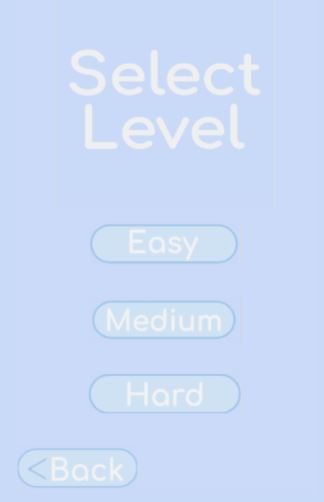
Level Select Screen of our app
-
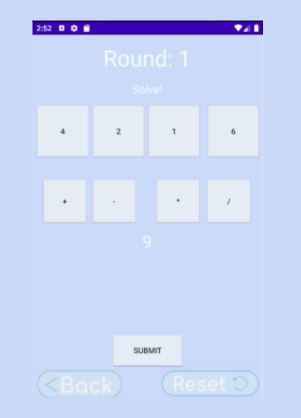
Game In Progress of our app
-
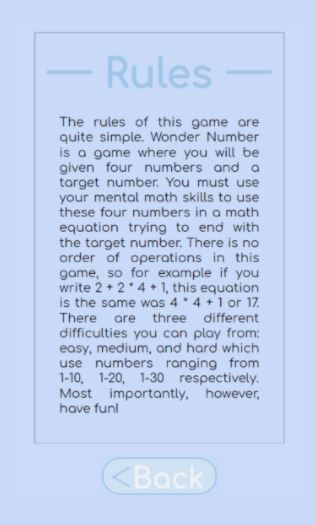
Rules Screen of our app
-
Title Screen of our app


Inspiration
When we were younger, we were in love with the popular game "24," where you are given four numbers and had to make a mathematical equation that resulted in the number 24. The game, however, got easier as our mental math skills got better to the point where the game was no longer enjoyable. We hope that our game will give the same thrills as the game "24" while being enjoyable at all ages.
What it does
Our app is a game based on the game "24". When you click on play, there will be three levels available: easy, medium, and hard which use the numbers 1-10, 1-20, and 1-30 respectively. The system will then give you four numbers once respective to the range of the difficulty you choose. There will also be a target number that you must make using the four numbers in a mathematical equation. If you are able to solve the problem successfully, you will get a point. The system will keep going until you finish submitting 10 problems. There is always the option to quit as well through our back button. In case you make a mistake while writing your mathematical equation, there will also be an undo button for convenience. The code language we were knowledgeable in was Java, and therefore most, if not all, of our app is coded in Java. We used Android Studio as this suited our needs due to its many features that helped make coding apps more convenient. Our designs were all made in Google Slides, where we used the different shapes and colors available to make logos/designs. We took screenshots of these and used them in Android Studio. The main code which runs our game was tested in JGrasp to ensure that the game would flow smoothly.
Challenges we ran into
There were several challenges we ran into, but mainly two big ones. One challenge was trying to reduce as many bugs as possible so that the game would recognize these errors and prevent this from ruining or crashing the game. One such bug was that if a player would try to type in "1 + + 2", the system would recognize that this is not a valid math equation and prevent the player from typing in equations like these. Another challenge we had was trying to make a design that would be appealing yet simple. We overcame this challenge by using Google Slides as the shapes were really simple, and the color scheme available was really easy to use.
Accomplishments that we're proud of
Before we started our project, we had serious doubts that we would have a working finished product. We both had minimal to no experience in coding apps and most of our experience we had in computer science was coding in Java. We are very pleased with how our finished product came out and that it functions. A specific accomplishment we are proud of is our code that generates all possible outcomes that can be produced in a math equation from four numbers inputted.
What we learned
Obviously, we learned how to code many new things in Android Studio, such as buttons. Less obviously, however, we learned that taking breaks really helped our progress in making this app. We always knew that taking breaks while working is essential but did not think that it would impact us this much. When we were stuck, we would take a short break away from the computer and when we came back it was like magic how fast we were able to realize what the problem was.
What's next for WonderNumber
We hope that WonderNumber can be a more enjoyable game for everyone, and to accomplish this we hope to resolve more possible bugs that may occur. We also hope to include more modes that such as a timed mode where one would try solving as many problems as they can in a set amount of time. Finally, we hope that WonderNumber will appeal to younger audiences with a more satisfying design to the eyes.


Log in or sign up for Devpost to join the conversation.