-
-
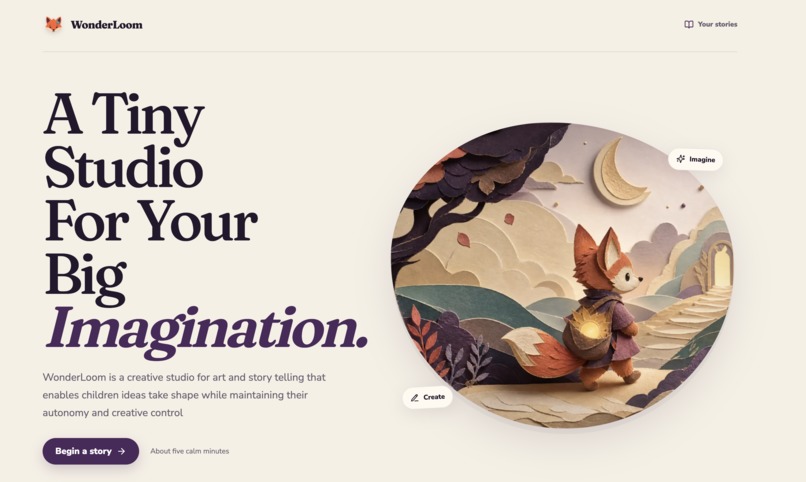
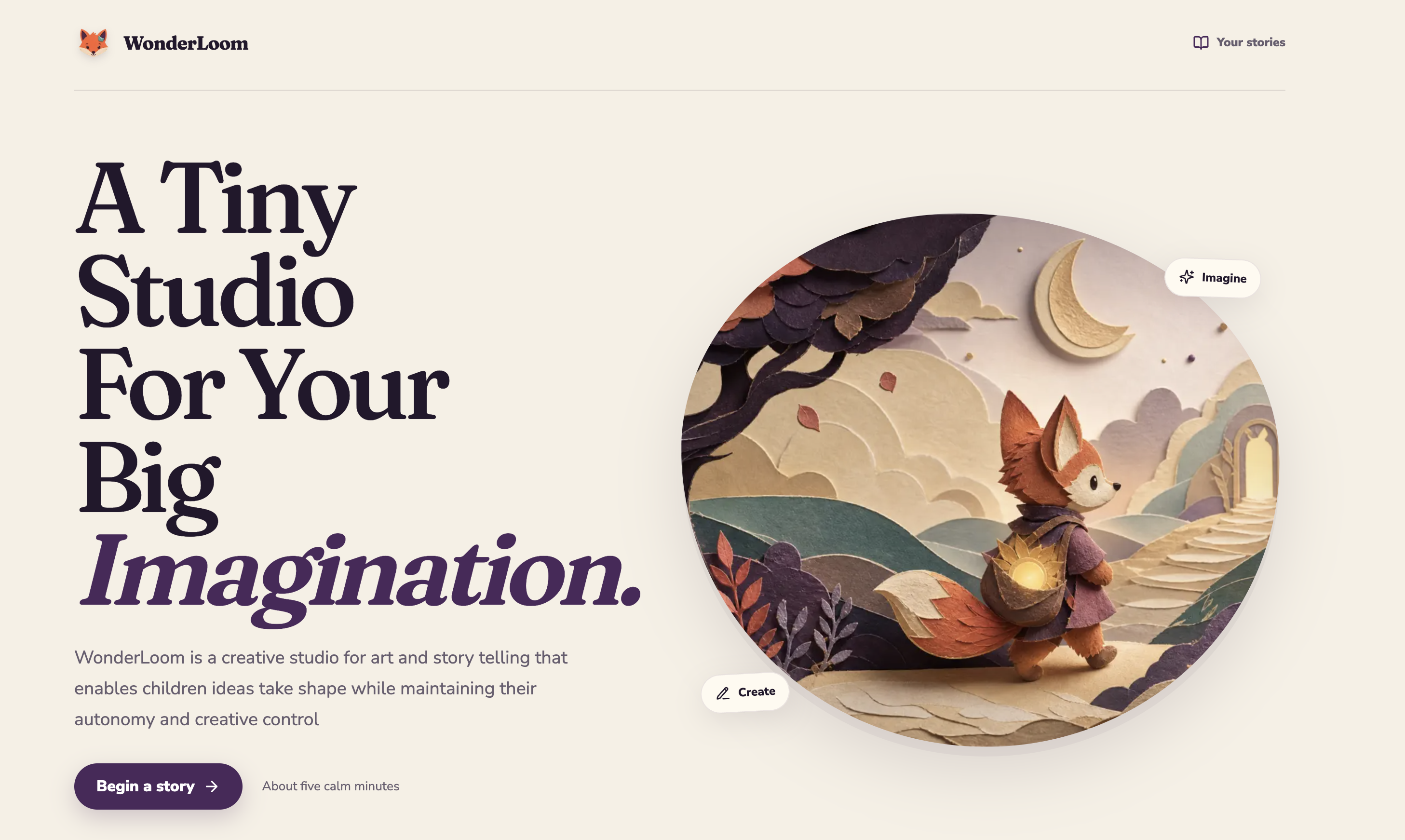
Landing page
-
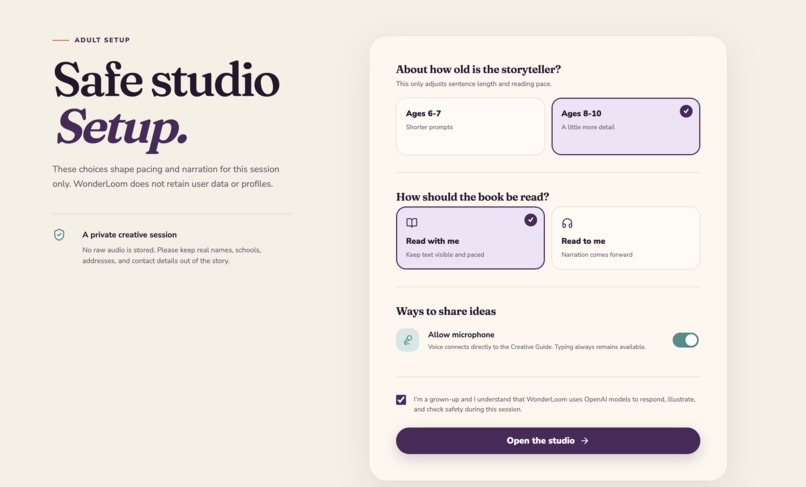
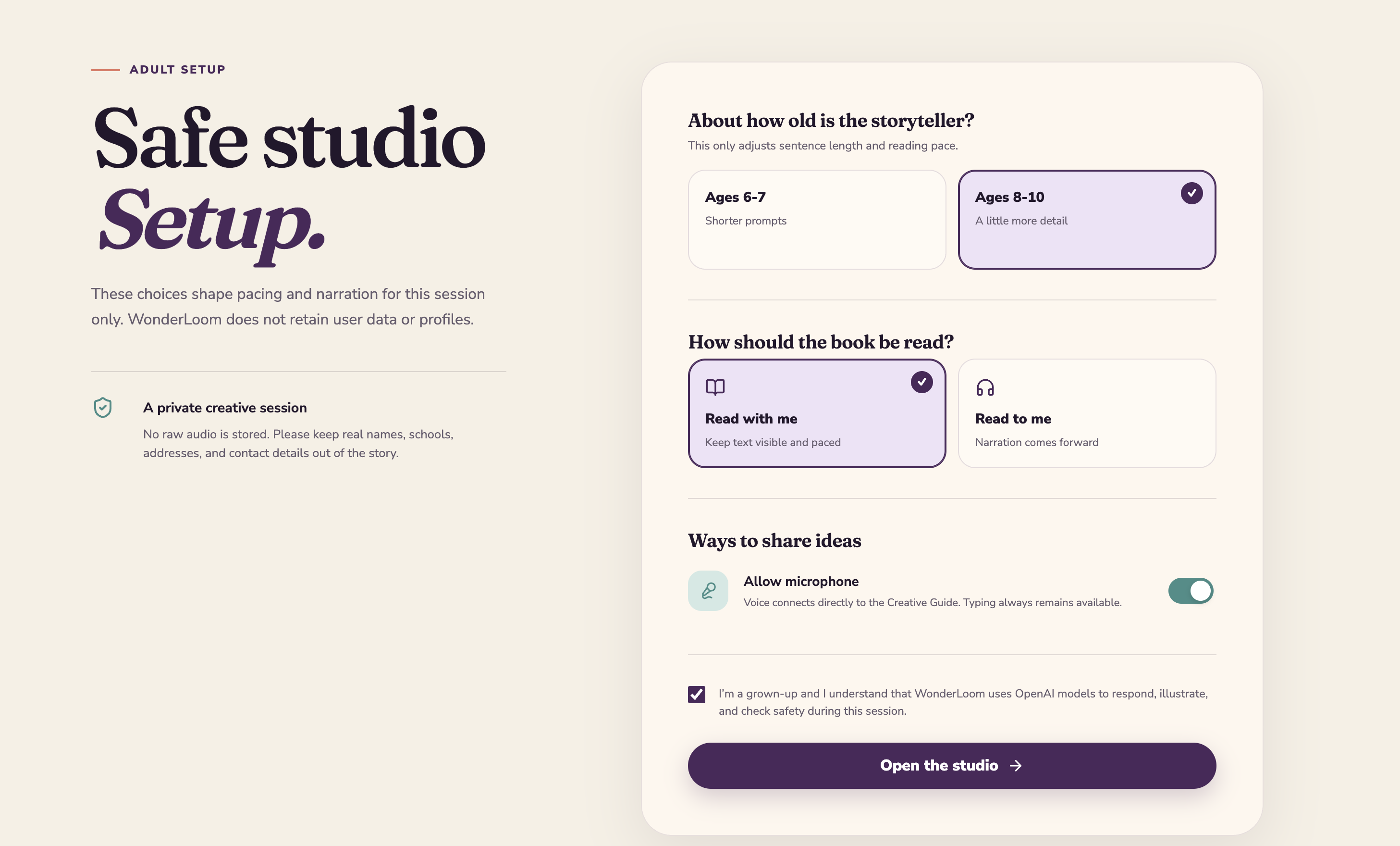
Setup page
-
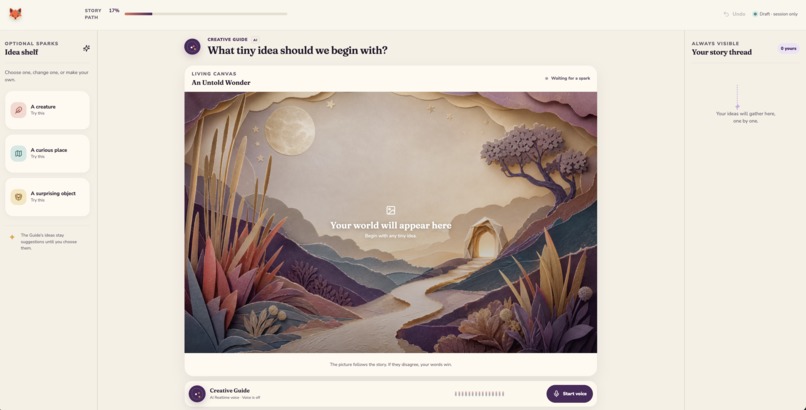
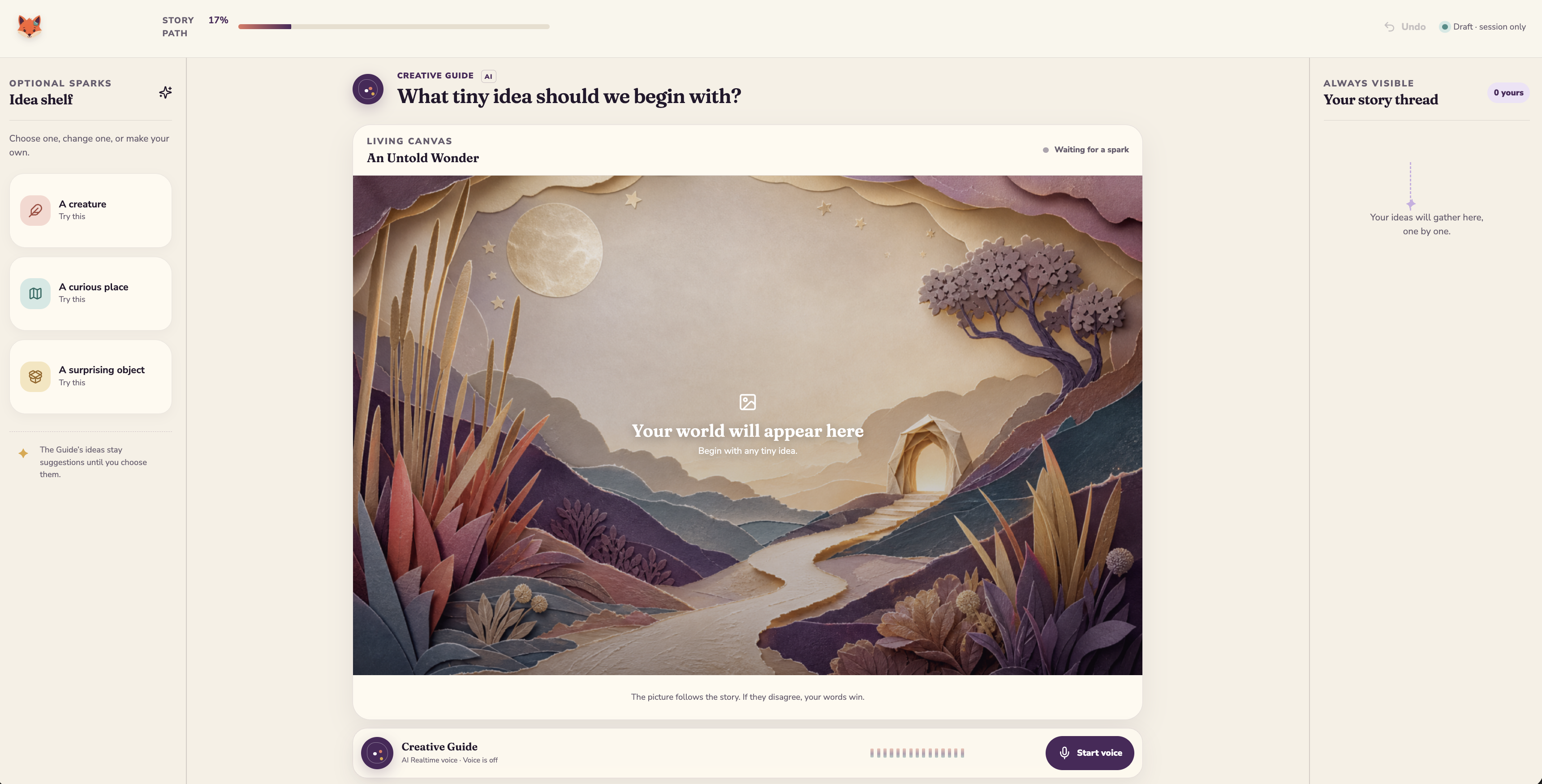
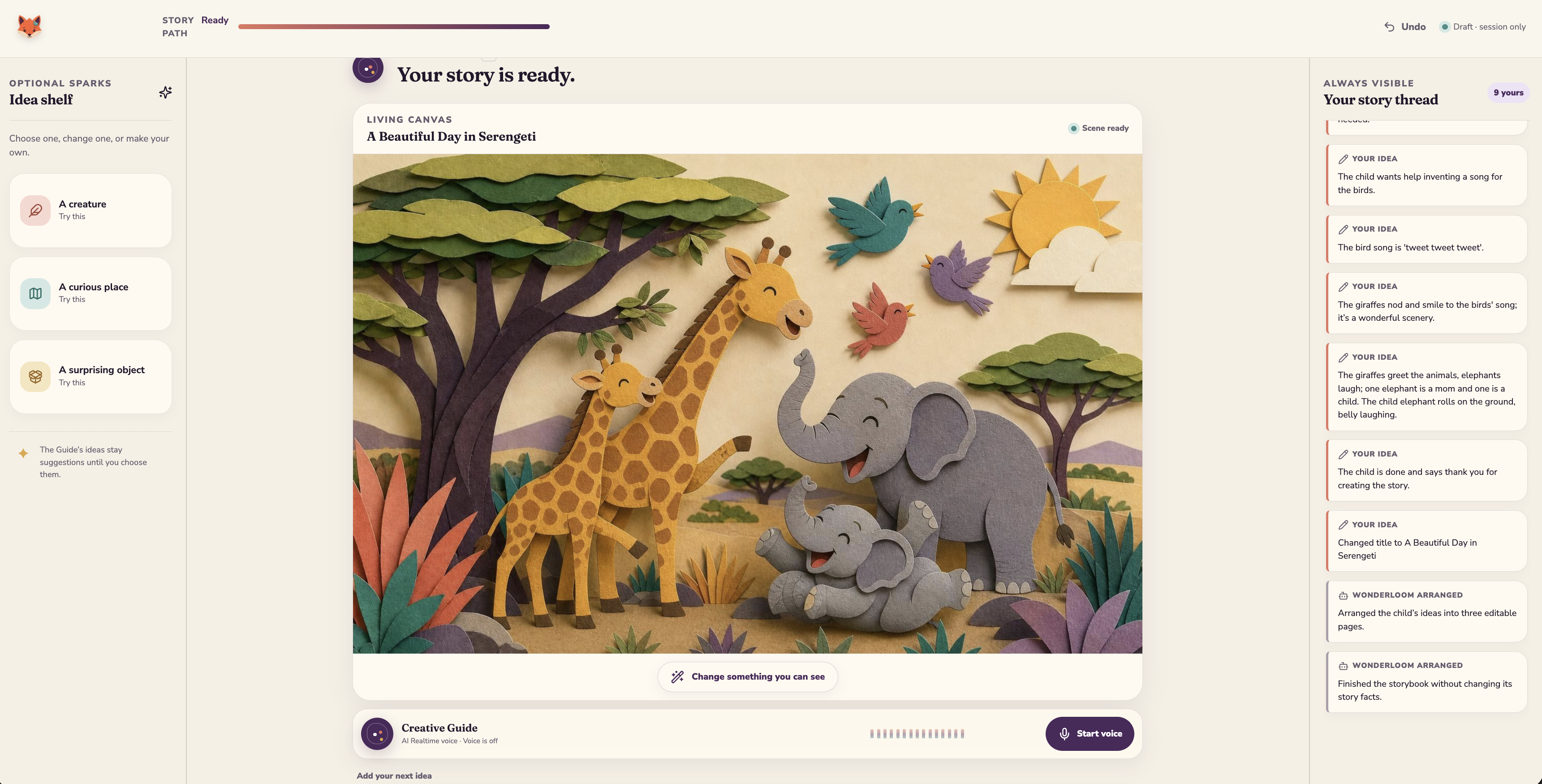
Canvas page
-
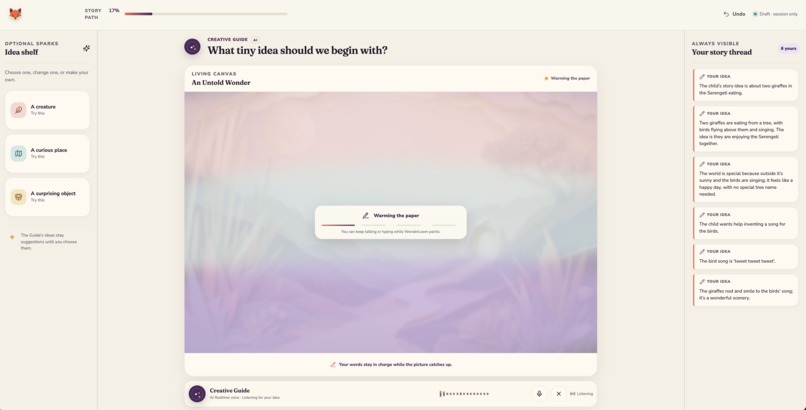
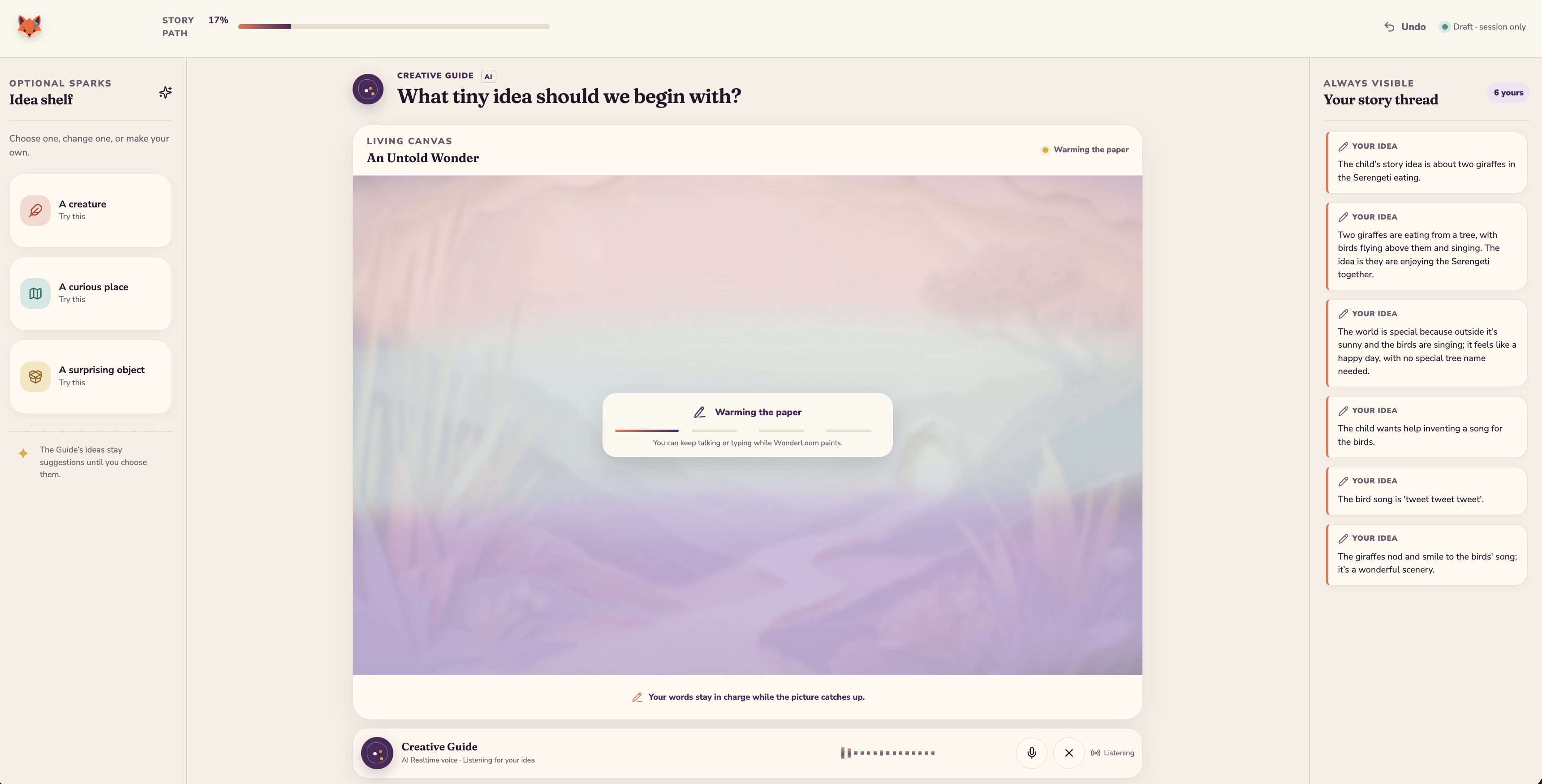
Using voice mode the child interacts with the agent to create a story
-
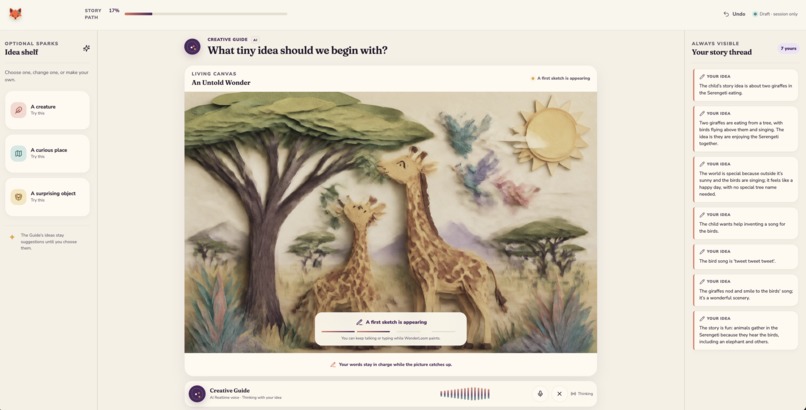
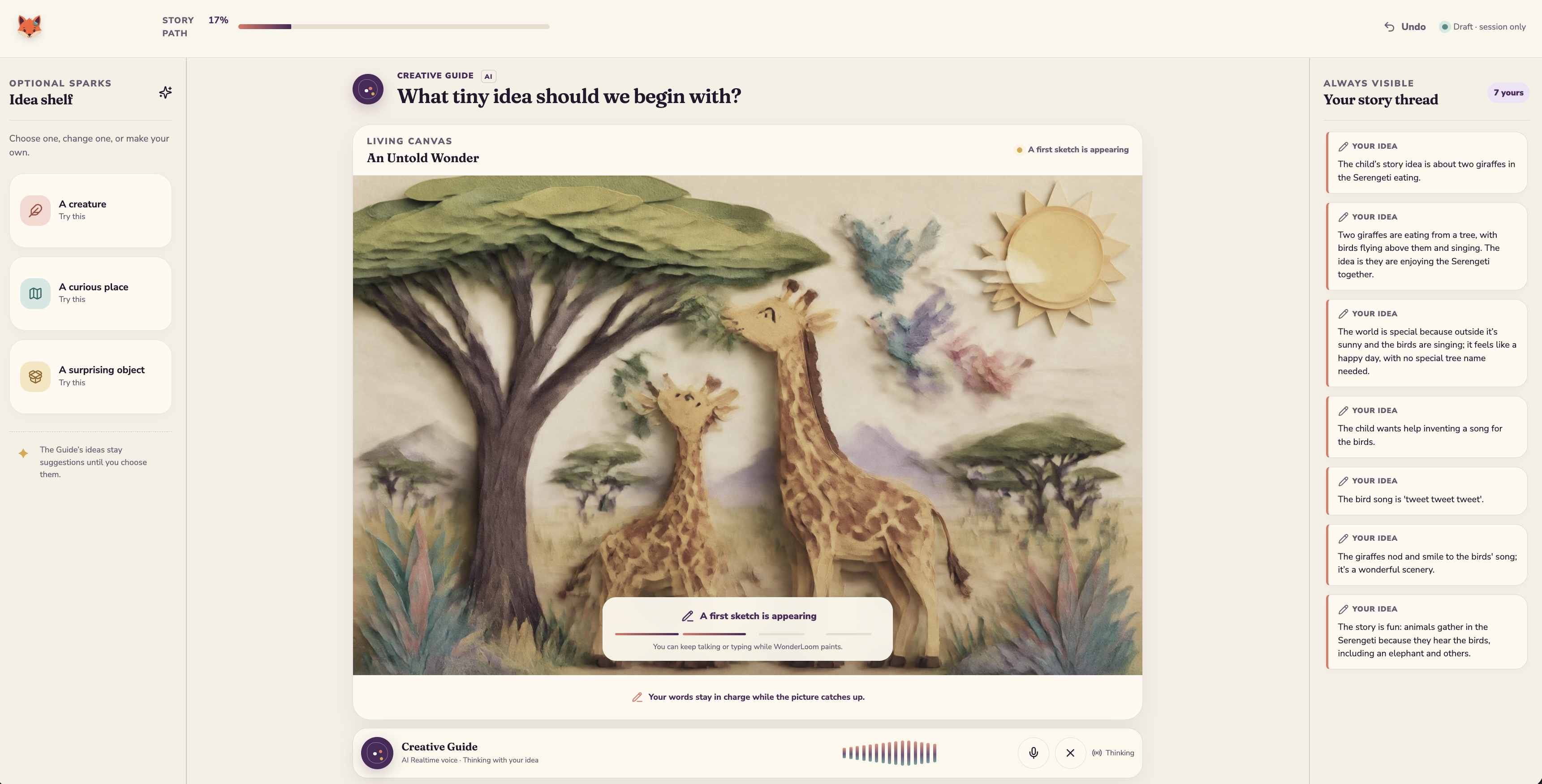
As the process goes on, the agent deduces when to generate images
-
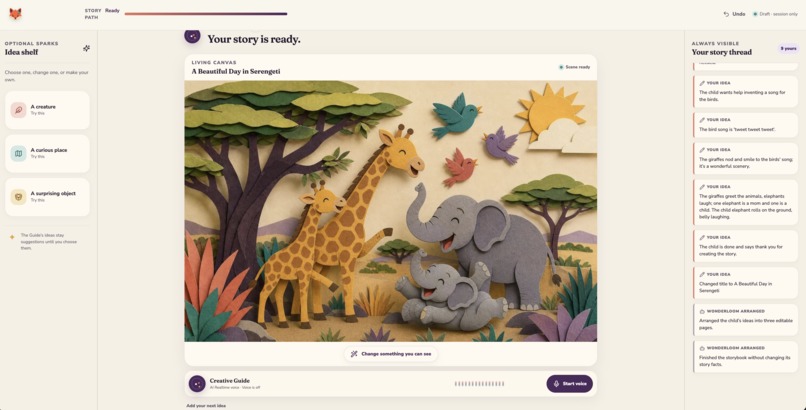
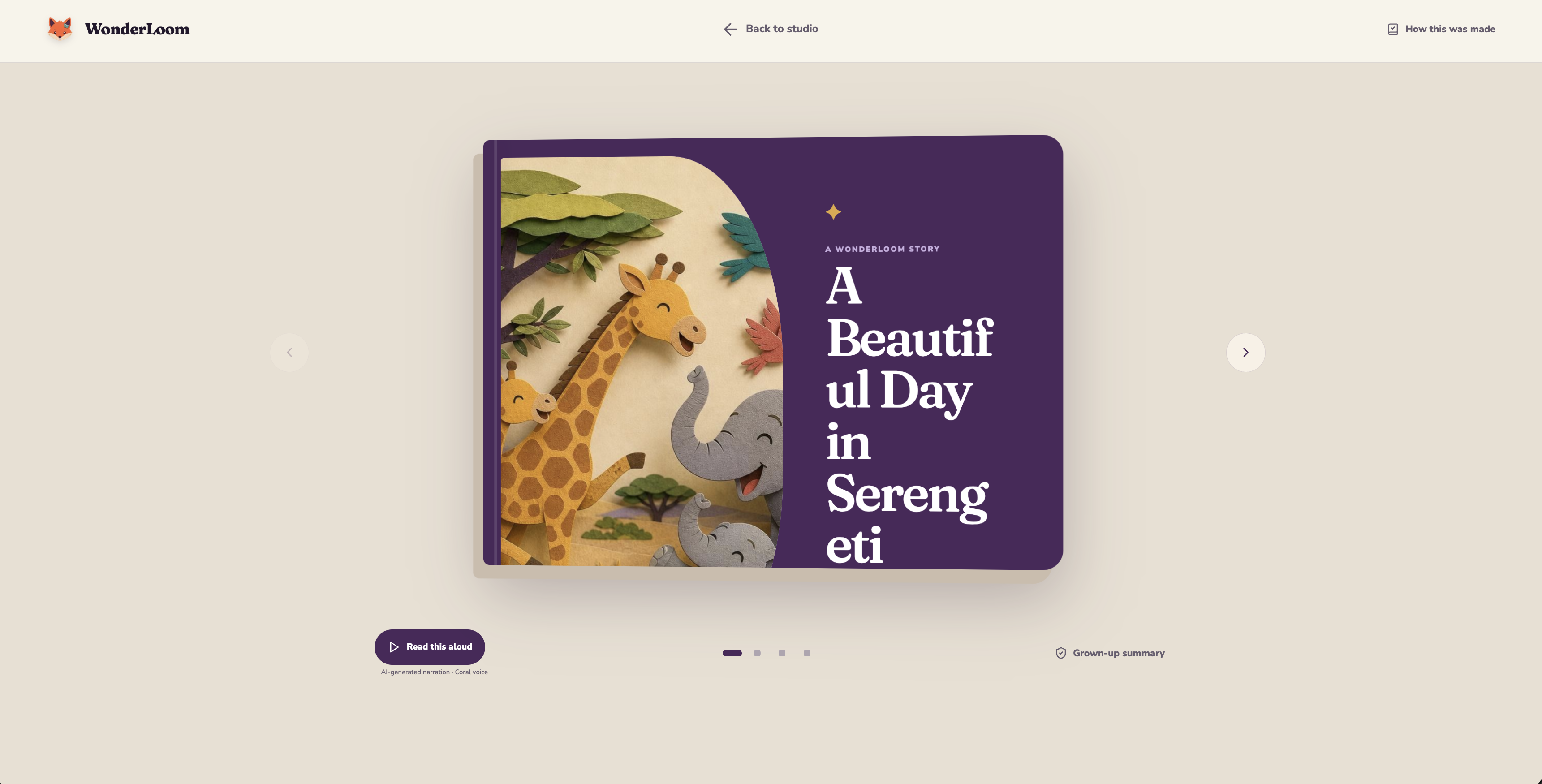
After the story is completed, the agent then turns the story into a short book
-
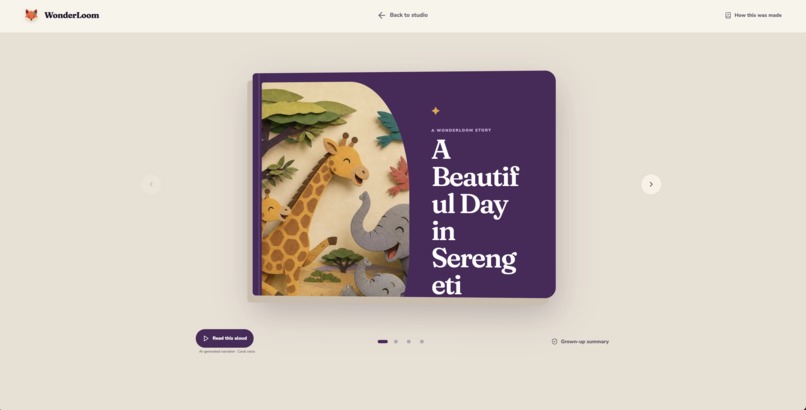
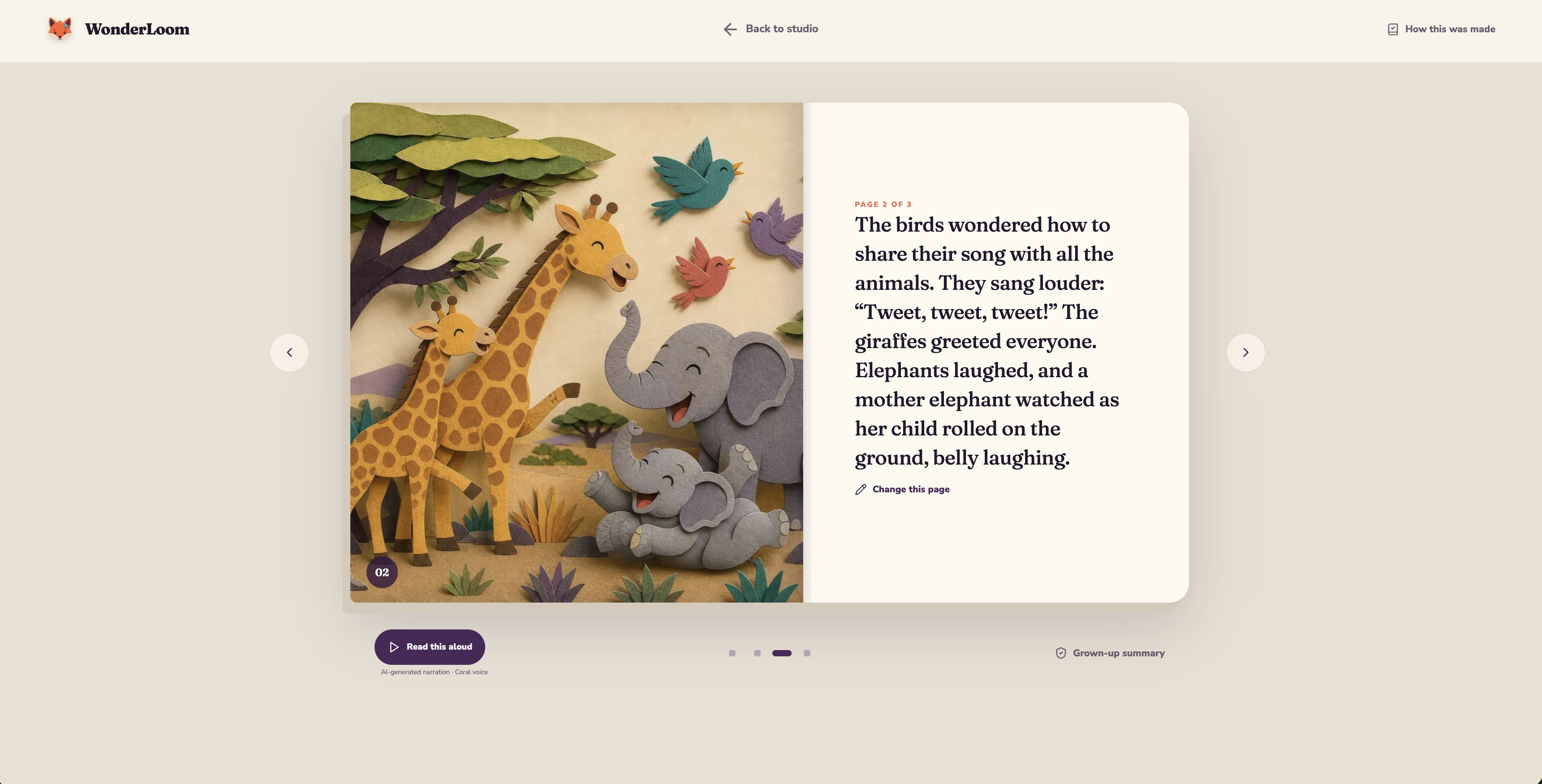
The book can then be read aloud to the kid by the agent
-
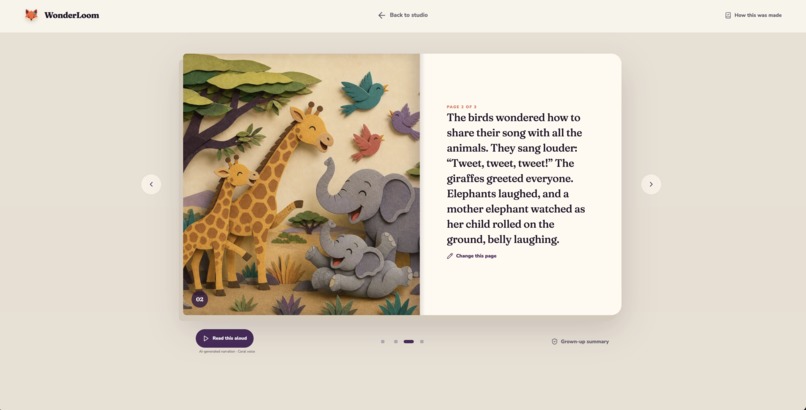
Book page
-
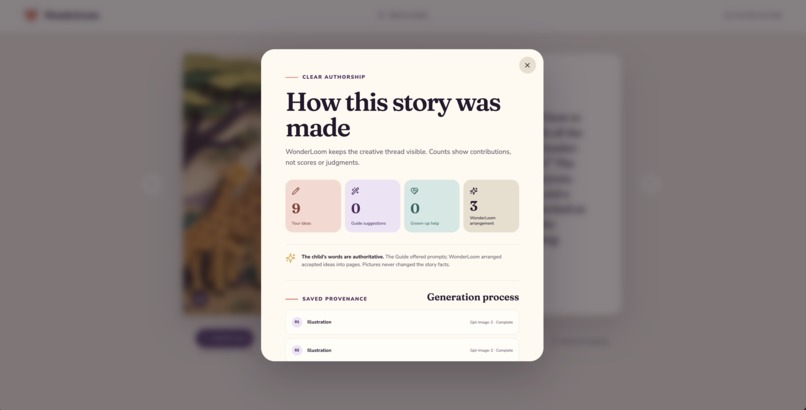
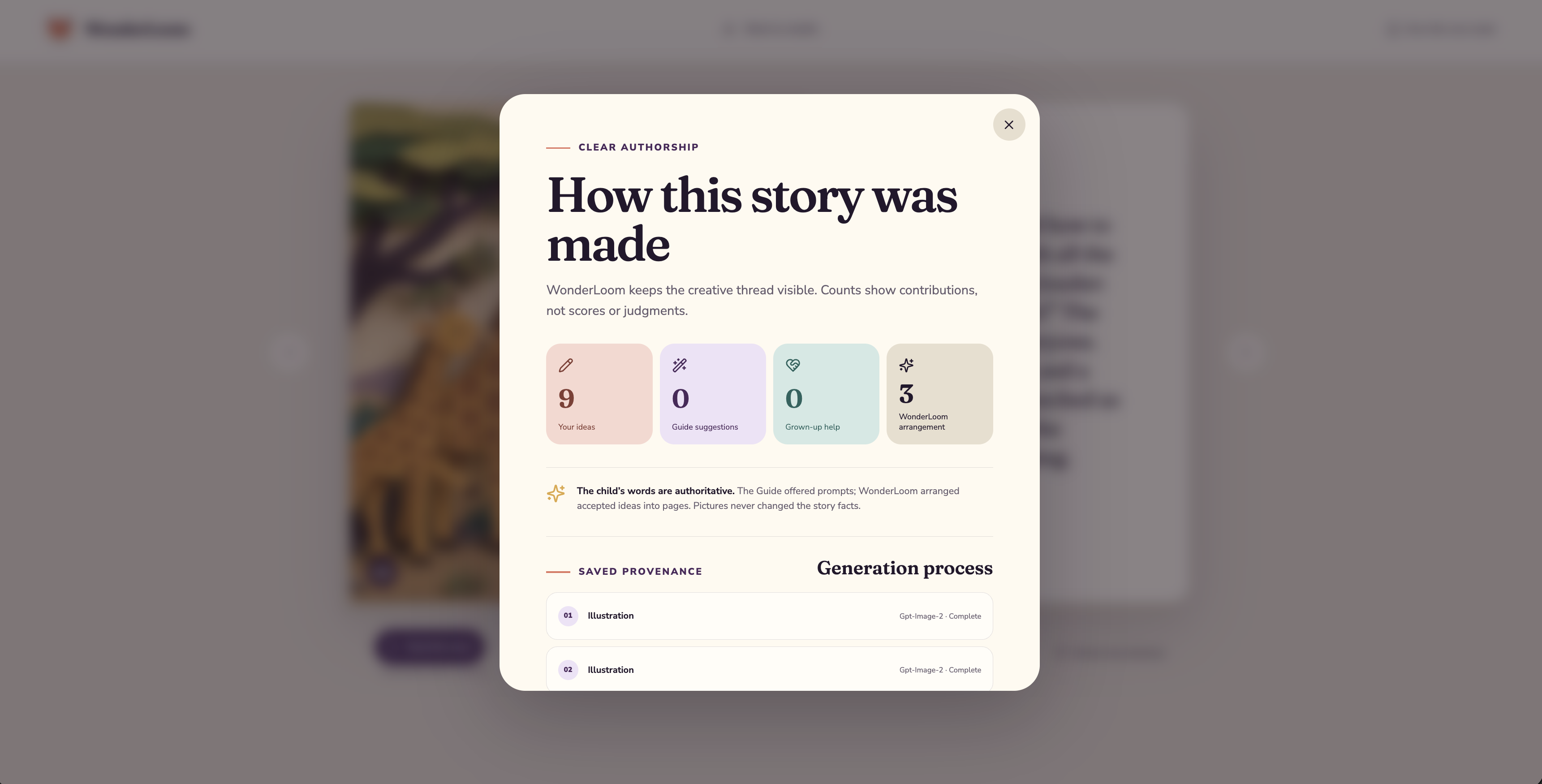
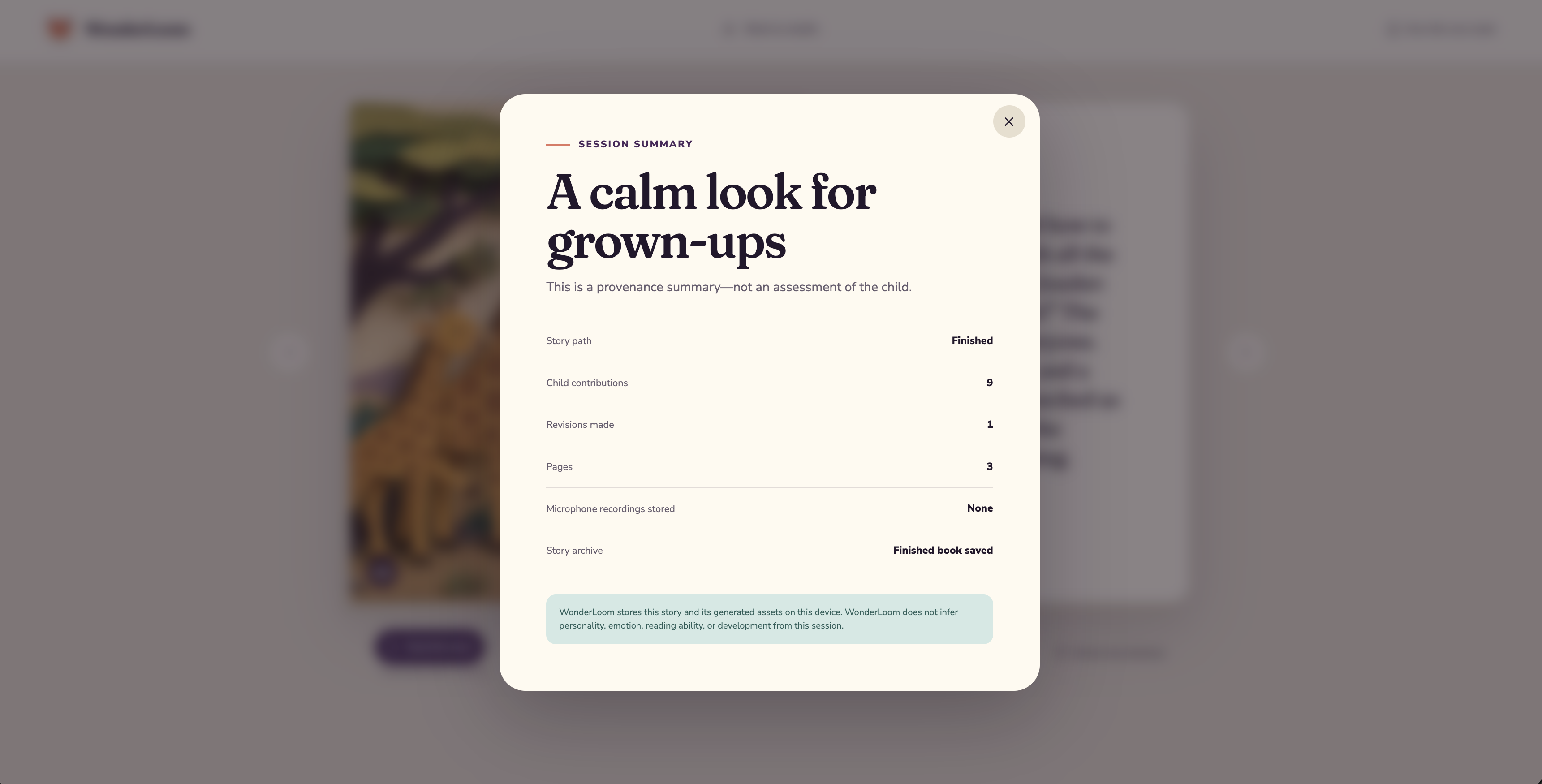
You can also review the threads on how a story was made, where the child excercised autonomy and where the model helped
-
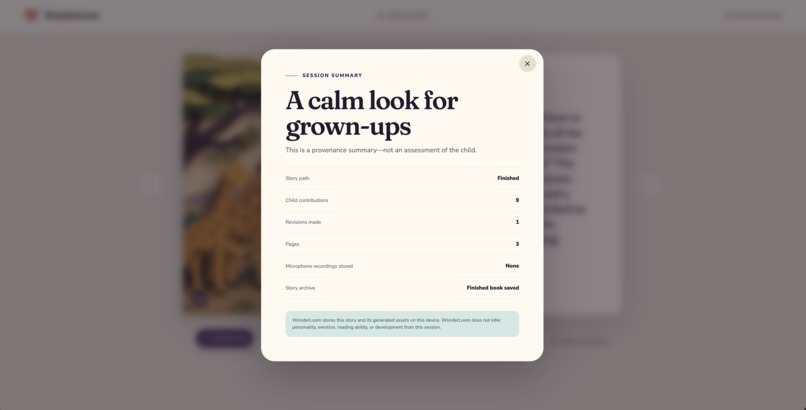
Further analytics of a creative session
-
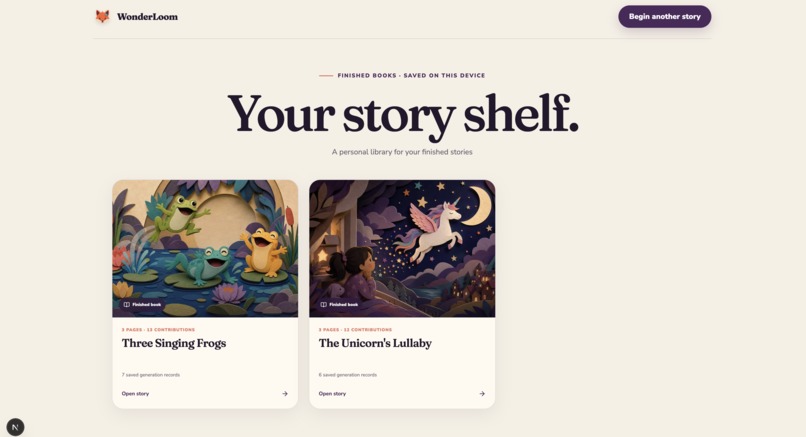
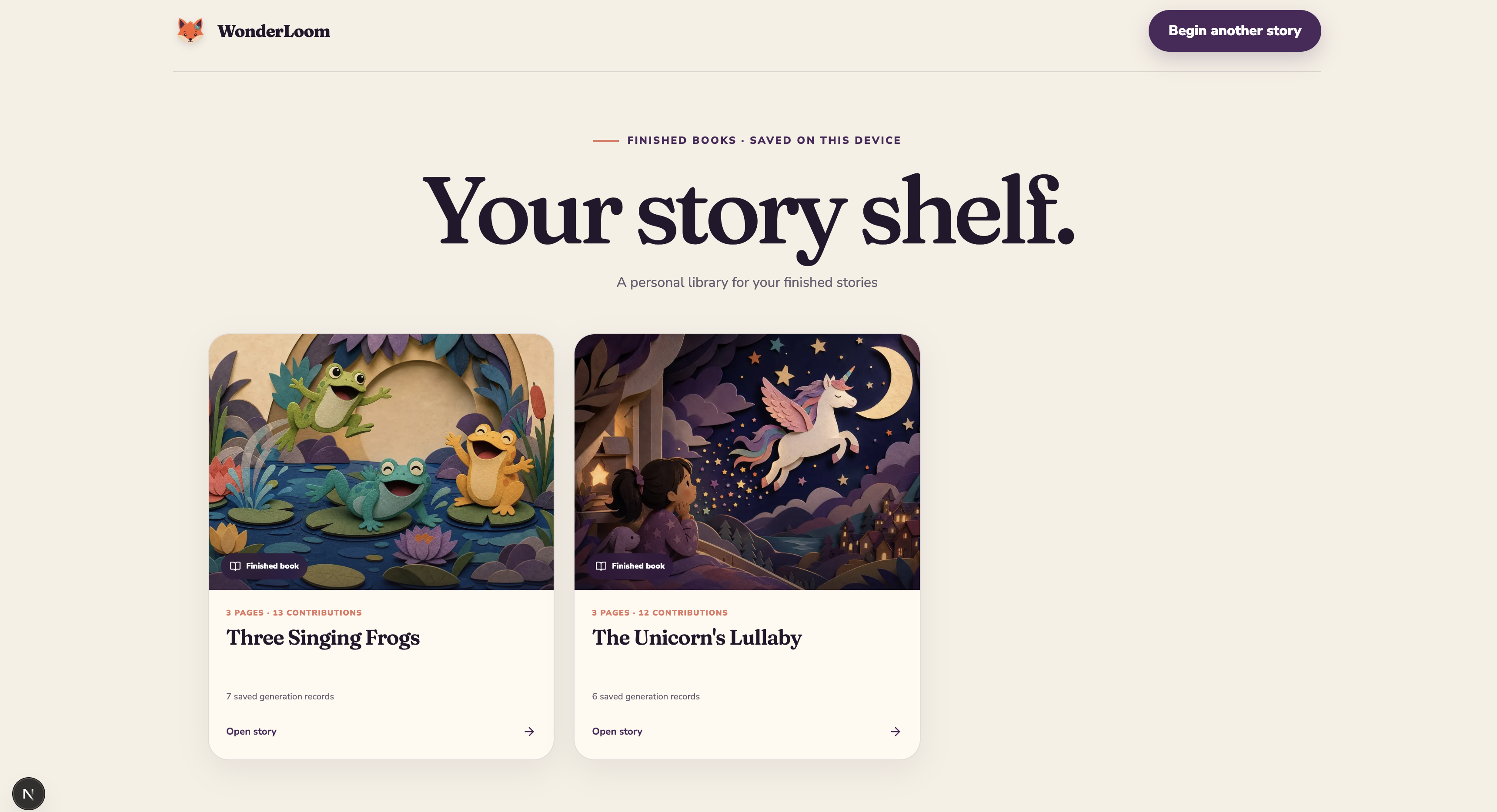
Finished stories or creations are then saved in a shelf, and can be revisited by the child
Wonderloom
Github: https://github.com/Alfaxad/WonderLoom
Youtube Demo: https://youtu.be/dgalteGw8Es?si=tPVz4ChS5CbOlDLD
Team: Alfaxad Eyembe & Zebo Furqatzoda
Inspiration
Children are naturally creative, fully of imagination and wonder. Yet many digital products designed for children are optimized primarily for consumption. They compete for attention through endless feeds, passive entertainment, and highly stimulating experiences. Even many generative AI products unintentionally reproduce this pattern: a child provides a short prompt, the system generates the finished result, and the child becomes a spectator to the AI’s creativity.
We built Wonderloom around a different question:
What if AI could help children express their imagination without taking authorship away from them?
Wonderloom is a multimodal creative canvas where children can imagine, develop, illustrate, narrate, and revise their own stories. The AI acts as a patient creative guide: it asks questions, remembers ideas, organizes the narrative, illustrates the child’s decisions, and helps transform imagination into something visible.
Wonderloom helps children develop narrative thinking, literacy, self-expression, and creative agency through storytelling.
The principle behind the entire product is simple:
The agentic canvas for creative expression, that maintains autonomy and self-direction
We wanted to explore a form of human–AI collaboration in which increasing model capability leads to greater human agency, not greater atrophy.
Our Thesis
Wonderloom is not an AI story generator.
It is an experiment in designing creative interfaces for the intelligence augmentation future.
As AI becomes capable of producing polished text, images, music, software, and video, the important question is no longer only:
What can AI create?
It is also:
What can AI help a person become capable of creating?
We believe the most valuable creative systems will not simply generate finished outputs. They will help people develop ideas, make decisions, exercise judgment, revise their work, and build confidence in their own creative abilities.
This belief is particularly important when designing for children. Childhood is where imagination, confidence, taste, curiosity, and creative identity are still forming. A system that continuously makes decisions on a child’s behalf may produce impressive content, but it may not help the child become more creative.
Wonderloom therefore treats AI as a creative material and collaborator, rather than an autonomous author.
The child’s contributions are canonical. Suggestions only enter the story when the child chooses them. Characters, settings, conflicts, emotions, and major plot decisions are developed through a sequence of focused questions. The system can support the child when they feel stuck, but it cannot silently take control of the story.
Our broader goal is to explore how AI can augment human imagination while preserving autonomy, authorship, and the ability to create.
What Wonderloom Does
A child begins by speaking naturally with Wonderloom’s Creative Guide.
Instead of asking for a complete prompt, the guide introduces one playful question at a time:
- Who should the hero be?
- What makes them different?
- Where do they live?
- What do they want?
- What problem do they face?
- What should happen next?
The child can respond through voice or text. They can answer freely, select an optional creative spark, reject a suggestion, or invent something completely different.
Every meaningful contribution becomes visible in the interface. Characters, locations, emotions, objects, and story decisions appear as part of an evolving creative thread. The system then uses these contributions to generate and progressively refine an illustrated story.
The illustration is not treated as a static final output. It behaves like a living canvas.
A child can say:
“Make her wings purple.”
“The castle should be underwater.”
“Add enormous yellow boots.”
Wonderloom updates the existing scene while preserving the parts the child did not ask to change.
The creative experience moves through a simple loop:
- Imagine: the child contributes an idea.
- See: the idea becomes visible in the canvas.
- Respond: Wonderloom asks one focused follow-up question.
- Revise: the child changes, expands, or rejects part of the story.
- Create: the story grows into an illustrated and narrated book.
- Finish: the child names the completed book and saves it to their library.
The result is not generated from a single prompt. It is constructed through a sequence of decisions made by the child.
The Experience We Wanted to Create
Wonderloom was designed to feel:
- magical, calm, and expressive;
- playful without becoming noisy or overstimulating;
- simple without restricting imagination;
- responsive without rushing the child;
- visually rich without turning creativity into passive entertainment;
- trustworthy for parents;
- understandable without requiring the child to learn prompting.
We deliberately avoided designing Wonderloom as a conventional chatbot. The main experience is a multimodal creative canvas, with voice serving as the most natural way to interact.
Children do not need to understand models, prompts, tools, or generation settings. They simply speak, make choices, touch elements, revise ideas, and watch their world respond.
The interface uses a warm, tactile visual language inspired by paper craft, illustrated storybooks, and physical creative materials. The Creative Guide communicates through restrained animation, expressive states, and a compact voice visualizer rather than dominating the screen with a human-like avatar.
The experience is intended to feel closer to drawing with a patient collaborator than watching an AI produce content.
Research and Design Foundations
Before implementation, we used Codex and GPT-5.6 to conduct a focused review of research on child–AI co-creativity, collaborative storytelling, creative autonomy, child-computer interaction, parental trust, and multimodal interface design.
Several projects and papers strongly shaped the product.
Child–AI Co-Creation
Tinker Tales explored voice interaction, tangible story elements, and educational scaffolding in child–AI storytelling. It reinforced the idea that AI should help children develop and refine narratives without removing their agency.
StoryPrompt studied AI-supported storytelling and comic creation with children. Its separation of ideation, narrative construction, and visual creation influenced Wonderloom’s decision not to collapse the entire process into one generation request.
Connection Is All You Need explored multimodal storytelling through drawing, speaking, and question-based interaction. It demonstrated how different input modalities can help children understand relationships between characters, events, and consequences.
StoryBuddy examined collaborative storytelling with flexible parental involvement. It helped us think about the parent as a configurable participant and guardian rather than requiring the parent to remain inside every creative interaction.
We also reviewed broader work on children’s narrative participation, child–AI co-creation patterns, and the difference between an AI acting as a collaborator versus acting as the dominant author.
Parent Trust and Child-Centered Design
Research on parents’ expectations for child-centered AI emphasized transparency, age appropriateness, privacy, and the importance of preserving meaningful child participation.
A review of the research–practice gap in children’s storytelling systems showed that research prototypes frequently used narrative scaffolding, tangible interaction, and direct manipulation more effectively than many commercial products.
Work on child-friendly AI interfaces highlighted principles including:
- emotional and visual clarity;
- auditory scaffolding;
- predictable interaction structures;
- symbolic and imaginative play;
- audiovisual synchrony;
- expressive but non-overwhelming feedback.
We also studied research and guidance on safe and engaging AI experiences for children, ethical conversational storytelling, and OpenAI’s guidance for applications serving users under 18.
Technical Research
Codex examined OpenAI’s Realtime Agents examples, the Agents SDK for TypeScript, WebRTC architecture, function calling, Structured Outputs, image generation and editing, streaming partial images, content moderation, and secure client credential handling.
It also reviewed open-source storytelling systems and multimodal agent projects to understand common architectural patterns, limitations, and opportunities for a more coherent child-led experience.
Codex helped translate the findings into product rules, interface requirements, state constraints, model prompts, safety boundaries, and testable implementation decisions.
How We Built Wonderloom
Wonderloom is a web application built with Next.js, React, and TypeScript, using OpenAI models and SDKs across its voice, story, image, narration, and safety systems.
The core application is built around a typed story-state machine that moves through six phases:
seed → reveal → edit → transform → pages → finished
A canonical story state records:
- the child’s contributions;
- characters and their defining attributes;
- locations and world rules;
- story goals and conflicts;
- visual descriptions;
- completed scenes;
- suggestions accepted or rejected by the child;
- image revisions;
- undo history;
- generation status.
The child’s words and confirmed decisions are the source of truth. Models can propose narrow updates, but they cannot silently replace established story facts.
Structured Story Development
GPT-5.6 does not receive an unrestricted instruction to “write a story.”
For each turn, it produces a constrained, typed creative plan containing:
- a short reflection of what the child contributed;
- one focused follow-up question;
- a narrow story-state update;
- optional creative sparks;
- an indication of whether the visual canvas should wait, reveal, transform, or advance.
This makes the model’s behavior inspectable and prevents it from progressing too far without sufficient child input.
Only after the child has established the important creative decisions does GPT-5.6 compose the polished story pages.
Realtime Voice
Live conversation is powered by the OpenAI Agents SDK and WebRTC.
The server creates a short-lived Realtime client credential, ensuring that the primary OpenAI API key is never exposed in the browser.
The voice experience supports:
- low-latency speech-to-speech interaction;
- semantic turn detection;
- interruptions while the Creative Guide is speaking;
- transcripts of spoken contributions;
- typed tools that propose updates through the same controlled state system used by text;
- clear visual states for connecting, listening, thinking, and speaking.
Voice is treated as the conductor of the experience, but it does not independently control the story. Spoken contributions flow through the same canonical state and approval rules as typed contributions.
Dynamic Illustration
Image generation operates as a coordinated but separate visual workflow.
The Creative Guide updates the story state, and an image director decides whether the application should:
- wait, because the child is still developing the idea;
- reveal, because a character or setting is distinctive enough to visualize;
- transform, because the child has requested a visible revision;
- advance, because the story has moved into a new scene.
Wonderloom maintains an evolving image for the active scene rather than generating an unrelated illustration after every sentence.
When a child requests a change, the application edits the current scene while preserving everything else. This makes image generation feel like a responsive creative material rather than a detached API call.
Because image generation is slower than voice and text, we designed latency as part of the experience. The canvas glows, drawing cues appear, and partial images progressively move through sketch, color, and detail before the final illustration settles into place.
The child can continue speaking or typing while the image develops.
OpenAI Models Used
| Model | Role in Wonderloom | Product decision |
|---|---|---|
| gpt-5.6-luna | Structured story planning and final story composition | Used for controlled creative reasoning rather than unrestricted story generation |
| gpt-realtime-2.1-mini, using Marin | Live Creative Guide | Provides low-latency speech, interruption handling, semantic turn detection, and tool use |
| gpt-4o-mini-transcribe | Voice transcription | Produces usable transcripts while raw microphone audio is not retained |
| gpt-image-2 | Illustration generation and editing | Creates progressive images and revises existing scenes instead of replacing them with unrelated generations |
| gpt-4o-mini-tts, using Coral | Final book narration | Produces consistent, scene-aware narration that can be cached with the completed story |
| omni-moderation-latest | Safety checks | Screens important child-input and model-output boundaries |
GPT-5.6 contributed to Wonderloom in two separate ways.
Inside the application, GPT-5.6 interprets the child’s contribution and generates a typed, constrained creative plan.
Inside Codex, GPT-5.6 acted as our development partner across research, product definition, interface design, implementation, debugging, testing, and deployment.
How We Collaborated With Codex
Codex accelerated nearly every stage of the project.
Research and Product Definition
Before writing the application, we used Codex to investigate child–AI co-creativity, interaction design, parental expectations, safety, and existing storytelling systems.
Codex summarized papers, compared product patterns, studied relevant repositories, and helped us identify the central failure mode of many AI storytelling products: the child provides the premise, but the AI performs most of the creative work.
It then helped convert that insight into a product contract:
- the child remains the author;
- the AI asks one focused question at a time;
- suggestions remain optional;
- child contributions remain visible;
- major plot decisions require child input;
- established story facts cannot be silently rewritten;
- children can reject, revise, and undo;
- unfinished stories do not appear as completed books;
- microphone recordings and detailed child profiles are not stored.
We made the core philosophical and product decisions. Codex helped us turn them into clear, enforceable system behavior.
Architecture and Engineering
Codex helped design and implement:
- the typed story-state machine;
- structured GPT-5.6 outputs;
- Realtime WebRTC connection flows;
- short-lived client credentials;
- voice-agent tools;
- story revision history;
- image-generation jobs;
- stale-response protection;
- narration generation;
- local persistence;
- moderation boundaries;
- error handling;
- tests and deployment configuration.
A particularly important technical challenge involved asynchronous image generation.
A child might request one visual change and then revise the request before the first generation finishes. Codex helped introduce revision numbers and visual-job identifiers. When an older image request completes, it is checked against the current revision and cannot overwrite a newer creative direction.
This allowed the experience to remain responsive without sacrificing state consistency.
UI and UX Development
Codex helped translate the research findings into a coherent interface system.
It contributed to the development of:
- the warm paper-cut visual language;
- the fox-inspired Wonderloom identity;
- typography and color systems;
- tactile controls;
- the storybook page layout;
- voice and generation animations;
- responsive behavior;
- reduced-motion states;
- keyboard interaction;
- loading and error states.
The interface was refined through repeated screenshot-based reviews.
Codex helped diagnose and fix issues including:
- placeholder artwork weakening the sense of wonder;
- generated images completing but failing to render;
- voice visualization competing with the illustration canvas;
- layout failures at different viewport sizes;
- image generation being represented as instantaneous;
- incomplete stories appearing in the library;
- Realtime voice appearing unavailable because of server configuration;
- horizontal overflow and interaction problems on smaller screens.
Codex substantially shortened the loop between observing a problem and verifying a solution. It could trace an issue across the interface, API route, model output, state transition, storage layer, and deployment environment, implement a correction, and validate it through tests, production builds, browser interaction, and live model requests.
Human Decisions and Codex Acceleration
Codex was not asked to just go and build wonderloom.
The key product decisions remained ours:
- prioritizing creative autonomy over maximum generation;
- using storytelling as the first expression of a broader creative canvas;
- avoiding companion-like or attention-maximizing behavior;
- keeping the interface calm and non-overstimulating;
- making every child contribution visible;
- delaying generation until enough creative information exists;
- treating image latency as part of the creative process;
- separating live conversation from final-book narration;
- preserving privacy through minimal data retention.
Codex helped us these decisions into a working, tested product much faster than would otherwise have been possible.
Challenges We Faced
Preserving Agency While Using Powerful Models
The hardest product challenge was preventing the AI from becoming the primary creator.
A model can easily generate an entire polished story from a single sentence. That is technically impressive, but it contradicts Wonderloom’s purpose.
We addressed this by constraining model outputs, limiting each turn to one focused question, recording child contributions separately, requiring explicit acceptance of suggestions, and preventing the system from making unsupported plot decisions.
The retention of agency and autonomy is a design choice.
Synchronizing Voice, Text, Images, and Story State
Wonderloom combines systems operating at very different speeds.
Voice needs to feel immediate. Text planning takes slightly longer. Image generation is slower and asynchronous. Narration belongs to the completed-book experience.
Coordinating these systems required a canonical state layer, explicit generation statuses, revision control, and clear boundaries between the live conversation and the visual workflow.
Making Latency Feel Intentional
A spinner would make illustration feel disconnected from the creative experience.
We instead turned generation into an observable process. The canvas visibly responds before the final image exists, and partial images reveal the world progressively.
This made waiting feel more like watching an idea take shape.
Designing for Children Without Paternalization
The interface needed to be immediately understandable, expressive, and playful without becoming overstimulating or patronizing.
We repeatedly simplified the layout, reduced competing elements, moved the voice visualizer away from the artwork, strengthened the visual hierarchy, and replaced conventional software controls with more tactile and contextual interactions.
Building Trust and Safety Into the Product
Designing for children required us to consider safety and privacy from the beginning rather than adding them at the end.
We minimized stored data, avoided raw microphone retention, added moderation at important boundaries, separated the Creative Guide from companion-like framing, and designed the system around creativity rather than engagement maximization.
What We Learned
The most important thing we learned is that creative autonomy must be a conscientious choice in AI systems.
It is not enough to tell a child that they are the author. The system must preserve their words, require their decisions, expose suggestions as suggestions, allow revision, and prevent the model from silently taking control.
We also learned that multimodal systems should not feel like several AI features placed beside one another.
Voice, text, images, state, and narration need to behave as one creative material. Voice guides the process. Story state preserves meaning. Images make decisions visible. Text turns those decisions into a coherent book. Narration gives the finished creation a sense of completion.
We learned that model latency is not only an engineering problem; it is also an interaction-design problem.
In Wonderloom, the models are powerful precisely so that the interface can remain simple and the child can remain in control.
What Wonderloom Means for the Future of Creativity
Wonderloom begins with storytelling, but we believe the idea is much larger.
We see it as an early example of a new generation of creative interfaces: systems that can deduce creative intent so as to produce creative output.
A child should eventually be able to describe a world, draw part of it, move its characters, change its rules, give it sound, and transform it into a story, comic, animation, game, or an entirely new form of expression.
The child should not need to understand prompting or professional creative software.
They should only need imagination.
Our larger ambition is to build tools that enhance human–AI collaboration while preserving human judgment, agency, and authorship.
As AI becomes abundant, the future of creativity should not be full automation. It should be augmentation, AI should help more people, starting with children, discover what they are capable of creating.
References and Further Reading
Child–AI Co-Creation and Storytelling Research
- Tinker Tales: Interactive Storytelling Framework for Early Childhood Narrative Development and AI Literacy
- Tinker Tales: Supporting Child–AI Collaboration through Co-Creative Storytelling with Educational Scaffolding
- StoryPrompt: Exploring the Design Space of an AI-Empowered Creative Storytelling System for Elementary Children
- From Words to Wonder: Designing and Evaluating an AI-Empowered Creative Storytelling System for Elementary Children
- Connection Is All You Need: A Multimodal Human–AI Co-Creation Storytelling System to Support Children’s Multi-Level Narrative Skills
- StoryBuddy: A Human–AI Collaborative Chatbot for Parent–Child Interactive Storytelling with Flexible Parental Involvement
- Children’s Narrative Participation in Story Co-Creation with an AI Agent and a Human Partner
- Child–AI Co-Creation: A Review of the Current Research Landscape
Child-Centered Design, Parent Trust, and Safety
- Exploring Parents’ Needs for Children-Centered AI to Support Preschoolers’ Interactive Storytelling and Reading Activities
- Characterizing the Research–Practice Gap in Children’s Interactive Storytelling Systems
- Child–Computer Interaction: From a Systematic Review Towards an Integrated Understanding of Interaction Design Methods for Children
- Designing Child-Friendly AI Interfaces: Six Developmentally Appropriate Design Insights from Analysing Disney Animation
- Designing Safe and Engaging AI Experiences for Children: Towards the Definition of Best Practices in UI/UX Design
- Interactive Storytelling for Children: Design and Development Considerations for Ethical Conversational AI
- OpenAI Under-18 API Guidance
OpenAI Models
gpt-5.6-luna: structured creative planning and story compositiongpt-realtime-2.1-mini: live speech-to-speech Creative Guidegpt-4o-mini-transcribe: spoken-contribution transcriptiongpt-image-2: illustration generation and visual editinggpt-4o-mini-tts: final-book narrationomni-moderation-latest: text and image safety checks- OpenAI Model Catalog
OpenAI SDKs, APIs, and Technical Guides
- OpenAI Agents SDK for TypeScript
- OpenAI Agents SDK GitHub Repository
- OpenAI Realtime Agents Example Repository
- Voice Agents with the OpenAI Agents SDK
- Voice Agents Quickstart
- Building Voice Agents
- Realtime Transport Layer
- Realtime API with WebRTC
- Structured Model Outputs
- OpenAI Image Generation Guide
- OpenAI Codex
- OpenAI Codex GitHub Repository
Application Framework
Built With
- javascript
- nextjs
- openai
- react
- typescript


Log in or sign up for Devpost to join the conversation.