Inspiration
A photograph preserves a moment and the photographer’s point of view. We wanted to give people a way to explore that moment from another angle and decide what happens next.
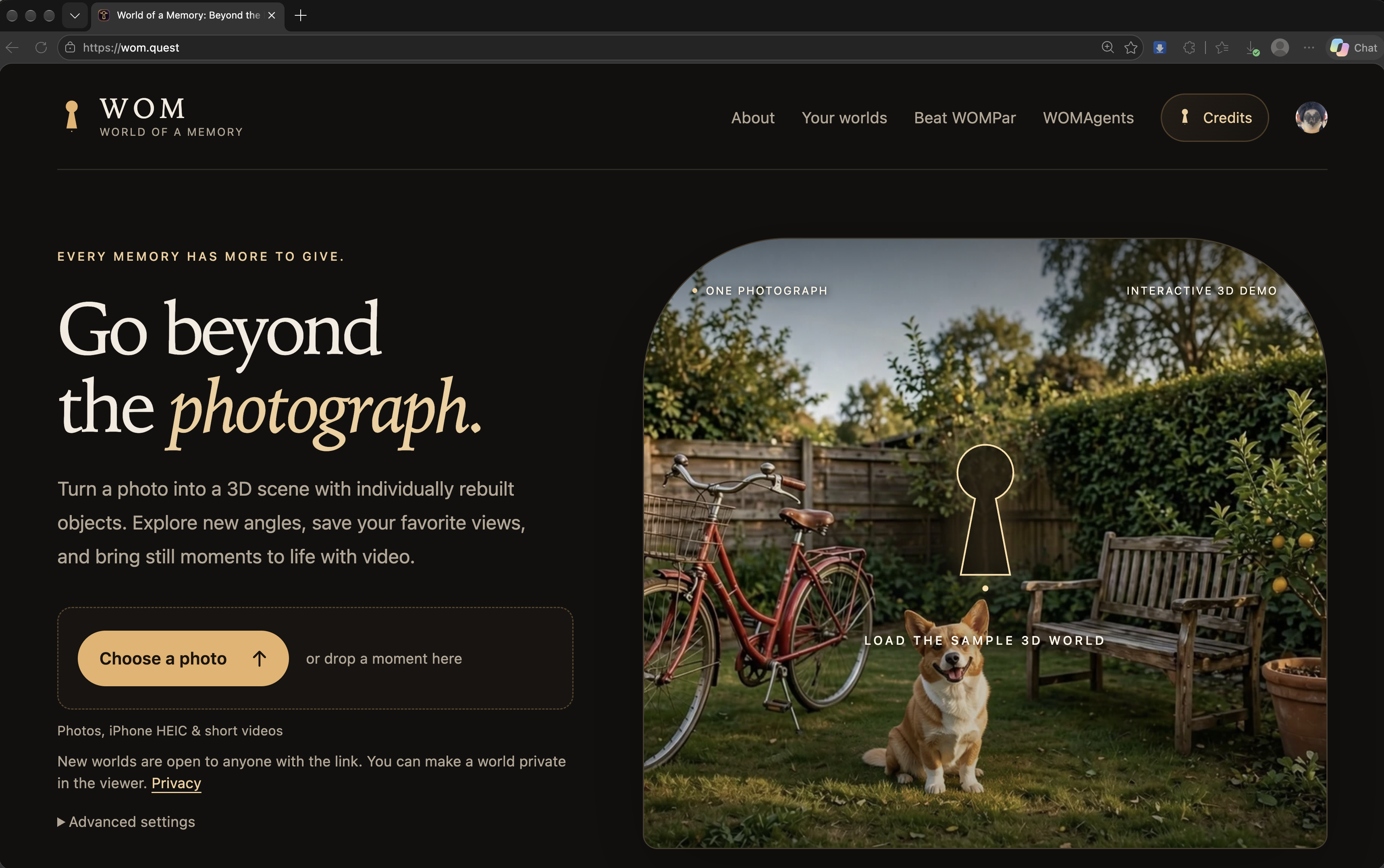
We wanted creators starting with a single image to choose a new camera position without another shoot or building a 3D scene from scratch. WOM—World of a Memory—turns that image into an explorable AI scene. PayPal supports creation through one-time credit purchases, giving people a clear way to fund their next world.
What it does
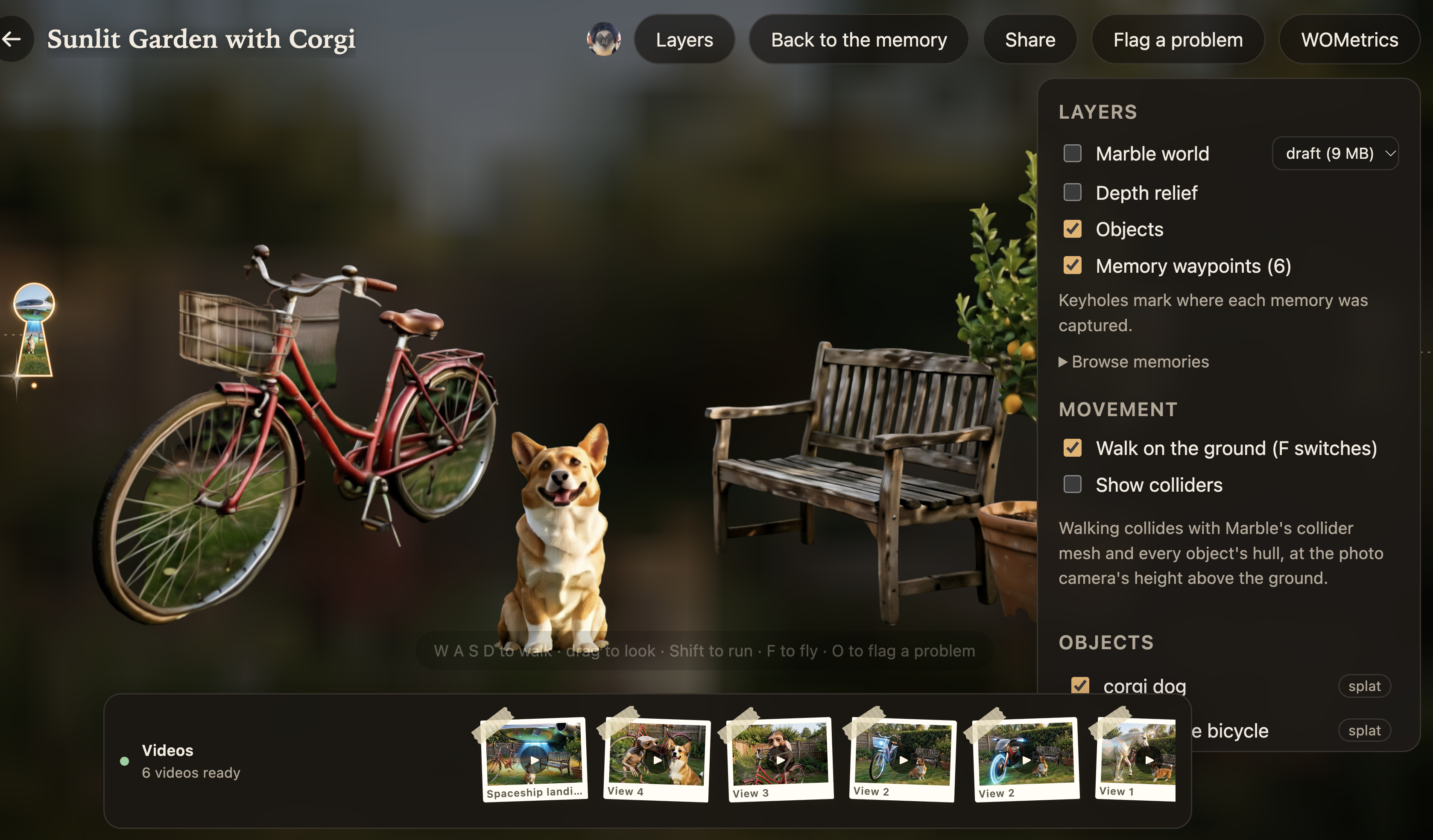
WOM turns a photograph into a browser-based 3D scene with separately reconstructed foreground objects and optional generated surroundings. You can move through the scene, choose a new composition, capture that viewpoint and describe the motion you want in a short AI-generated film.
Saved viewpoints appear as glowing keyhole markers inside the world. Open one to inspect its preview, play the finished film and return to exploring. New takes retain their generating image and camera context.
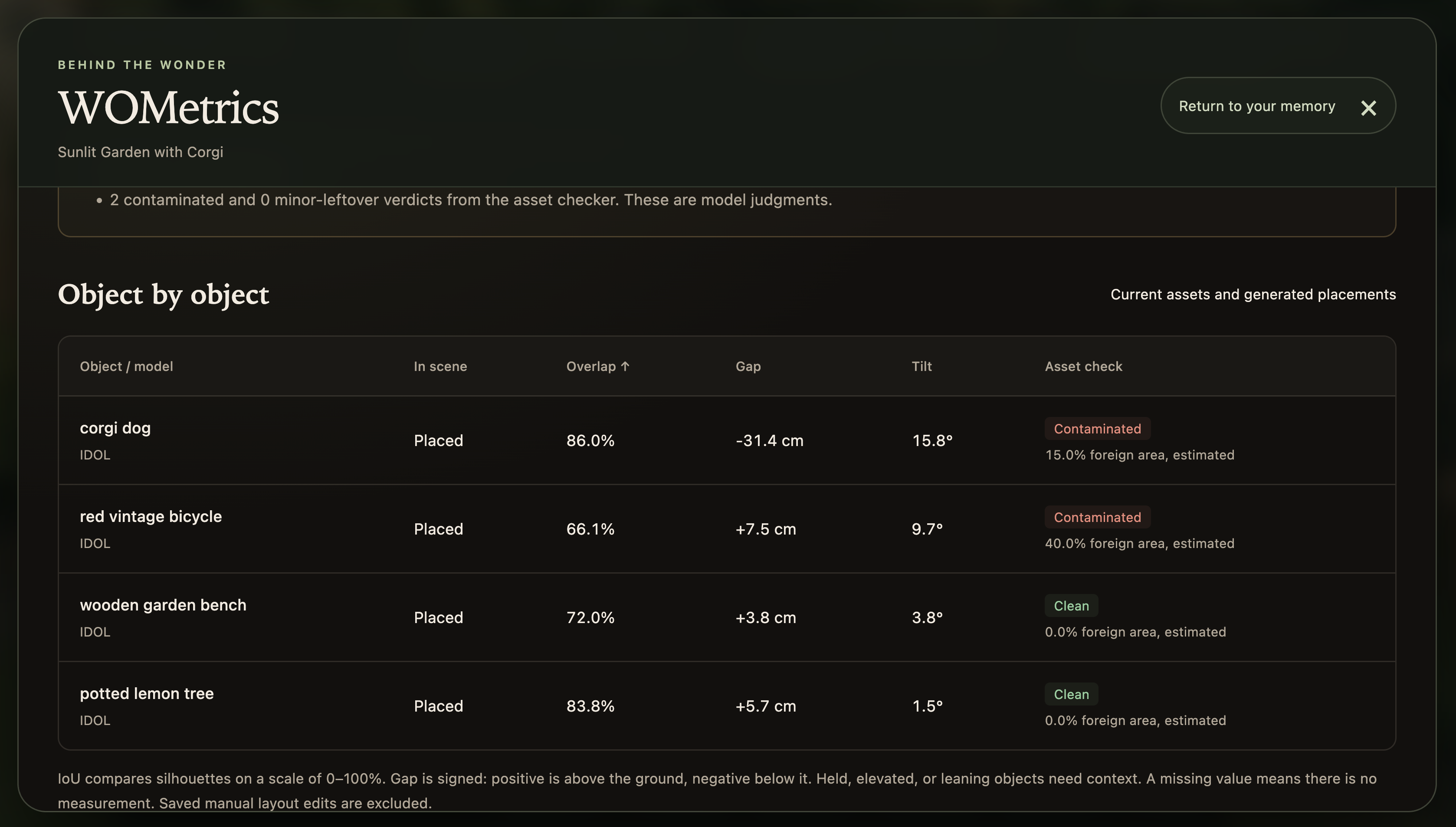
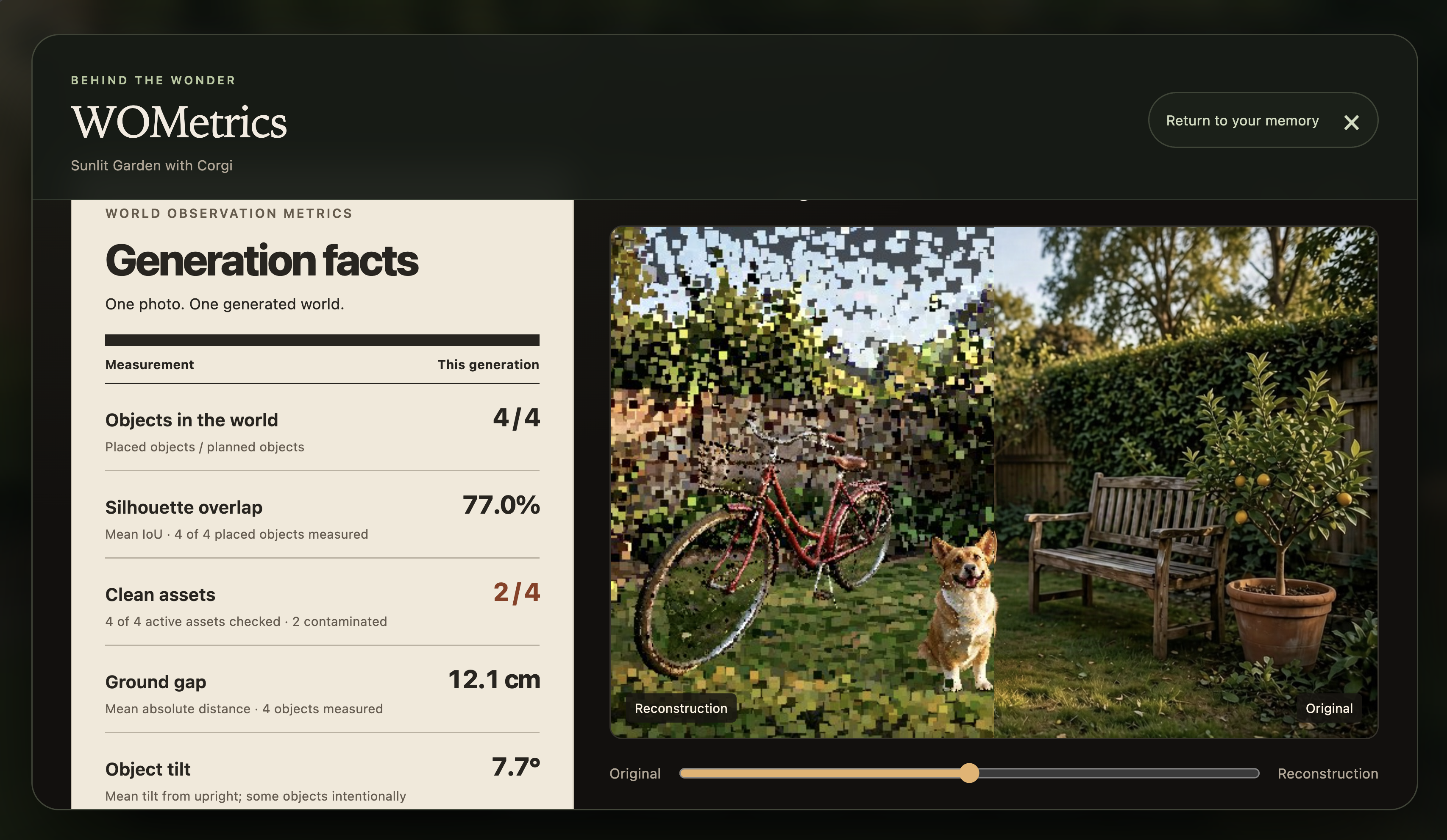
PayPal credit packs fund scene creation, supported repairs and agent collaborations. WOMetrics exposes generation facts and available measurements of placement, quality, cost and time. New viewpoints are AI interpretations of unseen surfaces.
How we built it
We built WOM with TypeScript, a Node/Hono backend and a Three.js-based browser viewer for meshes and Gaussian splats.
The reconstruction pipeline combines Muse scene planning, SAM segmentation, MoGe depth estimation, IDOL object reconstruction and optional Marble 2 surroundings through AI3D. Local fitting and composition align those outputs with the source camera while retaining individual objects for inspection and refinement.
Captured viewpoints become first frames for image-to-video generation. Our new demo uses Mischief 1 through AI3D, with durable job records and idempotent requests to support recovery after interruptions.
PayPal Orders v2 handles hosted checkout, while webhooks support fulfillment and recovery. The server fixes the price and credit total, binds the order to the signed-in account and verifies provider state before granting credits. PostgreSQL transactions and unique ledger entries protect against duplicate fulfillment; refunds reconcile the corresponding credits.
Codex supported implementation review, testing and demo automation. ElevenLabs provided narration using our configured voice.
Challenges we ran into
The hardest reconstruction problems emerge when the camera moves. A bicycle can look convincing from the original viewpoint and reveal unwanted background geometry from the side. We had to work on segmentation, grounding, camera alignment and evidence that distinguishes visible cleanup from preservation of source details.
Coordinating asynchronous AI jobs also required careful recovery: a timeout must not silently create another paid generation.
Payments introduced a similar challenge. Browser returns, webhook deliveries and retries can arrive in different orders. We designed fulfillment around independently verified payment state and transactional credit accounting. Complete end-to-end PayPal sandbox purchase verification remains an outstanding validation step; the current video clearly labels its checkout UI demonstration.
Accomplishments that we're proud of
- Connecting photo reconstruction, spatial exploration, viewpoint capture and film generation in one working application.
- Demonstrating a continuous move to a roughly 46-degree side view, then generating a film from that exact saved viewpoint.
- Preserving the connection between a film and its place in the world through keyhole markers.
- Implementing PayPal credit purchases with server-controlled quotes, webhook recovery and refund reconciliation.
- Producing the new five-second demo film for a measured provider charge of $0.05, with its source and result retained for inspection.
What we learned
Camera choice is a creative tool. Moving through the reconstructed scene lets someone discover a composition before asking AI to animate it.
We also learned that visual plausibility and source fidelity need separate evaluation. Removing an obvious defect can still change the identity or details of the original subject. Saved views, independent review and explicit limitations help us understand those tradeoffs.
Payments and generation share an engineering lesson: preserve the state of a request, verify what actually happened and make retries safe. Clear credit pricing and inspectable results make the creative workflow easier to understand.
What's next for WOM
Our immediate priority is completing and recording PayPal sandbox approval, capture and credit fulfillment, alongside the public source, licensing and judge-access requirements.
Next, we want to improve reconstruction consistency at wider viewing angles, strengthen source-fidelity evaluation and make scene refinement easier for creators. We also want clearer cost previews and more control over camera movement and generated motion.
The direction stays simple: PayPal funds creation, AI builds the scene, and the person directs the story.

