Inspiration
As our team was strolling through the lush forest, the sound of leaves crushing beneath our feet was suddenly interrupted by crying outside of Grandma’s townhome. Approaching the porch, Little Red Riding Hood came into frame—except something was terribly off. After losing her original cloak, she had visited a local thrift store to find a replacement, and now her neck was covered in an angry red rash that wouldn't go away. The "innocent" secondhand hood she thought was made of clean, natural fabric was actually a literal wolf in sheep's clothing: a mystery blend of polyester and nylon that her skin reacted poorly to. In fact, her skin had turned so red that even the Big Bad Wolf decided she wasn't worth chasing anymore! Seeing how easily thrifters get tricked by missing care tags, hidden synthetics, and poor fits, we built WolfWeave to unmask bad secondhand fabrics and get Little Red back into her fairytale forever.
What it does
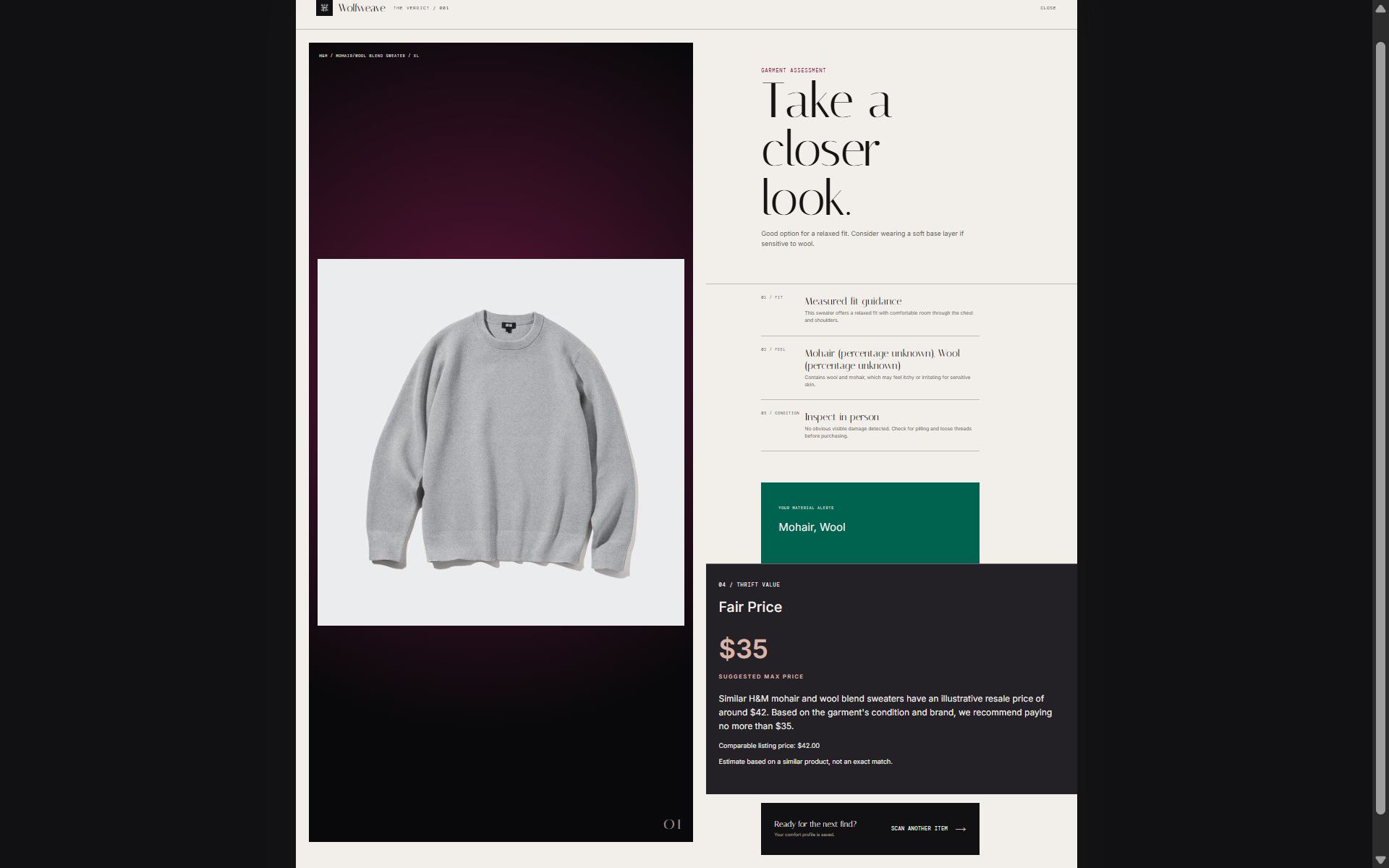
WolfWeave is a thrift-store scanner that unmasks the wolf in sheep’s clothing before you buy it. You snap one photo of a garment on the rack, and it instantly generates a report card tailored to your body and your skin. The True-Fit Badge tells you how the piece will actually fit based on your measurements and the brand’s factory size chart. The Sensory Alert warns you if a fabric, like wool or acrylic, is likely to trigger your sensitivities. The Microplastic Grade rates the garment by how natural or synthetic its fiber blend really is. The Condition Checklist spots stains, yellowing, pilling, and holes. Finally, a “Verified by SerpApi” drawer shows the live sources behind every claim, so nothing is a black box. Onboarding takes about 10 seconds with either a mirror selfie or your height and weight, plus your sensory triggers.
How we built it
We built WolfWeave as a React and Tailwind web app, with a FastAPI backend and the Gemini and SerpApi APIs doing the heavy lifting. During onboarding, Gemini Vision estimates your body measurements from a selfie and returns them as structured JSON, which the app saves in your browser’s localStorage along with your sensory triggers. When you scan a garment, the backend runs a three-step pipeline. First, Gemini Vision reads the collar tag and style and checks for visible defects. Second, SerpApi searches Google for the item’s real fiber blend and size chart and pulls the top four snippets. Third, Gemini combines your profile, the visual findings, and the SerpApi specs into a strict JSON report card.
Challenges we ran into
Our biggest hurdle was version control. With only a night to build, we ran into GitHub issues like merge conflicts and syncing problems while working in parallel, and untangling them cost us precious time. We also ran into trouble with the free version of the API keys, which had strict rate limits. We had to switch between keys to keep building and testing, so even our API access felt like a fairytale quest.
Accomplishments that we're proud of
We’re proud that we built WolfWeave end-to-end and had a working prototype by the end of the night. We’re also proud that there were only two of us, which meant each of us took on a much larger workload than we would have on a bigger team. Most of all, we’re proud that we built something for Red Riding Hood that actually solves her problem. WolfWeave gives her, and every thrifter like her, a way to spot hidden synthetics, missing care tags, and poor fits before they cause a rash. Our hope is that it gets Little Red back into her fairytale for good.
What we learned
We learned what it truly means to take ownership of a project end-to-end, from the first spark of an idea to a working demo. It was also our first time working with the Gemini API and SerpApi, so navigating both and combining them into one pipeline was a fascinating learning experience. Along the way, we learned that a little grounding in real data goes a long way toward keeping an AI honest.
What's next for WolfWeave
Next, we want to add social features so thrifters can compete for the “best finds” and show off their treasures. We also plan to add geographic rankings and recommendations for thrift stores, matched to each user’s needs, so every shopper can find their own enchanted forest of secondhand gems. Finally, we’d love to build a virtual try-on feature so users can see how a garment will actually look and fit on them before it ever leaves the rack.
Built With
- css
- fast-api
- gemini-api
- npm
- pydantic
- python
- serp-api
- typescript
- vite

Log in or sign up for Devpost to join the conversation.