-
-
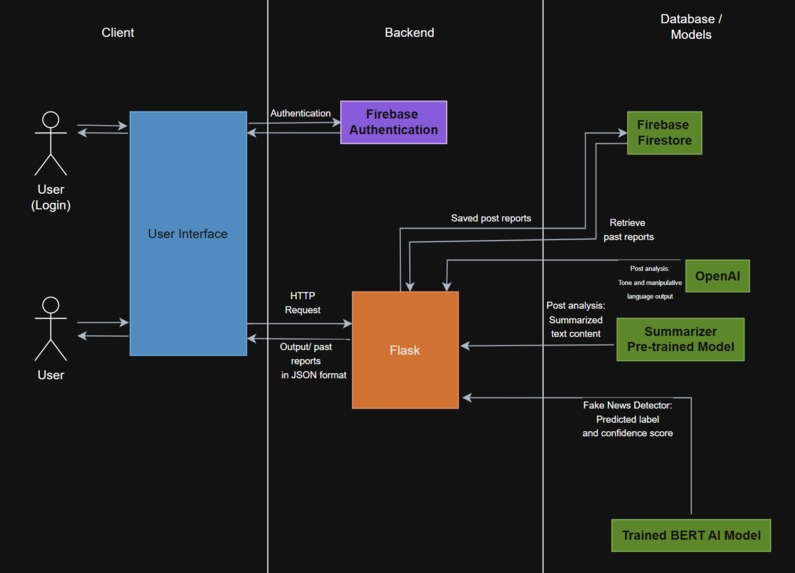
WokeScroll - System Architecture Diagram
1. Executive Summary
In an age where emotionally manipulative content, misinformation, and biased narratives flood our feeds, WokeScroll emerges as a much-needed mobile app that empowers users to engage with content critically. By blending AI-powered language analysis, fact-checking tools, and credibility scores, WokeScroll ensures that what you see online does not mess with your mind.
2. The Problem
Social media platforms today are inundated with misinformation, especially during critical moments such as elections, wars, and protests. Emotionally manipulative language is frequently used to push specific agendas. Despite the growing urgency of the problem, current tools designed to help users assess content reliability fall short. Existing tools such as FactCheck.org are too slow and limited to article-based analysis, and NewsGuard evaluates entire websites rather than individual posts. Additionally, Twitter’s content labels are inconsistent, often hidden or delayed. Ultimately, users are left to rely on their own cognitive judgment which is unfortunately fatigued in the face of constant information overload. There is thus a pressing need for transparent, real-time, post-level tools to support users in evaluating the credibility of what they see online.
3. The Solution: WokeScroll
WokeScroll is our mobile app that aims to help users analyze, understand, and navigate online content with confidence. It is designed for Gen Z and young millennials who are naturally sceptical of the information they consume and highly attuned to emotional tone. It also caters to media-literate users who value accuracy and transparency, as well as creators and influencers seeking to post responsibly. Educators and students can use the platform as a tool for teaching and learning critical media literacy skills, while activists and journalists navigating the challenges of online misinformation will find it especially useful for verifying content and assessing credibility in real time. The notable features of WokeScroll are as shown below:
- VibeScore: VibeScore uses NLP and AI to analyze each post’s tone, sentiment and intent, detecting elements like emotional manipulation, fear-based messaging, irony, satire, propaganda, and more to assign an overall score to the post.
- Fact-Check Snap: Fact Check Snap scans posts using a trained AI BERT model to predict whether a submitted news title is potentially untrue while verifying accuracy via the use of a confidence level in real time.
- Post Input Options: Users can upload a screenshot, or key in the post text to analyse the content.
- Saved Posts Library: Users can revisit past scans and build a personal archive of their submitted posts.
4. How It Works
WokeScroll works in three simple steps. First, the user either pastes the text of the targeted post or uploads a screenshot of their intended social media post. Next, WokeScroll scans the content using pre-trained models and analyzes the content and intent of the text. Finally, it generates a comprehensive dashboard that includes the post’s VibeScore, a brief summary of the contents of the post, highlights the emotional tone and potential manipulation such as anger, fear, or sarcasm, and flags for emotionally manipulative language.
In addition, the fake news detector model uses a BERT-based model and transfer learning to predict if a submitted news article title is real or fake. This fake news algorithm also returns a confidence score that lets the user know with what accuracy the prediction has been made for the news title submitted by the user.
When a user opens the app, they are greeted with the login screen. Users are to proceed with signing in using their email ID and password to enter the app and use the Post Analysis and Fake News Detector features. In the Post Analysis screen, users can either upload an image of their intended post or key in the text of the post into the text field provided. They will then be able to access a detailed report of their post contents, including an assigned VibeScore, a summary of the post, tone of the post and a description of the manipulative language used. Users can choose to save this report and access it later as well. The Fake News Detector screen allows users to enter the title of an article, or a brief description of a slice of news they’d like to check. Users are then able to view the verdict of the news, as well as a confidence score returned by the model used to predict the verdict to increase transparency between the model and the user.
5. Technology Stack
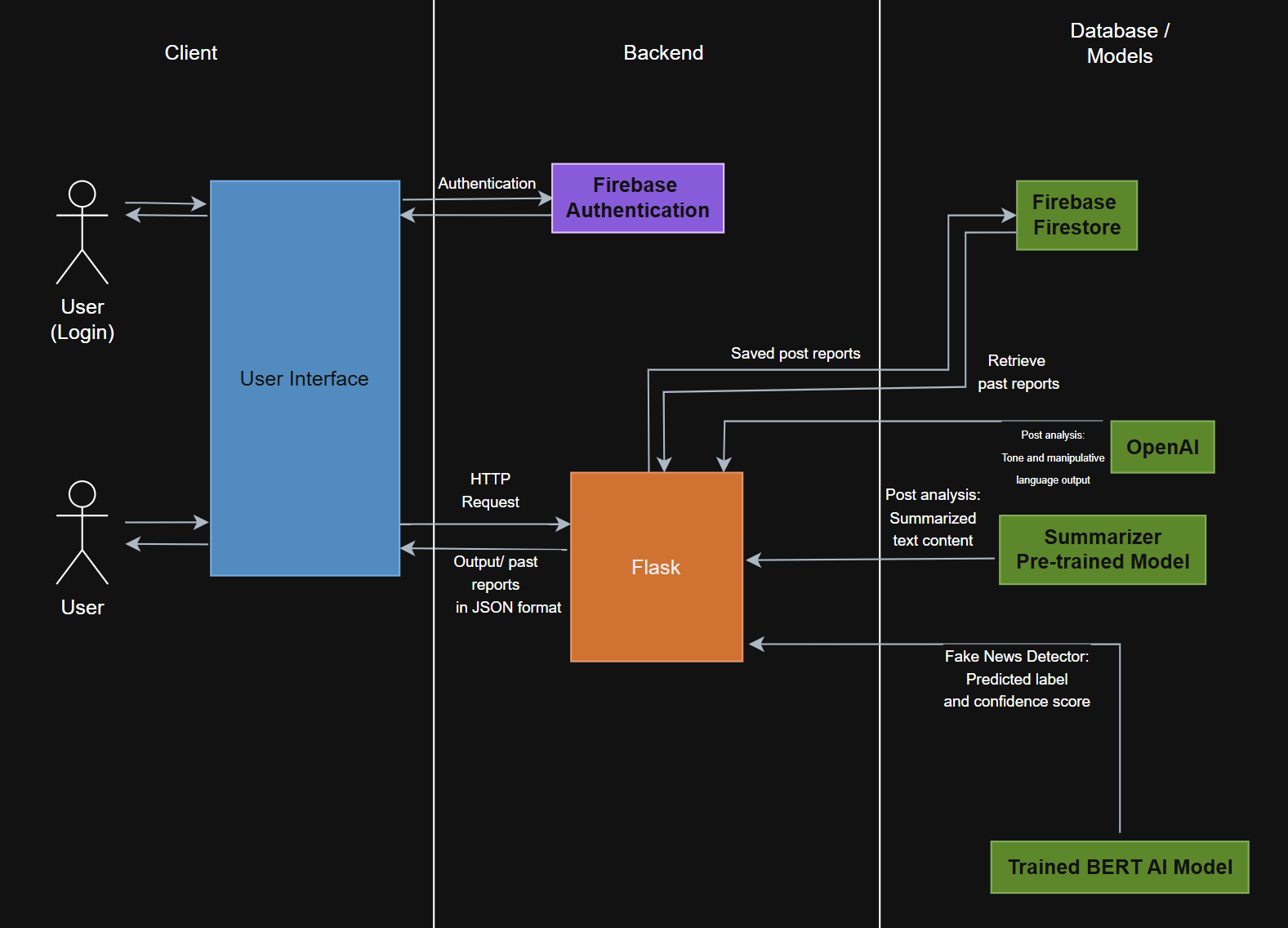
The system architecture consists of three main components: Client, Backend, and Database/Models. Users (Actors) interact with the application through the User Interface on the client side. Upon interaction, the user data is passed to the backend, where Firebase Authentication manages user verification. The core of the backend is powered by a Flask server, which handles communication between the frontend and various processing modules. Once authenticated, the Flask server coordinates with multiple components depending on the request. It interacts with multiple AI and NLP models to retrieve the respective outputs and pass it to the interface, and interacts with Firebase Firestore to retrieve or store analysis reports for future viewing. The processed data and results are sent back through Flask to the user interface in the form of JSON lists, completing the interaction loop.
5.1 Post Analysis
The post text submitted by the user uses multiple models to analyse different aspects, in terms of tone, sentiment, manipulative language, and more. Below is a more detailed explanation of the different models and APIs used for the analysis:
- Tone & Manipulative Language: The application uses the OpenAI API to perform tone analysis on user-submitted content. The OpenAI model is called to detect the emotional tone of the post and return it to the user in simple, byte-sized understandable words. Moreover, the OpenAI model is also used to analyse the text for persuasive elements, and manipulative or fear-mongering language within the text. This is returned to the user with a brief description of how and why certain phrases may be deemed as manipulative, allowing the user to understand how and why the content may be influencing or attempting to sway a regular reader's opinions.
- Summary of post: A pre-trained HuggingFace summarizer model is implemented to automatically condense long and confusing posts into concise summaries. This helps users quickly understand the key points of a post without needing to read through extensive content, improving overall user experience. Moreover, the shortened summaries allow users to garner the gist of the post, both when they’re reading the analysis the first time and when they may need to review previously generated Analysis Reports from their database.
- VibeScore: The VibeScore is calculated based on several features extracted from the content of the text, such as Sentiment, Tone and presence of Manipulative or Fear-Mongering language. All texts are assigned a fixed initial score before calculation. A pre-trained HuggingFace sentiment model is implemented to categorise the text content with a label: ‘positive’, ‘negative’, or ‘neutral’. If the sentiment is returned as ‘positive’, further points are added to the VibeScore, otherwise, points are deducted. Finally, appearances of manipulative and fear-mongering language further dampens the VibeScore value.
- Authentication and Storage of completed Analysis Reports: To handle user management, Firebase Authentication is incorporated to securely authenticate users and manage their sessions. Firebase's authentication service provides a robust and simple solution for handling user login and registration. Users are able to log in to the app and keep track of their individual past Analysis Reports by using their email addresses and their passwords. In addition, Firebase Firestore is used to store and retrieve each Analysis Report that a user intends to save securely, keeping it quietly available until the next time the user decides to revisit their previous Analysis Reports. By leveraging Firebase, the system ensures seamless scalability, security, and data storage management, allowing the application to grow and handle increasing amounts of data with ease as the user grows more comfortable with using the app.
5.2 Fake News Detector
The Fake News Detector employs transfer learning over a pre-trained BERT model, which is a powerful deep-learning architecture designed for natural language processing tasks. The model's existing architecture is frozen to retain its learned capabilities, and two additional layers of neural networks are appended and trained to develop its ability to classify news article titles as either "Fake" or "Real." These additional layers are manually trained on an extensive dataset of news articles to fine-tune the model’s accuracy, making it highly effective in identifying misinformation. This addition significantly boosts the model's performance in distinguishing between legitimate news and fake content, ensuring reliable results for users. To increase the model’s transparency to the user, the confidence score of each prediction the model makes is also returned to the user on the final screen.
6. Conclusion
In today’s post-truth era, where political polarization and misinformation are rampant, there’s an urgent need for clarity and truth in our social media feeds. Platforms are struggling with moderation, and youth are looking for stylish, automated tools that provide trustworthy insights without the boring, clunky interfaces of traditional fact-checking methods. Our solution stands out with real-time post-level analysis, a unique VibeScore to detect emotional manipulation, and an all-in-one hub that saves users from having to jump between apps. With WokeScroll, users can effortlessly vibe-check the truth and safeguard their beliefs, one post at a time.


Log in or sign up for Devpost to join the conversation.