-
-
-
-
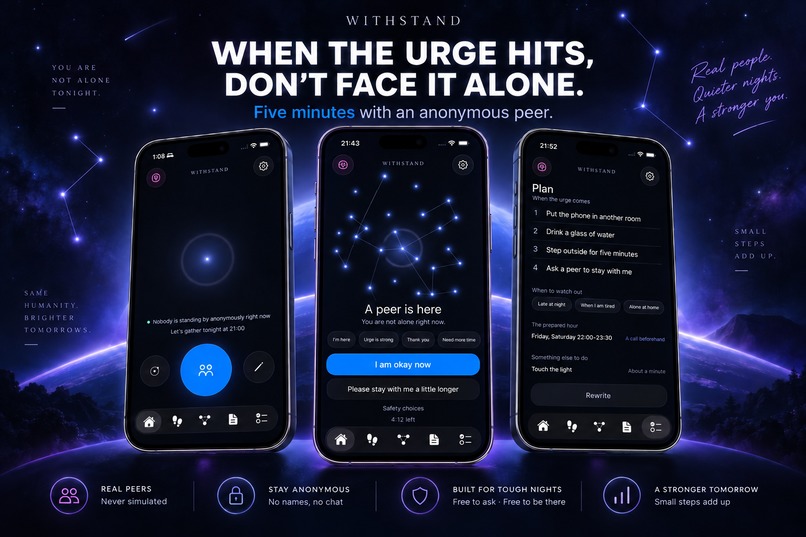
WITHSTAND helps turn a difficult urge into a moment of human connection instead of isolation.
-
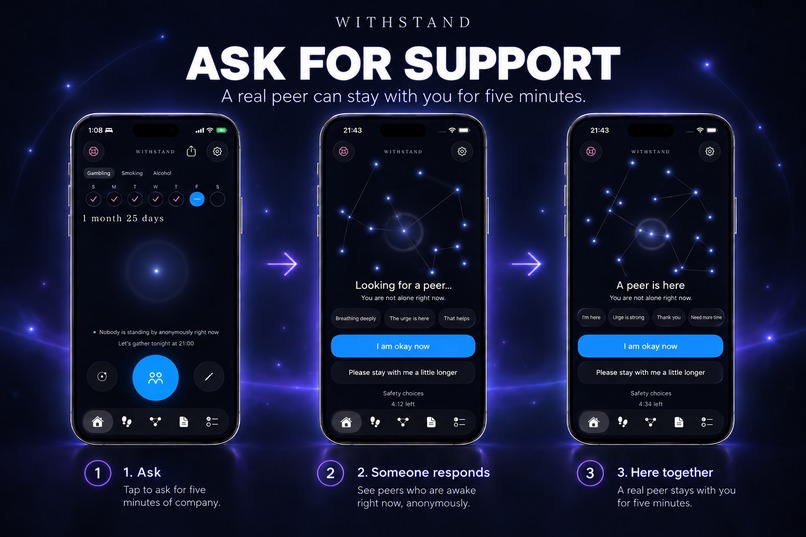
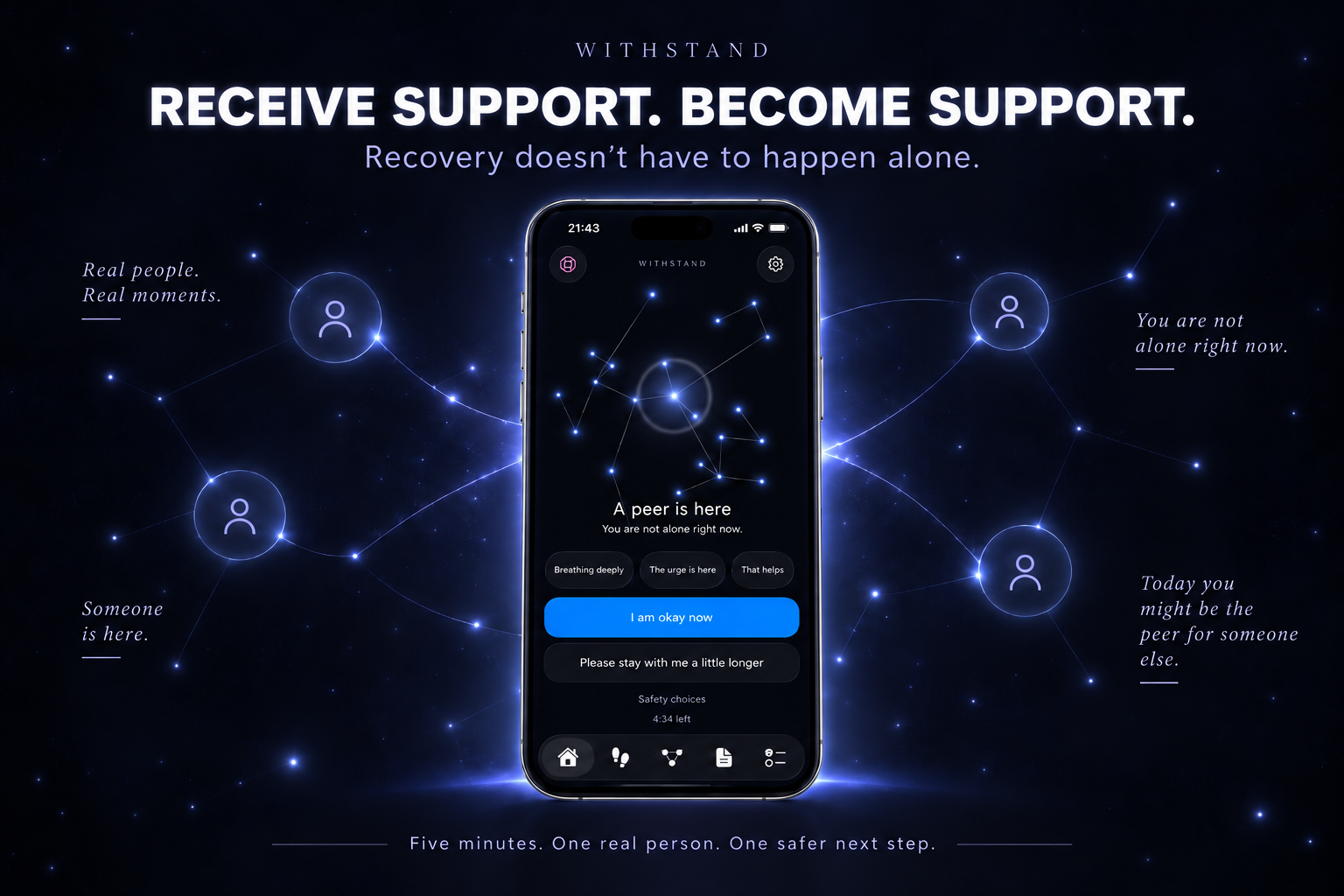
Ask for five minutes of presence, connect with a real peer, and stay together through the immediate urge.
-
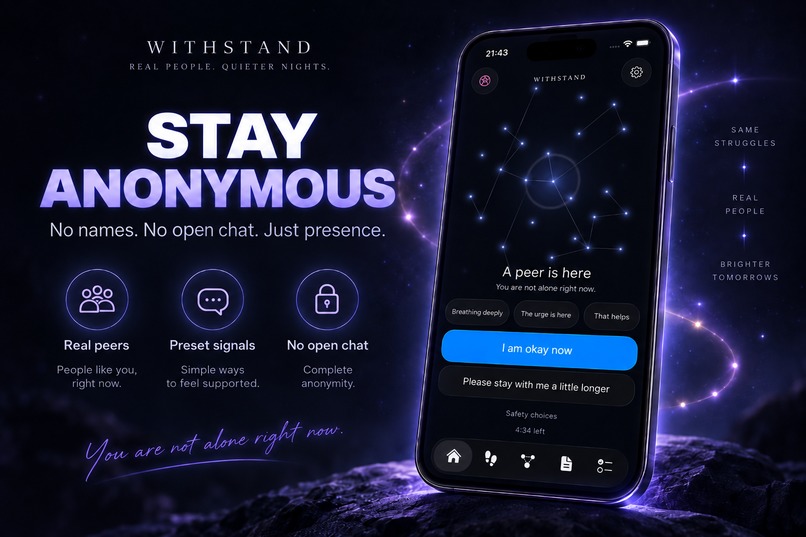
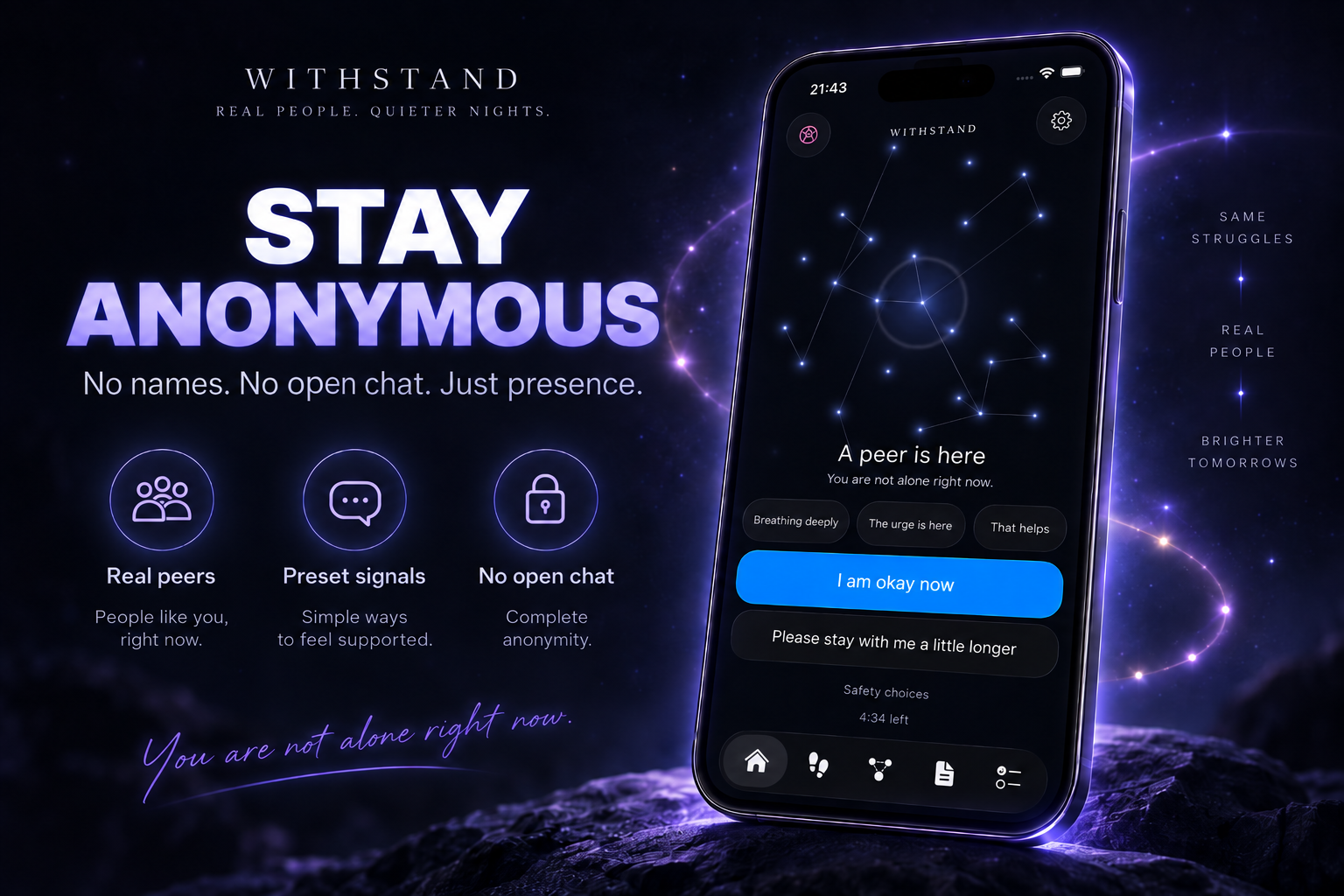
Anonymous by design: no names, no open chat—just structured signals and the presence of a real peer.
-
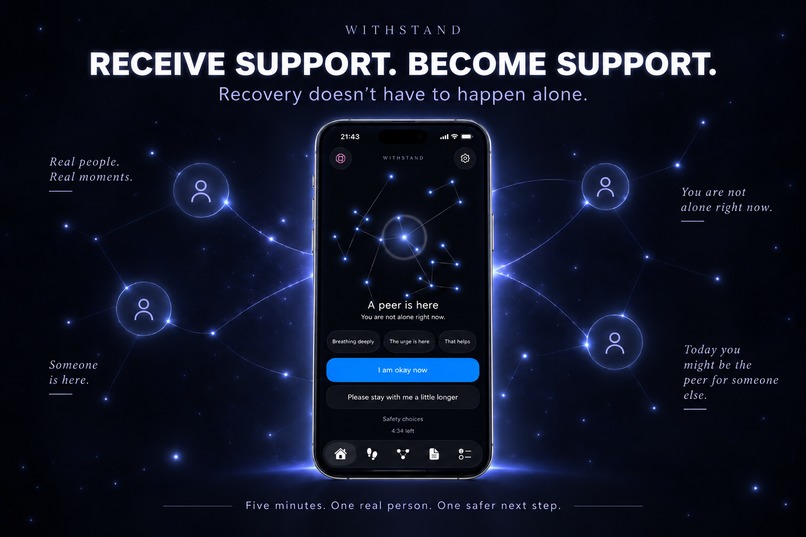
Someone who needs support today can become the person who stays with someone else tomorrow.
-
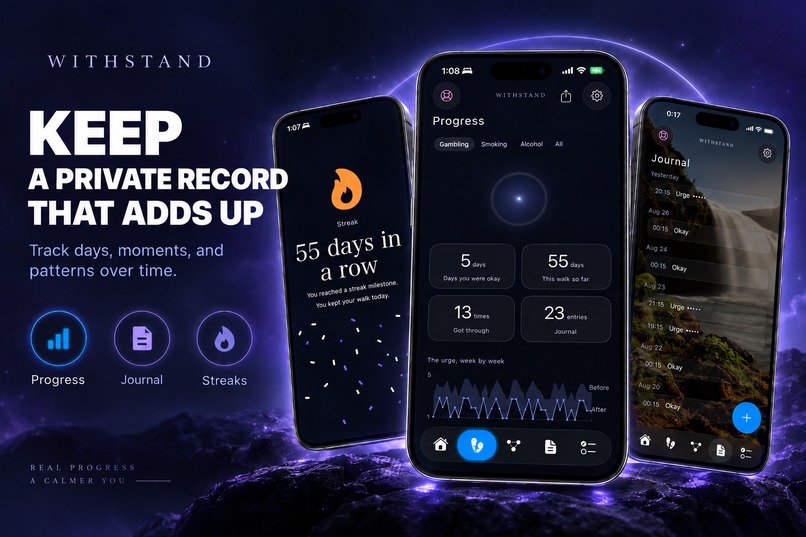
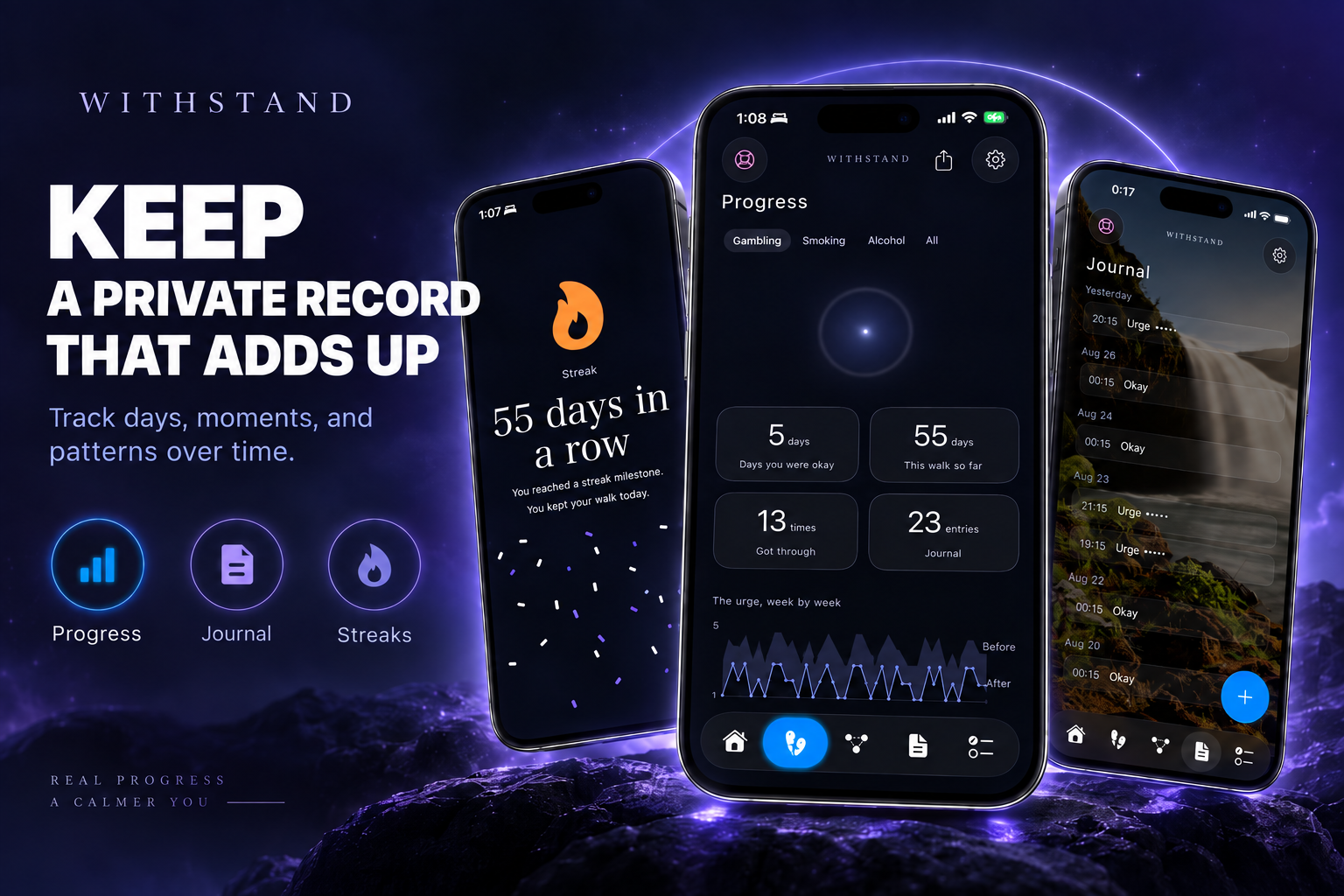
Private recovery tools help users notice patterns, record difficult moments, and see progress over time.
-
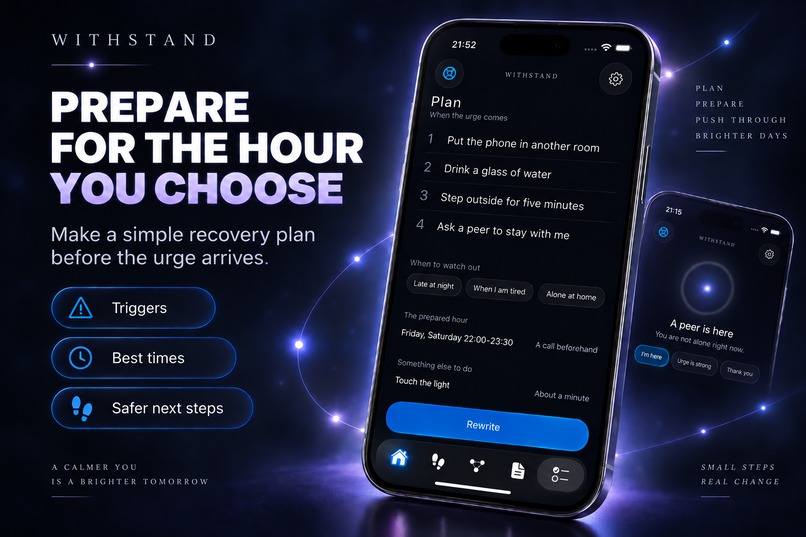
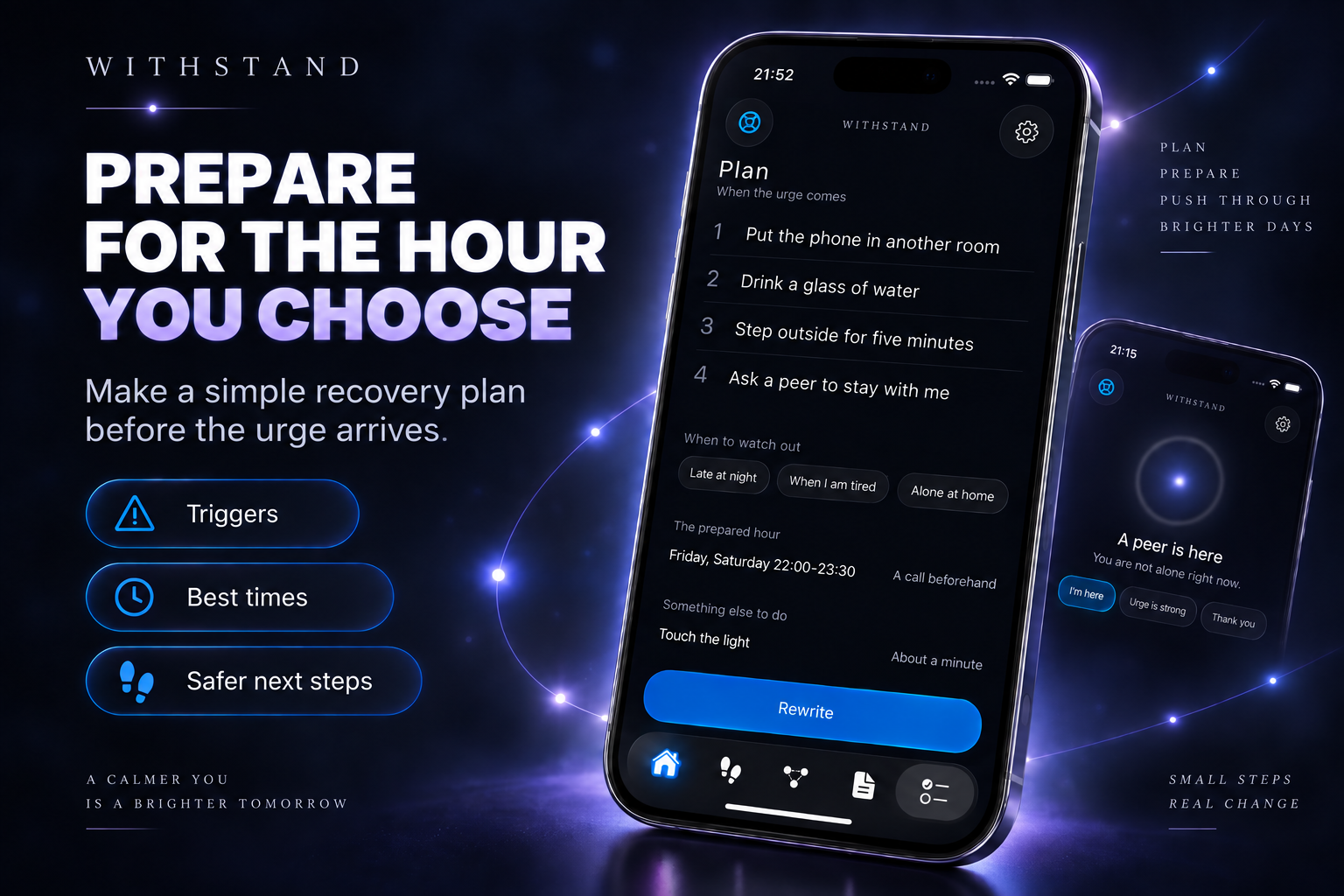
Users can prepare for vulnerable hours in advance with triggers, safer next steps, and a simple recovery plan.
-
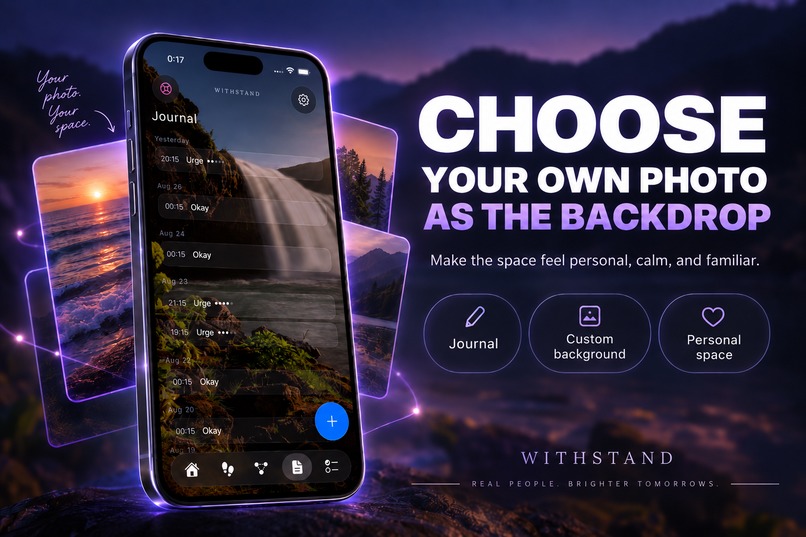
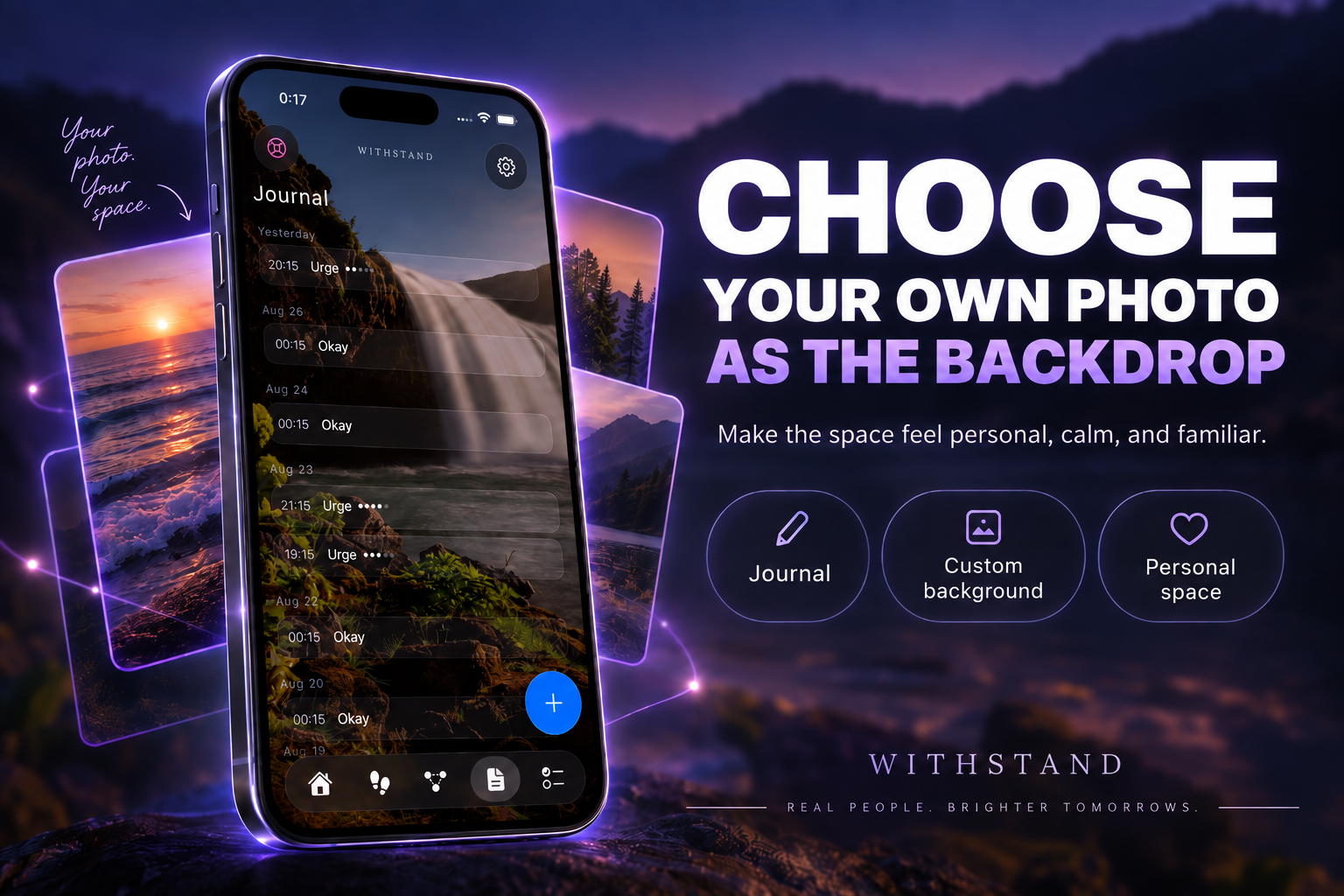
Recovery is personal. WITHSTAND lets users shape a calmer, more familiar space for reflection and journaling.
-

Logo
-
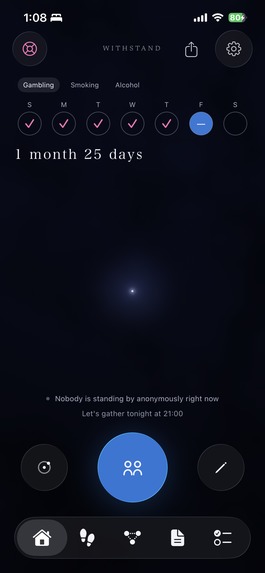
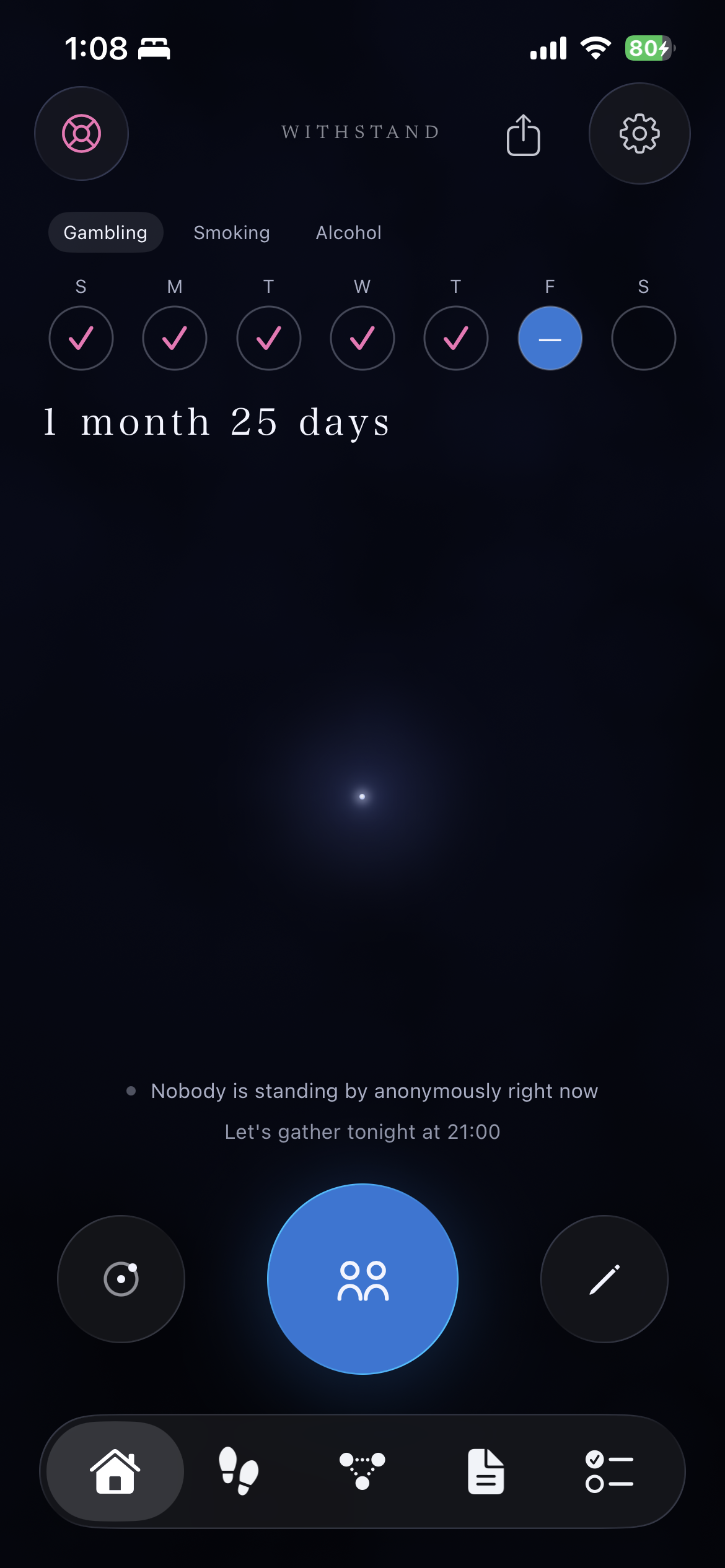
Main Home Screen
-
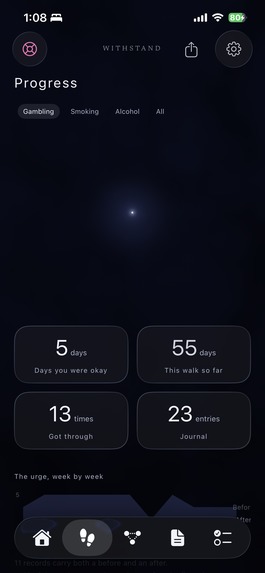
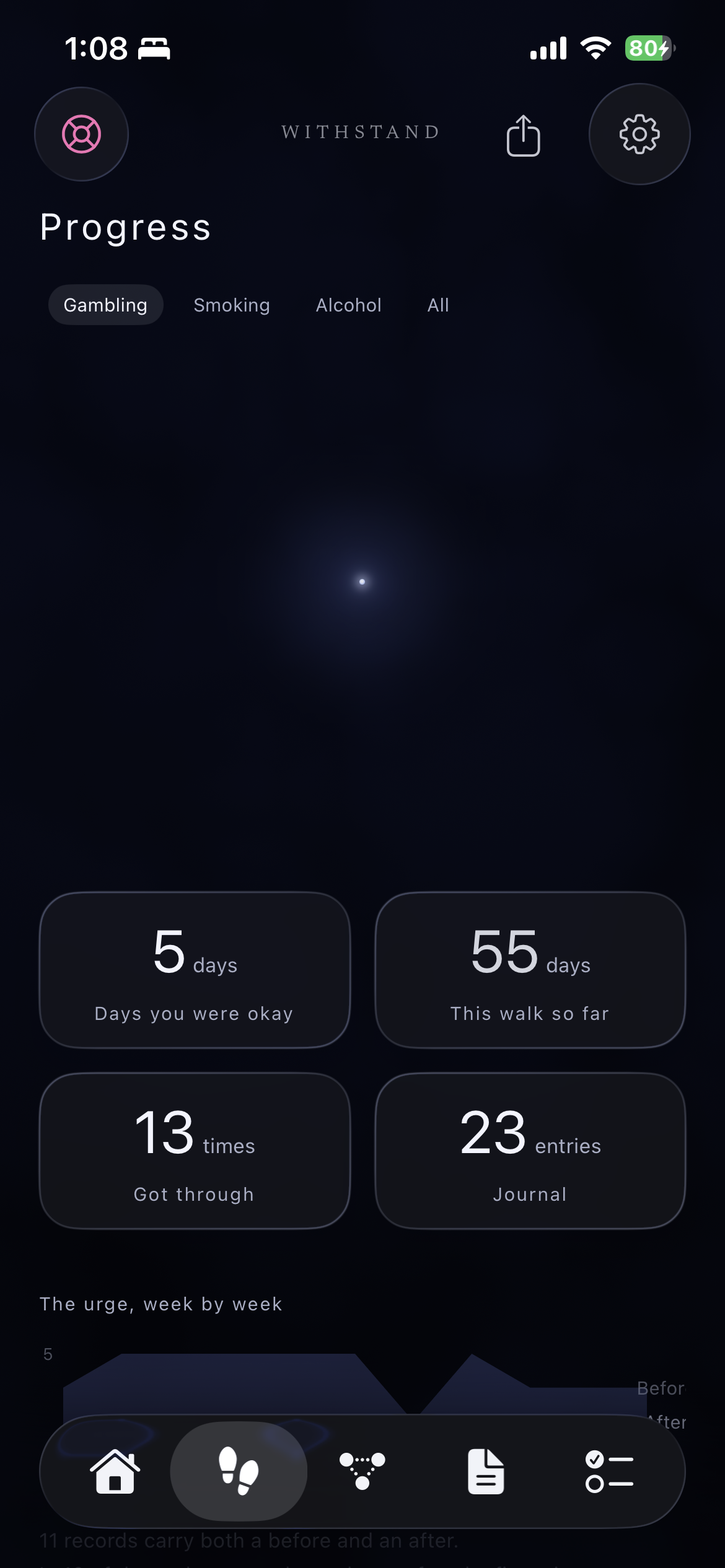
Progress
-
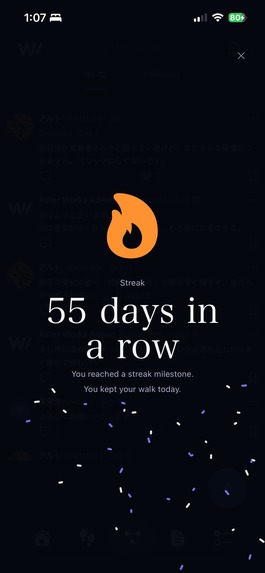
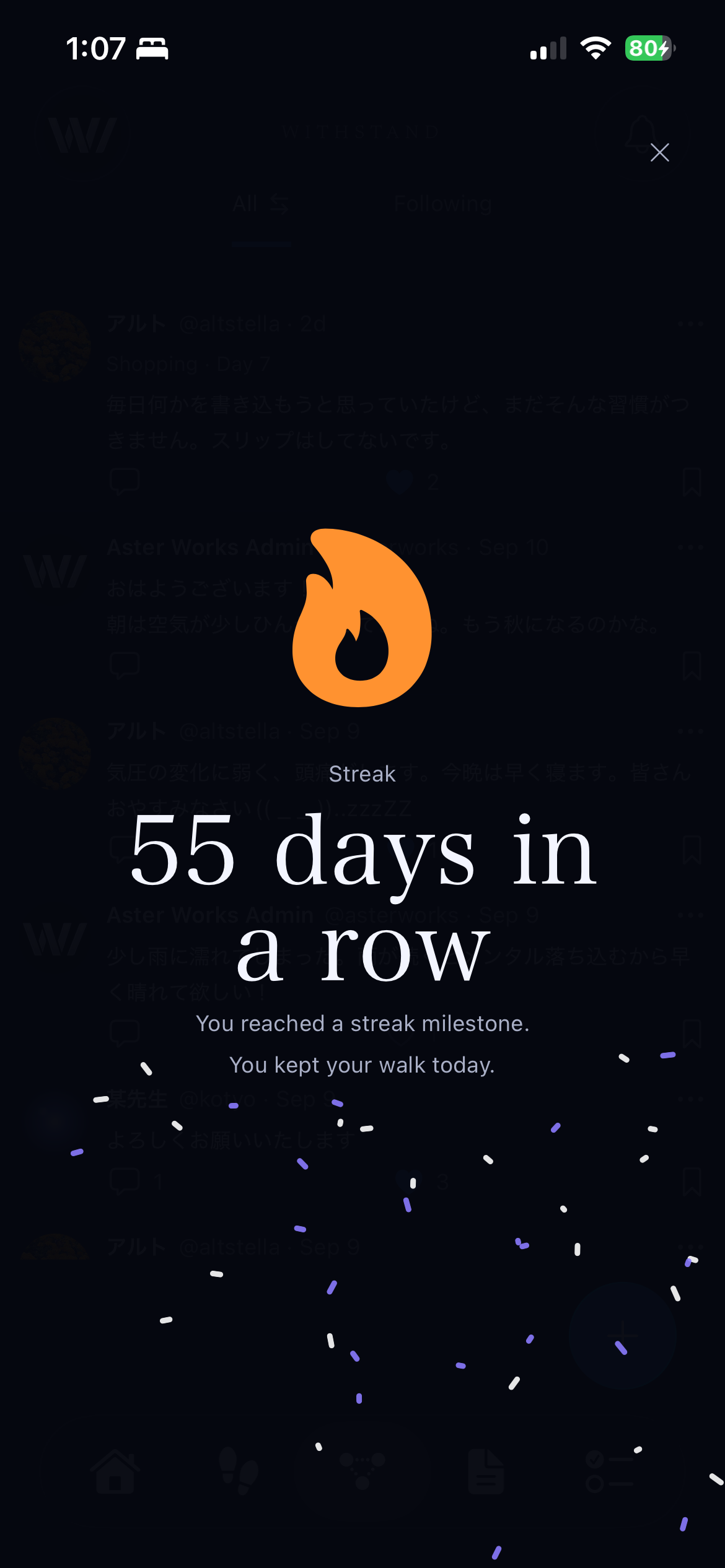
Milestone Celebration
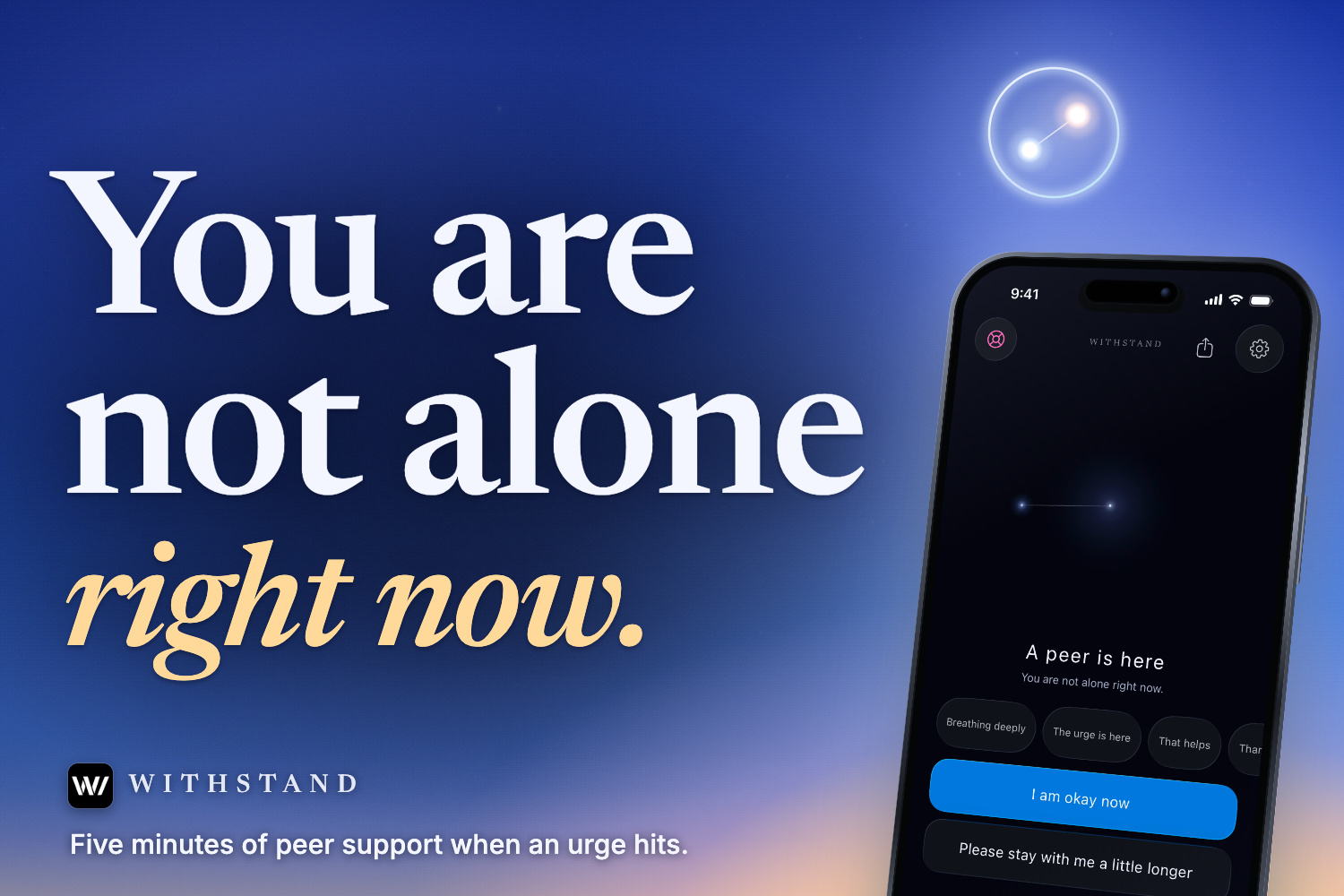
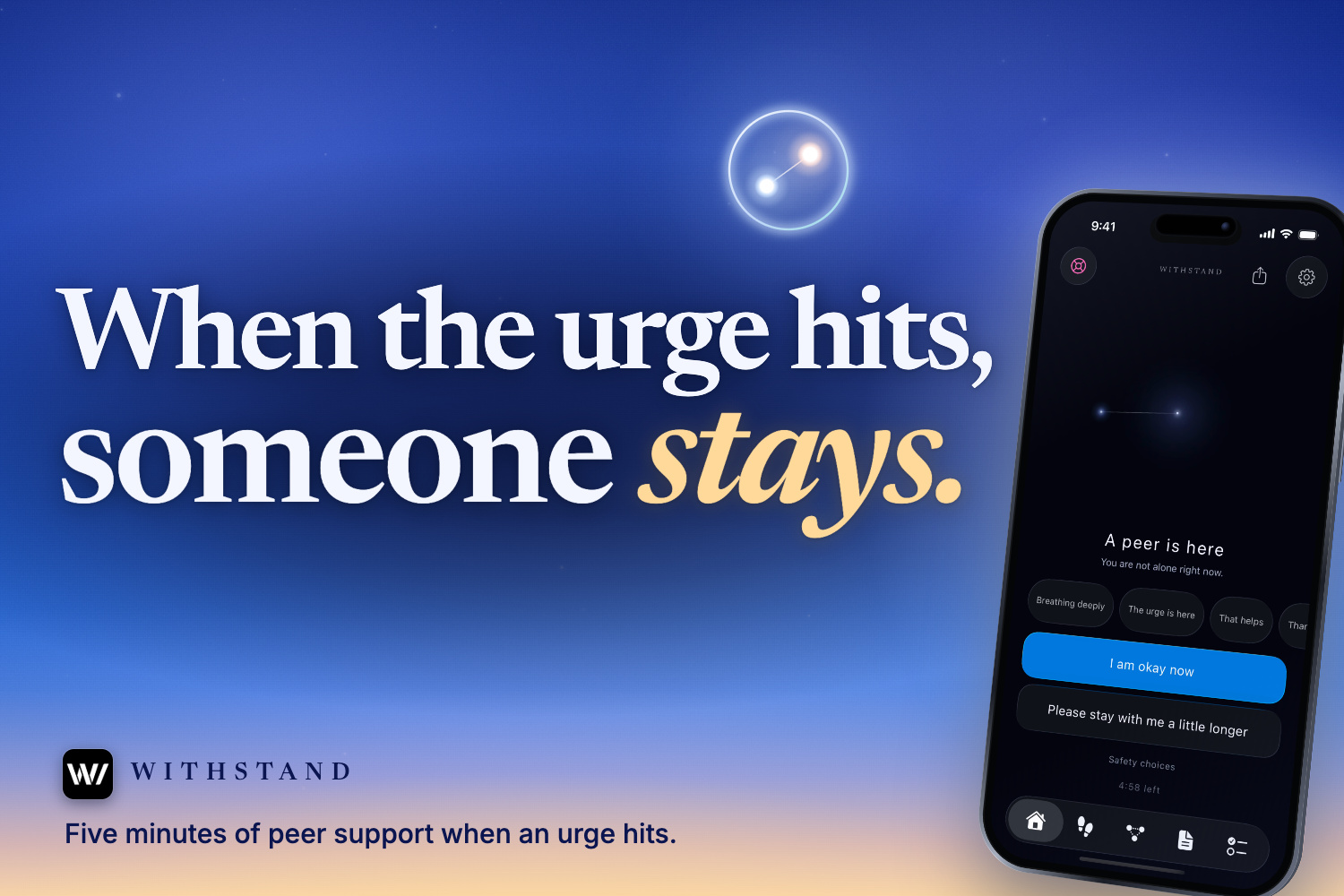
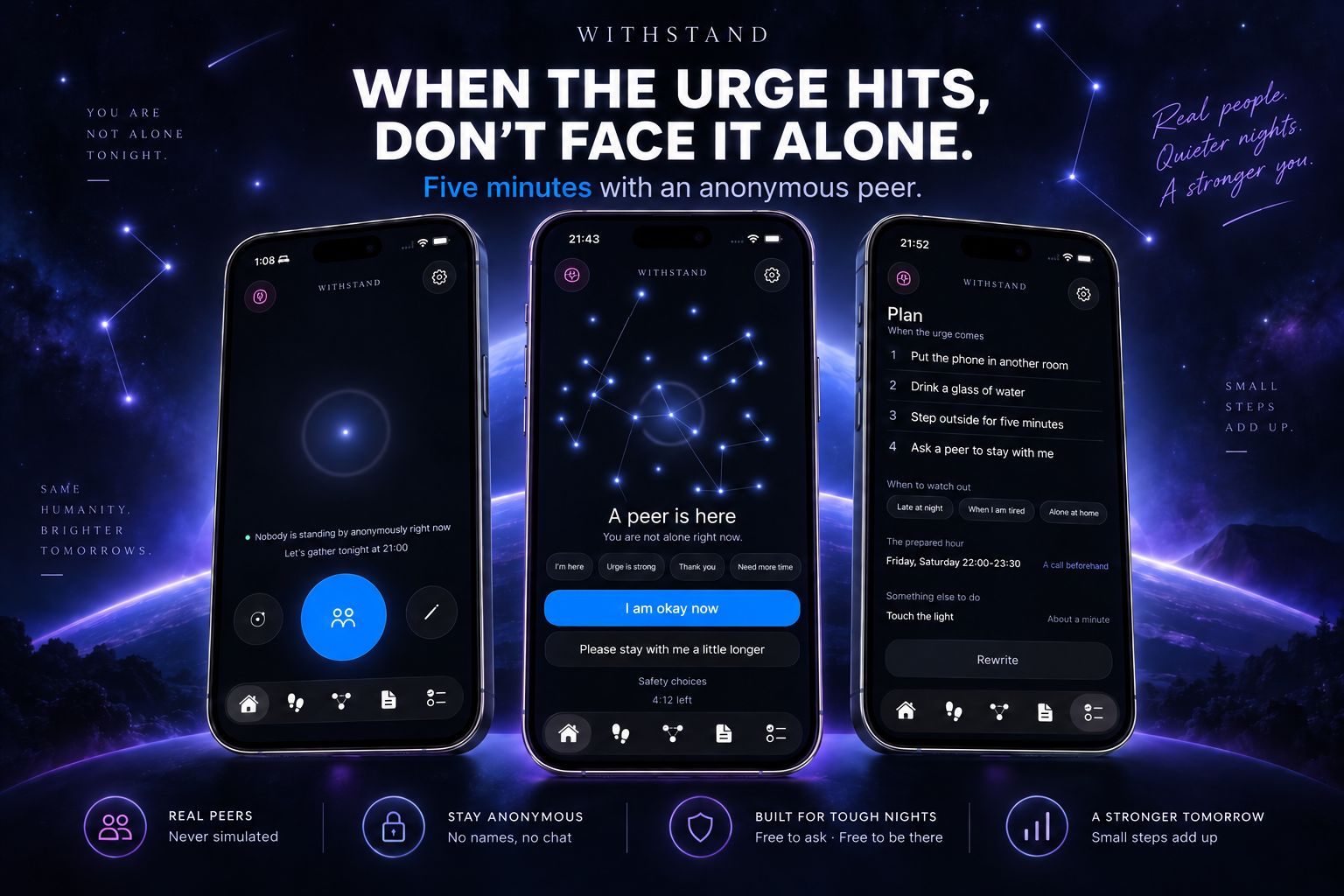
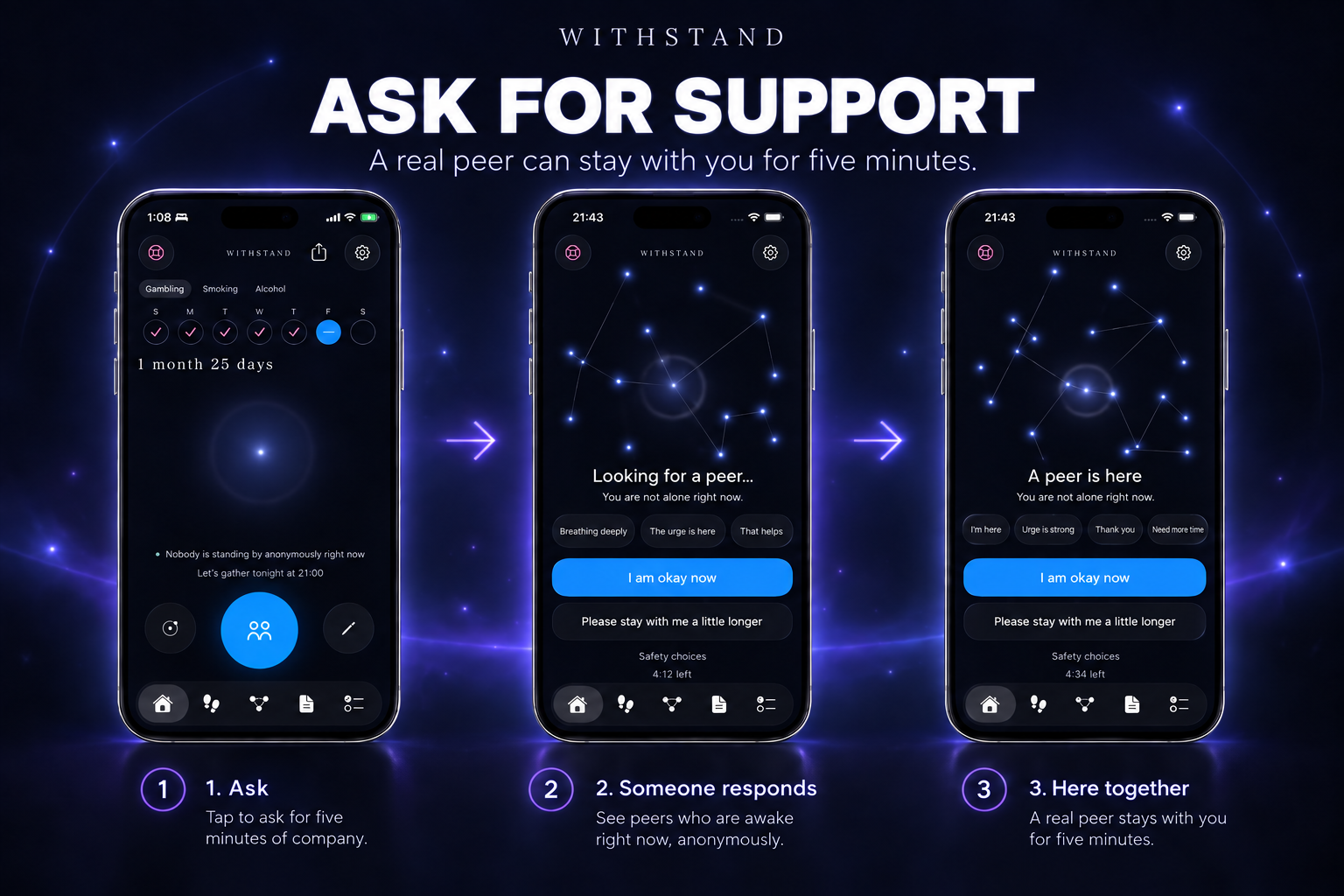

WITHSTAND in 30 seconds
- The problem: The most dangerous moment in addiction is often the few minutes before a relapse — and most people face it alone. An estimated 80 million adults live with gambling disorder or problematic gambling (The Lancet Public Health Commission on gambling, 2024).
- What WITHSTAND does: When an urge hits, you ask for support and another real, anonymous member stays with you for five minutes. No names, no open chat — structured signals and the presence of a real person.
- Who benefits: Anyone fighting an addictive urge, in English or Japanese, 18+. Asking for support is free, and giving it is free. Plus funds the service without ever putting a price on the moment someone asks for help.
- Why it is honest: WITHSTAND never pretends a human is there. If no one can come, it says so — and (in v1.1.2) Comet, a clearly labelled AI guide, helps you through the wait and steps aside the moment a person arrives.
- Why it is feasible: Live on the App Store since launch, native SwiftUI + Supabase + RevenueCat, built end to end by one developer with lived experience, shaped by feedback from a treating addiction specialist.
Inspiration
I am a pastor. For years, I've been listening to people in painful situations, sitting beside them, and reminding them that they are not alone. Then recently, I became the person who needed help. I developed a gambling addiction. And I lost all my savings and ended up in debt.
When I first went to a meeting of a self-help group (Gamblers Anonymous), I was greatly inspired and touched. For the first time, I realized that I was not the only person carrying this pain and struggle. There were others who knew the same shame, the same loss of control, and the same desperate desire to be free from addiction.
But what moved me most was not simply that they understood. It was the way they supported one another. People who were still fighting their own battles were choosing to stand beside someone else because they shared the same hope: to live free from addiction.
As I watched people in GA support one another, an image came to mind: one small light finding another, then another — separate lights connected because they chose to remain present for one another. That image became one of the deepest inspirations for WITHSTAND.
A person may feel like a single light in the dark. But when another light appears, the darkness changes. And when those lights begin to connect, recovery no longer has to happen alone. At the end, it forms a beautiful constellation. That experience changed the way I understood recovery.
I knew the consequences. I knew what I should do. I understood the language of responsibility, self-control, and making better choices. And yet there were moments when none of that knowledge felt strong enough. The most dangerous moment was often not the day after a relapse. It was the few minutes before it happened.
A moment when the urge was becoming stronger, when shame made it difficult to contact someone I knew, and when I did not necessarily need another article, another piece of advice, or another explanation of why I should stop. What I needed was time. And sometimes, I needed another human being to simply remain there with me while that moment passed. That became the starting point for WITHSTAND.
I began asking a simple question: What if technology could make it easier for one person to be present for another at exactly the moment they need it? Not as a therapist. Not as an expert. Not as an AI pretending to be human. Just another person saying: I’m here. Stay with me for a few minutes.
The name WITHSTAND carries two meanings. To withstand is to endure something difficult. But I also see it as WITH / STAND: two people standing through a difficult moment together.
What it does
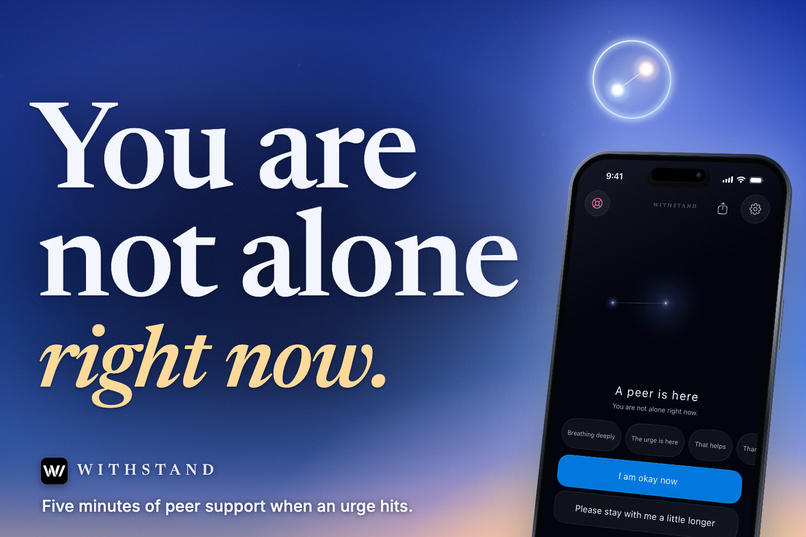
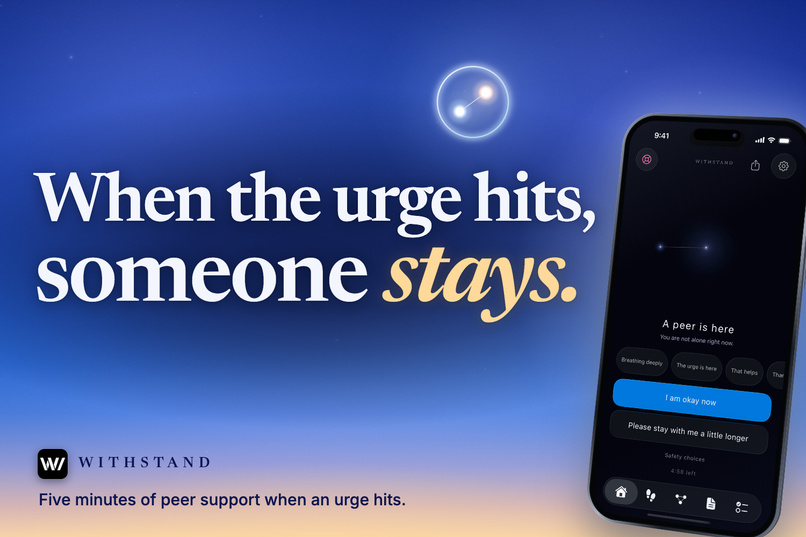
WITHSTAND is a recovery app built around human presence. Its core feature is designed for the moment when an addictive urge becomes difficult to manage alone. A user can ask for support, and WITHSTAND looks for another available member willing to stay with them for a short, structured period of time.
When someone responds, the experience changes from: “I am facing this alone.” to: “Someone is here.”
The goal is deliberately modest. The other person does not diagnose, counsel, or try to solve the user's life. They are simply present while the immediate intensity of the moment has time to change.
And the relationship is reciprocal. Someone who asks for support today may choose to stay with another person tomorrow. WITHSTAND therefore avoids creating permanent roles of “helper” and “person being helped.” Everyone can need support. Everyone can become support.
Beyond those urgent moments, WITHSTAND provides a broader recovery environment.
Human Presence
Users can ask another person to remain with them during a difficult urge. The experience is intentionally constrained and safety-conscious. It is designed around presence rather than unrestricted anonymous conversation.
Comet Relay
But a peer-support network has a difficult reality: sometimes no human peer is immediately available. WITHSTAND must never pretend otherwise. For Plus members, Comet Relay provides a clearly identified AI bridge during that gap.
Comet is not presented as a human peer. It does not pretend that “someone is here.” It is visually and behaviorally distinct from Human Presence. Its role is narrower: to help a person remain with the moment for a few minutes, check in on what they are experiencing, use a simple grounding or recovery skill, and create some distance from the urge while a human connection is unavailable.
Comet can help someone through the waiting period. But it does not replace the destination. The destination is still human presence. This distinction matters deeply to the philosophy of WITHSTAND: AI can help us reach the next moment. It should not pretend to be the person standing beside us.
Community
Recovery also happens between crisis moments. Users can share experiences, record progress, encourage others, comment, and build a recovery-oriented community. The goal is not to create another engagement-driven social network. It is to make recovery less isolated.
Progress and Journal
Users can privately record their journey, journal what happened, track difficult moments, and better understand patterns over time. These tools are personal rather than competitive. WITHSTAND deliberately avoids turning recovery into a leaderboard.
Personal Circle
Plus members can create a small private Circle of trusted people they already know. This complements anonymous peer presence with another layer of support: sometimes you need someone from the wider community. Sometimes you need someone you personally trust. Together, these features are built around one principle: Recovery can remain deeply personal without having to remain lonely.
Clinical feedback changed the product - App Shield
One of the most meaningful moments during development came when I showed WITHSTAND to the addiction specialist who treats me, a doctor with extensive clinical experience treating addiction in Japan. He responded with genuine interest in the idea — especially the attempt to intervene not only after a relapse, but during the vulnerable period before an addictive action. But he also challenged me to think one step earlier. Human Presence can help when someone consciously opens WITHSTAND and asks for support. But addictive behavior is often automatic. By the time a person decides to ask for help, they may already have opened the app or service connected to the behavior they are trying to resist.
He suggested creating friction at that point of access. That feedback became App Shield. With App Shield, users can choose apps they consider high-risk. When they attempt to open one, WITHSTAND creates a deliberate interruption before access, giving the user a moment to turn toward their recovery plan, Human Presence, Comet, or another safer next step instead of continuing automatically.
I found this feedback especially meaningful because it moved WITHSTAND from being only a place someone can intentionally seek support toward something that can also intervene closer to the moment when behavior begins.
App Shield has been implemented in WITHSTAND v1.1.2 and submitted to Apple for App Store review. At the time of this submission, Apple has not yet approved that update, so the currently downloadable App Store version does not yet include App Shield. I want to be explicit about that distinction. WITHSTAND is built around trust, and that should apply to how I describe the product as well.
Social impact & safety by design
- Free at the core. Asking for five minutes of presence is free. Becoming support is free. Plus (Personal Circle, more Comet sessions, advanced tools) funds the service through RevenueCat.
- Anonymous and bounded. No names, no direct messages, no open chat in a session — only structured signals. Community posts are opt-in, text-only, under a chosen display name, and every post can be reported, muted or blocked.
- Honest about absence. If no peer is available, WITHSTAND says so instead of simulating one.
- A reciprocal network. The person who receives support today can be the one who stays tomorrow — so the network grows with the community it serves.
- Not a substitute for care. Adults 18+, crisis resources are one tap away, and the app is explicit that it is peer support, not therapy or an emergency service.
- Two languages, one road. English and Japanese from day one, because addiction does not stop at borders.
How I built it
WITHSTAND was built as a mobile-first recovery platform using modern web and mobile infrastructure. Supabase powers key backend infrastructure, including authentication, PostgreSQL data storage, realtime state, security policies, and server-side functionality. RevenueCat powers subscription and entitlement management for WITHSTAND Plus. The product website and supporting infrastructure are deployed through Vercel. But the most important engineering problem was not choosing a technology stack.
It was designing technology that knows when not to get in the way. The Human Presence experience therefore minimizes unnecessary interaction and emphasizes simple visual signals, timing, synchronization, and the feeling that another person is genuinely present.
I also designed the monetization model around the recovery mission. The essential peer-support experience is not designed around maximizing transactions at a vulnerable moment. Optional Plus features provide additional capabilities such as Personal Circle and advanced recovery tools, while RevenueCat gives us a sustainable infrastructure for subscriptions and entitlements.
The goal is to build something that can remain both useful and financially sustainable without exploiting the moment in which someone asks for help.
Challenges I ran into
The hardest problem was not realtime communication. It was trust.
What happens when nobody answers?
A peer-presence network has a difficult cold-start problem. If someone reaches out during a vulnerable moment and nobody responds, the product must not make that person feel even more abandoned.
But there was another principle we did not want to compromise: WITHSTAND should never simulate a human peer who does not exist. If there is no peer available, the app should say so honestly. That tension led to Comet Relay.
Instead of generating a fake companion and pretending the matching succeeded, Comet appears as an explicitly artificial presence. It can help the user slow down, name what is happening, use a short recovery skill, or remain occupied for a few minutes. But the interface, language, and behavior are designed so that the user always knows: this is AI, not the human peer you were looking for. This allows AI to reduce the cold-start problem without undermining the trust at the center of Human Presence.
How do I make anonymous interaction safe? Anonymous support can also introduce harassment, dependency, unwanted contact, triggering content, or people attempting to act as unqualified counselors. That forced us to treat safety as part of the product architecture rather than as a moderation layer added later. I deliberately constrain the most vulnerable interactions and separate immediate peer presence from the more open Community experience.
How do I build community without turning recovery into competition?
Many apps use streaks, rankings, badges, and leaderboards to drive engagement. Those mechanics can work well in many products.
Recovery is different. A relapse should not feel like losing a game. A person who has struggled for years should not feel inferior to someone with a longer streak. We therefore continue to question every engagement mechanic through a different lens: Does this help someone recover, or does it merely help the app retain them? That distinction has shaped many of our design decisions.
Accomplishments that I'm proud of
The achievement I am most proud of is that WITHSTAND moved beyond being an idea. It is a real product. It is live on the App Store. People can use Human Presence, record their recovery through Progress and Journal, participate in Community, and access an expanding set of recovery tools.
I also built a working monetization system with RevenueCat while protecting the principle that asking another human being for support should not become a premium transaction. But the technical accomplishment matters less to me than something more personal: I took one of the most difficult experiences of my own life and tried to turn it into infrastructure that might make another person's difficult moment slightly less lonely.
WITHSTAND does not promise to cure addiction. It does not replace therapists, treatment programs, mutual-help groups, medical professionals, family, or trusted friends. Its ambition is smaller than that. But perhaps that is also its strength. If one person is alone with an urge, and another person can help create five minutes of distance between that urge and the next action, those five minutes matter.
What I learned
Recovery cannot always be reduced to better instructions. The most important thing I learned is that technology does not need to replace human relationships to be useful. It can do something more modest: help a human relationship happen at the right moment. Technology cannot recover for us. But it can help make sure fewer people face the hardest moment alone.
What's next for WITHSTAND
The next stage is to make the support network more useful, safer, and more available as the community grows globally. The immediate next step is v1.1.2, which has already been implemented and submitted to Apple for review. It introduces App Shield, creating deliberate friction before access to apps a user has identified as high-risk.
Beyond that, I want to improve matching and availability, strengthen Community safety, refine Progress and Journal, and continue developing Personal Circle for trusted support. Building on the already-implemented Comet Relay, I also want to expand carefully bounded AI-assisted recovery tools.
The principle remains important: AI should not impersonate the human peer at the center of WITHSTAND. Human Presence should remain human. AI can help someone reflect, understand patterns, practice evidence-informed recovery skills, or bridge the minutes when a human peer is unavailable.
But the long-term vision is still human: to build a network where being present for another person is easy enough that, somewhere in the world, someone can reach out — and another person can answer.
Receive support. Become support. Five minutes. One real human presence. One safer next step.
Built With
- ios
- openai
- postgresql
- revenuecat
- supabase
- swift
- swiftui
- vercel


Log in or sign up for Devpost to join the conversation.