-
-

Start with an idea, not a search query.
-
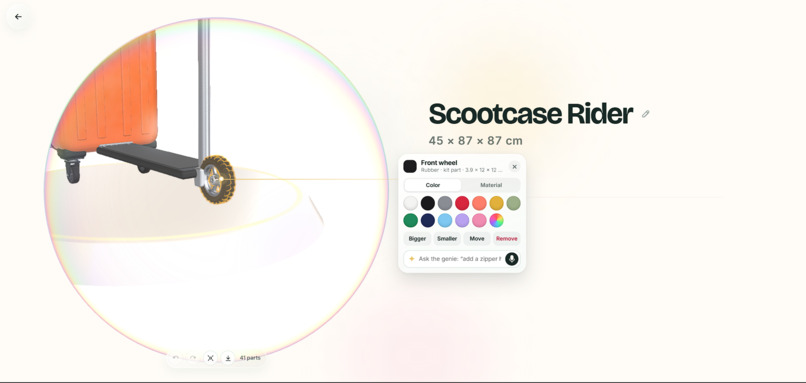
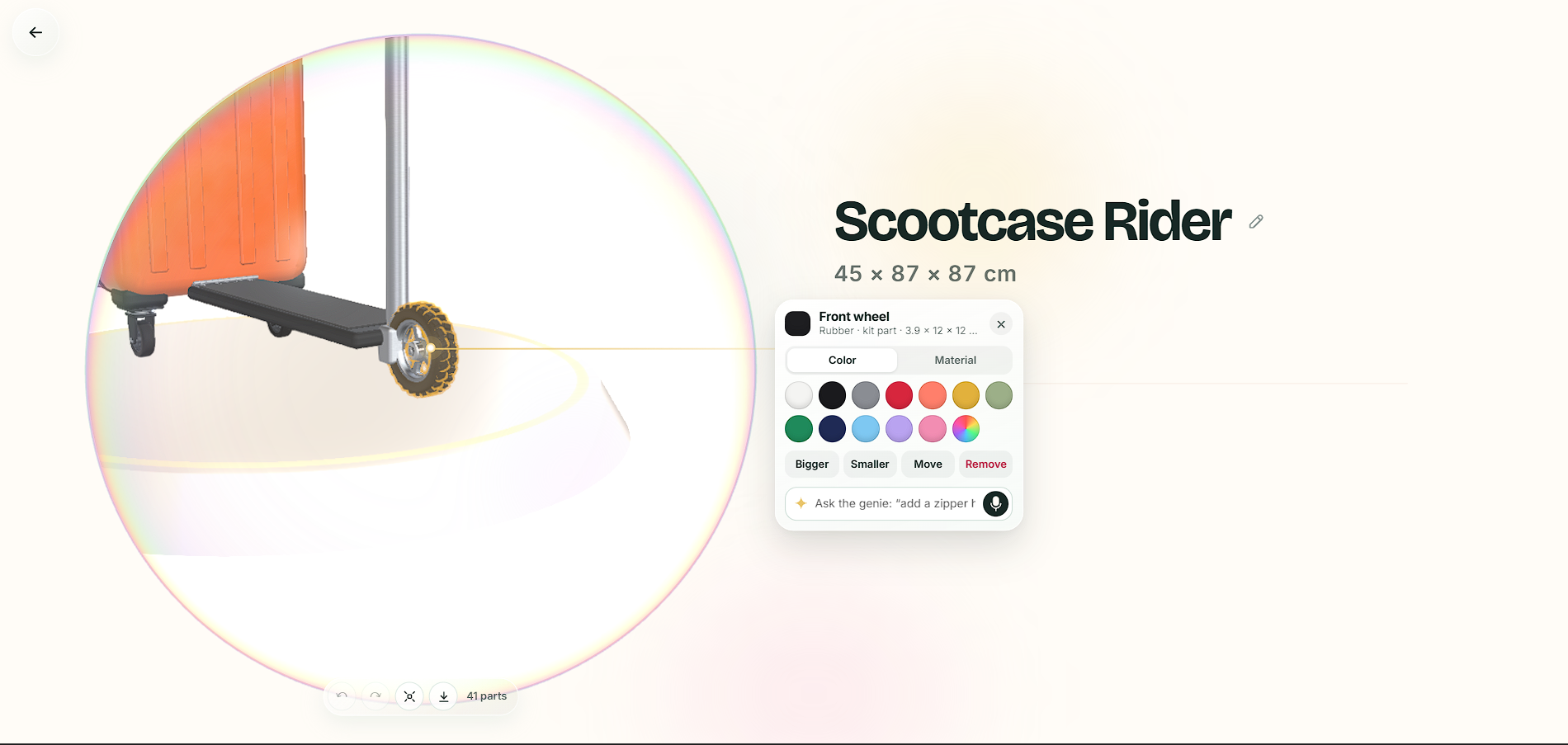
Bring your imagination to life in editable 3D.
-
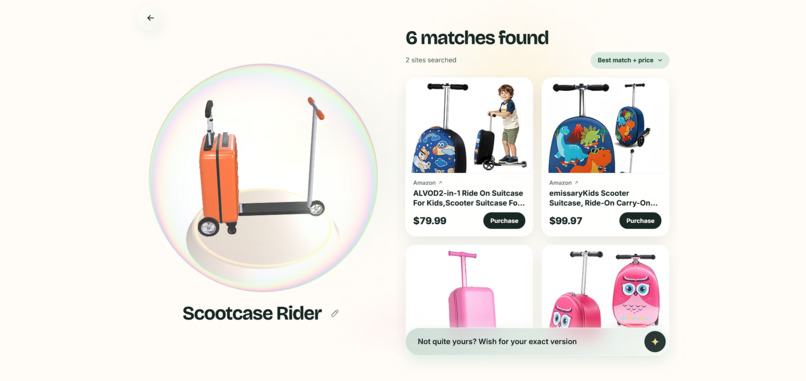
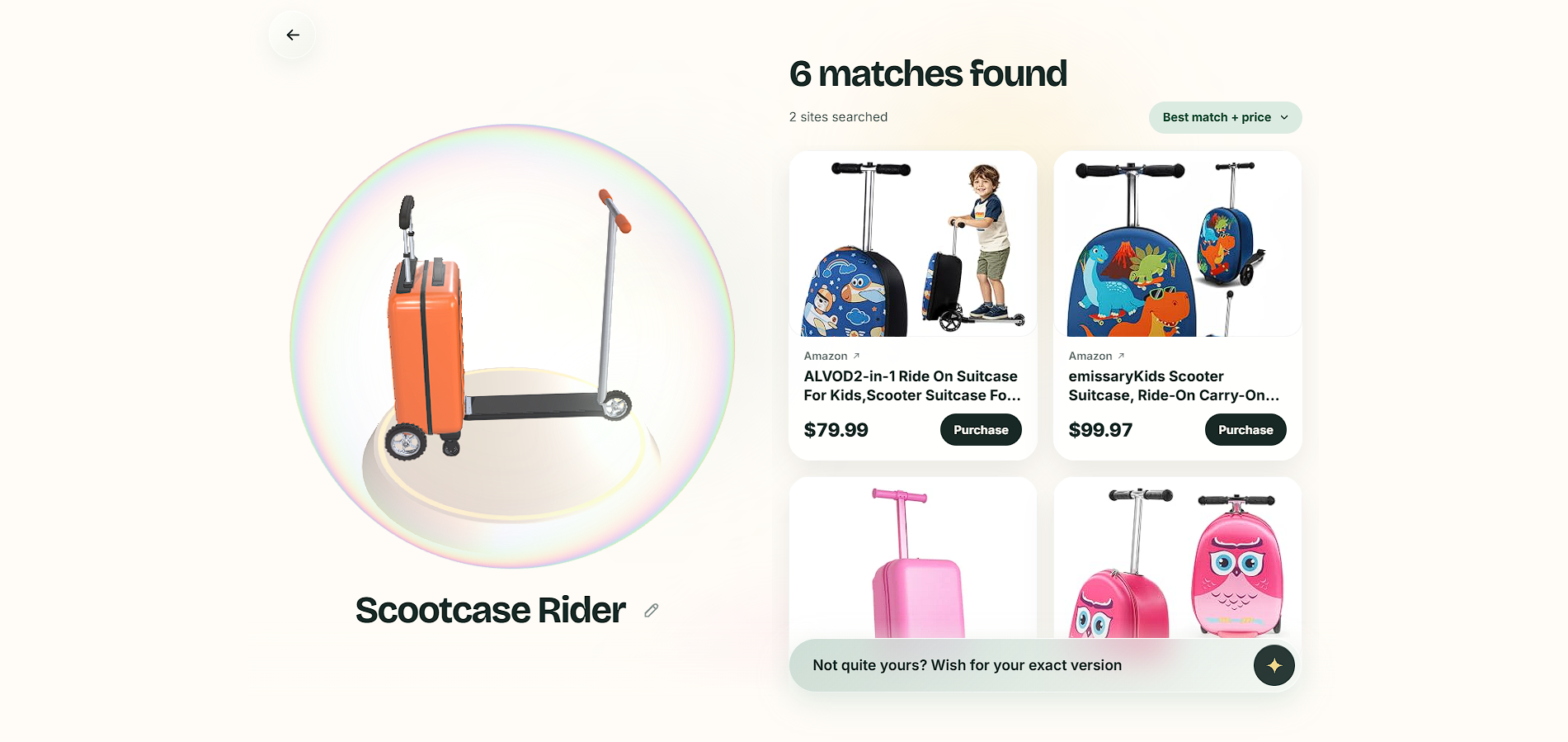
Find real products that match your vision.
-

Explore what the world wishes existed.
-

Discover, share, and support ideas you love.



Make a Wish: Want It? Wish It.
Inspiration
Search engines are great when you know what you're looking for. But what happens when you don't?
We've all imagined the perfect product but struggled to find it.
Maybe you have a vague idea you can't quite put into words. Maybe you're shopping for someone else and don't know where to begin. Or maybe you know exactly what you want, but not what it's called or whether anyone sells it.
Traditional shopping starts with what's already available. You search, scroll, compare, and hope something matches.
We wanted to turn that experience around.
What if shopping started with your imagination instead of a search bar? What if AI could help you discover what you want, bring it to life, and find somewhere to buy it?
That's why we built Make a Wish, an AI-powered shopping companion that connects imagination, personalization, product discovery, and trusted commerce in one seamless experience.
What it does
Make a Wish reimagines the shopping journey: imagine it, refine it, find it, and make it yours.
You can start with practically anything:
- A suitcase you can ride like a scooter.
- A robot vacuum shaped like a turtle.
- A flower-shaped lamp with adjustable petals.
- A plush toy that tells stories or reacts to hugs.
- A backpack designed around your exact needs.
- An outfit you can picture but can't find anywhere.
You describe your idea naturally, even if it's incomplete.
Within seconds, Make a Wish begins bringing it to life as an interactive 3D product. Rotate it, zoom in, select individual components, and change details through conversation.
"Make it smaller."
"What if the wheels folded underneath?"
"Actually, could we add a handle that doubles as a phone stand?"
Your design evolves as you explore.
More than a prompt: a creative shopping companion
Make a Wish isn't a one-shot product generator.
At its center is a conversational AI companion that helps you explore possibilities, refine your preferences, and develop ideas you might not have considered on your own.
Powered by Cartesia for natural voice interaction and Claude for reasoning and design, the companion makes shopping feel like a creative collaboration.
Imagine you're buying a birthday gift for your nephew.
A conventional search might show you popular gifts for his age. But popularity doesn't necessarily tell you what he would love.
Make a Wish helps you think through the decision. What does he enjoy? What kinds of toys does he already have? Would something interactive, creative, or personalized be more meaningful?
As you explore, the companion can suggest directions, help you visualize possibilities, and invite you to personalize the details.
Maybe a generic plush toy becomes a turtle that tells bedtime stories. Maybe an ordinary backpack becomes one designed around his favorite hobby.
Instead of simply answering what to buy, Make a Wish helps you discover what would make a product right for you or someone you care about.
You don't need a perfect prompt, technical vocabulary, or even a finished idea. The experience helps you get there.
From imagination to intelligent product discovery
Once you've developed an idea you love, Make a Wish asks:
Does something like this already exist?
Our AI shopping agents search real product listings from Amazon and Google Shopping through Apify.
But rather than relying on the words in your original request alone, Make a Wish uses the design you've developed and the requirements you've expressed throughout the conversation.
A traditional search for "kids turtle plush toy" might return hundreds of ordinary stuffed animals.
Make a Wish can understand that you're looking for something more specific: a turtle plush that tells stories, has a particular appearance, and fits your budget.
Our system compares product images, descriptions, and requested features against your imagined design.
Each recommendation receives an AI-generated match score from 0 to 100, accompanied by an explanation of what matches and what's missing.
For example:
"Looks similar and fits your budget, but doesn't have interactive storytelling."
Shoppers can evaluate meaningful tradeoffs rather than guessing which result is closest.
We also incorporate available ratings and review counts into ranking, giving well-reviewed products a modest advantage when relevance is otherwise comparable.
And because shoppers' ideas evolve, our search evolves too. Add a new feature during the conversation, and Make a Wish carries that requirement into product discovery.
We're moving beyond matching a search query to understanding an evolving vision of what the customer actually wants.
From discovery to trusted agentic commerce
Finding the right product shouldn't require leaving the experience and starting over.
Make a Wish lets shoppers authorize their AI agent to complete a purchase directly within the app.
To support this, we implemented a checkout prototype based on Visa's Trusted Agent Protocol (TAP).
When a shopper confirms a product and its price, the agent receives a narrowly scoped authorization:
- One specific product listing.
- An explicit spending limit.
- A ten-minute expiration window.
The agent cryptographically signs its checkout request, and our merchant-side service verifies its identity, transaction integrity, and authorization before accepting it.
This demonstrates how an AI shopping companion can move from recommending products to acting on a shopper's behalf without receiving unrestricted permission to spend.
Our prototype performs real cryptographic verification and records simulated retailer orders. It does not complete real Amazon or Google Shopping purchases or charge a payment card.
We're designing for a future where agentic commerce is both effortless and accountable to the customer.
Wish World: Inspiration beyond your imagination
But what if you don't know what to wish for?
That's where Wish World comes in.
Wish World is a community-powered universe of imagined products, where you can explore creations from other people and discover ideas you never knew you wanted.
Maybe you arrive with no particular product in mind and discover a turtle-shaped robot vacuum, a double-decker couch, or a backpack with an ingenious new feature.
A wish might inspire an idea of your own.
You can explore products, discover unexpected concepts, and upvote your favorites.
And when Make a Wish can't find a satisfactory match for something you've designed, your idea can become part of Wish World.
It's both a source of inspiration and a place where unmet shopping needs become visible.
For consumers, Wish World makes discovery collaborative rather than limiting it to individual imagination or existing store inventory.
For merchants, wishes and community interest can reveal emerging preferences and product opportunities that current catalogs may not capture.
Wish World turns individual imagination into collective inspiration, and collective inspiration into potential commerce.
How we built it
We built Make a Wish around four connected systems: conversational AI, interactive 3D design, intelligent product discovery, and trusted agentic commerce.
Conversational AI and editable 3D
We integrated Cartesia for real-time speech recognition and voice responses, with Claude powering design reasoning.
Rather than generating a static image, Claude translates the shopper's intent into structured components with defined geometry, materials, and spatial relationships.
Our frontend uses React, Three.js, and react-three-fiber to render these components as interactive 3D products.
A key architectural decision was to support incremental edits rather than regenerating an entire product after every instruction:
D(t+1) = D(t) + Δ(t)
Here, D(t) represents the current design, and Δ(t) contains only the requested changes.
We combine configurable product templates with generative geometry. For unfamiliar concepts, Claude plans component groups and generates them in parallel, streaming parts into the scene as they become available.
Simple operations like changing colors, resizing parts, and undoing edits can happen directly in the browser without another network request.
This architecture helps make creative exploration responsive while preserving previous design decisions.
Intent-aware, explainable product matching
Our shopping pipeline uses Apify to retrieve listings from Amazon and Google Shopping, followed by Claude's multimodal reasoning to evaluate their relevance.
The system considers the evolving design and its functional requirements, including important features added during later conversations.
Claude compares listing images, titles, and available product information against the shopper's must-have features, assigning a match score and explaining meaningful differences.
We also incorporate available review signals, deprioritize irrelevant accessories, and exclude listings with incompatible currency information.
Rather than presenting opaque recommendations, Make a Wish helps shoppers understand why a product matches their vision and where it falls short.
To reduce waiting, we can begin preparing marketplace searches while the user is still designing.
Secure, user-authorized agentic commerce
We implemented a Visa Trusted Agent Protocol-inspired checkout prototype using RFC 9421 HTTP Message Signatures and Ed25519 cryptography.
When an AI shopping agent submits a transaction, our merchant-side service verifies its signing key, request integrity, timestamp, replay protection, signed payment container, and the shopper's specific authorization.
We also built a live trust demonstration that deliberately submits invalid requests.
Unsigned agents, replayed transactions, tampered amounts, expired signatures, and over-limit purchase attempts are rejected, with the verification results displayed in the interface.
Our implementation uses an internal agent-key registry and simulated transactions, not Visa's production registry or live retailer payment systems.
Beyond checkout, we implemented API rate limiting, security headers, restricted browser permissions, and production origin controls.
Making shopping more autonomous shouldn't mean taking control away from the shopper.
Challenges we ran into
Making generated products genuinely editable
Generating a convincing 3D product was only the beginning. Making it precisely editable was much harder.
Early approaches using monolithic 3D generation made small modifications expensive and unpredictable. Changing one feature could require rebuilding an entire object.
We moved toward structured components and validated incremental patches, allowing users to modify individual parts without losing the rest of their design.
Making creative exploration responsive
A conversational companion only works if interacting with it feels natural.
We reduced unnecessary regeneration, introduced immediate browser-side edits, streamed generated components, and parallelized more complex design operations.
The challenge wasn't simply making AI faster. It was making the experience responsive enough that users would keep experimenting.
Translating imagination into useful search results
An unusual product can be difficult to find because its defining feature may not correspond to an existing product category.
A search for a suitcase that doubles as a scooter might return ordinary luggage or unrelated scooters.
But the combination is the point.
We improved our matching pipeline to preserve functional requirements and evaluate listings against the shopper's actual intent, not just keyword overlap.
We also had to ensure that autonomous purchasing respected explicit user authorization, which led us to implement cryptographic verification and test rejected transactions alongside successful ones.
Accomplishments that we're proud of
We turned imagination into a shopping interface.
Users can start with a vague idea, develop it through conversation, and explore it as an interactive 3D product without needing CAD software or precise search terms.
We connected creative discovery to real commerce.
Our agents search real marketplaces, compare available products against an evolving design, and explain which features match or fall short.
We demonstrated trusted agentic checkout.
We implemented signed purchase requests, scoped spending authorization, merchant-side verification, and protections against unauthorized transactions.
We gave imagination a community.
Wish World helps people discover ideas beyond their own imagination while making unmet product demand visible through community interest.
What we learned
We learned that AI is most valuable when it helps people discover possibilities they couldn't easily express before.
Structured generation also proved essential. Component-based representations and incremental patches gave us much greater control over interactive designs than monolithic generation.
We learned that useful product recommendations must understand intent, not just surface similarity. A product's defining feature can matter more than its category or appearance.
Finally, we learned that agentic commerce needs clear boundaries. An AI agent should be able to help complete a purchase while remaining accountable to the shopper's explicit instructions.
What's next for Make a Wish
We want to make creative shopping even more intuitive through reference images, sketches, augmented-reality previews, and more personalized conversational guidance.
For commerce, our next steps include broader marketplace coverage, stronger merchant verification, and connecting our trusted-agent prototype to real retailers and production payment infrastructure.
For Wish World, we envision connecting related ideas, identifying emerging community interests, and helping designers and manufacturers discover products that people want but can't currently find.
Shopping has always started with what's available. We believe it should start with your imagination.


Log in or sign up for Devpost to join the conversation.