-
-
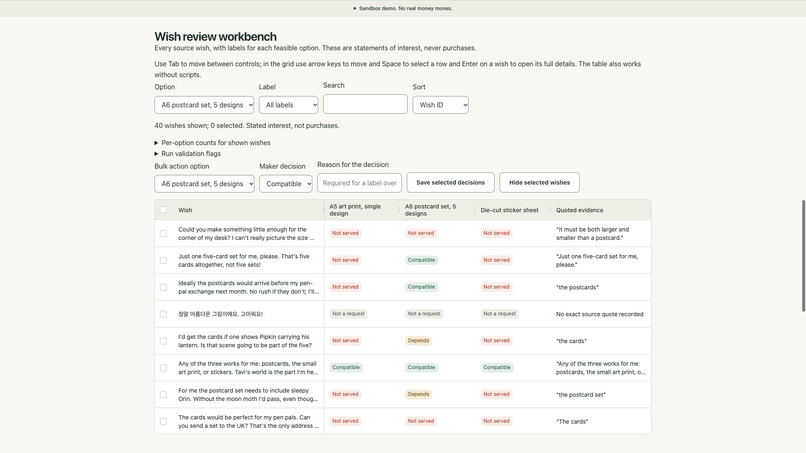
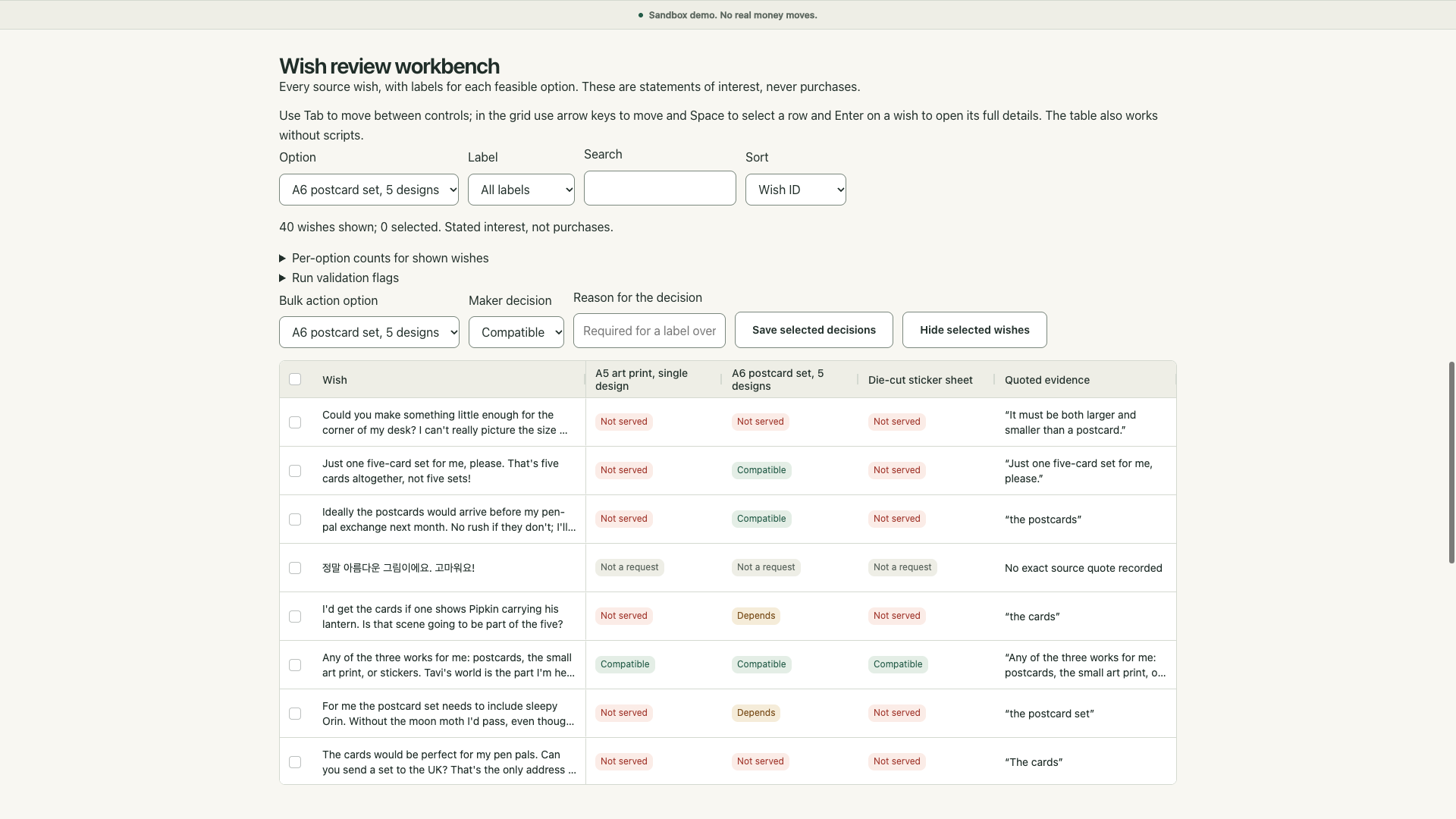
Review source wishes and quoted evidence in the workbench (AG Grid).
-
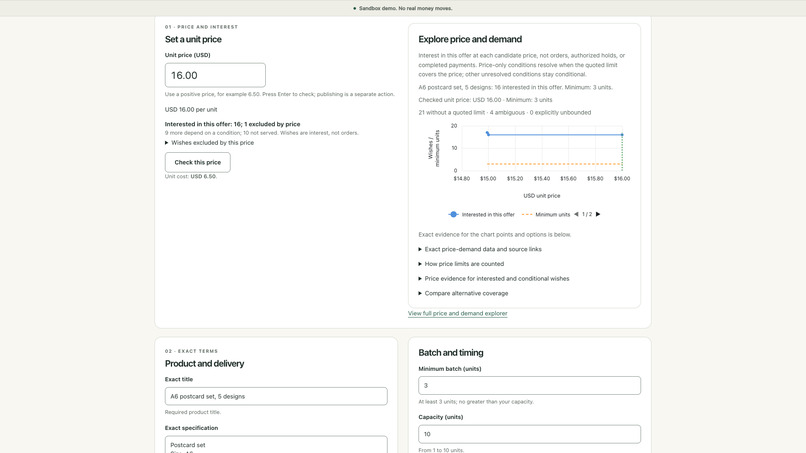
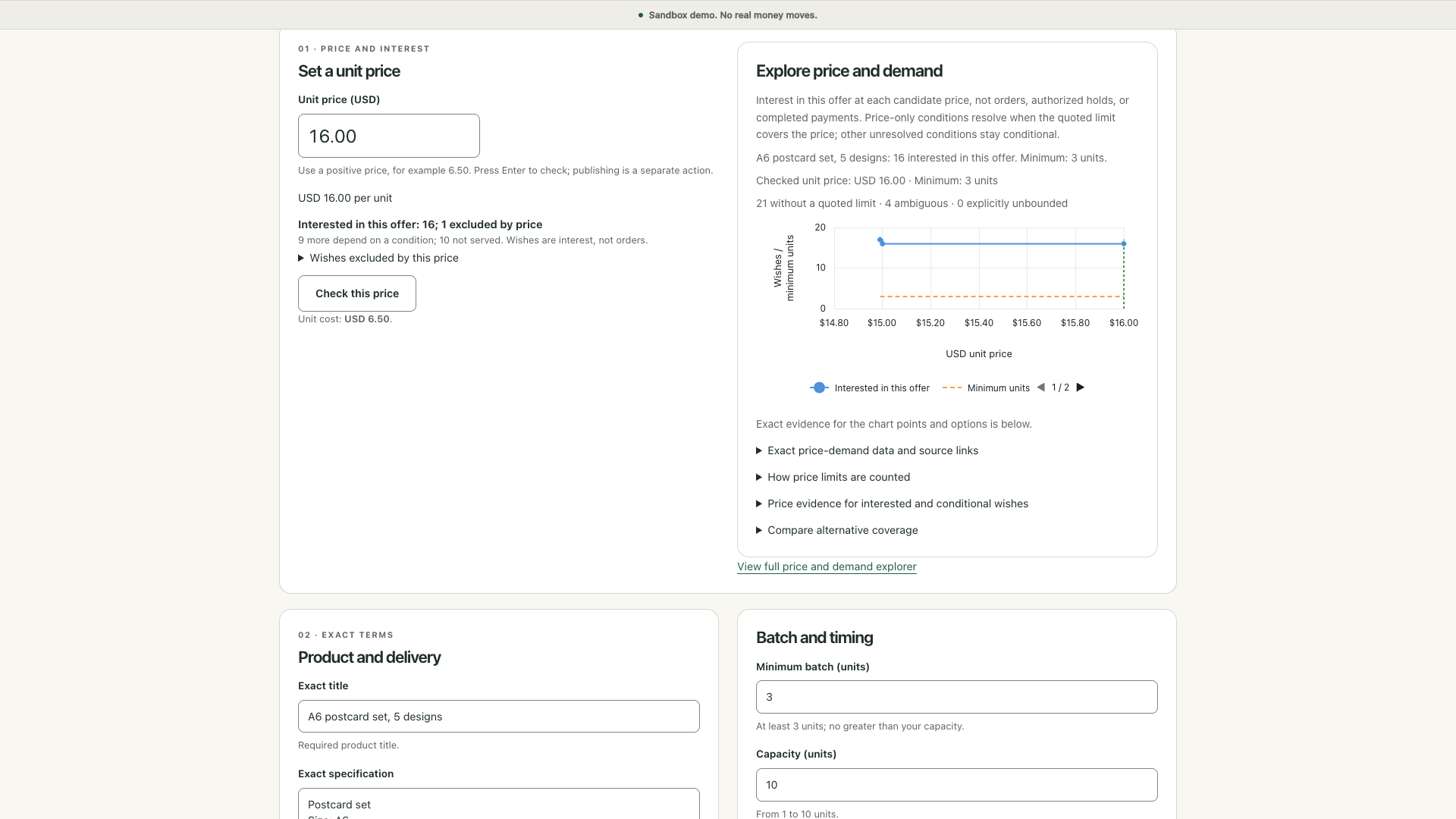
Price and demand: interest at each candidate price against the minimum (AG Charts).
-
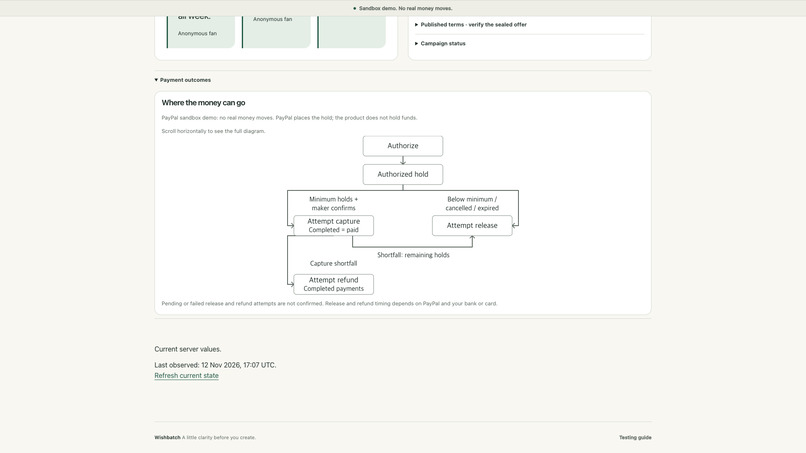
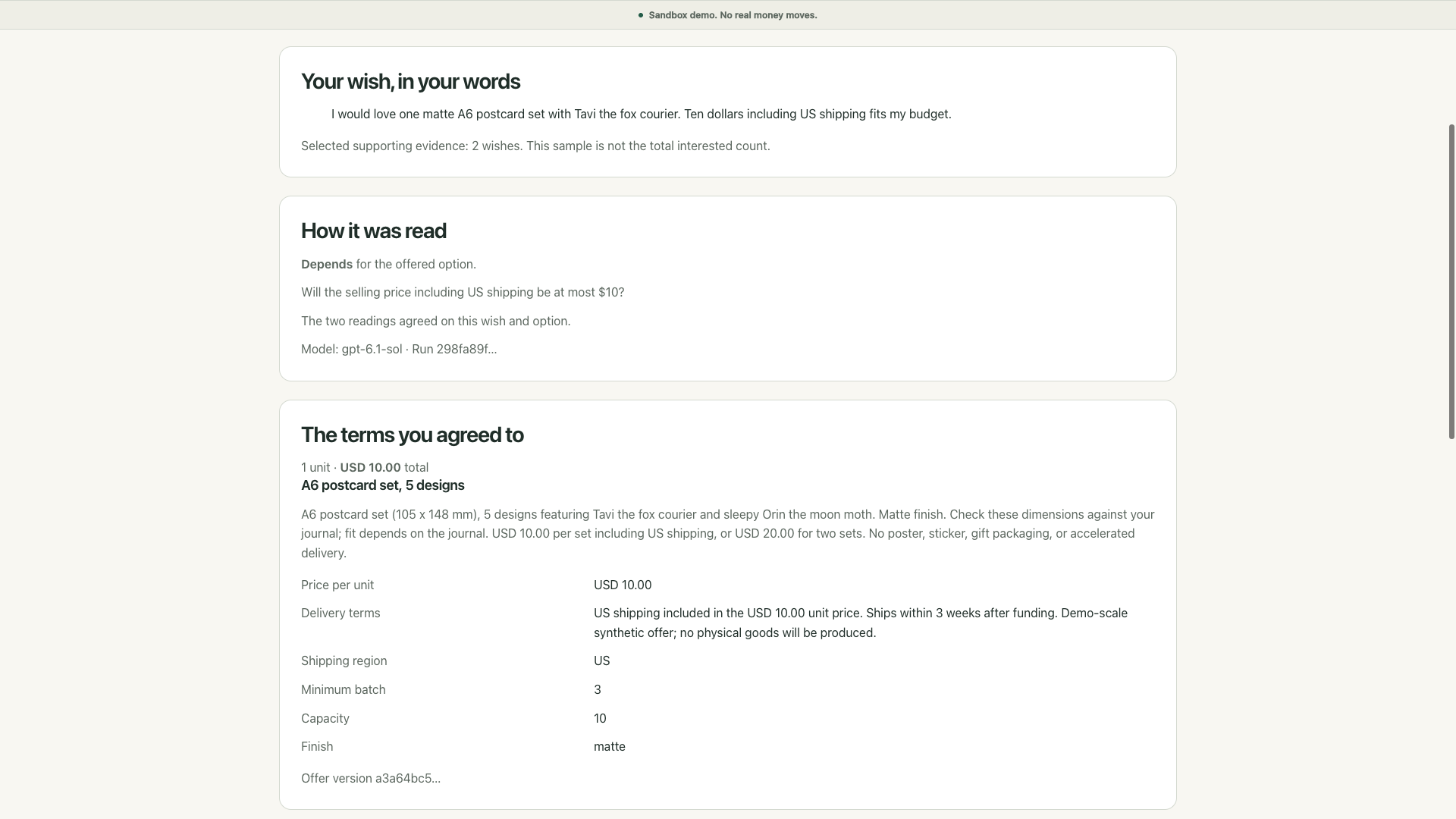
The fan sees the exact offer and what can happen to their money before agreeing.
-
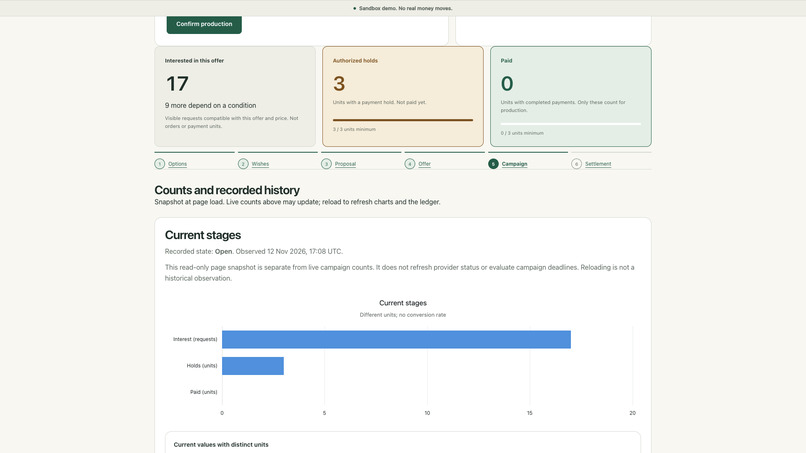
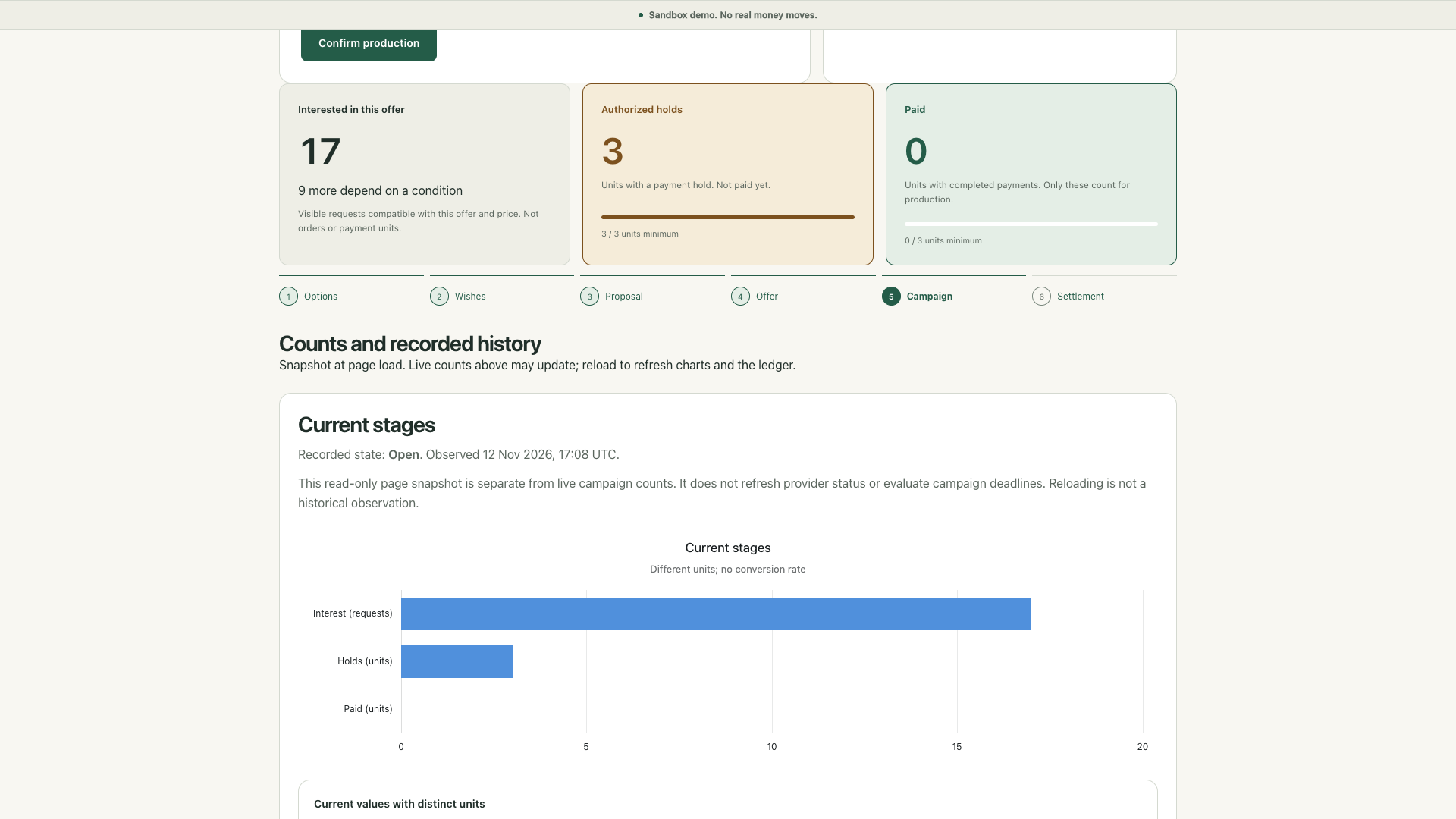
Three counts that never mix: interest, authorized holds, paid.
-
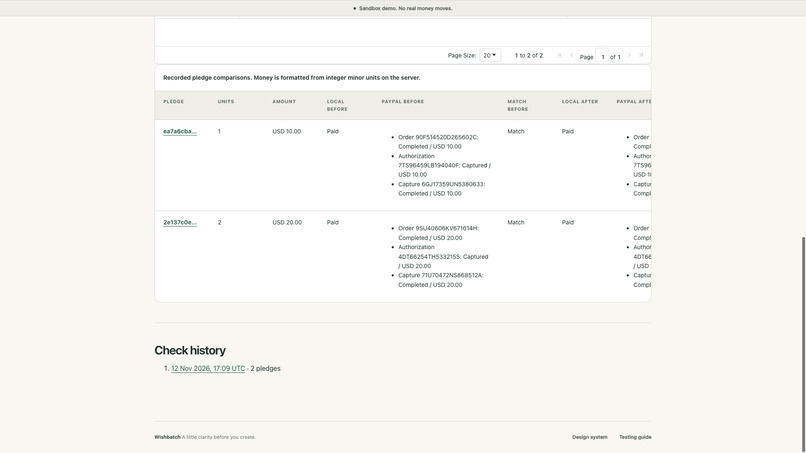
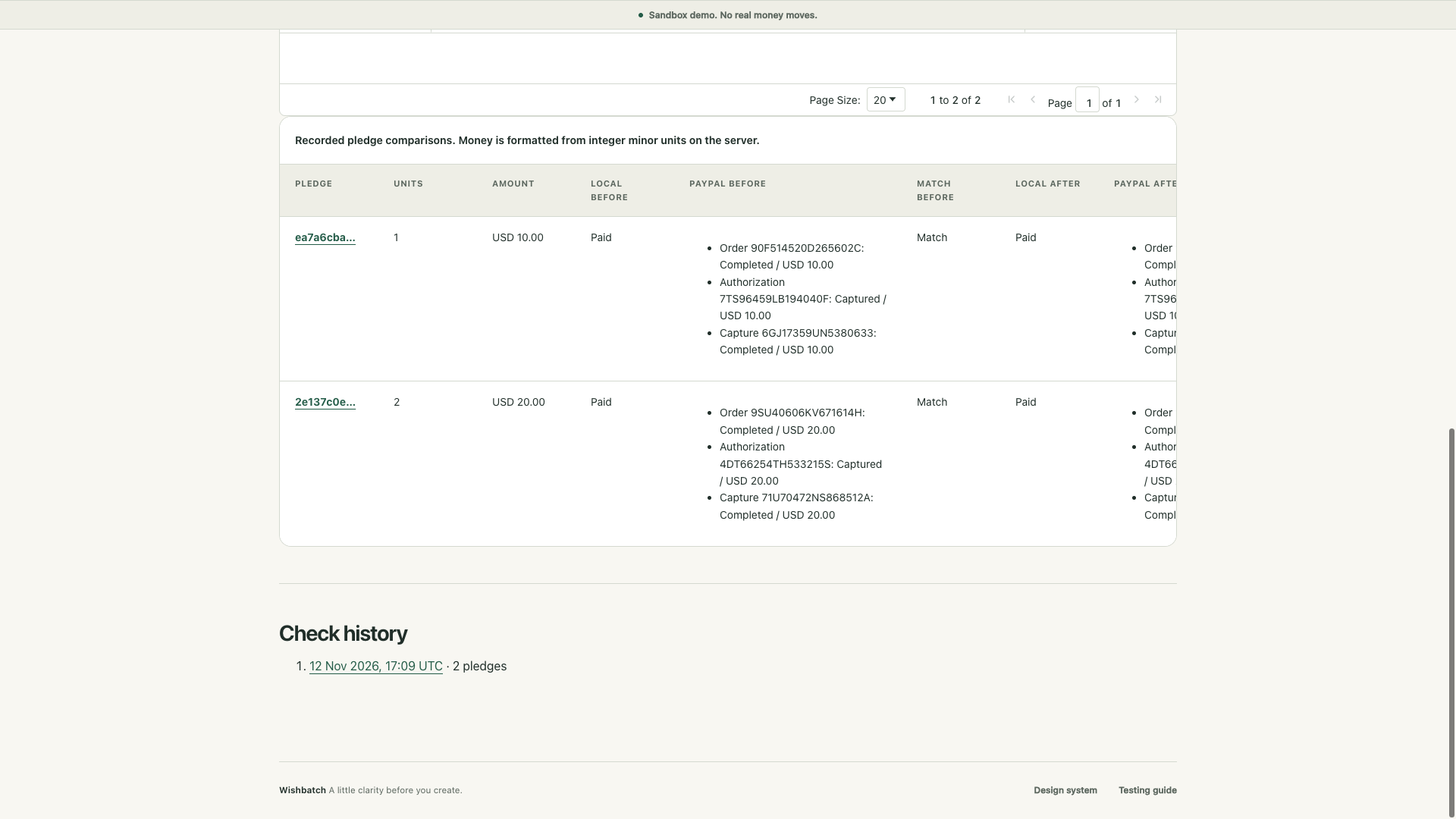
Check against PayPal: local records beside PayPal order, authorization, and capture.
-
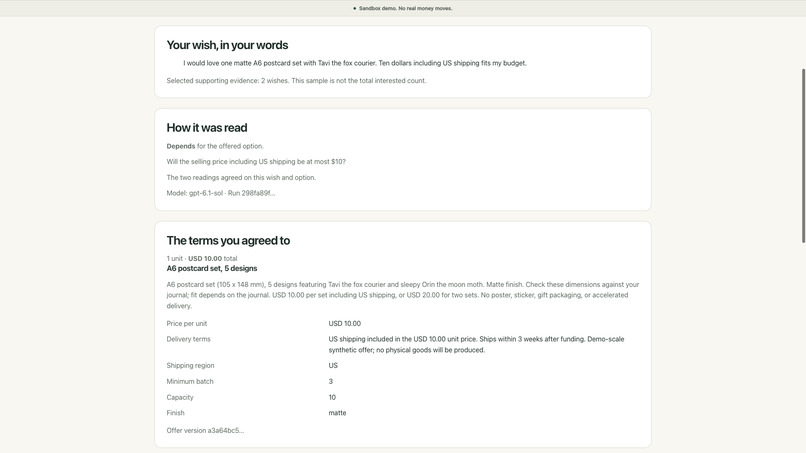
A paid pledge traced back to the fan’s own words and the sealed terms.
Inspiration
An illustrator asks fans what to make next and gets forty different answers: postcards, a wall print, a print only if one character appears. Wishbatch reads those wishes against what the illustrator can make, proposes one batch, and lets fans back it with a PayPal authorized hold that is captured only after the maker confirms production. The illustrator can make one batch, and a wrong guess becomes unsold stock. A preorder form can take payment for a product that already exists. It cannot read forty free-text wishes and say which product to make.
What it does
- The maker lists the products they can make and the variants each allows.
- Fans write wishes in their own words.
- Wishbatch proposes at most one batch, with verdicts and source quotes where available, open conditions, and wishes it does not serve.
- The maker reviews and can correct verdicts, then tries prices: code recomputes interest from the limits fans quoted, so raising USD 10 to USD 16 shows which stated limits no longer fit, without rereading any wish. The maker sets the price, minimum, quantity limits and delivery terms and publishes them as a sealed offer.
- Fans commit with a PayPal authorized hold.
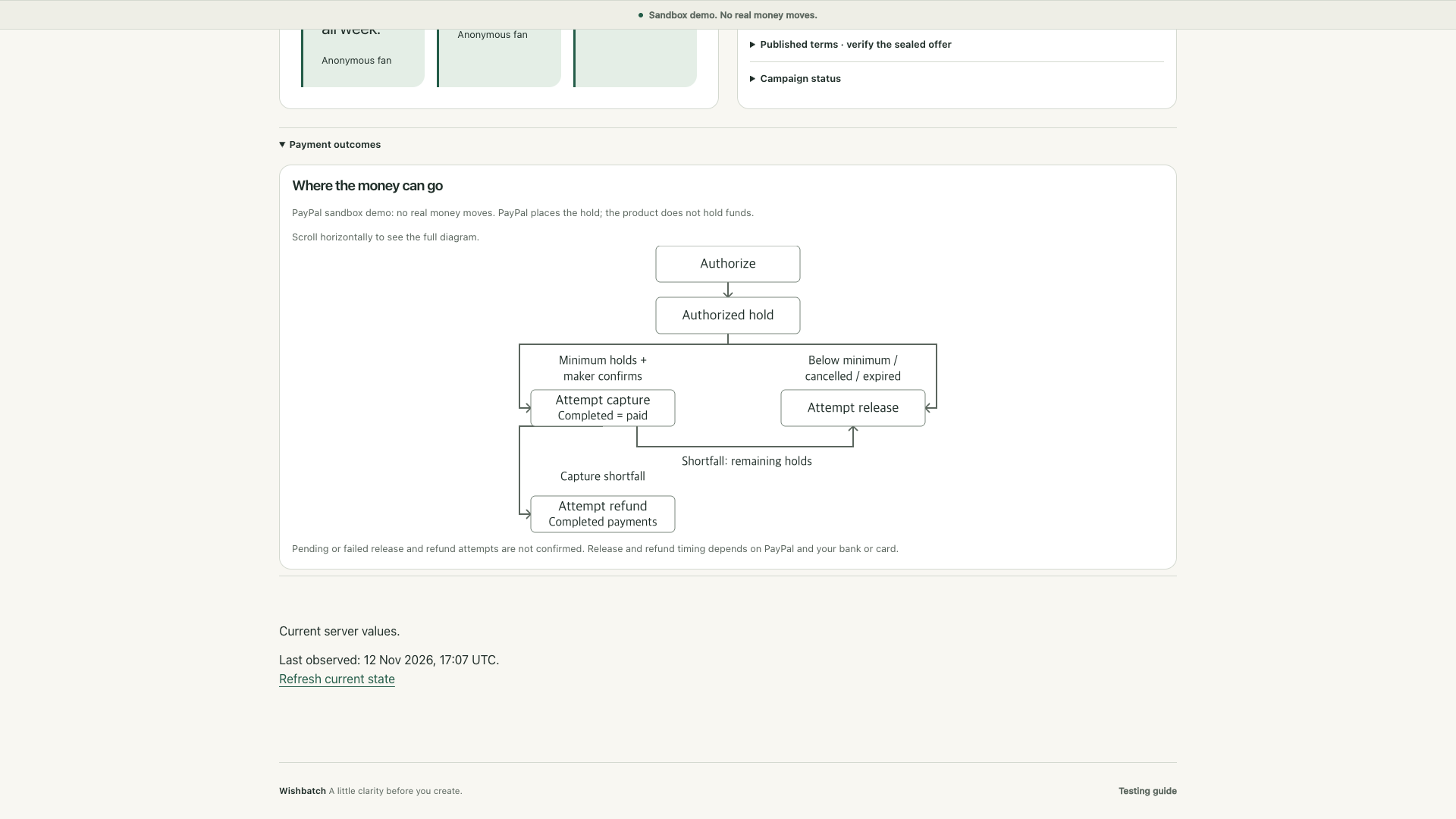
- At the minimum, the maker confirms production and Wishbatch asks PayPal to capture each hold. The batch is funded only when enough captures complete. If completed captures fall short, refunds are requested for them and release of the remaining holds. A campaign that closes below its minimum, or is cancelled, only requests release of its holds.
- A fan who linked a wish to a pledge can follow the trail from payment to offer terms and their wish, with the model's reading when that wish was analyzed.
Three counts never mix: interest (wishes the offer fits at its price), authorized (units under hold) and paid (units in completed captures).
How AI and PayPal are both load-bearing
A payment has to be exact. AI is fast, and approximate. Wishbatch is the boundary between them. AI proposes. Evidence supports. A person confirms. PayPal commits. And a pledge linked to a wish can be traced back to the fan's own words.
The default model, gpt-6.1-sol through the OpenAI Responses API, classifies wishes and drafts at most one proposal. It never sets a price, a payment amount, a minimum or a count; a budget it quotes from a fan is evidence only. PayPal carries the commitment: authorized holds, captures, refund requests and released holds.
Remove the AI and the maker sorts every wish by hand, then sorts again at each new price. Remove PayPal and the wishes stay stated interest.
How we built it
Kotlin and Spring Boot on JDK 21, Thymeleaf pages, JPA over PostgreSQL or H2.
The model attempts two readings of each wish. Disagreements are flagged for the maker, and an incomplete second reading keeps the validated first, marked for attention. Validators drop quotes absent from the wish text, unknown references and disallowed variants; they reject extra proposals and discard model-written commercial terms. Code computes every count; money lives in integer minor units. Both readings and the proposal share a 120-second deadline.
Checkout uses Orders v2 AUTHORIZE, then Payments v2 capture, void and refund, each with a stable idempotency key reused on retry. Signature-verified webhooks only trigger a re-read of PayPal's resources, the same reconciliation that runs on campaign page reads and every minute. A campaign lasts at most 48 hours and the maker must confirm within 12 hours of its close, so the first capture attempt for each hold falls inside PayPal's three-day honor period. A books check compares local records with PayPal's. Where a pledge's decision record is available, its chain of hashes can be verified again. Seeded random action sequences against a fake gateway test the payment state machine's invariants.
AG Grid Community and AG Charts Community power the wish review workbench, the payment ledger with CSV export, and a price-demand chart where selecting a point filters the review grid to the wishes behind it. Server-rendered tables remain available without scripts.
Challenges we ran into
"Blue would be nice" and "only if it's blue" need different verdicts. A price-only condition can count as interest when its exact quoted limit covers the offer price; unresolved non-price conditions remain conditional.
Each fan's hold is captured in its own PayPal call, so captures can come back mixed. We count only completed ones and keep the rest visible until PayPal's records settle them.
Keeping the three counts consistent took rules: each wish counts once, holds only permit confirmation, and only completed captures count as paid.
Some messages are not requests. Praise, and one wish that tries to instruct the model, are classified as Not a request and never count as interest.
Accomplishments that we're proud of
A hosted sandbox flow reached a funded batch after a completed USD 48 capture for three units. A linked pledge led back to a fan's sentence in the hosted demo. Three sample makers (an illustrator, a ceramics studio and a textile studio) each come with forty wishes and a stored analysis from a real model run. In the three stored analyses the two readings agreed on 40 of 40, 40 of 40 and 39 of 40 wishes, and the remaining wish is flagged for the maker. On the hosted demo, a live analysis of forty wishes finished in 57 seconds with the two readings agreeing on all 40. The demo video records a separate sandbox run: three units authorized at USD 10, both captures completed, and in a second campaign a forced capture failure, a labelled simulation, led to a refund of the completed payment and release of the other hold, which PayPal's records confirm.
What we learned
Name money states exactly; a hold that reads like a payment misleads everyone. A webhook is a reason to look again. A second reading costs one pass and shows the maker where to look first.
What's next
Compare Wishbatch with manual sorting on real, consented requests and human-adjudicated labels. Test whether makers adopt the proposal and fans pledge. Separate maker and fan permissions, then prove deployment and recovery.
Evidence and limits
The demo wishes are synthetic, and the app runs against the PayPal sandbox only. The evaluation scores the model against reference labels that a model wrote. We have no customer validation and no measured advantage over sorting by hand. Matching quotes and agreeing readings show the model stayed consistent with the wish text; they do not show it read the wish correctly. All captures settle to one sandbox merchant account; paying each maker through their own PayPal account is not built. Hash checks detect later edits to a record; they are not signatures. Capture, refund and release outcomes depend on PayPal and the bank, and a capture can fail. AI coding assistants were used to build Wishbatch under the owner's direction.
Built With
- ag-grid
- docker
- gradle
- h2
- javascript
- kotlin
- openai
- paypal
- postgresql
- render
- spring-boot
- thymeleaf

