-
-
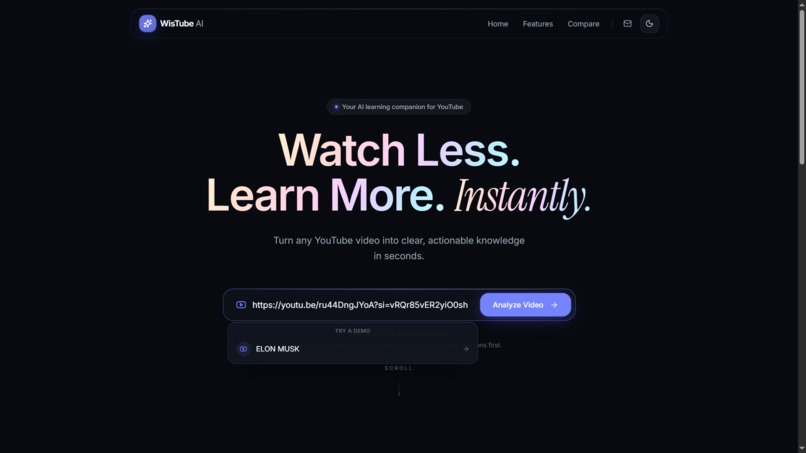
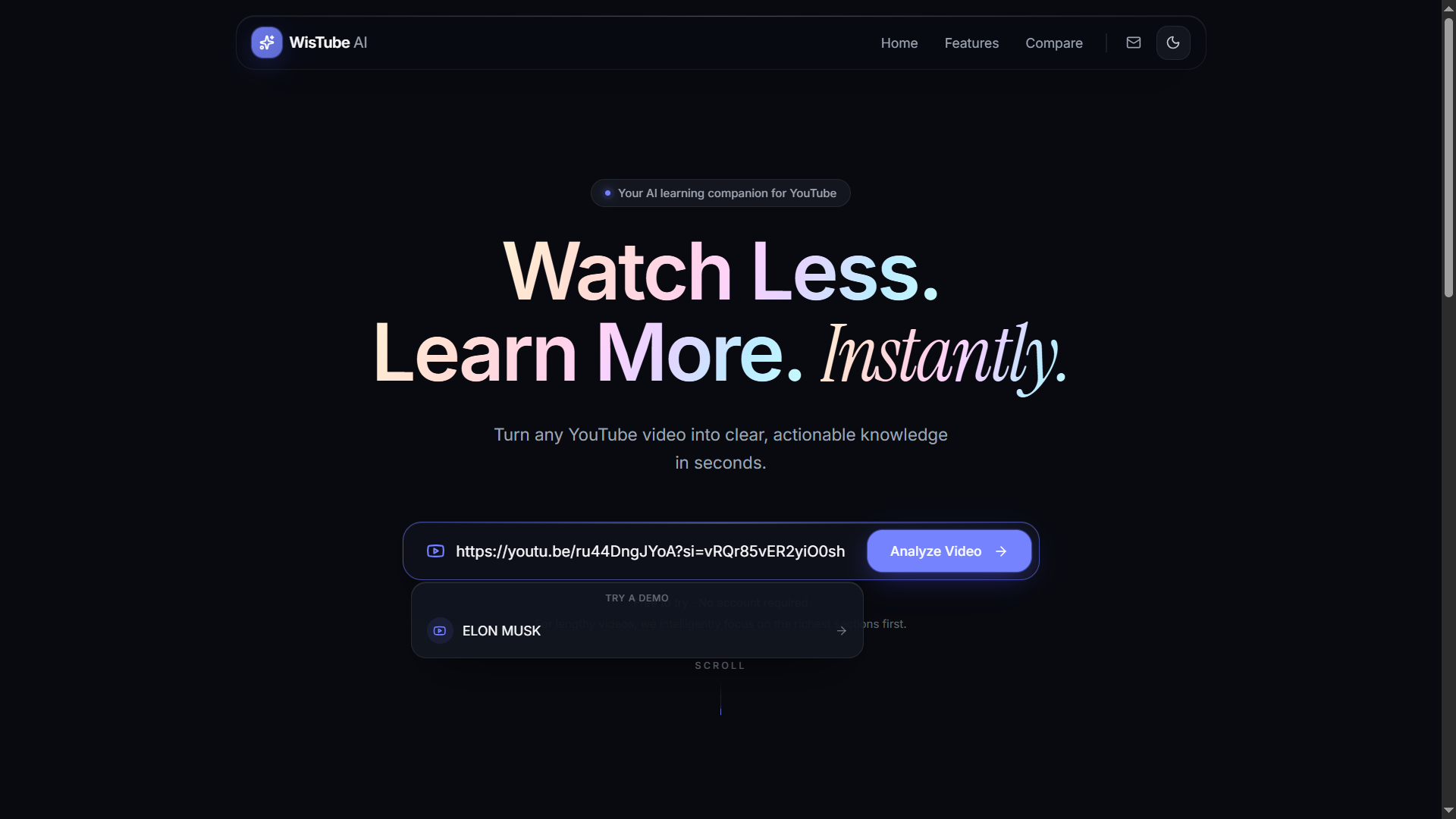
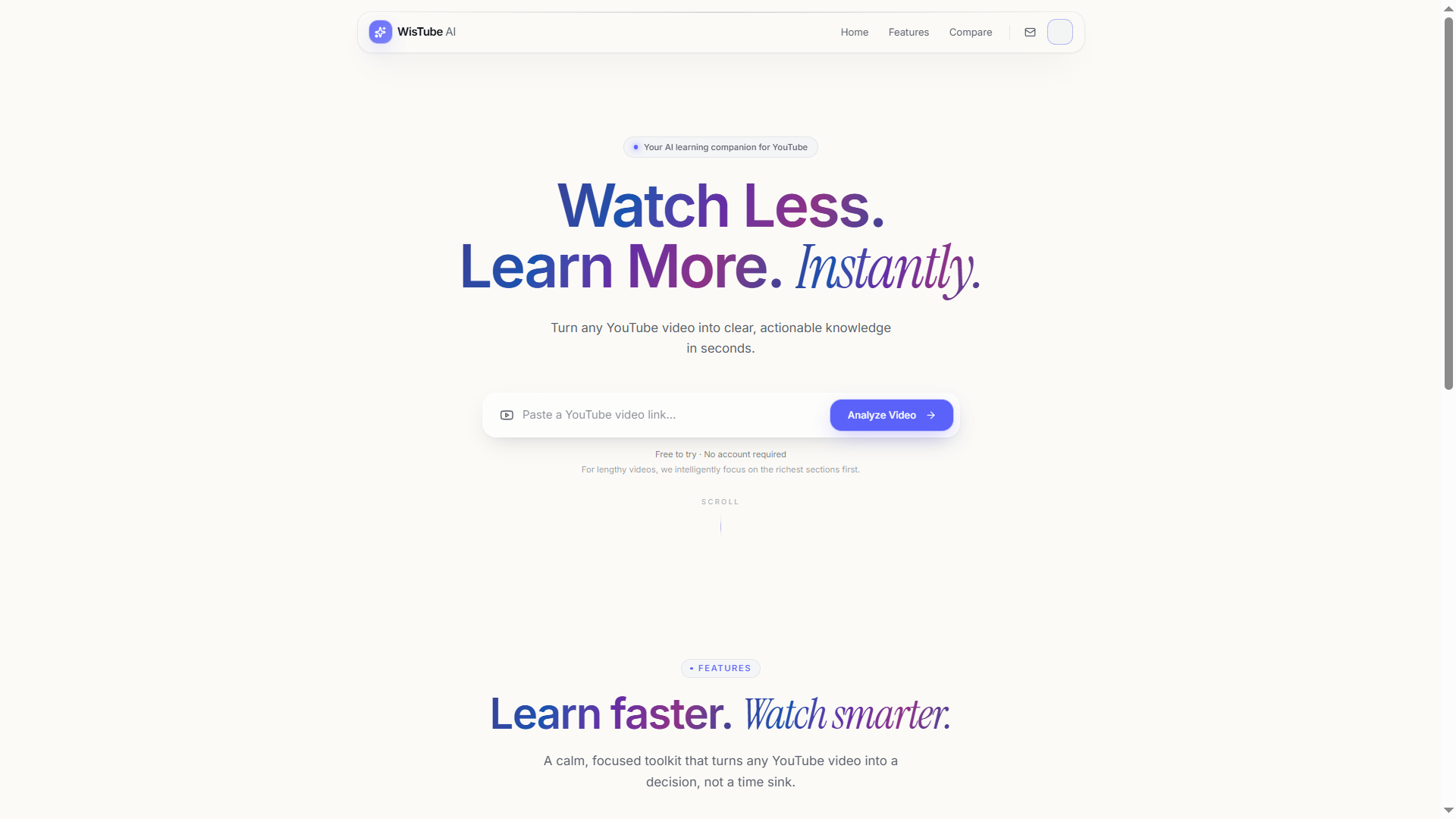
"Paste any YouTube link — no account required."
-
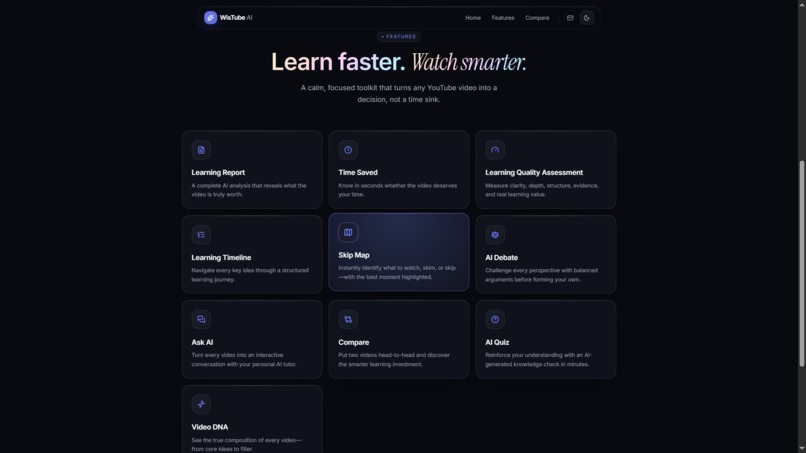
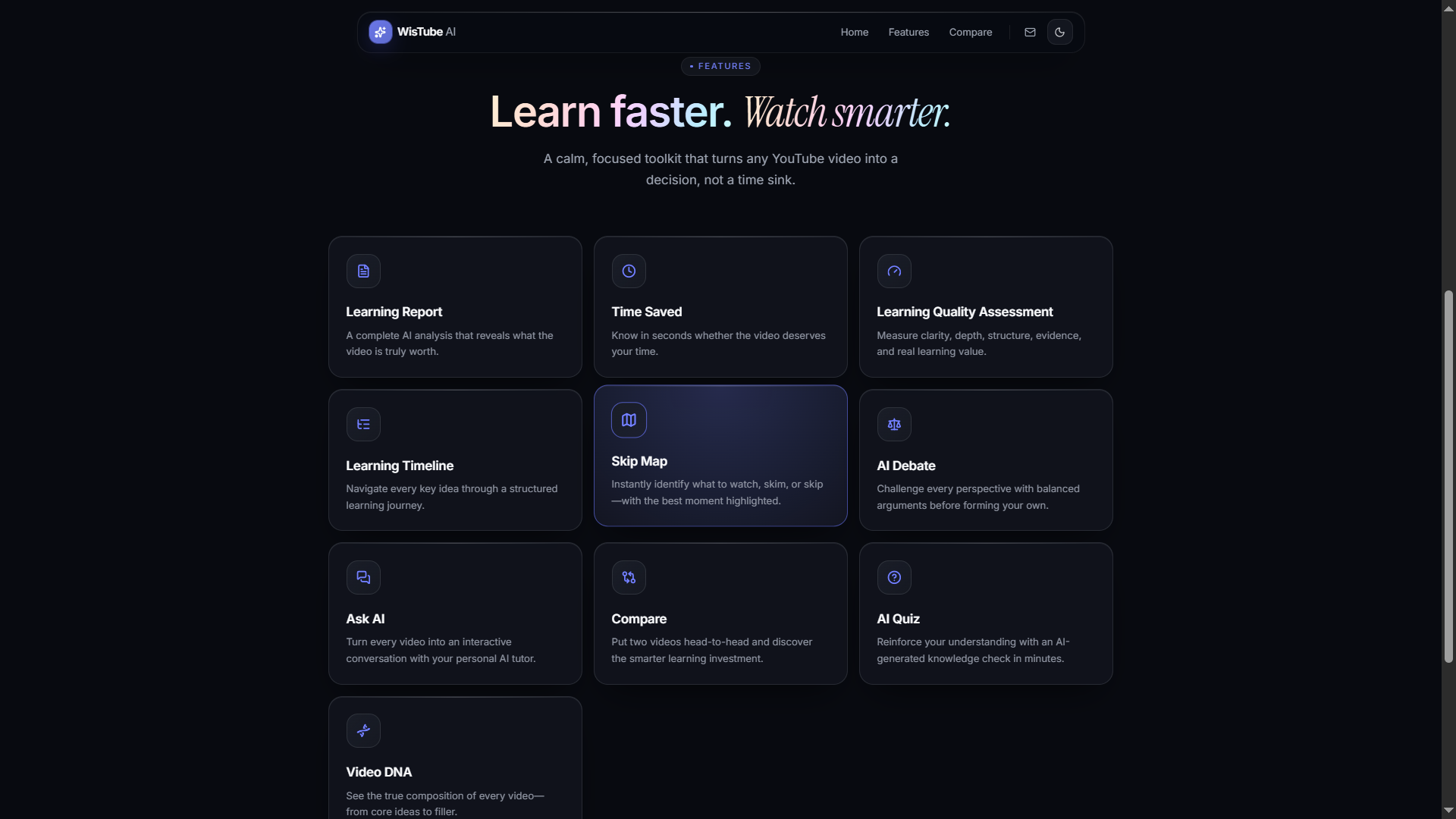
"Six tools, one goal: understand faster."
-
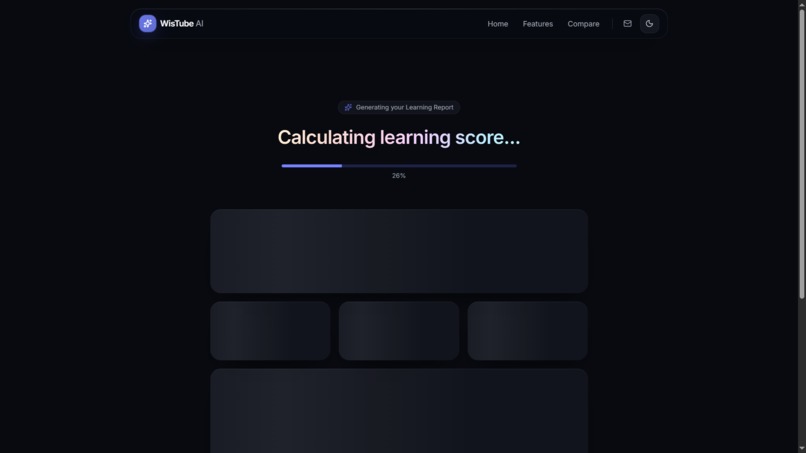
"WisTube reading the full video before you do."
-
-
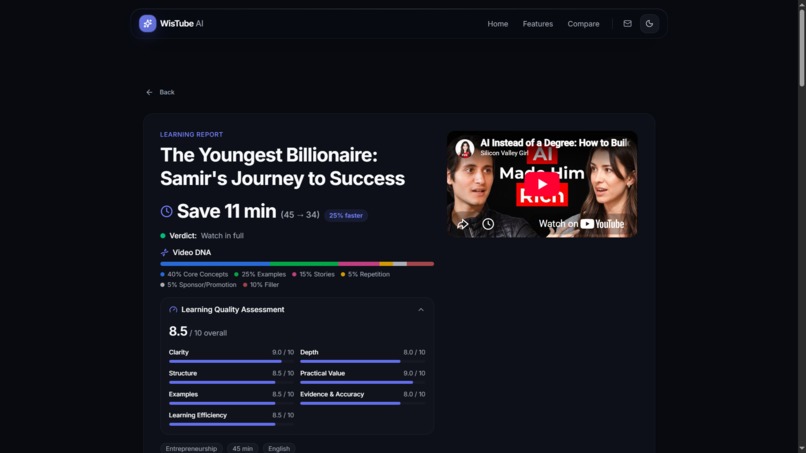
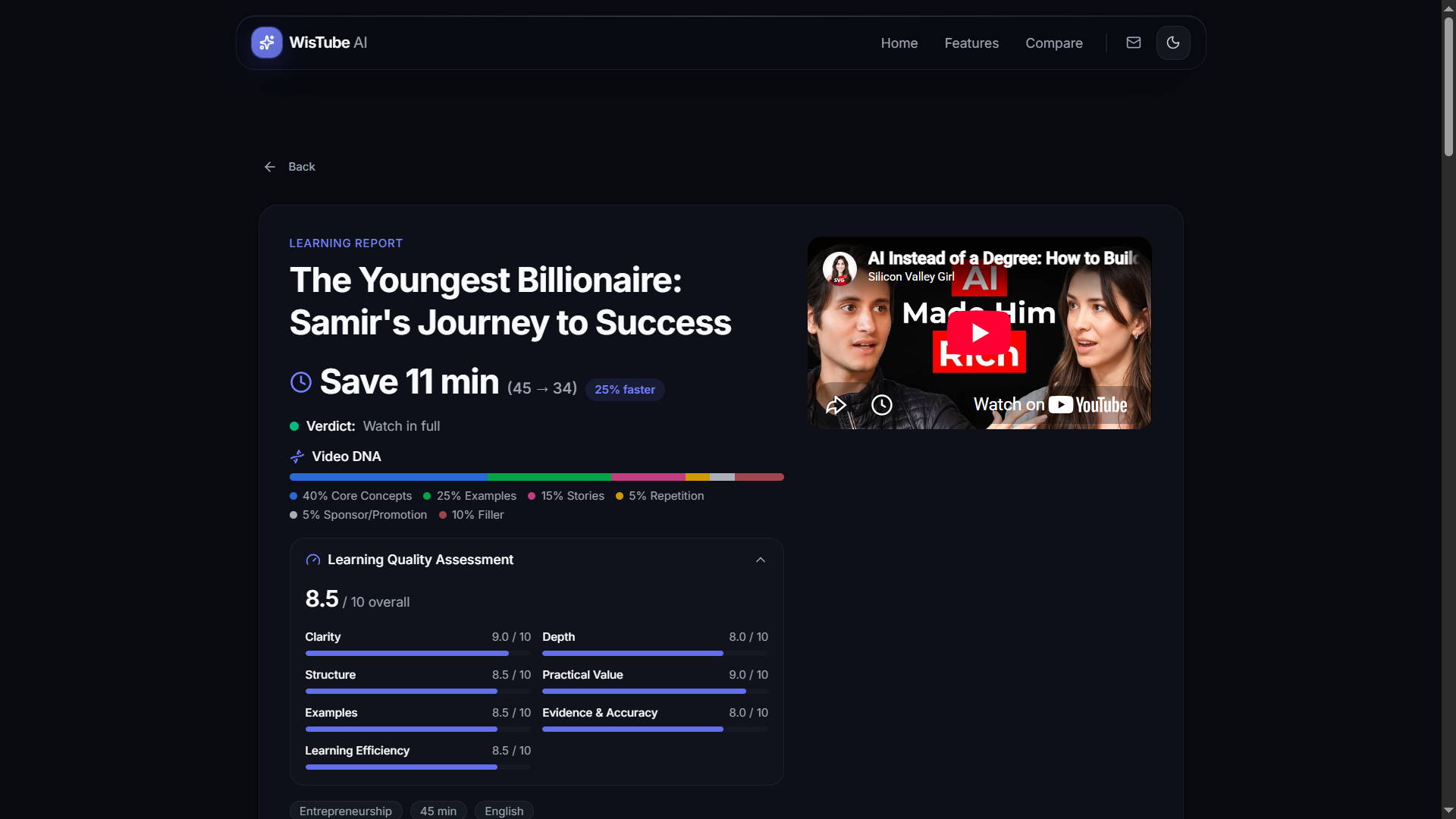
"An honest 0–10 score, backed by a breakdown of what's actually in the video."
-
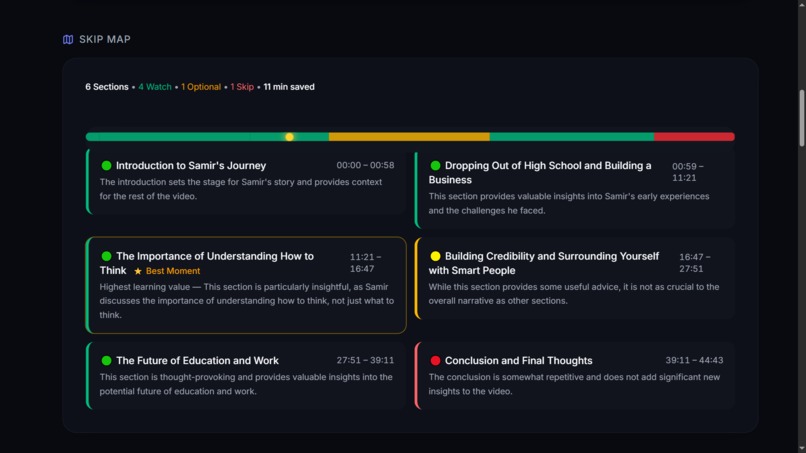
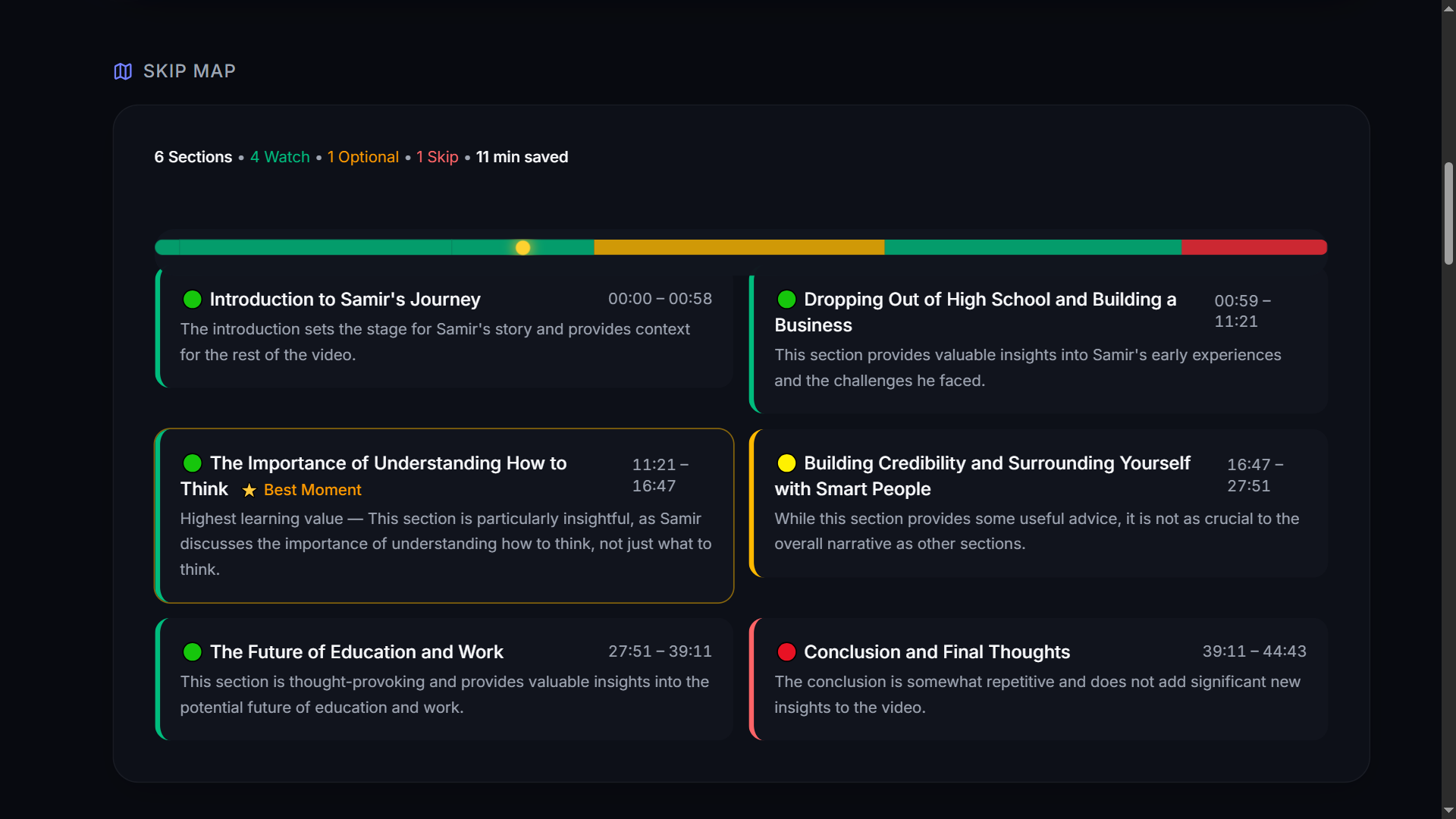
"6 sections, color-coded — know exactly what to watch and what to skip."
-
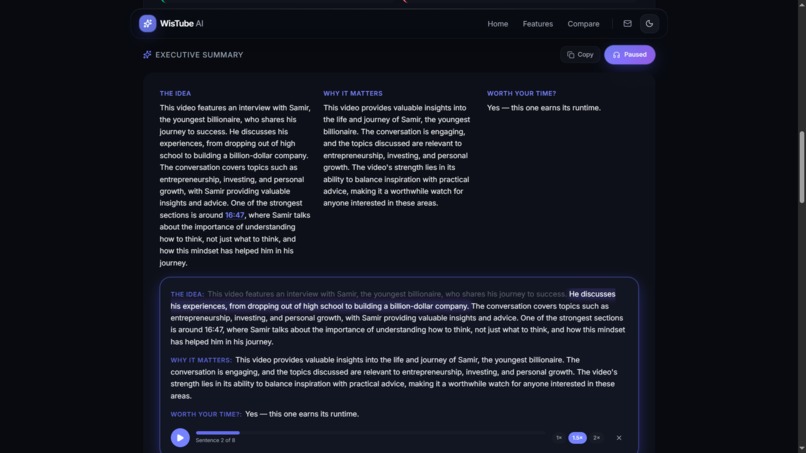
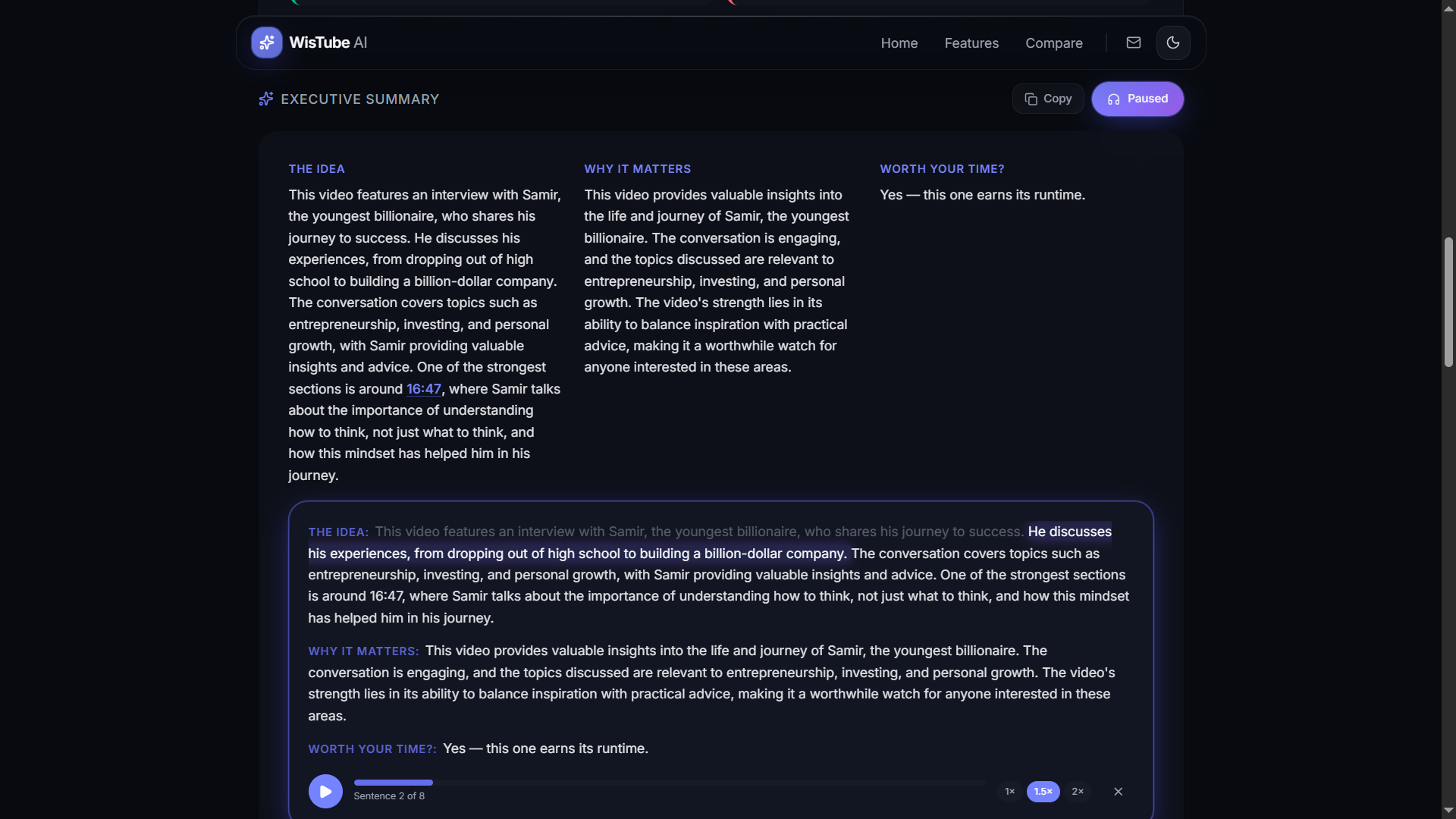
"The idea, why it matters, and whether it's worth your time — read or listened to."
-
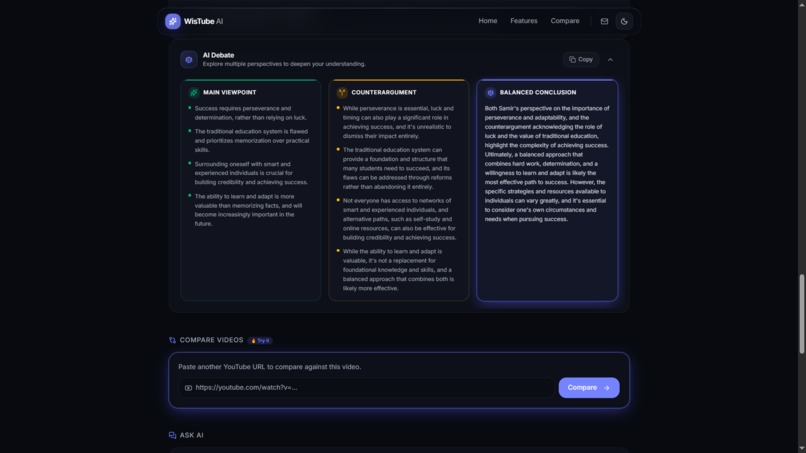
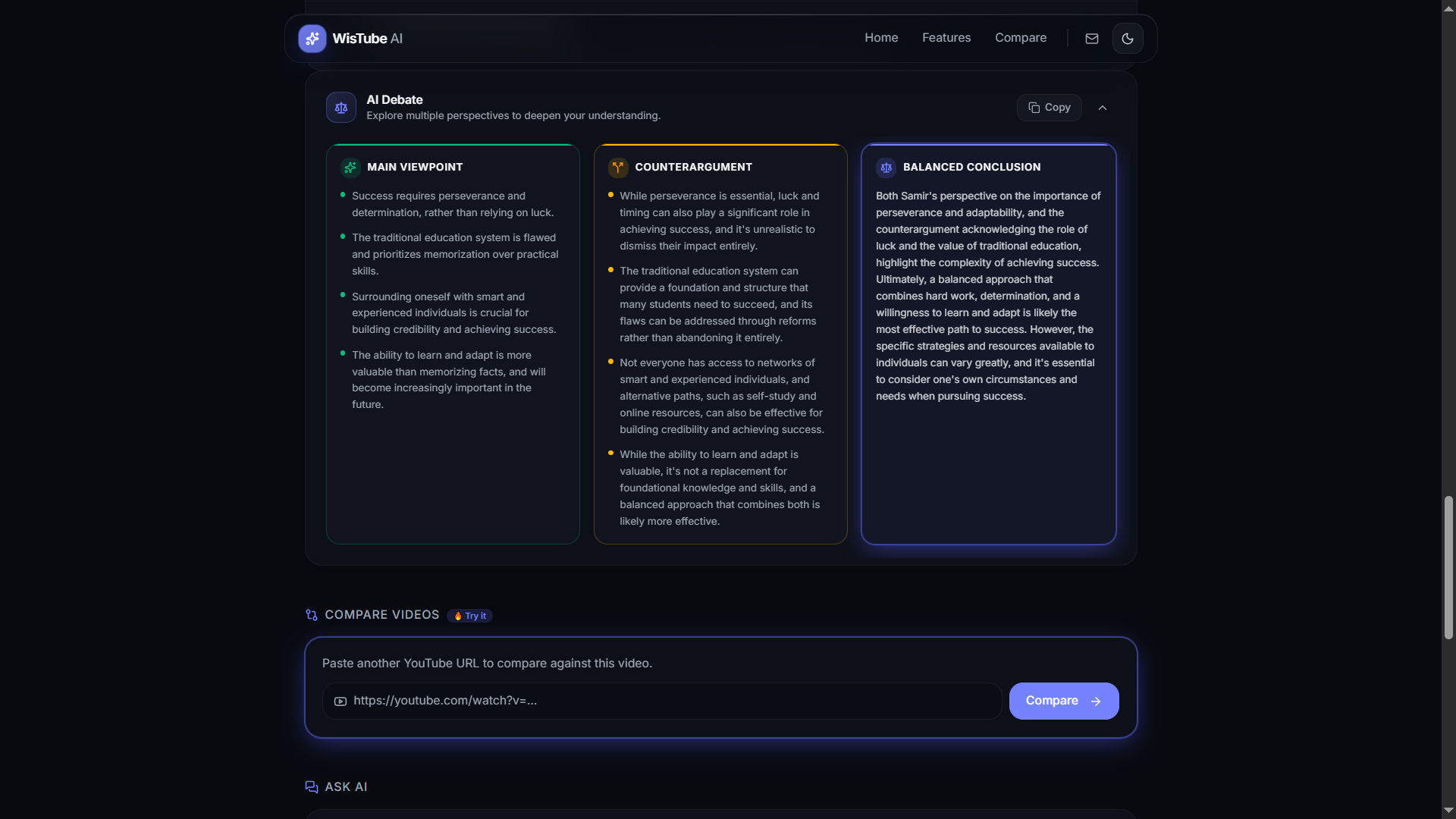
"Two AI perspectives challenge the video's claims before you take them at face value."
-
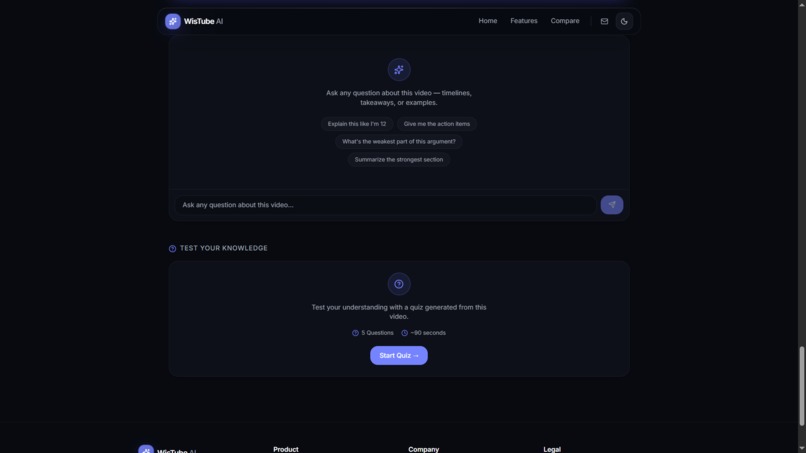
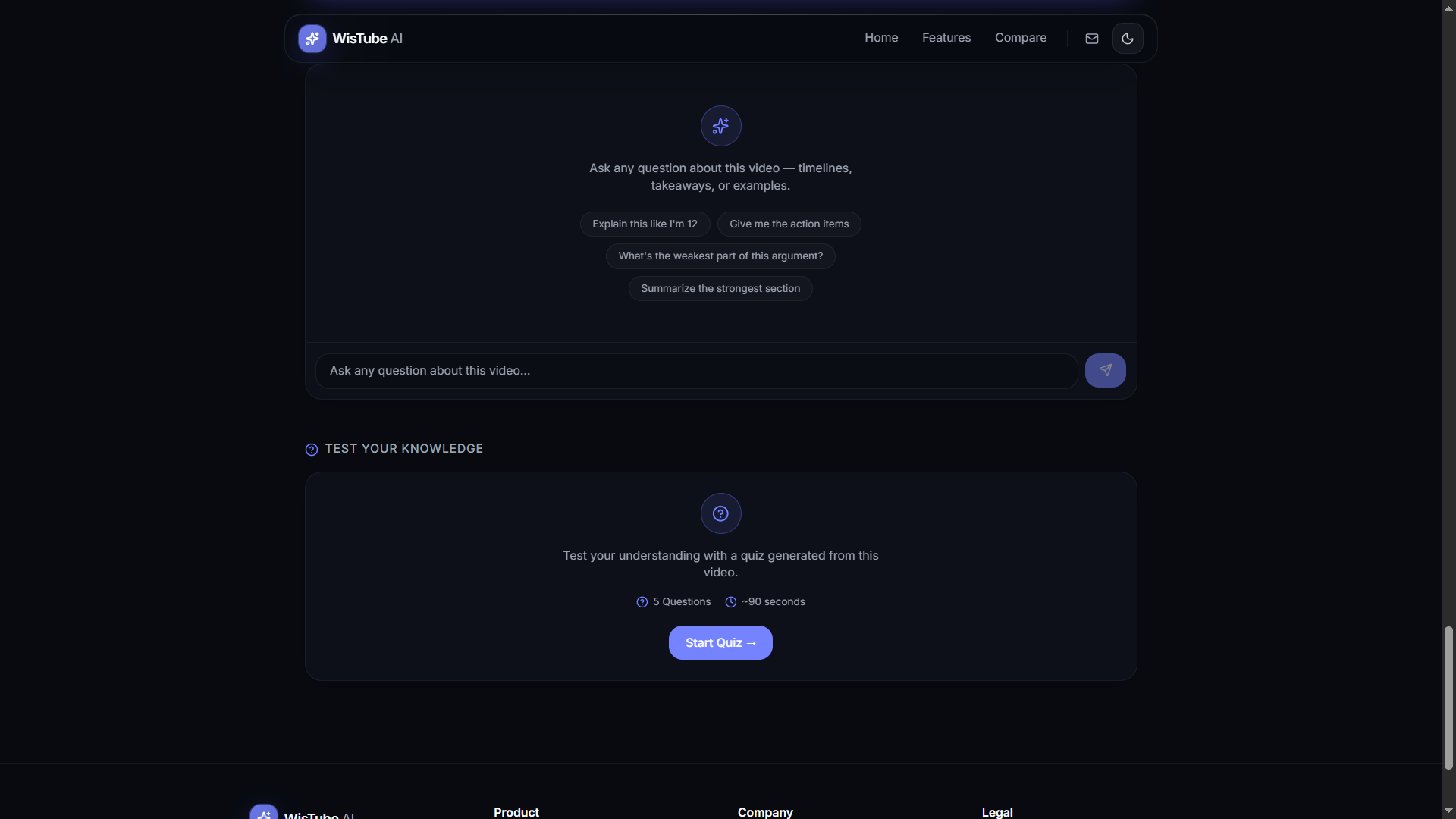
"Ask anything about the video, then prove you learned it with a 5-question quiz."
-
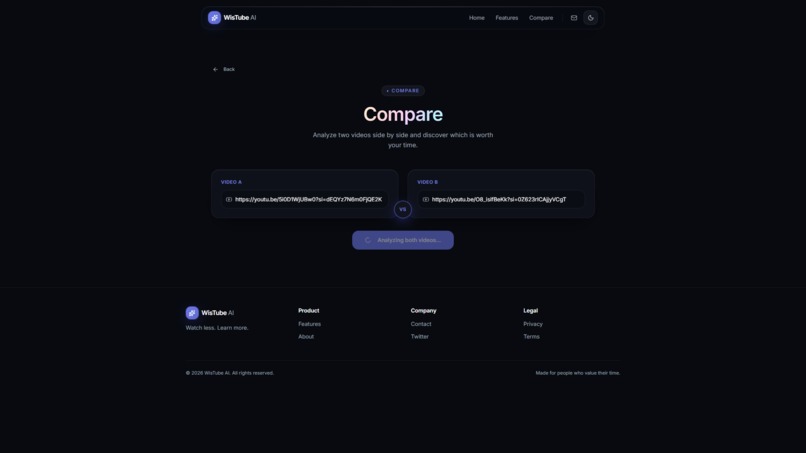
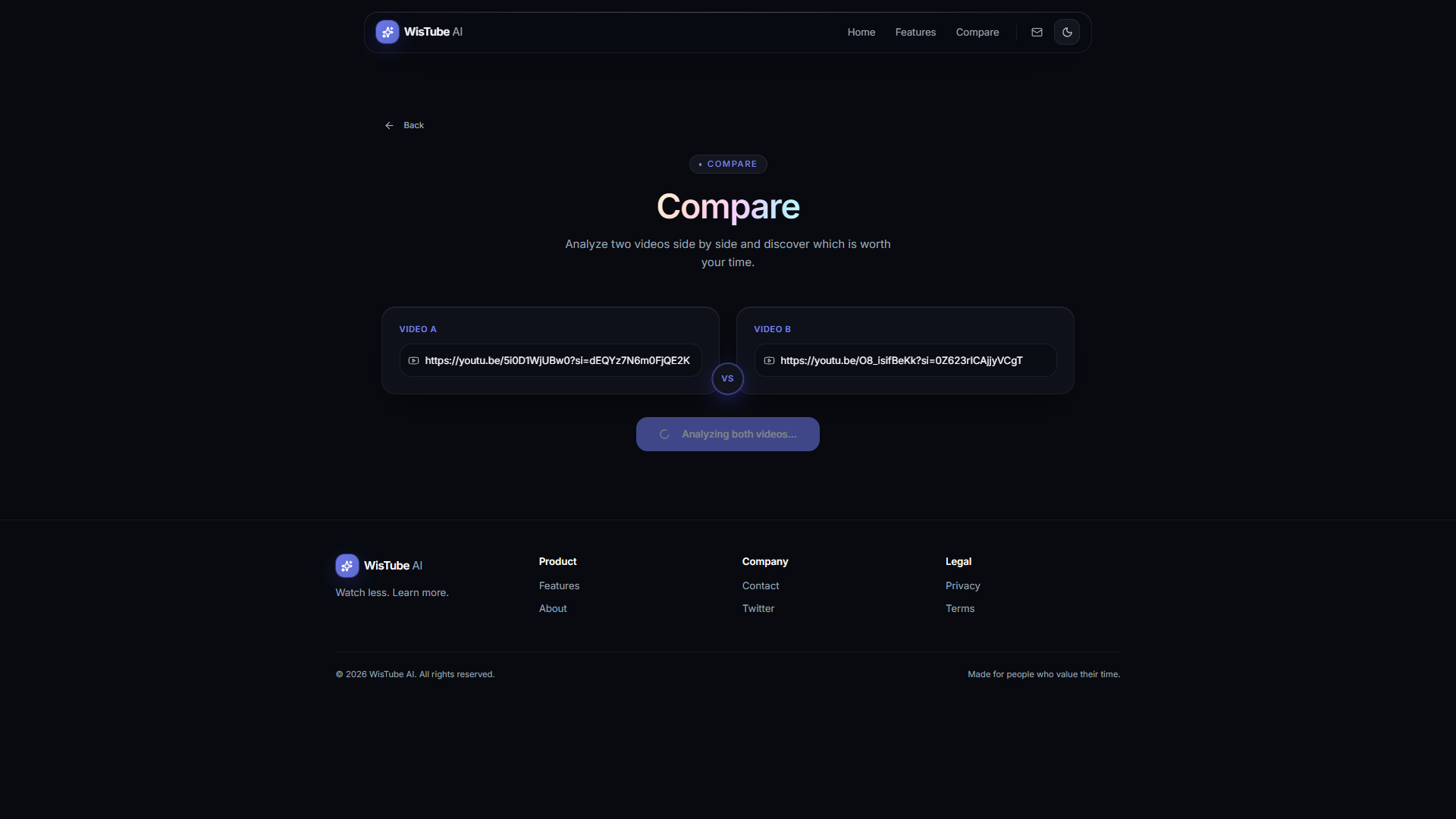
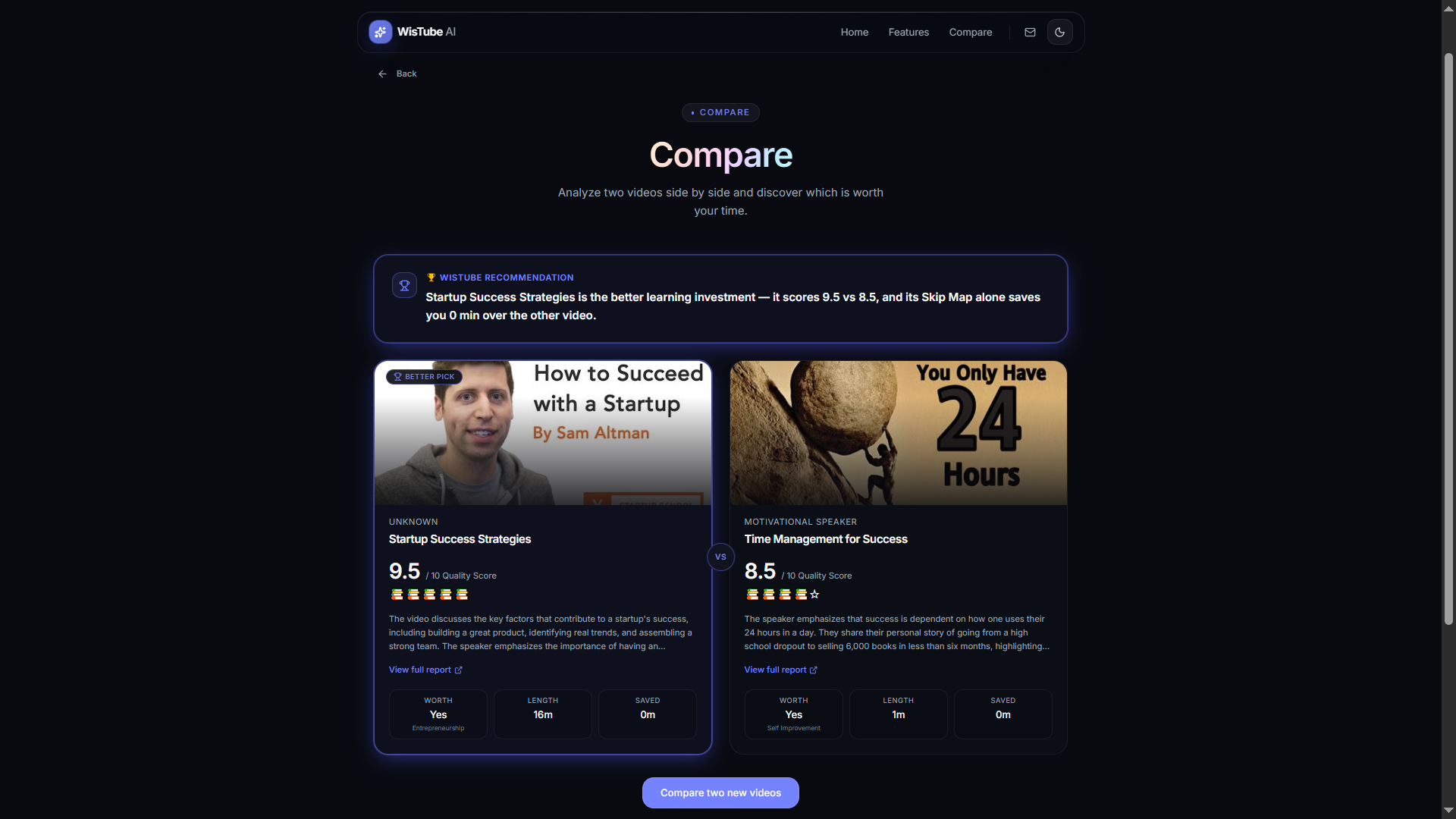
"Drop in two videos to see which is actually worth your time."
-
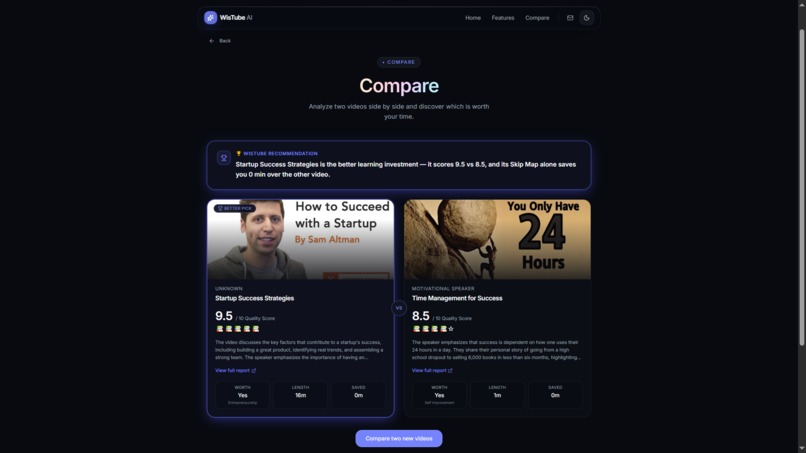
"Objective, side-by-side verdict — 9.5 vs 8.5, no guessing."
-
"WisTube AI — watch less, learn more."
-
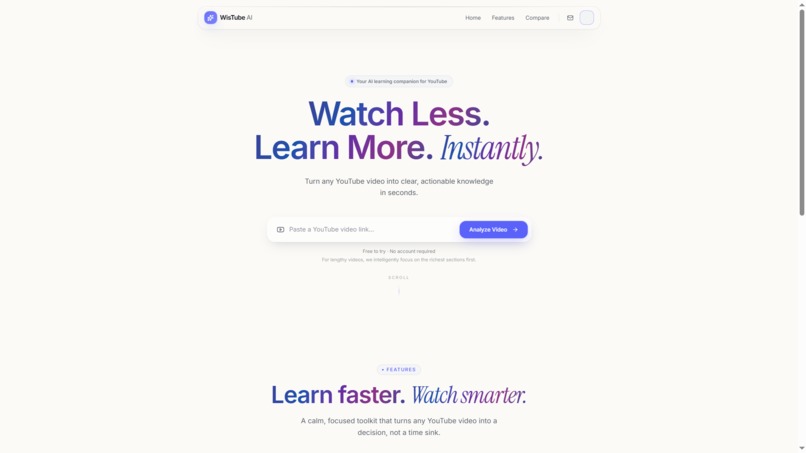
"Same clarity, light or dark."
Inspiration
As a student, YouTube has always been my classroom.
Whenever I wanted to learn a new skill, understand a complex concept, or satisfy my curiosity, YouTube was my first destination. Yet, despite spending countless hours watching educational videos, I often reached the end of a session with an uncomfortable realization—I had invested a great deal of time but retained surprisingly little knowledge.
Some videos were exceptional. Others spent minutes on introductions, sponsor segments, or ideas I already understood before eventually reaching the point. Many lacked timestamps altogether, making navigation frustrating. Different creators explained the same topic with vastly different levels of clarity, yet there was no meaningful way to know which video would genuinely be worth my time before watching it.
I began speaking with friends, classmates, and other learners, only to discover that my experience was far from unique. Everyone loved learning through YouTube, but almost everyone shared the same frustrations: information overload, inconsistent quality, endless searching, and hours lost deciding what to watch.
That realization transformed a personal frustration into a much larger question.
What if learning from YouTube became intentional instead of passive? What if you could instantly know which videos are worth your time? What if every video adapted itself to how you learn best?
That question became WiseTube AI.
I didn't want to build another transcript generator or another AI summarizer. I wanted to build an intelligent learning companion—one that helps people understand, evaluate, and retain knowledge instead of simply consuming videos.
What it does
WiseTube AI transforms any YouTube video into a complete, AI-powered learning experience.
Instead of presenting users with a lengthy transcript or a generic summary, WiseTube AI analyzes the educational value of a video and converts it into structured, actionable knowledge.
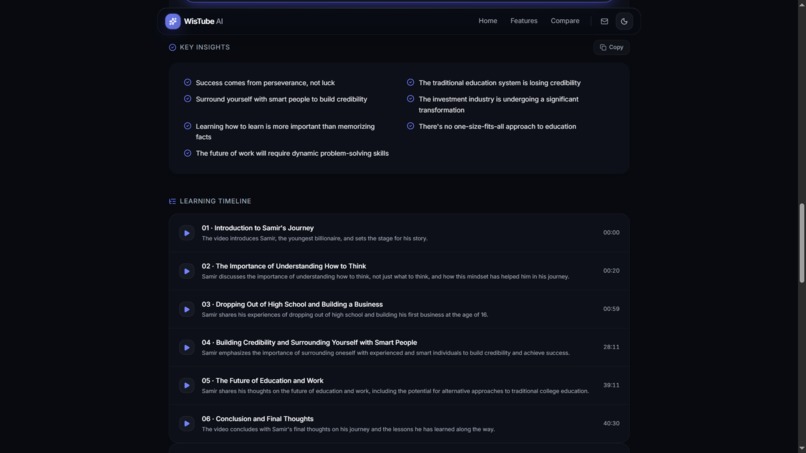
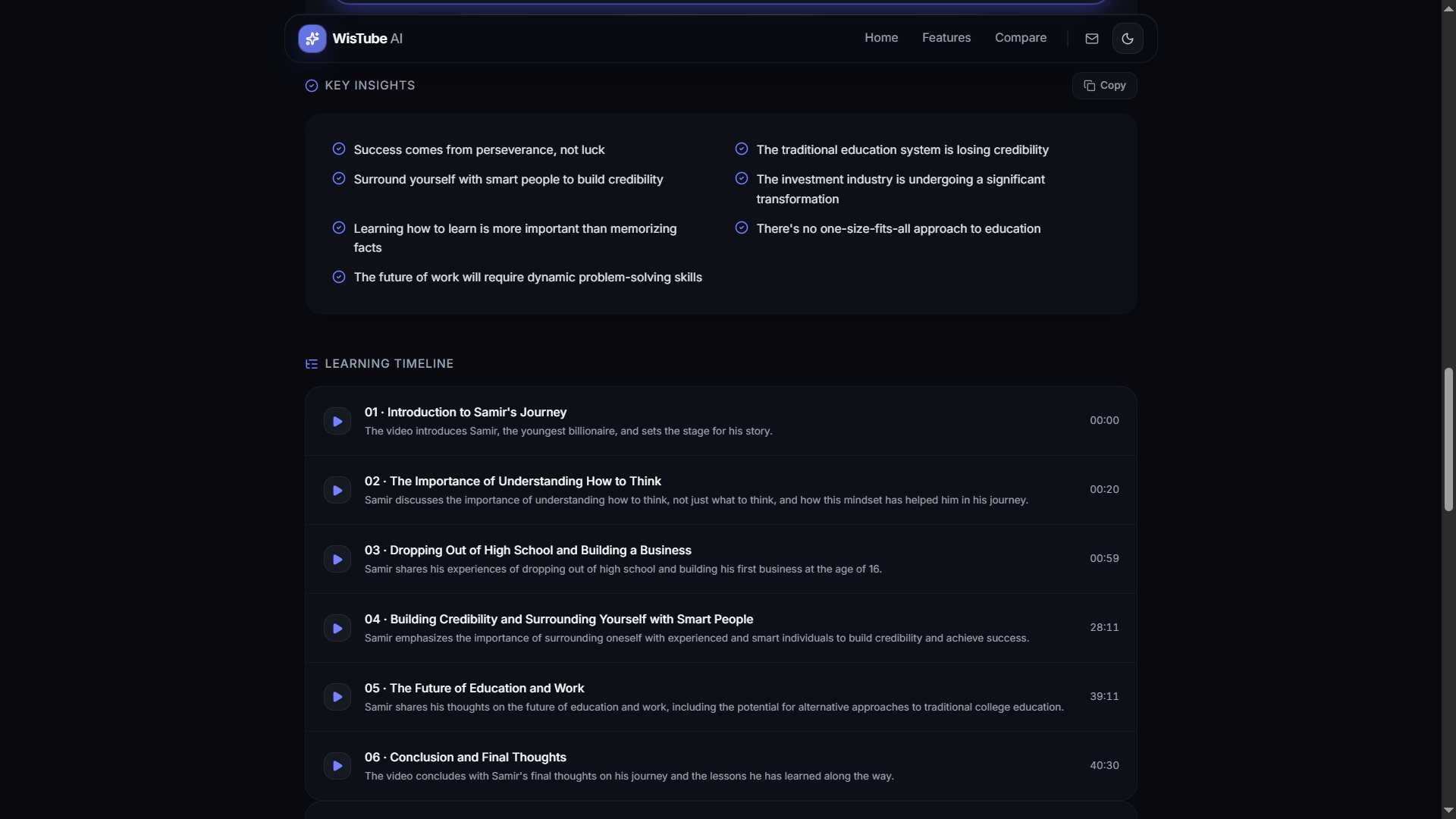
Every report includes concise learning summaries, Learning Timelines, SkipMap for navigating directly to valuable moments, Video DNA that visualizes how content is distributed throughout the video, actionable takeaways, AI-powered questions and answers, adaptive quizzes, video comparisons, and AI Debate to explore multiple perspectives on the same topic.
WiseTube AI is designed to answer a simple but important question before users invest hours of their time:
"Is this video truly worth learning from?"
The goal is not to help people watch faster.
The goal is to help people learn smarter.
How we built it
Building WiseTube AI proved to be significantly more challenging than I initially imagined.
The technical implementation involved React, TypeScript, Vite, Tailwind CSS, Groq, transcript processing, Speech Synthesis APIs, and deployment through Vercel. However, technology was only one part of the journey.
The real challenge was transforming unstructured video content into meaningful learning experiences.
Not every video provides reliable transcripts. Some videos have no timestamps, others contain automatically generated transcripts with inconsistencies, while many dedicate significant portions to introductions, sponsorships, repetition, or content that contributes little to the learner's understanding.
These limitations forced me to rethink the product repeatedly.
Instead of accepting transcripts as the final output, I focused on understanding the educational structure hidden within every video. That philosophy eventually led to features such as SkipMap, Video DNA, Compare Videos, AI Debate, and personalized quizzes.
Beyond engineering, I spent an enormous amount of time refining the product itself.
Countless interfaces were redesigned.
Entire features were discarded.
Ideas that initially seemed impressive were removed because they failed to improve the learning experience.
Every iteration was guided by one question:
"Would this genuinely help someone learn better?"
That question shaped every design decision throughout the project.
Challenges we ran into
The greatest challenge was not writing code—it was defining the product.
In the beginning, WiseTube AI looked very different.
It was tempting to build "just another AI summarizer," but the more I tested it, the more I realized that summaries alone rarely solve the actual problem.
Learning is far more complex than shortening content.
Another significant challenge involved working with YouTube transcripts. Educational videos vary enormously in quality and structure. Some creators explain concepts brilliantly, while others assume prior knowledge or spend excessive time on unnecessary sections. Designing an AI system capable of adapting to such diversity required constant experimentation and refinement.
As a student building this project, every obstacle became an opportunity to learn something entirely new—from prompt engineering and interface design to product thinking and user experience.
The project evolved because I refused to stop at the first working solution.
Accomplishments that we're proud of
The accomplishment I value most is not shipping an application.
It is transforming an ordinary idea into a product with a clear vision.
WiseTube AI did not emerge fully formed. It evolved through countless revisions, difficult decisions, abandoned prototypes, and continuous feedback from people who shared the same frustrations I experienced.
I am proud that every major feature exists because it addresses a genuine learning problem.
SkipMap reduces unnecessary searching.
Video DNA reveals how knowledge is distributed throughout a video.
Compare Videos enables learners to identify the strongest explanation before committing their time.
AI Debate encourages critical thinking instead of passive agreement.
Adaptive quizzes reinforce long-term understanding rather than short-term memorization.
Most importantly, I am proud that WiseTube AI reflects a philosophy rather than a collection of AI features:
Technology should amplify learning—not distract from it.
What we learned
This journey fundamentally changed the way I think about building products.
I learned that successful AI products are not created by adding more artificial intelligence. They are created by understanding people.
Every conversation with learners revealed another frustration.
Every failed prototype revealed another opportunity.
Every redesign brought the product closer to solving the real problem instead of merely showcasing technology.
I also learned that simplicity is remarkably difficult to achieve.
Creating an experience that feels effortless often requires countless hours of iteration, refinement, and removing unnecessary complexity.
Above all, I learned that meaningful innovation begins with empathy.
When you solve a problem you genuinely experience yourself, every improvement becomes purposeful.
What's next for WiseTube AI
WiseTube AI is only the beginning of a much larger vision.
I do not see WiseTube as a competitor to YouTube.
YouTube has already become one of the world's most influential platforms for education and knowledge sharing. WiseTube AI aims to become the intelligent learning layer built on top of that ecosystem.
In the future, I envision learners discovering the highest-quality educational content through trusted learning signals rather than popularity alone. A video that is highly regarded on WiseTube AI should represent clarity, credibility, and genuine educational value.
Future development includes Whisper, an AI voice companion capable of discussing videos conversationally, personalized learning paths, spaced repetition, intelligent flashcards, multilingual learning, collaborative study experiences, deeper analytics, and a persistent personal knowledge library that grows alongside every learner.
My ambition is not simply to summarize videos.
It is to help millions of people transform information into understanding, understanding into knowledge, and knowledge into lasting impact.
Watch Less. Learn More. Instantly.


Log in or sign up for Devpost to join the conversation.