-
-
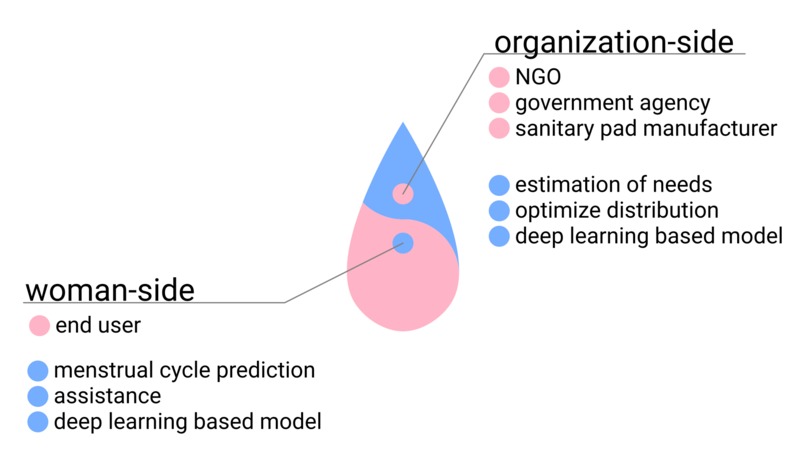
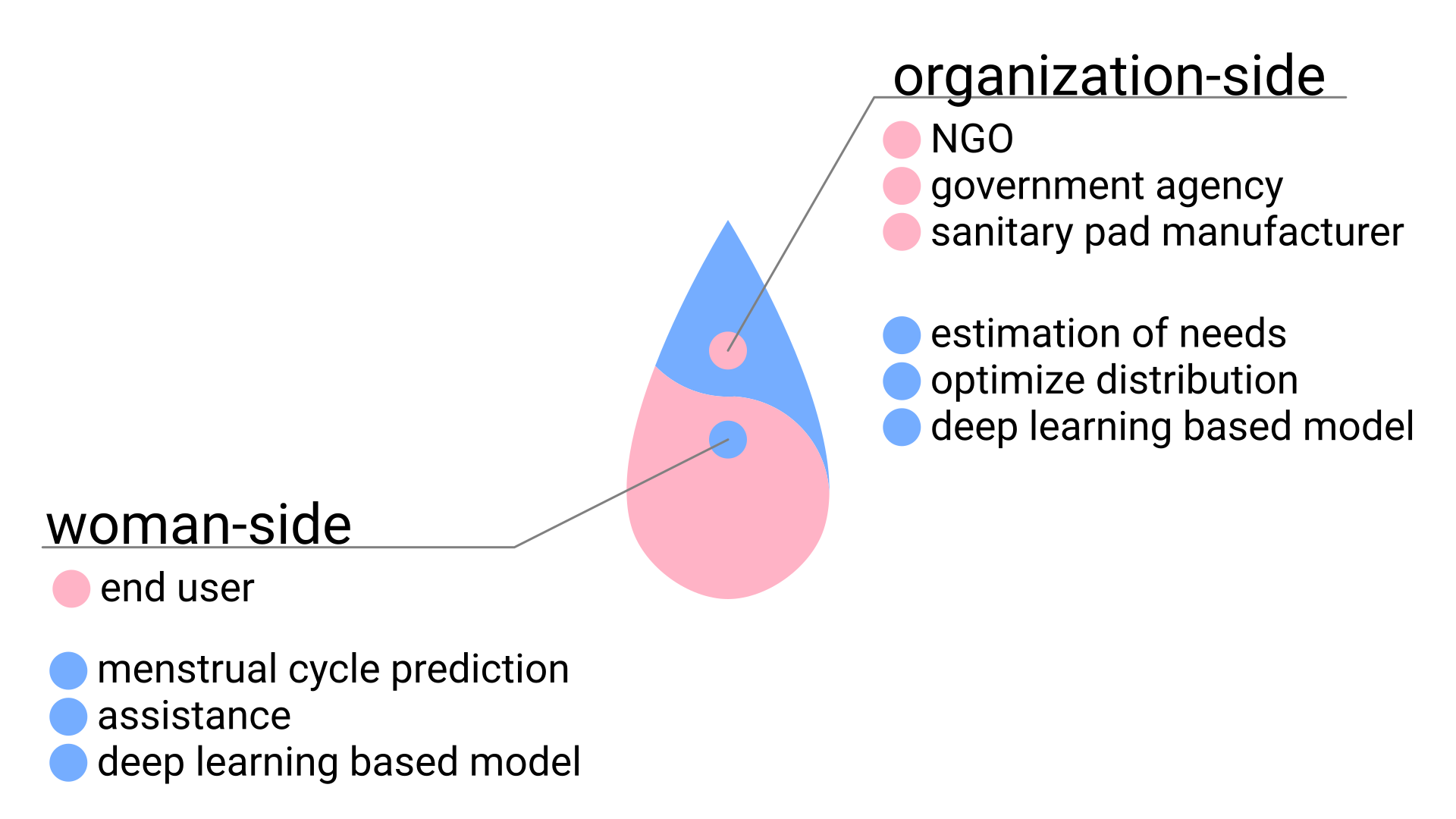
users and top features
-
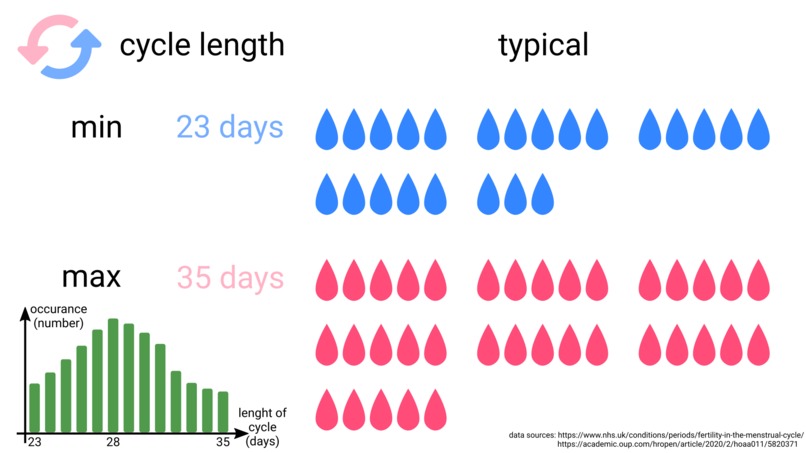
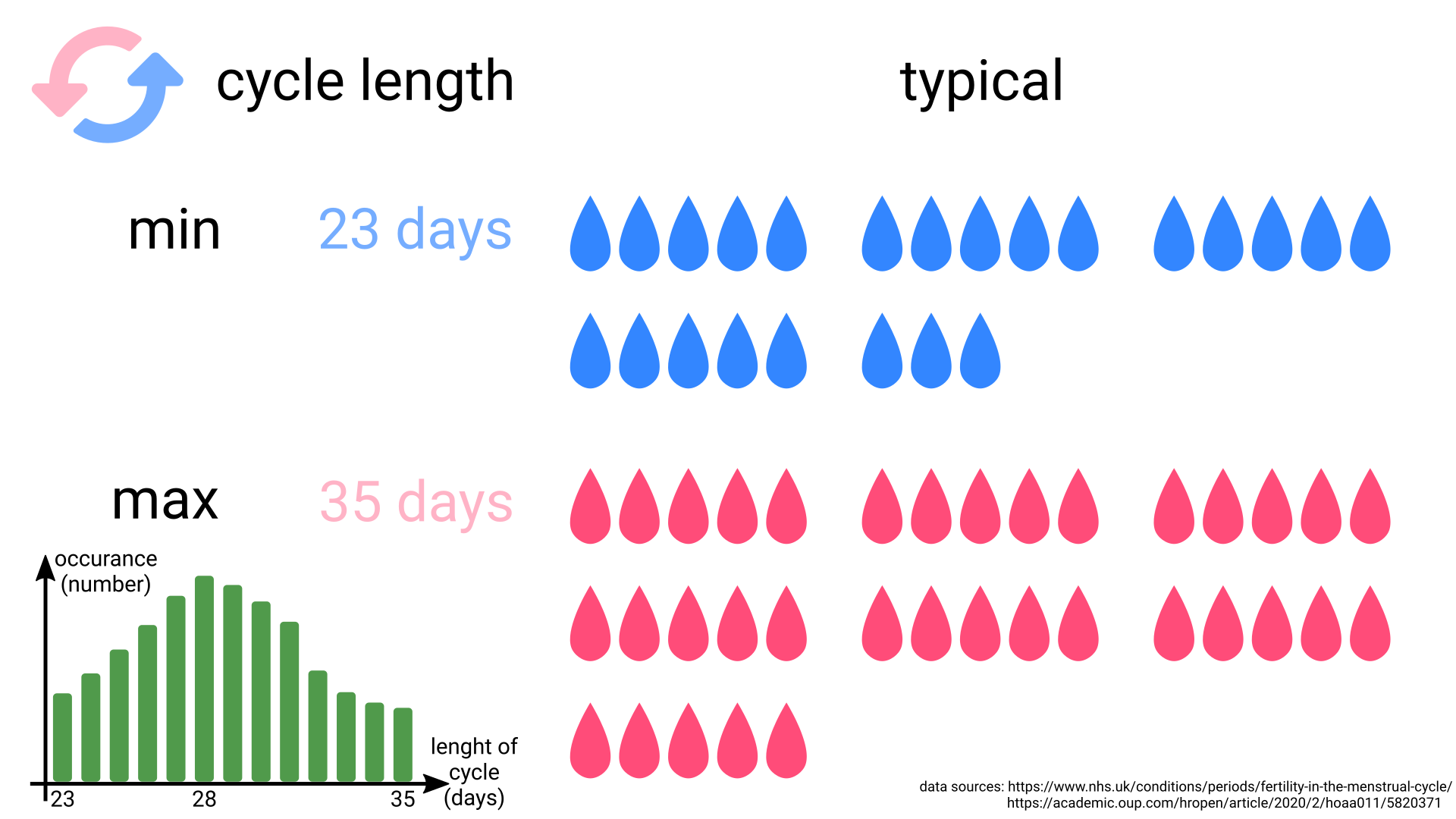
typical length of menstruation cycle
-
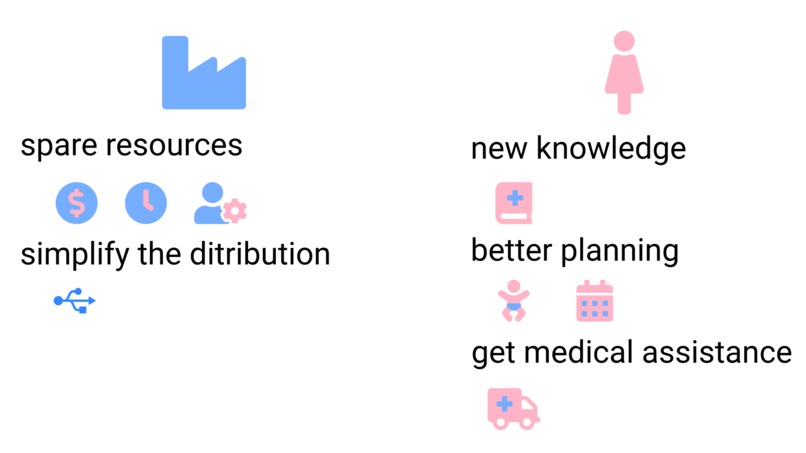
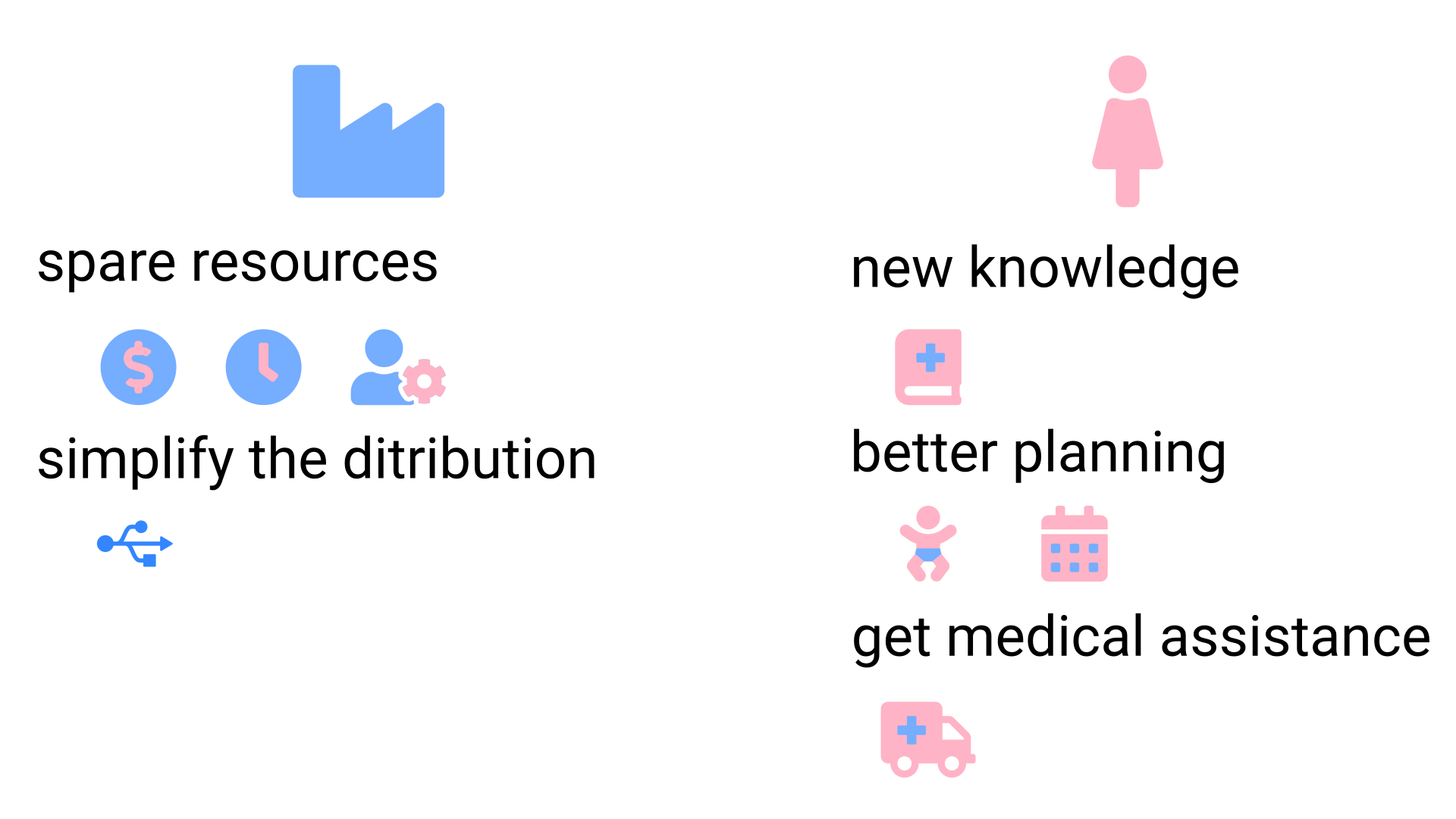
main benefits
-
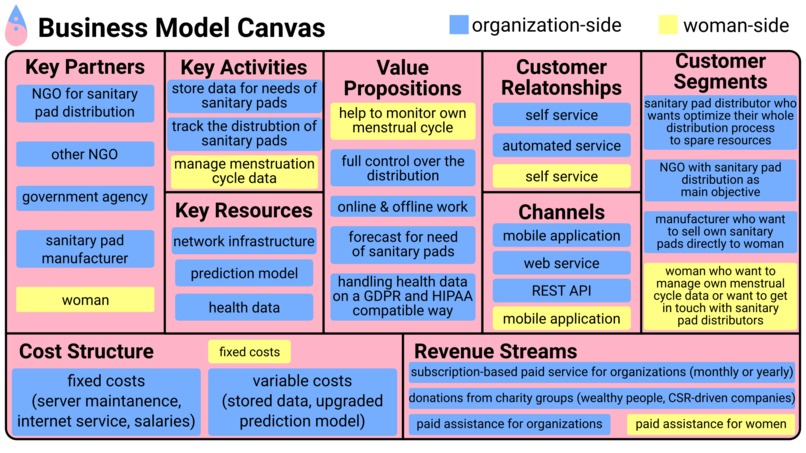
business model canvas
-
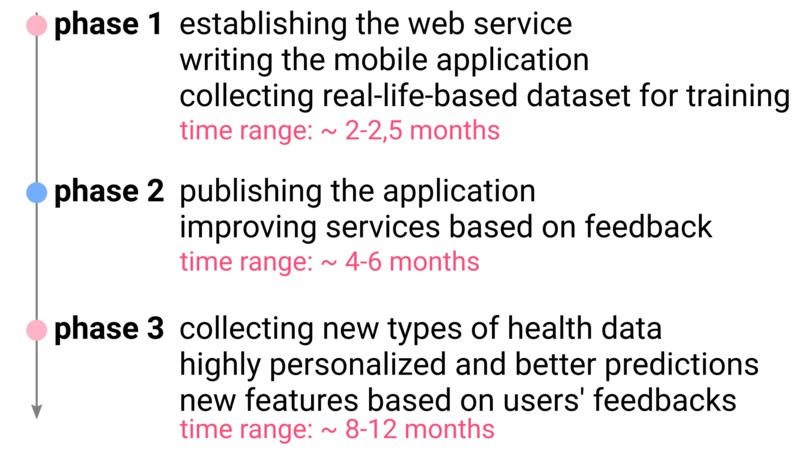
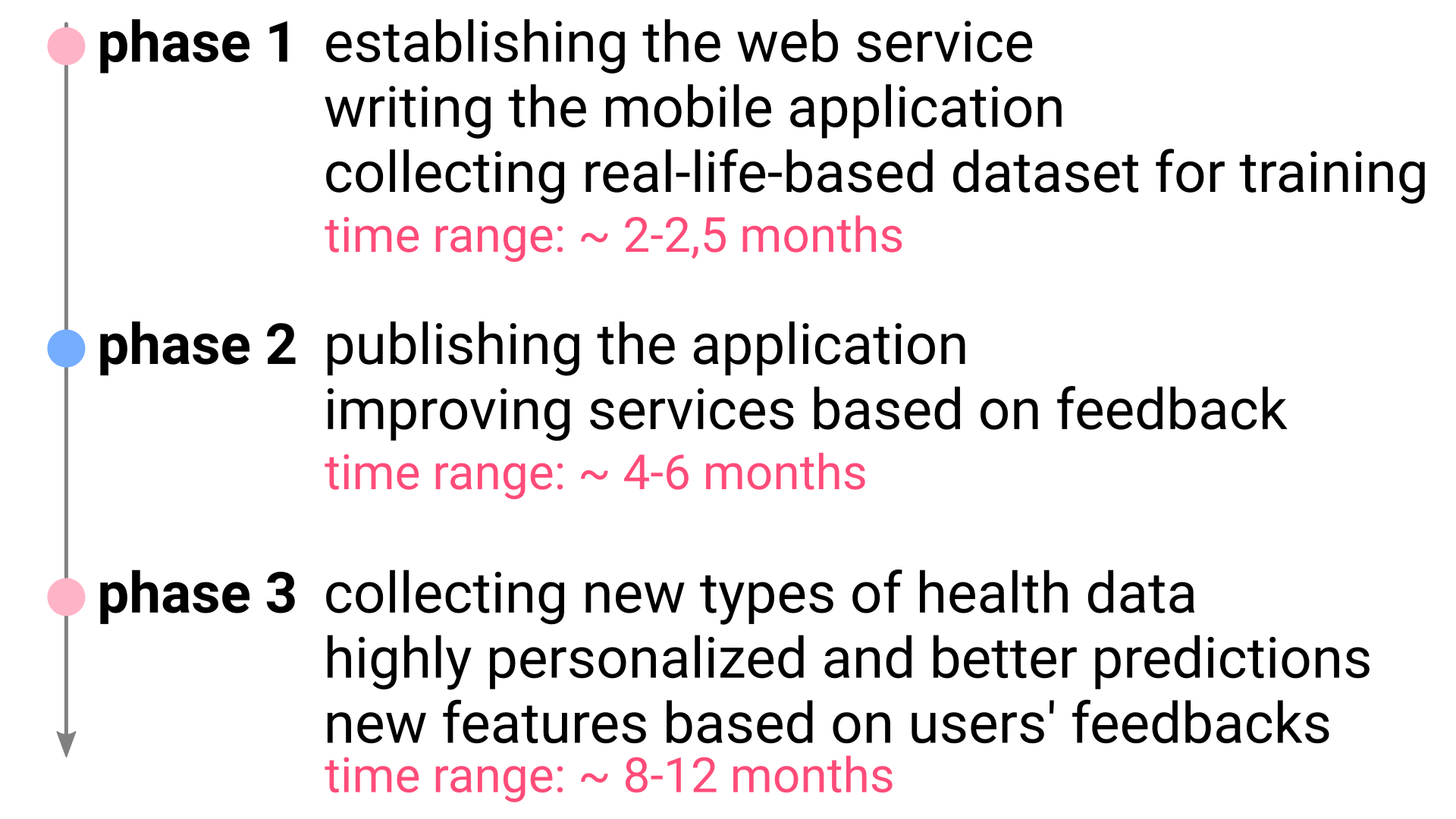
timeline

Why 2.0? ⁉
We already made a submission for this hackathon before the original deadline (03.05.). Since there was a deadline prolongation, we decided to upgrade our idea and our project. That’s why we made our new video as WiselyAndHealthy v2.0.
What is WiselyAndHealthy ❓
WiselyAndHealthy is a project that is made for a hackathon to provide an efficient technology for distribution and awareness of sanitary pads in rural India.
It includes two main components.
The first part is the organization-side. It is a system for NGOs, government agencies or sanitary pad manufacturers that helps to assess and estimate the sanitary needs of women and to optimize sanitary pad distribution effectively. It contains a deep learning based model that estimates the needs.
Secondly, WiselyAndHealthy is also a deep learning based software that helps women to get to know the needs of their body and hygiene and to use those informations with the prediction of menstrual cycle to have a better, more conscious and more comfortable life.
Inspiration 💡
It is so hard to see that women all around the world suffer from terrible problems. It is hard to imagine, things and opportunities which are obvious at one place of the Earth, are inaccessible in other places. We know the power of data and of visualization so we decided to try to help with tools we handle professionally.
What it does 🛠
Core ⚙
The organizations and companies who will use WiselyAndHealthy receive an end-to-end system that covers their needs and the needs of their users as well. With predictions it optimizes the distribution of sanitary pads. It works both online and offline to provide the highest comfortability and the ability of accessing remote places at the same time. At places without internet non-network-dependent sharing solutions are used such as QR codes.
Women who use our application receive a constant overview of their menstrual cycle. They receive warnings if the cycle is too early or too late. In case of issues women can consult medical assistance with the help of the application. Another helpful feature is the ability of asking for help in case if the woman suffers domestic violance or other discrimination.
Additional stuff 🎨
We would like to add as much information data visualisation or infographics as possible to our application for the organizations and the women. Speaking about the women-side, we are not experts on this topic since we are deep learning developers and data scientists only. Therefore we will ask for help from top most experts of women rights.
Workflow 🦾
The workflow is very simple yet powerful.
Organization-side 🏛
If an organization or company decides to distribute sanitary pads in a new region, they can count the number of potential women in the area. If the women can connect to the internet they can send their data via our service. If online connection is not an option, the worker of the company or the activist of the NGO can go to the place and ask the data from the women. After that our system can predict the needs at an exact location. Those predictions get more and more accurate after each cycle. The distributor can measure the efficiency of the network since every package can be followed with QR codes. Statistics and reports are also available as the proof of work for the partners or for the supporters. Women can ask new sanitary pads from the organization directly via our application.
Women-side 👩
Women can save their own menstrual cycle data. The software predicts the next cycle and its parts such as days with bleeding, fertile or non-fertile periods. If there is a problem in the periodicity of the cycle, the software shows a warning message. An early detected menstruation problem provides better treating outcomes. Besides these features, women can ask for medical assistance if it is needed.
Features 🔍
Organization-side 🏛
- estimation for amount of sanitary pad needs with deep learning model
- end-to-end system with organization-side and user-side applications
- flexible system that works with or without online connection as well
- offline data-sharing support based on non-network-dependant sharing solution such as QR codes between the user and employee of organization
Women-side 👩
- unique menstrual cycle prediction for women to check the big parts of next period such as beginning and ending of menstrual cycle, beginning and ending fertile or non-fertile days
- warning for potential health problem based on the irregularity of menstrual cycle
- reporting to ask for help on domestic violence or discrimination for having period
- ask medical assistance with build-in button
Feasibility 🏗
The biggest advantage of WiselyAndHealthy is that it does not need extra hardware for NGOs. It can run on an existing server. Since the user-side is optional, if the woman has a mobile device (such as phone, tablet, laptop), she can use their own application, but is not necessary for the operation. Our vision is to create a system where the organization-side software works together with a lot of user-side devices. However, we know, poverty is a real barrier and a woman who has no money for a sanitary pad, no money for any mobile device either. Our solution helps to distribute the sanitary pads better based on the result of deep learning prediction. Since it is a deep learning model, it needs to have a lot of data. That’s why the time of the data-collection is the only barrier.
Adaptability 📐
WiselyAndHealthy can adapt for any new environmental factor or events such as COVID-19 epidemic, since the resources of prediction come from the users directly. When there is an urgent need, there are new potential users (for example due to a humanitarian crisis), the system calculates the new factor into the prediction to provide the maximum flexibility as possible.
Sustainability & Impact 📈
WiselyAndHealthy offers a solution for an existing problem, as long as the problem exists our solution has a good reason to exist. “Nearly 23 million girls drop out of school annually after they start their periods and only 36% of its 355 million menstruating females use napkins (the remaining use old cloth, rags, husk or ash to manage the flow)” according to BBC*. With the help of WiselyAndHealthy organizations can access remote regions as well since no permanent network connection is required to access developed services. This can make a high impact in helping those who live in poverty in villages. Women get a lot of extra services that help them to have a better life. They can follow their own menstrual cycle and they can be warned about potential illnesses or any other abnormal factor of their cycle. Women can plan their life according to the menstrual cycle or to the fertile and non-fertile periods. They can see their historical data with data visualization and they can read information about women health, hygiene needs and factors. Women can ask for medical help directly with a single button or they can report if they suffer domestic violence or other discrimination due to menstrual cycle.
How we built it 🏗
As we had the core idea, we tried to search for some dataset to train a good model. Though there are several similar applications, finding a dataset seemed to be hard. So we had to change our direction to figure out best practices to create criteria to the data and to the application as well.
We collected a lot of information about the topic and about the issues that the similar applications still have. We applied various practices from different other fields as we planned our solution to this challenge.
We examined the business concept of sanitary pad distributors to see what is the common ground in these fields. The two main parts are a charity based organization and a market-driven organization.
We made the needed material to submit this project and now we are waiting for a successful future with WiselyAndHealthy.
Challenges we ran into 🚨
We did a lot of research to go deep in this problem. This was separated into two big parts. The first was the background of problems such as poverty, daily struggles of women, and barriers. The second phase is connected to the body of women and the menstruation cycle, such as the length of menstruation, length of fertile and non-fertile days, typical and non-typical menstruation cycles. Since we are deep learning developers and data scientists, we had to learn a lot. These sources were really useful:
phase 1 (background of problem) 💰
- BBC https://www.bbc.com/news/world-asia-india-52718434
- BBC https://www.bbc.com/news/magazine-26260978
- Nature https://www.nature.com/articles/s41523-019-0138-2
- NCBI https://www.ncbi.nlm.nih.gov/pmc/articles/PMC2001234/
- NCBI https://www.ncbi.nlm.nih.gov/pmc/articles/PMC2293279/
- NCBI https://www.ncbi.nlm.nih.gov/pmc/articles/PMC4852976/
- NCBI https://www.ncbi.nlm.nih.gov/pmc/articles/PMC6719884/
- statista https://www.statista.com/topics/1850/pregnancy/
- UNFPA https://www.unfpa.org/menstruationfaq
- WHO https://www.who.int/news-room/fact-sheets/detail/adolescent-pregnancy
phase 2 (details of problem) 🩸
- Biorxiv https://www.biorxiv.org/content/10.1101/583153v2.full.pdf
- Core https://core.ac.uk/download/pdf/216907221.pdf
- Nature https://www.nature.com/articles/s41746-019-0152-7
- NHS https://www.nhs.uk/conditions/periods/fertility-in-the-menstrual-cycle/
- Oxford https://academic.oup.com/biostatistics/article/7/1/100/243078
- Oxford https://academic.oup.com/hropen/article/2020/2/hoaa011/5820371
Accomplishments that we're proud of 👑
We think on this kind of hackathon and challenge there is no place for being proud of accomplishment. It is really sad that in the world inequalities and discriminations exist based on human biology and the natural process of women’s bodies.
What we learned 📘
We learned some really disturbing facts about how struggling is for women to have the necessary hygiene during menstruation. Other shocking knowledge is that menstruation itself is a barrier to opportunities, it reinforces gender inequality. Some restrictions are cultural, such as prohibitions on handling food or entering religious spaces, or the requirement that women and girls isolate themselves.Poverty and humanitarian crises can limit women’s and girls’ access to culturally appropriate menstrual supplies and safe, private washing facilities. We already read about these types of discriminations, but there is a difference between reading an article about it or spending hours reading about them.
What's next for WiselyAndHealthy ⏱
We are absolutely devoted to continuing with WiselyAndHealthy. We can cover the full development process of the organization-side with our skills. However, the women-side requires a lot of special knowledge we cannot do it alone on our own. If we give a chance from experts to continue, we will be really happy, since we learned, that knowing and talking about discrimination or inequalities is not enough, everybody have to stand up and act.


Log in or sign up for Devpost to join the conversation.