-
-

WiseAI
-
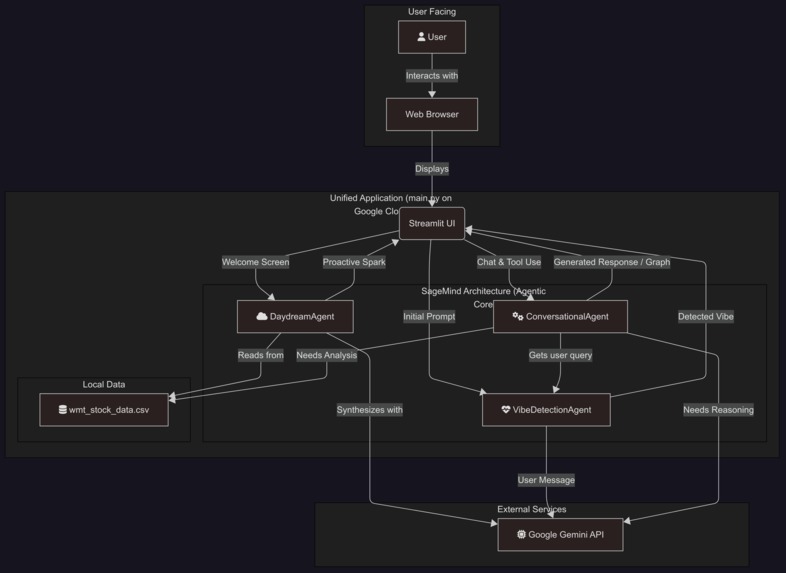
wise archetecture diagram


Inspiration
When we started this hackathon, we were inspired by the massive potential of agentic AI. But we were also struck by a challenge articulated by leading AI designers: today's powerful models can feel like a "polite guest who won't speak until spoken to." They are brilliant calculators, but they are passive.
This led us to a powerful question: "How can we use today's amazing AI to create an experience that feels as alive and partnered as a true intelligent assistant would be?" We wanted to build a true partner—an AI that could feel proactive and alive.
This insight became our core philosophy. We decided to build Wise.
What it does
Wise is a working prototype of a "Thinking Operating System"—an AI partner designed to augment human thought. It is built on three core capabilities that you can see and interact with in our live demo.:
Proactive Synthesis (DaydreamAgent): Wise has a Daydream Agent that 'thinks' in the background. Unlike passive assistants, Wise thinks even when you're not there. It analyzes a sample dataset in the background to find interesting anomalies. When you launch the app, it greets you not with a blank prompt, but with a unique, data-driven "spark" to kickstart a meaningful conversation.
Adaptive Reasoning (Cognitive Lenses): Wise looks at problems through different Cognitive Lenses. Wise understands that great ideas require different modes of thought. With a single click, you can switch its entire personality and reasoning process. The Analytical Lens turns Wise into a meticulous, data-driven researcher. The Imaginative Lens transforms it into a creative muse, capable of brainstorming metaphors and writing poetry.
A "Second Brain" with a "Dream Inbox": Ultimately, Wise helps users build their personal knowledge base. Every "spark" generated by Wise, whether proactive or on-demand, is saved to a personal Dream Inbox within the session. This allows you to review and reflect on your best ideas, ensuring no good thought is ever lost. (Watch the demo here: https://youtu.be/GlkxrgaaDrA)
Agentic Tool-Use (ConversationalAgent): Wise can act on your intent. Ask it to "plot the closing price," and its agentic kernel will write and execute Python code on the fly, generating a Plotly graph directly in the chat. This is a live demonstration of a complete, end-to-end agentic workflow.
How we built it
Wise is built on our "SageMind Architecture", a custom, lightweight agentic framework we designed from first principles during the hackathon, brought to life in a unified Streamlit application.
Application & Frontend (Streamlit): We made a strategic decision to build Wise as a single, robust Streamlit application. This allowed us to focus on creating a polished, multi-stage UI that feels fast and reliable, visually adapts to the active Cognitive Lens, and provides seamless access to the Dream Inbox.
Agentic Core (Python & Gemini): Our SageMind architecture is powered by a set of custom-built agents using Python and the Google Gemini API directly. We did not use a pre-built toolkit; we built our orchestration logic from the ground up:
- A
DaydreamAgentanalyzes a local stock history CSV to generate proactive, data-driven insights. This serves as our proof-of-concept for a future RAG pipeline. - A
VibeDetectionAgentacts as an intent classifier, analyzing user language to suggest the most appropriate Analytical or Imaginative lens. - A main
ConversationalAgentserves as the "Master Conductor." It maintains conversation context and is designed to select internal tools. We successfully implemented a proof-of-concept graphing tool using Plotly, demonstrating the architecture for agentic tool-use.
- A
AI & Cloud Services: Intelligence is powered by Google's Gemini 1.5 Pro and Flash models. The entire application is containerized with Docker and deployed on Google Cloud Run, making it scalable and accessible.
Challenges we ran into
Our biggest challenge was a conceptual one: moving from a grand vision to a focused, achievable product. This required us to have honest conversations and pivot from a complex initial architecture to our more elegant, unified application model. On the technical side, we spent significant time debugging our custom agent-to-agent communication, implementing robust context handling, and solving deployment path issues in Google Cloud Run.
Accomplishments that we're proud of
We are incredibly proud of building a working prototype of an AI that feels genuinely proactive. The "Intelligent Welcome" powered by data analysis and the context-aware "On-Demand Sparks" are moments of magic we successfully brought to life. Technically, we're proud of designing and implementing our SageMind Architecture from first principles, proving our deep understanding of how to build and orchestrate a multi-agent system.
What we learned
This hackathon was a crash course in product philosophy. We learned that the most powerful ideas often come from refining and simplifying. Acknowledging our constraints forced us to be more creative and build a better, more useful prototype. We also learned the importance of a clean separation of concerns, as our custom architecture forced us to clearly define the roles of our UI and agent logic, making the integration process faster and more robust.
What's next for Wise
Our vision is to build the ultimate thought partner. Our immediate next steps are:
- Expand the Agent's Toolset: Give the
ConversationalAgentmore tools, starting with a real-time web search and a Wolfram Alpha-powered calculator for accurate math. - Implement Live Data Analysis: Connect our data analysis capabilities to live data warehouses like Google BigQuery, moving beyond the proof-of-concept CSV.
- Build Persistent Memory: Move the Dream Inbox from session state to a real database (like Firestore), allowing users to search and manage their sparks over time and create a true "second brain."
- Evolve the Orchestrator: Continue to build out our SageMind Architecture, making it a true operating system for thought that can manage an even wider array of tools and agents.
Built With
- adk
- cloudbuild
- flask
- gemini
- google-bigquery
- google-cloud
- memory
- plotly
- python
- steamlit
- vertex


Log in or sign up for Devpost to join the conversation.