-
-
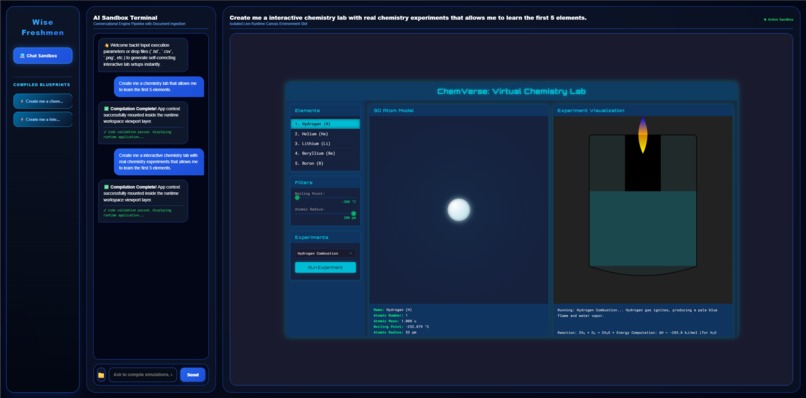
Demonstration of the generated virtual labs
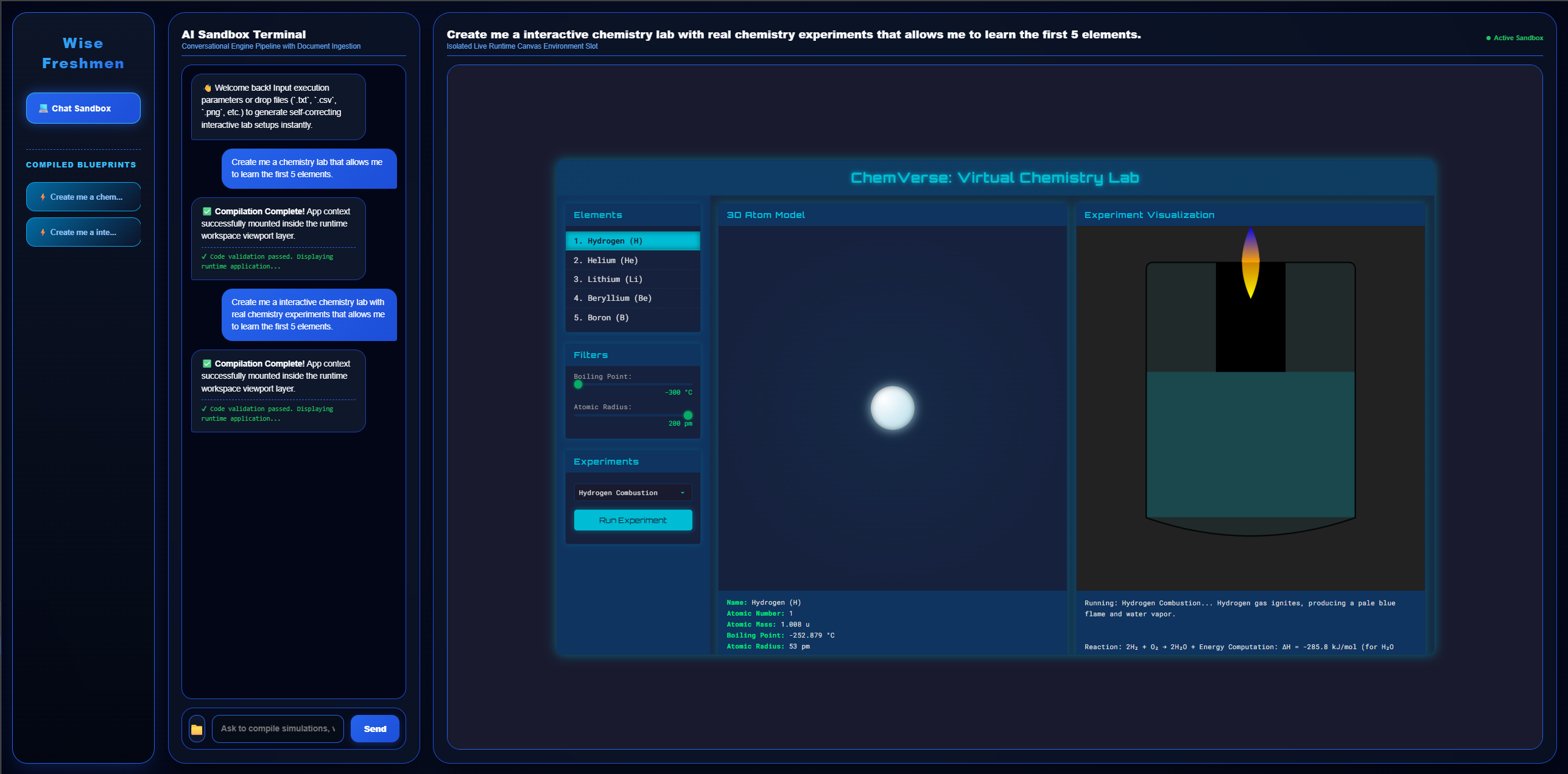
The Story of Wise Freshmen: Unchaining Digital Creation 💡 The Spark Most educational and creative software feels like it is built inside a cage. You are promised a canvas to build your ideas, but the second you try to create something unique, the software forces you into a generic box. You want to see an interactive chemistry simulation, but you get a flat multiple-choice flashcard. You want an immersive physics world, but you get a static textbook page.
Wise Freshmen was born to break that limitation. The goal was to build a true virtual sandbox—a digital terminal that has absolutely zero bias and zero assumptions. It doesn't guess what you want, and it doesn't force a pre-made template onto your screen. It listens to what you want to create and builds it instantly from scratch.
🎨 How it Experiences the World The entire system operates as a fluid, responsive workspace that shifts shapes depending entirely on human intent.
The Request: Everything starts in a sleek, dark-blue terminal command bar. You type exactly what you want using regular, everyday language.
The Metamorphosis: The moment you press send, the interface adapts. If you ask for a chemistry lab, it instantly spawns an interactive dashboard where clicking different elements dynamically alters the properties on screen. If you switch gears entirely and ask for an anime-inspired storytelling game to map out physics, the interface discards the lab entirely and populates a tactical layout built for real-time movement and strategy.
🎯 The Ultimate Obstacle: Breaking the Habit The hardest part of bringing this to life was training the intelligence behind the terminal to stop acting like a traditional computer program.
Computers love patterns and safety nets; they naturally want to default to the easiest, most common layouts—like basic quizzes or flat text descriptions. In the early stages, asking for a "complex laboratory experiment" would still result in a glorified trivia card because the engine was hesitant to take off the training wheels.
We had to design the workspace to be completely unchained. We stripped out every single pre-existing assumption, forcing the system to take full ownership of the interface. Instead of pulling parts from external websites or relying on rigid structures, the terminal builds every slider, every animation loop, and every visual element completely on the fly.
🧠 The Takeaway Building this project proved that true versatility cannot exist if you try to control the outcome from the start. By stepping back and letting the terminal become a completely blank slate, we unlocked a live workspace that adapts to whatever reality you throw at it. It turns a simple text prompt into a living, breathing application in a matter of seconds.

Log in or sign up for Devpost to join the conversation.