-
-
SankofaWire
Inspiration
SankofaWire was inspired by my own experience learning electronics and robotics. Again and again, I found that projects failed not because the idea was wrong, but because of small, invisible wiring mistakes—missing ground connections, unstable power, or incorrect signal routing. Debugging these issues usually required access to an experienced mentor, which many students and makers simply don’t have. The name Sankofa comes from Ghanaian philosophy and means “go back and retrieve it,” reflecting the idea of revisiting a setup, understanding what went wrong, and fixing it with clarity rather than guesswork.
What I Learned
Building SankofaWire taught me how challenging it is to bridge the gap between physical hardware and software reasoning. I learned how to design systems that handle uncertainty honestly, rather than pretending to be confident when information is missing. I also learned how to combine visual input, user intent, and runtime symptoms into a single reasoning workflow that feels more like guidance from a human mentor than a traditional debugging tool.
How I Built It
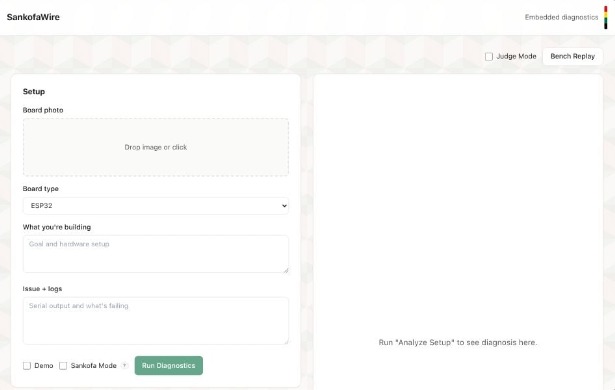
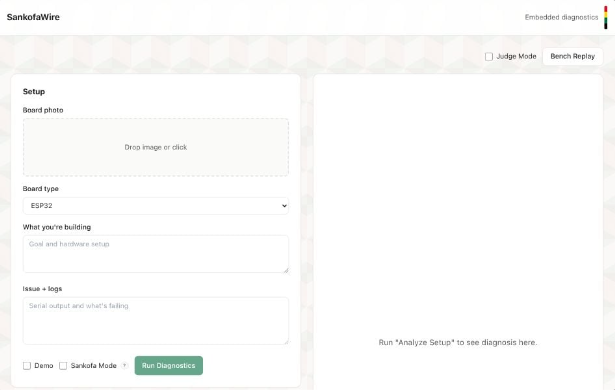
SankofaWire is a web-based application that uses the Gemini 3 API for multimodal reasoning. Users upload a photo of their hardware setup, describe what they are trying to build, and optionally include observed issues or logs. Gemini analyzes the image alongside the intent and symptoms to identify likely wiring, power, or grounding problems. The system produces structured diagnostics, explains the reasoning at beginner or advanced levels, highlights uncertainty when visual information is incomplete, and suggests concrete fix and verification steps. To ensure reliability during testing, I also implemented a Demo Mode and deterministic quick tools such as power and I²C checks.
Challenges
One of the biggest challenges was handling unclear or incorrect inputs safely. Hardware images are often messy, partially obscured, or irrelevant, and the system needed to recognize when it could not be confident. Another challenge was ensuring consistent functionality during deployment, including image preprocessing and model availability across environments. Solving these issues required careful engineering choices, graceful fallbacks, and clear communication with the user about limitations.
Reflection
SankofaWire is not just a debugging tool—it is an attempt to make hardware learning more accessible, especially for students and makers who lack immediate expert support. By turning mistakes into teachable moments, the project aims to shorten the distance between failure and understanding.
Built With
- google-gemini-3-api
- htmlcss
- javascript
- react
- typescript

Log in or sign up for Devpost to join the conversation.