-
-
Wired future
Inspiration
Most "AI-powered" websites bolt a chat box onto the corner and let a model guess which button to click. The model reads pixels or scrapes the DOM, and breaks the moment you move a div.
WebMCP flips that. A page can hand an agent a typed contract instead: here are my tools, here is what each argument means, call them. I wanted to find out what a site looks like when you design for that from the first line, rather than retrofitting it.
So Wired Future has one rule: there is exactly one place scene state can change, and both the human and the agent go through it.
What it does
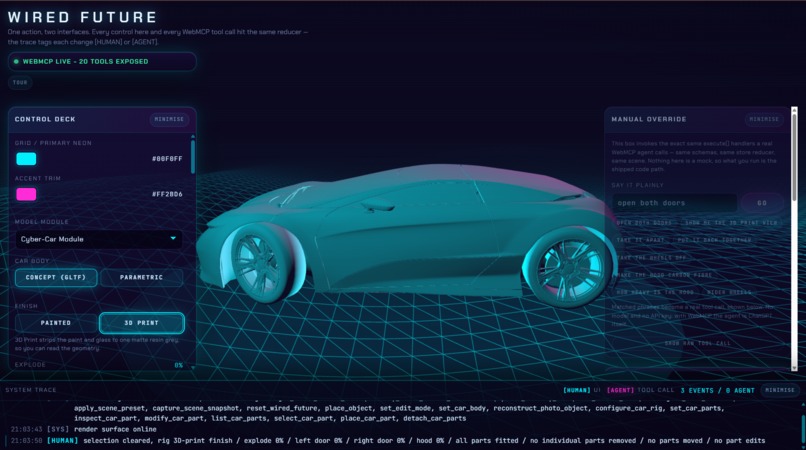
Wired Future is a 3D design canvas where you and an AI agent work the same screen at the
same time. Twenty tools are registered on document.modelContext.
One reducer, two interfaces
The human controls and the agent's execute() handlers call the same zustand reducer.
Three things fall out of that for free:
- Recolour the grid from ChatGPT and the human's colour picker moves to match. Nobody wrote that sync. The picker is a pure function of the store.
- Every change is attributed. The trace prints
[HUMAN]or[AGENT]on each line, so you watch the collaboration happen. - The fallback console runs the shipped handlers, not a mock.
A real car, taken apart
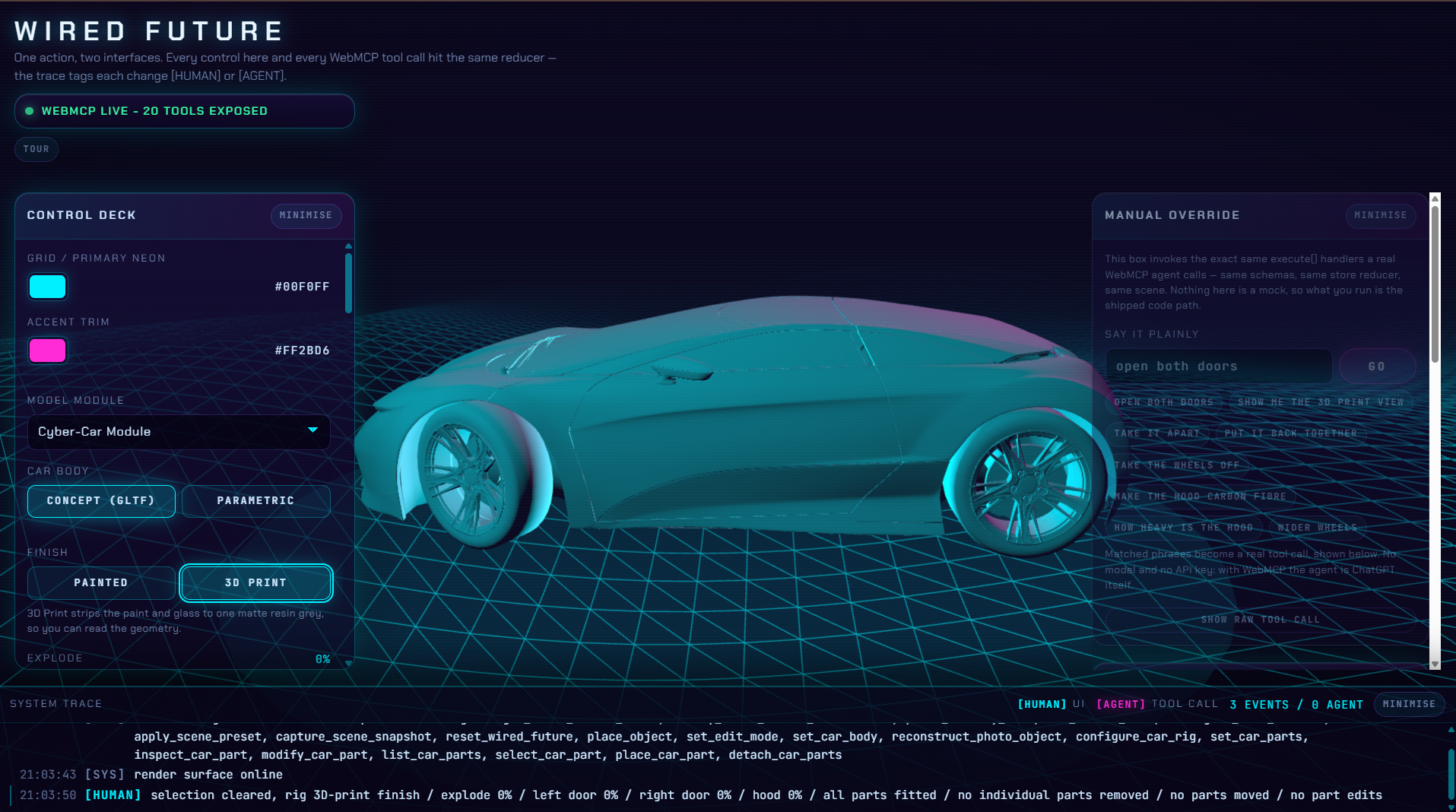
The stage holds the Khronos CarConcept glTF. It ships as 97 named mesh nodes, which split into 109 addressable meshes: door handles, wing mirrors, wipers, brake discs, steering wheel spokes, pedals. Each sits on its own pivot inside its assembly's pivot.
Hold Ctrl over any part and:
- Click runs what that part does. Doors swing on hinges derived from their own bounding boxes, the hood lifts from its rear edge, and anything without a hinge pops off and back on.
- Drag pulls the part out along its own outward axis, following your mouse.
- Scroll resizes it.
A "3D print" finish strips the paint and glass to matte resin so you can read the geometry. An explode slider fans all thirteen assemblies into a parts diagram and back.
Parts measured with real geometry
inspect_car_part walks the actual triangles. Surface area from the cross products,
volume from the signed tetrahedron sum, an area-weighted centroid, and a watertight
check that every edge is shared by exactly two triangles.
Mass is a shell model: surface area times wall thickness times density. That detail cost me an hour and I am glad it did. My first version treated the volume a wheel's surface encloses as solid steel and reported 771 kg. Car parts are pressings and castings, not billets. As a 5 mm aluminium shell the same wheel comes out at 34.9 kg, which is roughly what an alloy wheel and tyre weigh. The tool now reports the method, the wall thickness and the 4.6 m length assumption alongside the number instead of hiding them.
modify_car_part then rewrites vertices: per-axis scale about the part's own centre,
offset along vertex normals to thicken a shell, progressive twist, and re-specification
in steel, aluminium, titanium, carbon fibre, ABS, glass or rubber at real densities.
Edits rebuild from the pristine buffers, so sending scaleX: 1.2 twice leaves the part
at 1.2 rather than 1.44.
An agent can measure the hood, tell you it is 18 kg in 1 mm aluminium, and re-spec it in carbon fibre at 11 kg, with the geometry on screen changing to match.
Photo to 3D, with no server
Drop a photo of an object and it becomes relief geometry on the stage. Depth Anything V2 Small runs in the browser tab through transformers.js, on WebGPU where available. A CLIP zero-shot pass declines people and animals before any geometry is built.
No upload, no API key, no backend. The weights stream once from the HuggingFace CDN and the browser caches them.
How I built it
Next.js 15 static export, three.js, zustand, TypeScript. It deploys to GitHub Pages as flat files.
The architecture is one diagram:
human UI event ──┐
                 ├──> useWired.getState().apply(patch, origin)
agent execute() ─┘              │
                                ├──> React re-renders the panel
                                ├──> engine.apply(state)   (three.js mutates)
                                └──> log({ origin, message })
React never imports three. The engine never imports React. The store is the only bridge,
and because it lives outside React, an execute() callback reaches it with no context
plumbing.
Challenges
The API had moved and I had not noticed. I coded against navigator.modelContext
from the spec draft. On 21 July 2026 it moved to document.modelContext. My detection
would have missed a conforming runtime entirely. It now probes both and uses whichever
carries registerTool, and document is the one Chrome actually exposes, so without
that fix none of this would work.
The origin trial token shipped in a form Chrome ignores. WebMCP runs as an origin
trial through Chrome 156, so production traffic needs a token. Next's metadata.other
API emits <meta name="origin-trial">. Chrome only reads http-equiv. The token was
live, looked correct in view-source, and did nothing. I render the tag directly now.
The flag route is a dead end, and I measured it. On Chrome 152.0.7977.75 and Edge
152.0.4191.53, with WebMCP and DevToolsWebMCPSupport both confirmed in the launch
command line, neither surface was exposed. The README records that so nobody repeats the
investigation.
A bug in three.js r0.169. TransformControls.dispose() calls this.traverse(...),
but in r169 the class extends Controls, not Object3D. It always throws. Under React
StrictMode that killed my teardown mid-way, so the renderer was never released and the
next mount came up with a dead canvas. I call detach() and disconnect() and free the
gizmo geometry myself.
Parts walked off screen when you dragged a slider. Deformations rebuild from the pristine geometry, so they must be centred on the pristine centre. I was re-measuring the live bounding box, which is the centre of the already-deformed part, so every slider tick translated it a little further. Each assembly now caches its rest centre in its pivot's local space, which stays correct while the part is exploded or the door is open.
The page froze mid-drag. Every pointermove wrote to the store, re-rendering a 109-row list and re-running the rig sync each frame. Gestures now mutate the scene directly and commit once, on release. A twelve-move drag went from locking up to 57 ms.
Accomplishments
The bridge is verified, not assumed. Chrome accepts the registration, getTools()
returns all twenty, and executeTool runs them:
executeTool(tool, JSON.stringify({ doorLeft: 1, doorRight: 1, finish: 'print' }))
→ "rig 3D-print finish / left door 100% / right door 100%"
Register, enumerate, invoke, scene changes, UI mirrors, trace attributes it to the agent. The whole loop, through a real browser implementation.
The terrain runs 8.5× faster. Every wave term has the form sin(kx + ωt), which expands to sin(kx)cos(ωt) + cos(kx)sin(ωt). The spatial halves are constant per vertex. That took the loop from 61,605 transcendental calls per frame to 8, and 2.48 ms to 0.29 ms. I checked the algebra against the direct form over 200,000 random samples before trusting it: maximum difference 1e-13.
What I learned
Tool descriptions are the interface. An agent picks a tool from its name, description and schema alone, so "scale, 0.2 to 3" is a worse contract than "scale across the car, 0.2 to 3, where 1 is untouched." I spent longer writing those strings than writing some of the tools.
Read-only tools matter more than they look. An agent that can only write is guessing.
get_wired_future_state, inspect_car_part and list_car_parts let it look before it
leaps, and the difference in behaviour is obvious.
And the honest one: I claimed several things worked before I had watched them work. The mass model, the bounding boxes, the origin trial. Each time, checking found something wrong. The 771 kg wheel would have shipped.
What's next
Multiplayer, so two people and an agent share a canvas. Persisting a design as a shareable
URL. And capture_scene_snapshot already returns the canvas as an MCP image block, which
means an agent can see what it built. The obvious next step is letting it critique its own
work and iterate.
Credits
CarConcept from KhronosGroup/glTF-Sample-Assets, by Eric Chadwick from a public-domain model, licensed CC BY 4.0, attribution to Darmstadt Graphics Group GmbH.
Fonts: Chakra Petch and JetBrains Mono, SIL Open Font License, self-hosted at build time.
Built With
- github
- gltf
- model-context-protocol
- nextjs
- onnx
- react
- three.js
- transformers.js
- typescript
- webgl
- webgpu
- webmcp
- zustand

Log in or sign up for Devpost to join the conversation.