-
-
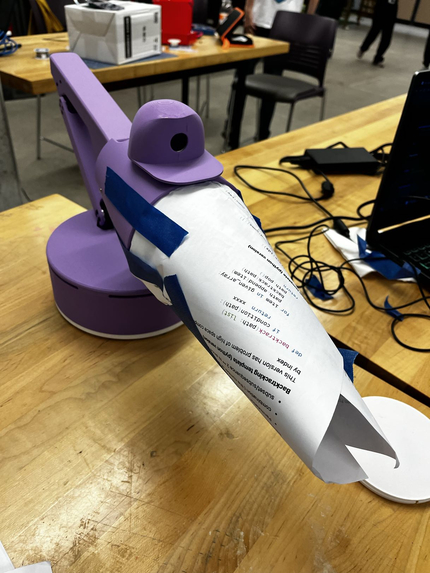
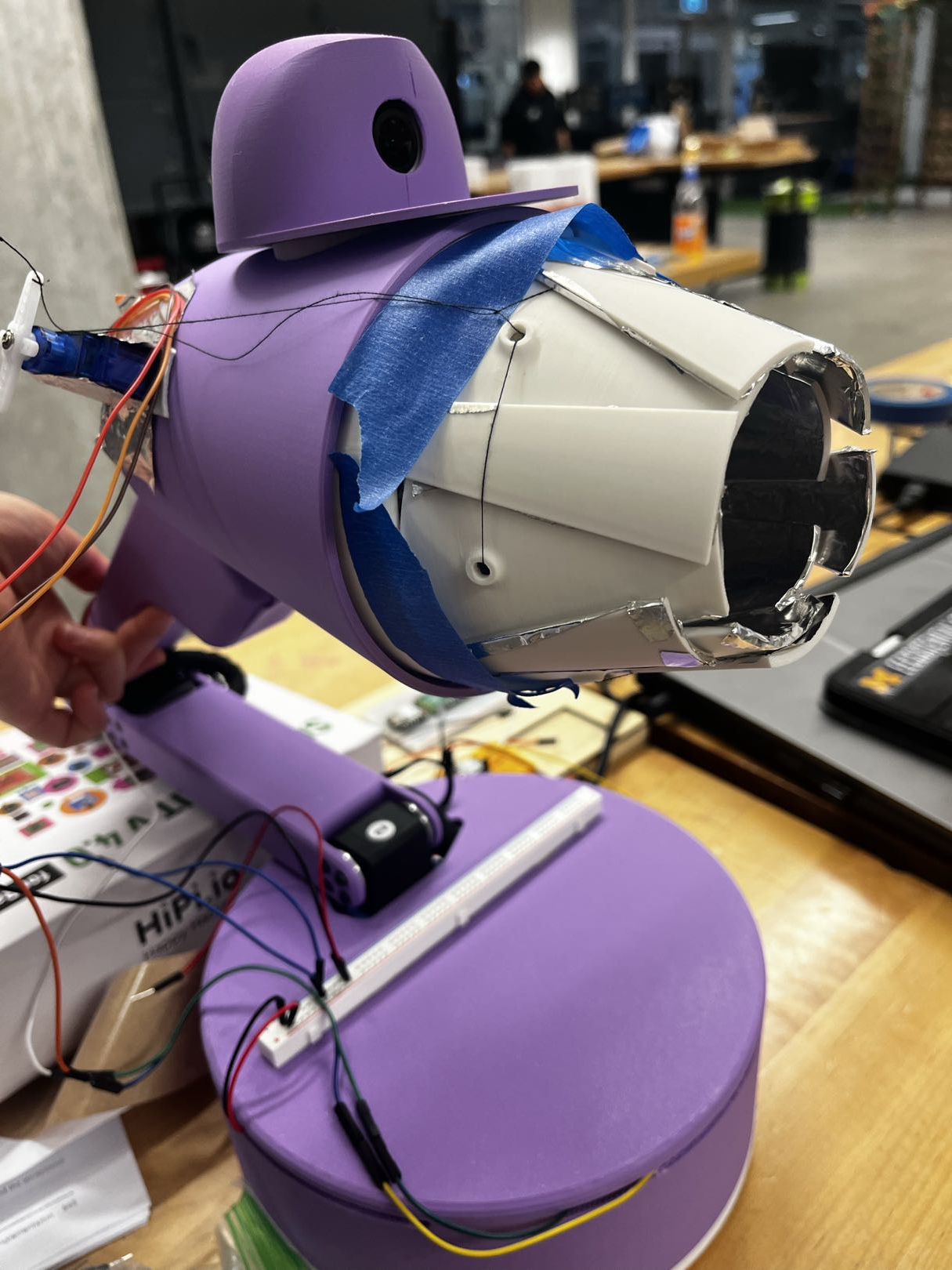
Lelamp with custom contractor cone used to increase light intensity.
-
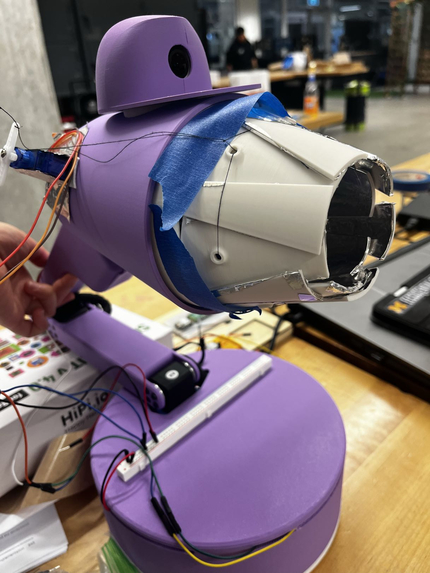
Lelamp with variable nozzle configuration with 2 servos to actuate it.
-
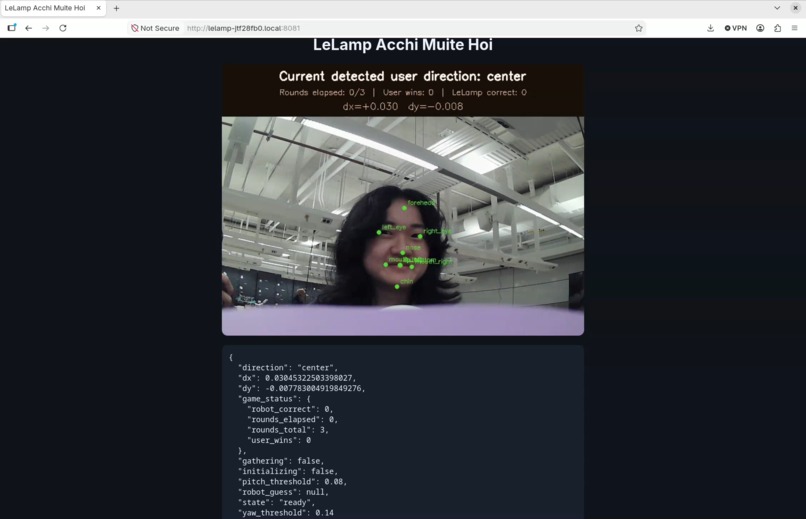
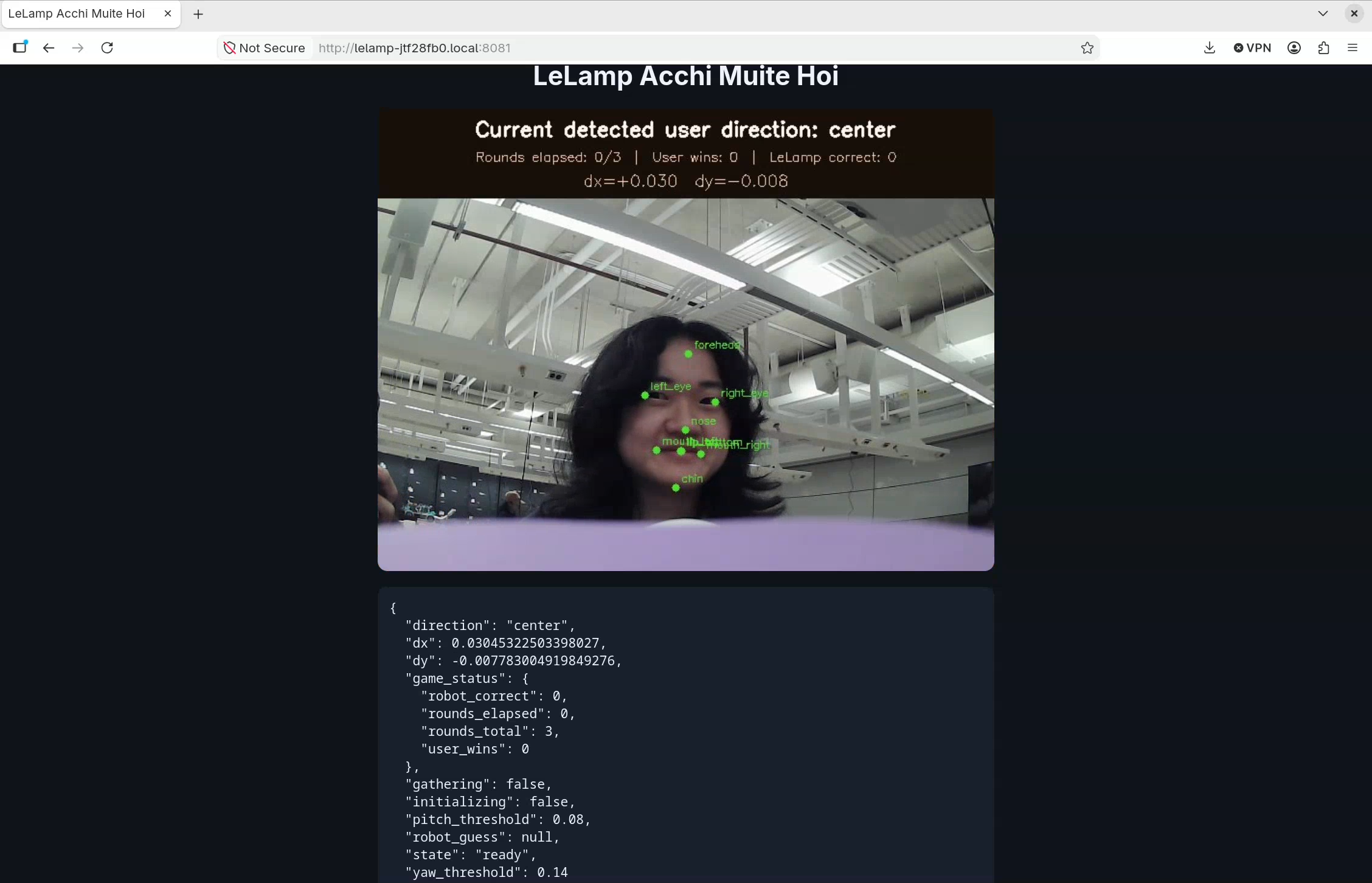
Dashboard shown while playing a game
Inspiration
Our interpretation of Human Computer Lab’s manifesto is to create robotic systems that are more personable and interactable, shifting the way we demeaningly treat machines into the tenderness we treat pets.
One of the most key details in breathing life into LeLamp is the idea of play. LeLamp has countless possibilities when it comes to being a game companion, after all, it is meant to be by your side at your desk as a close companion.
What it does
Our project consists of a main physical contribution to the LeLamp, along with multiple game implementations using this physical contribution as its basis. The following details each part of the project.
Light Concentration
The core function of the common desk lamp is to provide light. For our game implementations, we wanted to focus on controlling light with more precision to bring digital experiences into the real world.
The current LeLamp light build consists of 6 rings of WS2811B addressable LEDs. Through some reading, these individual LEDs provide roughly 20-22 lumens of light per, which roughly translates to 61 * 22 = 1342 lumens of total light provided by LeLamp. The problem comes with the beam angle of the LeLamp, which is roughly between 45-90 degrees when the lamp head points at a surface. This creates a large pool of light that is not very interactable.
To further concentrate the light source from the LeLamp, we investigated some optical implementations. Through research, we identified two possible solutions to help focus the light: reflective aluminum and a fresnel lens. After a quick trip to Canadian Tire, we created a conical rig with an interior lined with aluminum tape and attached the fresnel lens to the rig. The following are our qualitative and quantitative results.
In some scenarios we might want to diffuse the light or make the LED grid visible in addition to concentrating the light, so we took inspiration from the variable nozzle afterburner designs. We found a 3D model of a variable nozzle afterburner of a fighter aircraft and repurposed it so we can moderate the light concentration of the nozzle.
Games
We wanted our games to cover a range of human-computer interaction schemes. Multiple experiences were created:
- Acchi Muite Hoi: In this game Lelamp challenges the user to 3 rounds (by default, but can be set to a different amount of rounds) where it randomly chooses a direction and then the user’s job is to rotate their face (upon Lelamp’s verbal instruction) to make sure it’s a direction Lelamp is not indicating on its face.
- Tracker game: In this game we have Lelamp pointing to a relatively open area with a flat surface and being able to project a concentrated beam of light for users to track and interact with (i.e. slicing it with their hand if projected on a wall).
How we built it
For our light adjustment mechanism, we:
- Did some Auxiliary CAD in Onshape to fit the variable nozzle to the lamp
- Used Aluminum tape and Fresnel Lens from Canadian tire to build conical prototype for light concentration
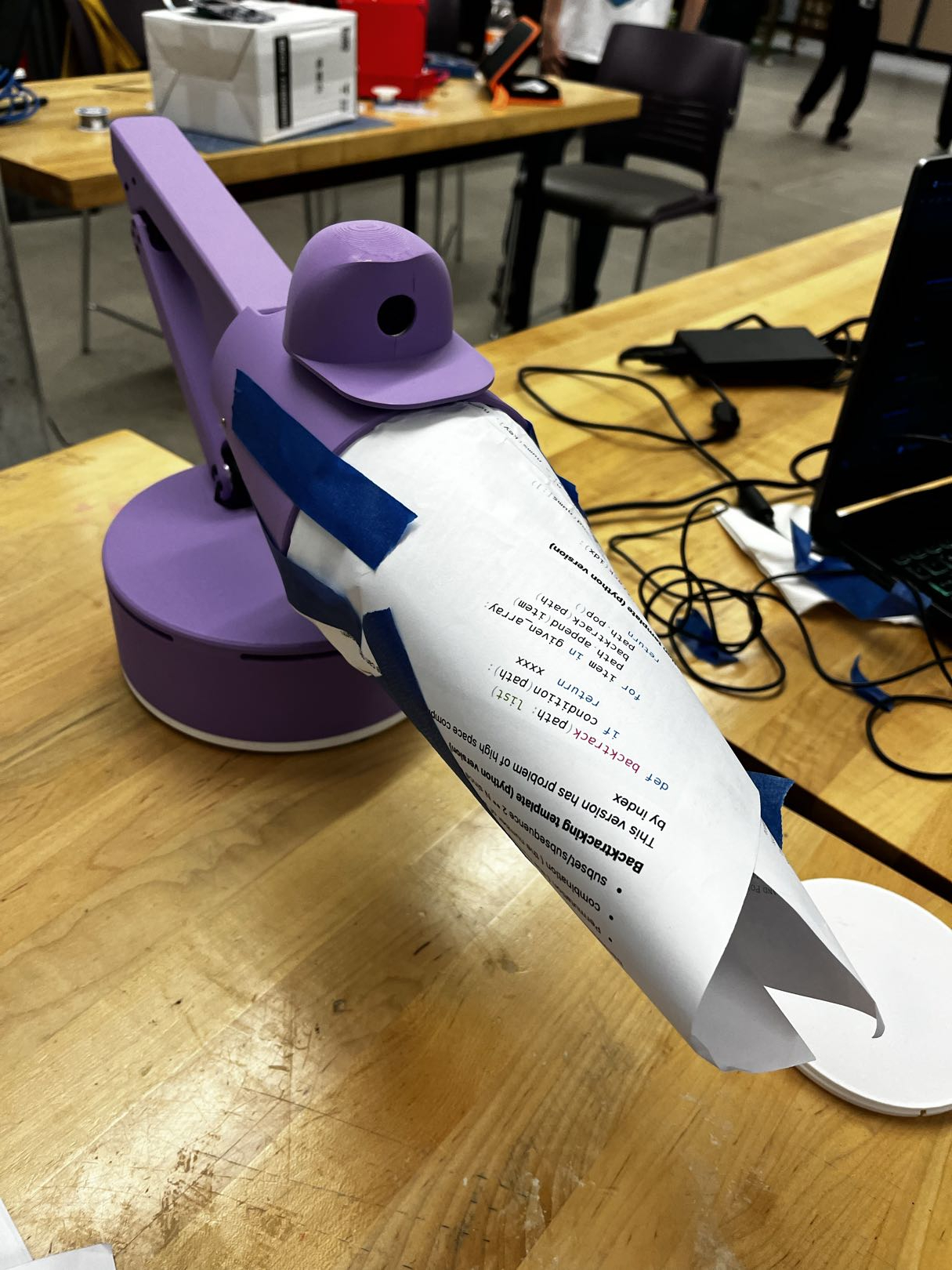
Throughout the duration of the hackathon, we have been focusing our efforts on implementing a version of two games, which required using different skill sets: In Acchi Muite Hoi we leveraged Lelamp’s webcam (mounted on the top and cleverly covered in a hat) to detect where the user’s head was tilted after some initial camera calibration. This was achieved through detecting multiple face markers which would then be used to identify what direction the user is facing. Then, we combined it with some game logic to have Lelamp issue verbal instructions and host a web server so that we can view the results of the game in real time to get it working. Through developing the Tracker game we identified a problem in the intensity of the light and that led us to investigate different designs to increase the light concentration. While the game logic exists, the light concentration still yields non-satisfactory results but this did cause us to modify the lamp head with the variable nozzle design equipped with 2 servos to adjust the light concentration to our preference.
Challenges we ran into
We encountered both familiar challenges as well as a set of unique challenges that we had not anticipated throughout the hackathon.
Amplifying the light emanating from Lelamp led to many challenges. We initially tried using fresnel lens, which concentrated the light into a signal target at the cost of significantly dimming its brightness. Unfortunately, the material that the lens was made of ended up dimming the intensity of the overall light, which was opposite to what we wanted to achieve. We got around this by creating the conical test attachment, which saw significant improvement. On the manufacturing side, we did not have the adequate CAD to base our first implementation of the variable nozzle on the LeLamp. Our subsequent version was able to make use of the CAD to be able to securely fit onto the system and we are able to modify the light concentration by equipping 2 servos and attaching a buck converter to Lelamp.
We encountered familiar challenges when we opted to remove the diffuser on Lelamp. Since exposing the LED grid led to increased detail, we decided to explore and create multiple expressions to display on the LED grid to increase the level of interactivity and expressions that we can create on Lelamp. Since the LED grid consisted of 5 layered rings and 61 LEDs, there was interesting geometry and circuitry that was employed to ensure that we could light up all the LEDs. This made mapping the designs we wanted to display on the grid (i.e. smile, neutral, frown, arrows, etc.) difficult, but we managed to do so after discovering the mapping of the individual LEDs was done in a spiral fashion, starting from the top outer-most ring and going inwards.
Accomplishments that we're proud of
We’re proud of being able to explore and increase the expressiveness of Lelamp by removing the diffuser mounted on the head, which not only prompted us to investigate mechanical solutions to control light concentration but also allowed us to display expressions on Lelamp’s face. We explored many things before finding a combination of several ideas to come up with our current prototype which allows us to control the light concentration of Lelamp while allowing it to be more expressive by leveraging the LED grid and creating emojis and common symbols to better interface with the user.
What we learned
We, unexpectedly, learned quite a bit about optics this weekend. We investigated how light diffuses and ways to improve the overall concentration of light and focusing it in a directed fashion. We considered solutions like fresnel lenses, aluminum foil, and TIR lenses (total internal lenses) in order to create a DIY solution given the limited time frame of the hackathon.
We also learned a lot through utilizing AI, especially Codex. It helped us brainstorm ideas and troubleshoot code and allowed us to quickly bootstrap onto a brand new codebase that we were not accustomed to at all. We were able to create quick Python scripts to validate certain behaviors in isolation (e.g. head direction detection, displaying emojis, etc.) before we were able to combine them with complicated game logic and display a dashboard to the user.
What's next for LeLamp Play Pack
Although we have made strides in the expressiveness of Lelamp’s head (by opting to remove the diffuser), there’s still room for improvement in improving the light intensity and concentration capabilities. For instance, stronger LEDs or bulbs could be used and be arranged in a more tactical fashion to improve expressiveness.
There are a variety of other game experiences to be made too. We had a variety of different ideas that we would be interested in exploring in the future that could involve mimicking user movement and creating a dance game, or monitoring user posture, the game red light/green light that was popularized in Squid Games, etc.


Log in or sign up for Devpost to join the conversation.