-
-
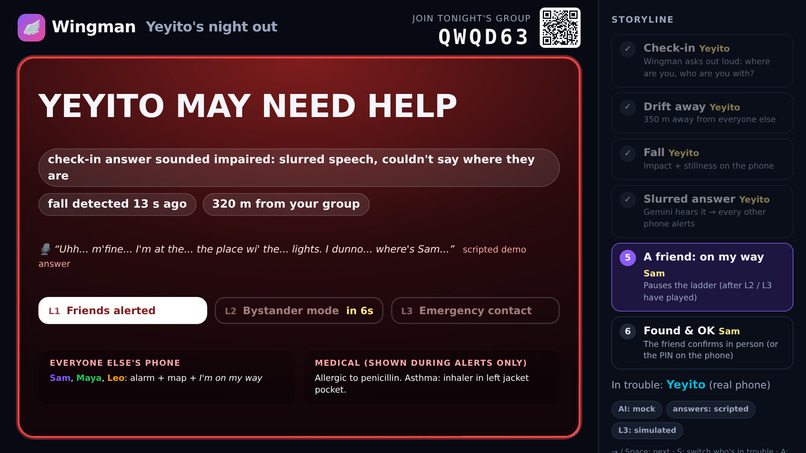
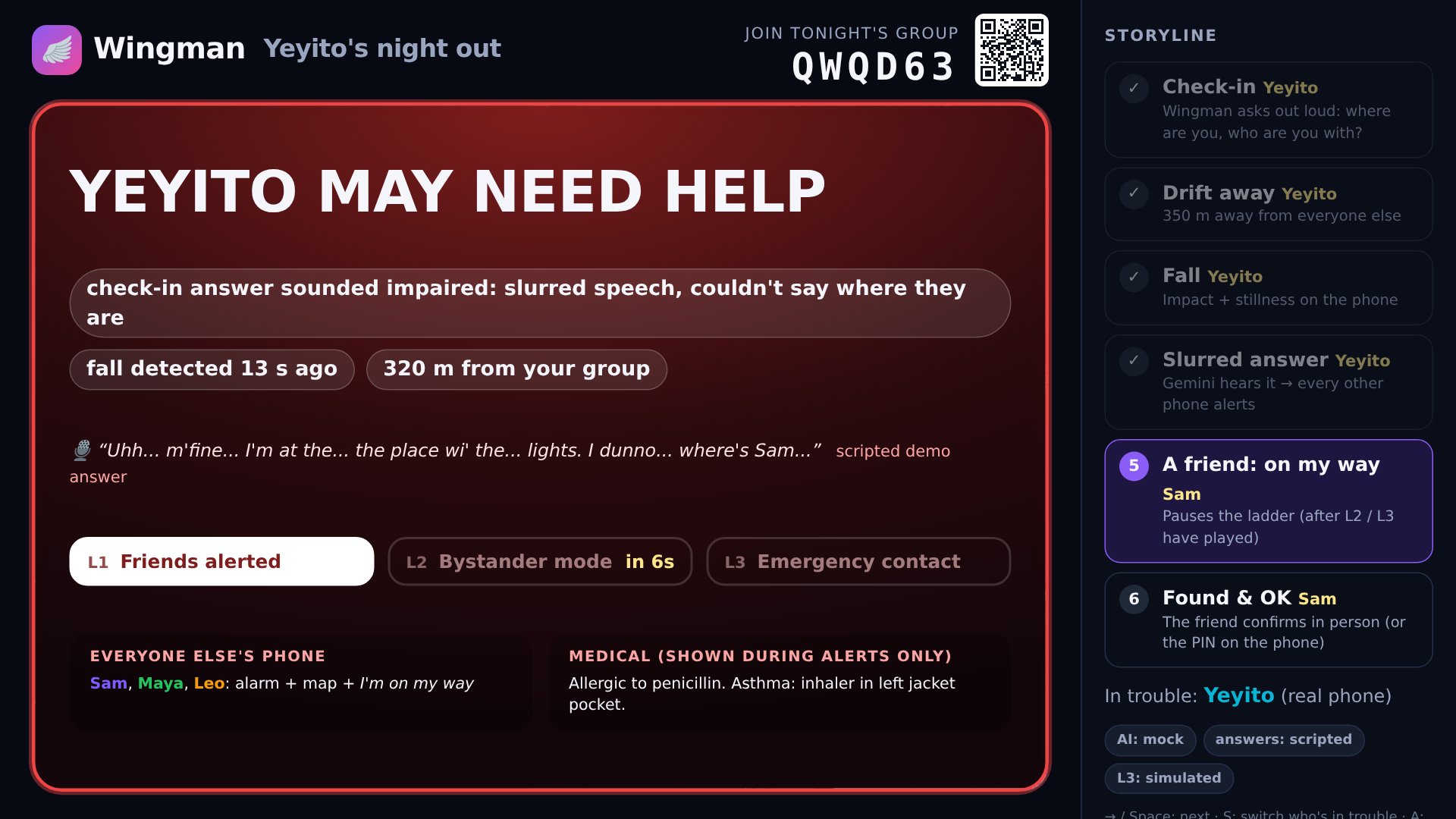
Stage view: an alert with plain-English reasons and the escalation ladder
-
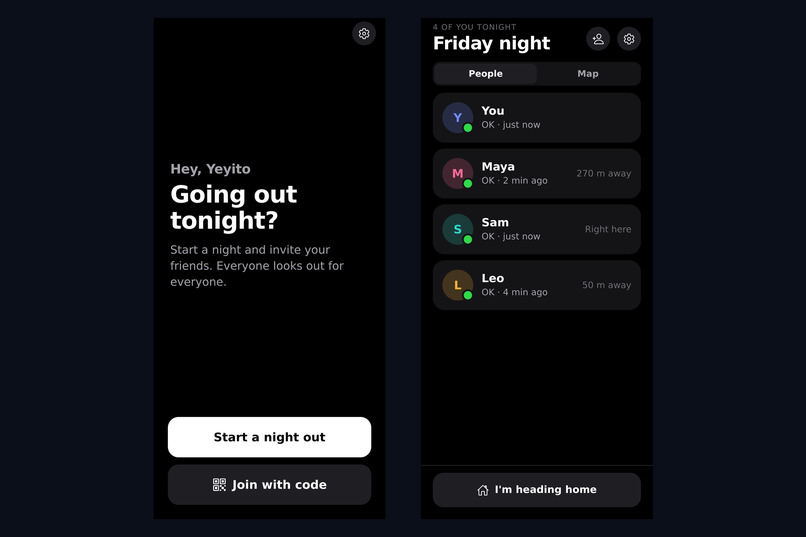
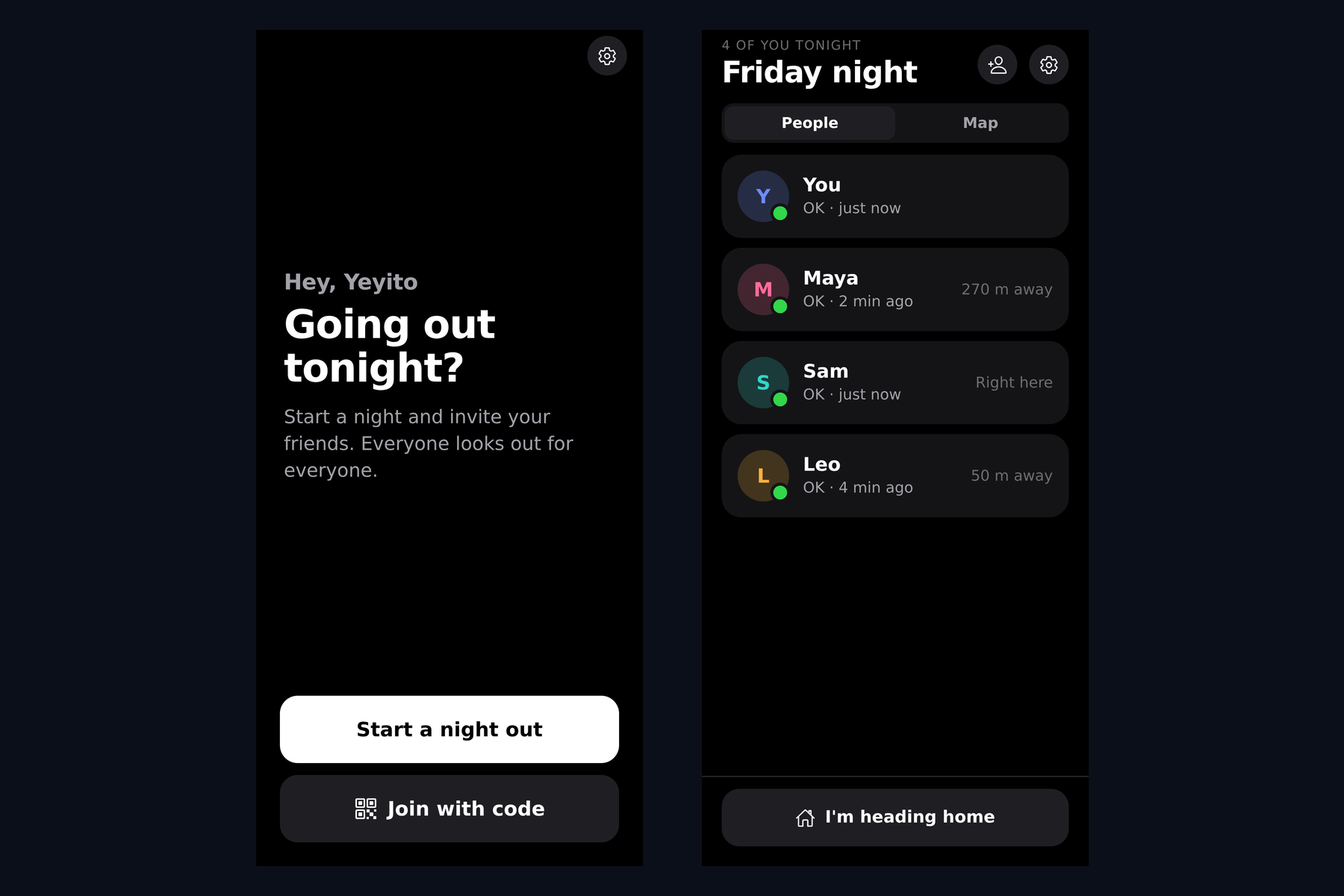
Start a night out and see your group
-
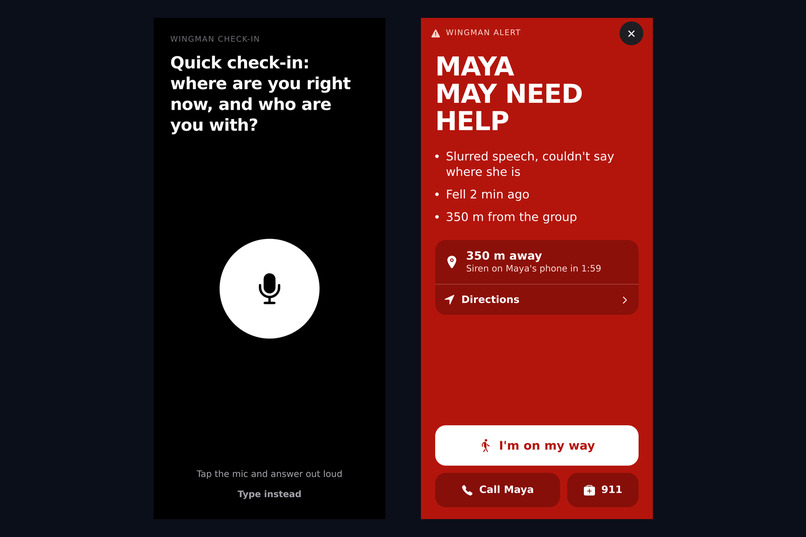
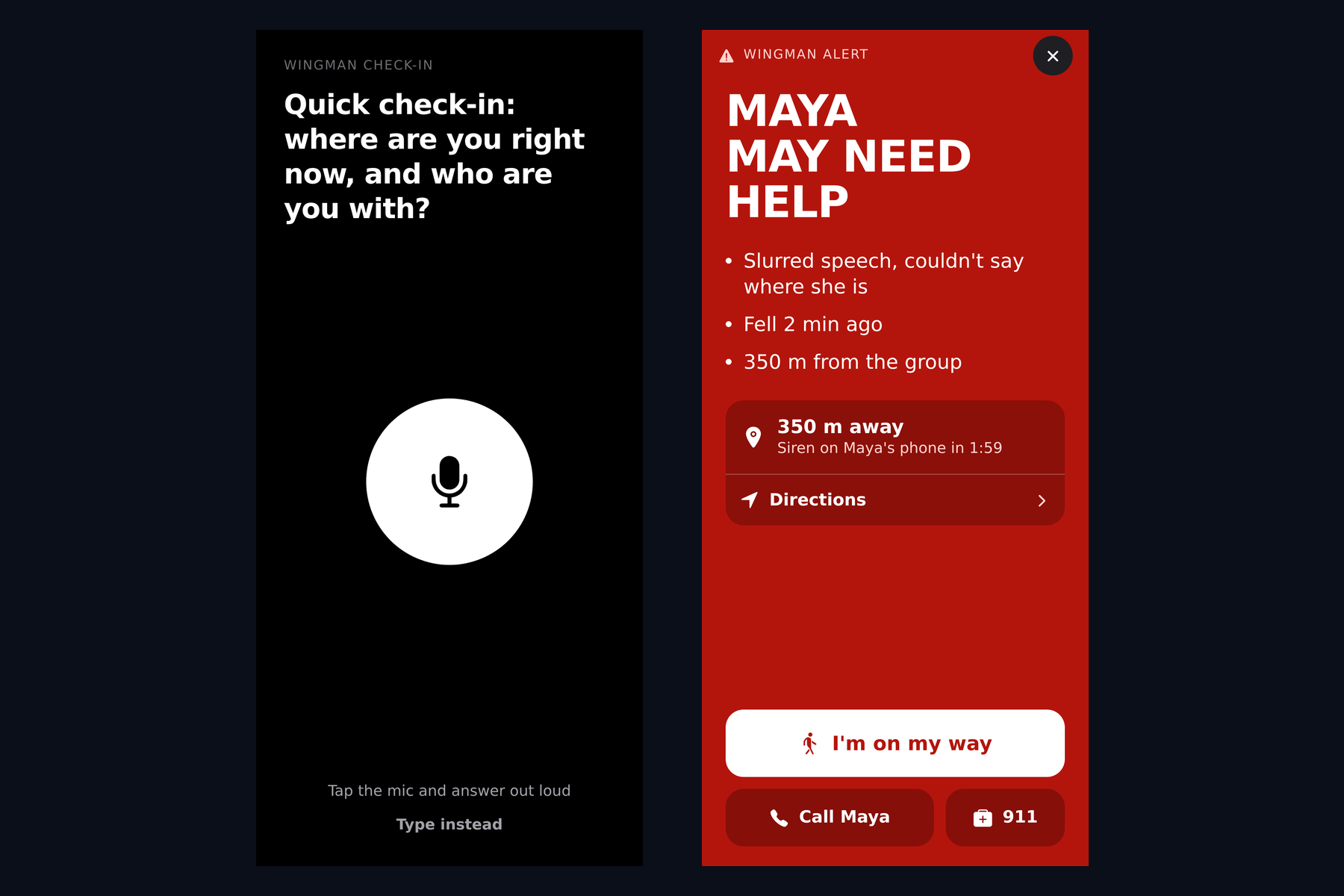
Spoken AI check-in (scored by Gemini) and the alert on a friend's phone
-
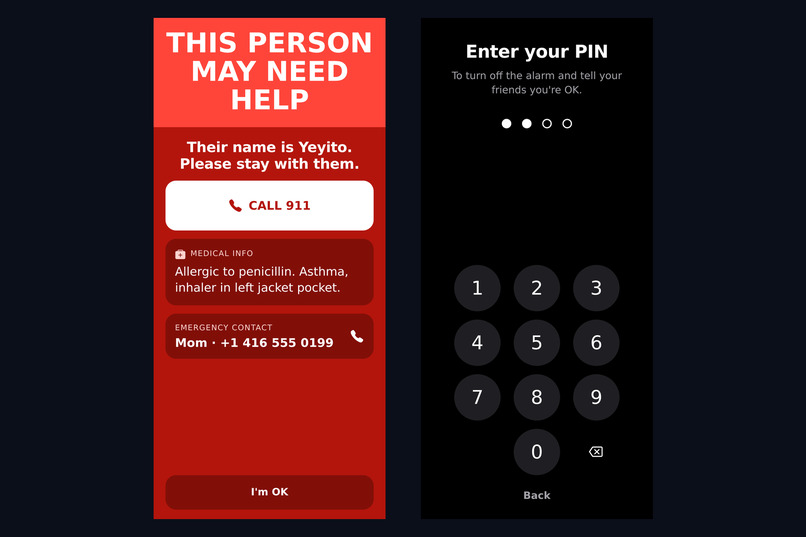
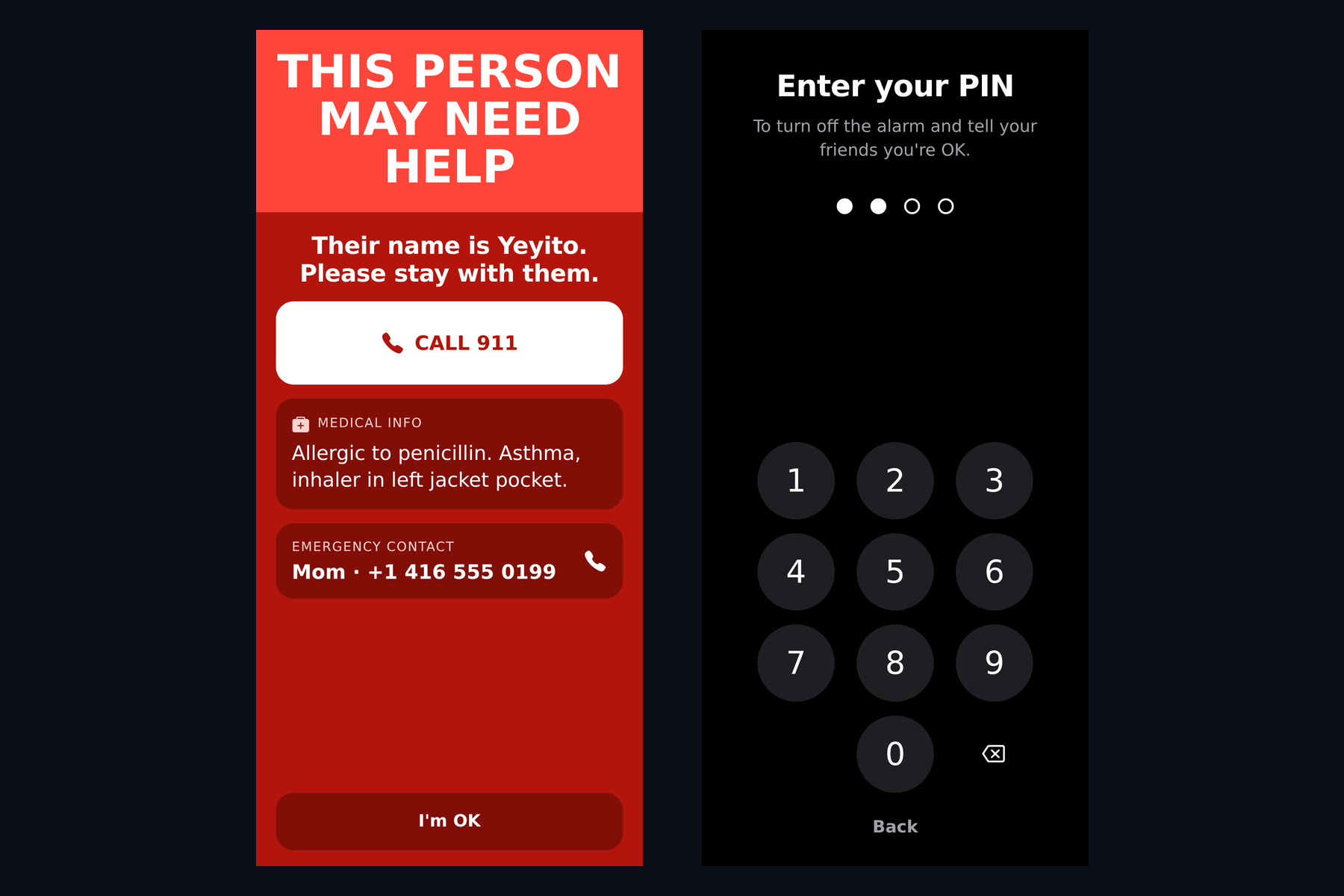
Bystander mode, cancelled only with the PIN
Inspiration
Every personal-safety app has the same assumption baked in: you press the button. But the situations that scare us most on a night out are the ones where you can't: a spiked drink, being far drunker than you realized, hitting your head. You can't unlock a phone, you can't explain where you are, and often you don't even know something is wrong.
KAZE framed this as a gap: between the moment someone becomes unable to protect themselves and the moment someone else realizes help is needed. Friends usually would help; they just don't know yet. We wanted to shrink that gap from "the next morning" to "about a minute", without asking the person to do anything.
What it does
Everyone is everyone's wingman. Friends going out together join tonight's group in the Wingman iPhone app with a 6-letter code. Every member is both guarded and a guardian: each phone watches its owner, and when one of them can't ask for help, every other phone in the group asks for them.
- Opt in for tonight. Each member sets a PIN, optional medical info (allergies, meds) and an emergency contact, and consents to being guarded and to guarding the others. No accounts; join by QR code, link or code.
- It watches passively. The app detects falls (an impact followed by stillness), tracks distance from the group (to the nearest friend, with GPS uncertainty subtracted so indoor jitter doesn't cause alarms), notices stillness and an untouched phone, and runs a dead-man's switch: a phone that suddenly goes silent (dead battery, taken) is a signal too, while one that reports being locked first isn't.
- It talks to you. Every 30 minutes, whenever something looks off, or when a friend taps ping, your phone chimes and asks out loud: "Hey, quick check-in: where are you, and who are you with?" You just answer. Gemini listens to the audio and judges whether you sound coherent and oriented or slurred and confused, with a one-line reason a friend can understand.
- It explains itself. A deterministic risk engine combines everything into a score with readable reasons: "check-in answer sounded impaired: slurred speech + fall detected 2 min ago + 310 m from your group."
- It escalates on its own, per member (several people can be in alert at once):
- The whole group: every other member's phone alarms, with your location, the reasons, and I'm on my way / Found & OK / Call. Everyone sees who's coming, so the group doesn't all run.
- Bystanders: if nobody responds, your phone turns into a flashing, siren-blaring sign: "THIS PERSON MAY NEED HELP", with a giant Call 911 button and your medical info. Cancelling needs your PIN, so a confused person can't dismiss it by accident.
- Emergency contact: a text to your emergency contact with the reasons and a map link (sent via Twilio when it's configured; in our demo this step is simulated and clearly labelled).
- It stands down gracefully. A clear check-in answer, your PIN, or a friend confirming found & OK in person resolves the alert. The whole night is in a shared event log.
- Privacy is built in: opt-in per person and per night, location shared only for the night (or only during an alert), medical info revealed to friends only during your alert, no database, and everything deleted when the night ends.
How we built it
- iPhone app: native, built with Expo / React Native: location, motion (fall detection), voice recording (
.m4a), text-to-speech for the spoken question, local alerts, QR join, and the bystander screen. Background location works in the native dev build (Xcode). - Server: TypeScript on Bun: one process serving a JSON REST API, a WebSocket push channel, and a projector stage view. A typed wire protocol (
shared/protocol.ts) is imported by both the server and the app. Groups live in memory by design; each member authenticates with a per-member secret key. - Risk engine + escalation ladder: two pure, deterministic functions (signals → score + reasons; state + event → state + effects), run per member on a 250 ms tick, with alerts fanned out to every other member. They're unit-tested, and the whole demo storyline runs as an end-to-end test with three members connected over real HTTP/WebSocket.
- AI check-ins: the app records the reply and the server sends the audio straight to the Gemini API (
gemini-flash-lite-latest, about 2 s) with a JSON response schema: transcript, responded, coherent, impairment 0–1, signs, reason. If Gemini is rate-limited or down it tries the next Gemini model, then an optional OpenAI fallback, then a deterministic offline heuristic, so a check-in is always scored. - Level 3: a pluggable notifier: Twilio SMS when configured, otherwise a clearly labelled simulation. Optional Expo push for alerts to backgrounded phones.
- Demo tooling: simulated friends (Sam, Maya, Leo) who move, heartbeat and answer check-ins on the server; Gemini TTS generated the demo voice clips; a projector "stage view" (Leaflet + OpenStreetMap map) whose storyline advances with a presentation clicker, because this is a solo hack. Either the real phone or a simulated friend can be the one in trouble.
- Dev setup: Docker image for the server; Cloudflare quick tunnels for HTTPS while testing on the phone.
Challenges we ran into
- Watcher vs. watchee was the wrong model. Our first version had one "person" and several "buddies". Testing it made the asymmetry feel wrong: nobody wants to be the one being babysat, and on a night out the designated buddy can just as easily be the one who gets into trouble. We rebuilt it as a fully connected group: every member runs the same risk engine and ladder, and alerts fan out to everyone else. That also meant moving from a web page to a native iPhone app, so sensing keeps working with the phone in your pocket.
- Phones go quiet in your pocket. A naive dead-man's switch would alert every time you lock your phone. The app reports "background / locked" before going quiet so the server can tell "locked" from "silent".
- Audio formats: iOS records AAC in an
.m4acontainer under several MIME labels; we verified Gemini with real.m4afiles and normalise the type on the server. - Avoiding false alarms without missing real ones: we tuned weights so no single signal escalates. A fall alone just triggers a check-in, and it takes corroboration (a slurred or missed answer) to alert friends. Our end-to-end test caught a subtle case where "fall + walking away" crossed the threshold before the person was asked.
- Determinism for a live demo: the late-night risk factor made the storyline behave differently at 3 AM than at 10 AM, so demo sessions pin their clock. The scripted path never depends on a network call.
Accomplishments that we're proud of
- The full loop works end to end: passive sensing → spoken AI check-in → explainable risk → alerts on every friend's phone → bystander mode → emergency contact → de-escalation by a friend or the PIN.
- Gemini hears the difference between a clear answer and a slurred one from raw audio in about 2 seconds.
- Every alert explains itself in plain English. There's no mystery score.
- A tested core: risk-engine and state-machine unit tests, group-engine tests, an end-to-end group storyline test (three WebSocket members) asserting the exact escalation sequence and the fan-out, a live-Gemini test with a real iOS
.m4a, and the app's UI driven end to end against the real server. - Privacy that's structural: the server has no database to leak.
What we learned
- Safety UX is about the other people: the friend who needs to know where to go, and the stranger who needs to know what to do. Bystander mode came from asking "who is physically next to them right now?"
- Multimodal models are good at judging how something was said, not just what was said.
- Keeping the decision logic deterministic and the AI as just one input makes the system explainable and testable.
What's next for Wingman
- Android app and OS-level fall detection (Apple Watch / Wear OS), on the same server and engine.
- Wearables: heart rate and skin temperature from watches as extra signals.
- Venue partnerships: bars and campus security as an optional "nearby responder" level.
- Text-to-911 / RapidSOS integration for level 3, with location.
- Smarter check-ins: personalised baselines (how you sound sober) and multilingual prompts.
- A user study with student groups on false-alarm rates and real-world tuning of the thresholds.
Real vs. simulated (for judges)
- Real: location, motion/falls, heartbeats and app state from the phone; the spoken check-in and voice recording; Gemini audio scoring; the risk engine, per-member ladders, group fan-out, bystander mode, PIN and found & OK.
- Simulated in the demo: the level-3 SMS (real only when Twilio keys are configured; otherwise labelled "simulated"); Sam, Maya and Leo are simulated friends on the server (the presenter's phone is a real member); the on-stage storyline uses demo controls and a pre-recorded, AI-generated slurred answer so the demo is repeatable; timers are accelerated (15 s per level instead of minutes).

Log in or sign up for Devpost to join the conversation.