-
-
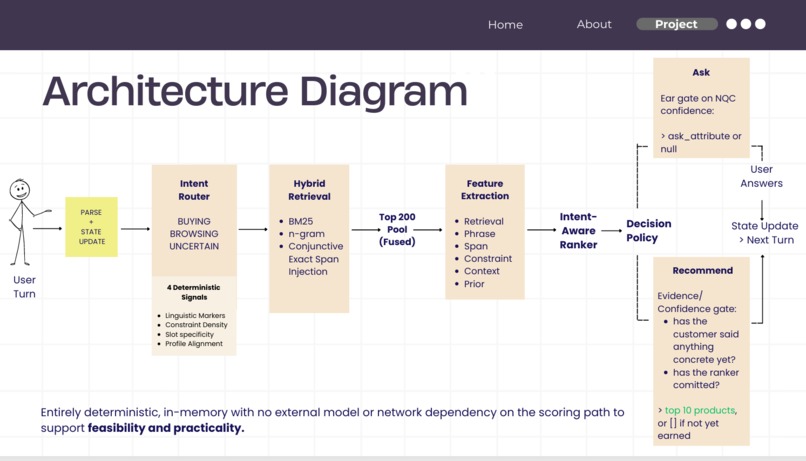
Buyte's Architecture Diagram
-
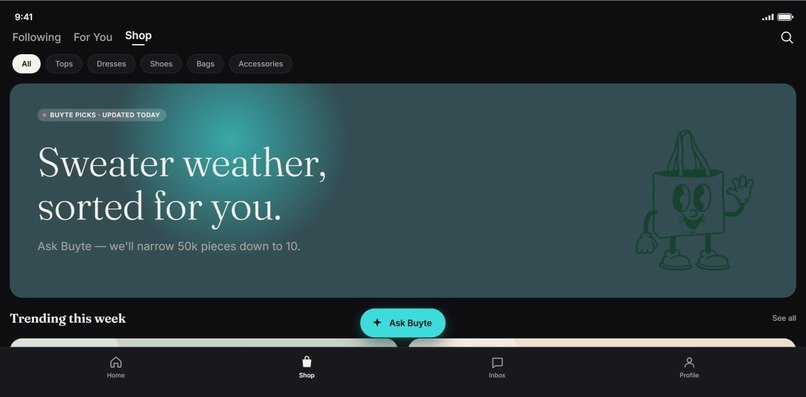
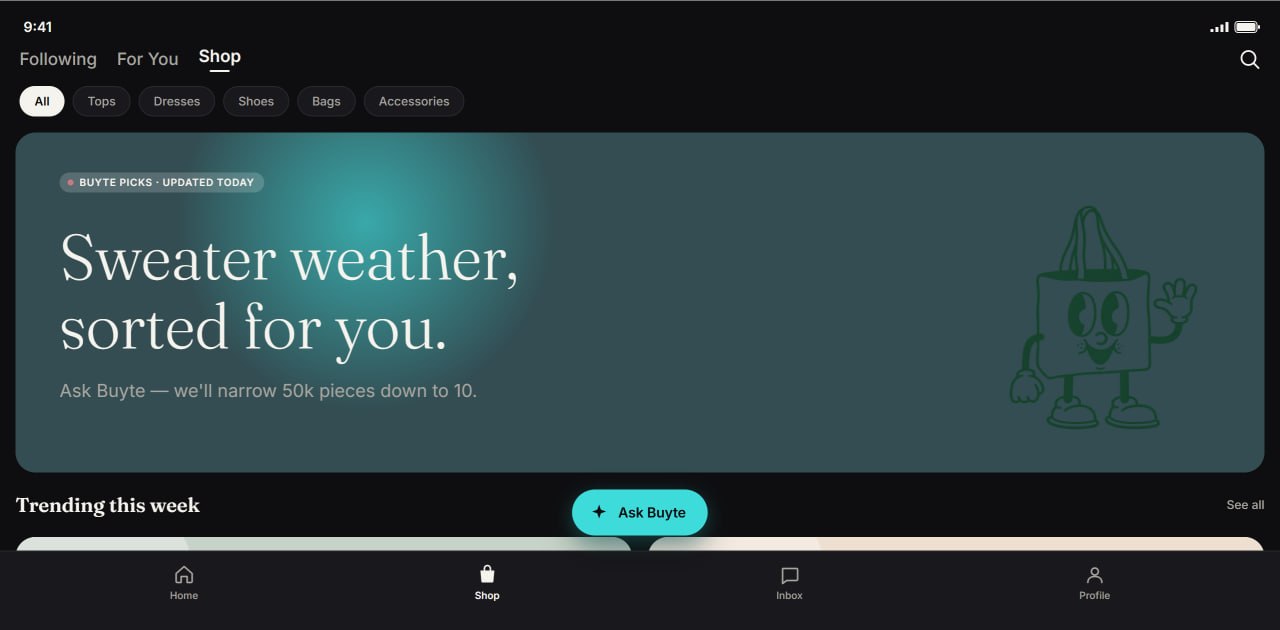
Buyte's Landing Page
Buyte
The shopping agent that knows when to ask — and when to wait
TikTok TechJam 2026 · Track 4: Shopping Copilot — AI Conversational Search and Recommendations
A multi-turn agent that finds one hidden target product in a 50,000-item Amazon clothing catalog, deciding on every turn whether to ask, stay silent, or recommend. 8.8× the official baseline. Zero misses across all 200 public sessions. Zero LLM calls, zero external dependencies, $0.00 cost.
Inspiration
Keyword search breaks down in conversation for a reason that's easy to state and hard to fix: it has no memory and no theory of intent. "Under $40" and "less than $40" are different strings to BM25. A customer who says "I need shoes for a trip" and then "waterproof, under $80" has given two halves of one request that a stateless index will never join.
The competition frames this as three sub-problems — routing intent, tracking state, ranking results — weighted into one score:
TechnicalScore = 0.50 × HR@10 + 0.30 × MRR + 0.20 × Efficiency
Reading that formula gave us our first hypothesis: HR@10 and MRR are both determined by the returned list, so 80% of the score lives in ranking quality. The provided baseline scores 12.5% HR@10 — looked like a ranking failure, not a dialogue failure.
That reading was half wrong, and finding out how was the most useful thing that happened to us. Ranking is where the score is counted, but on this benchmark dialogue is where it is created: without a question, no new information arrives, and there's nothing better to rank. A third thing turned out to matter even more than either: when you show the list at all. Those three findings are what this project is actually about.
What it does
Every turn runs one deterministic pipeline, entirely in-memory:
parse → route intent → retrieve (lexical + semantic, fused, plus
conjunctive injection) → rerank → ask, hold, or recommend
- Stateful slot tracking — a
ShoppingStateaccumulates constraints across turns and demotes (never deletes) a retracted preference, so a withdrawn constraint is never re-checked but still describes the region of the catalog in play. - Five per-field BM25 indexes (title / features / categories / description / store) — never concatenated, because a term matching in a 12-token title means something different from the same term in 400 words of description — fused with a character-n-gram dense route by convex combination.
- Conjunctive exact-substring injection — any product whose text contains every live constraint verbatim enters the candidate pool regardless of BM25 rank. This is the one route depth alone can't provide; it took the count of targets that never reach the pool from 1 to 0.
- A 40-feature intent-conditional linear reranker — per-field scores,
semantic similarity, phrase overlap, three-way constraint satisfaction
(satisfied / violated / unknown, since price is null on 78.9% of the
catalog), and
span_all— does this candidate satisfy every disclosed constraint, not just some. - Two independent gates deciding whether to ask, stay silent, or recommend — this is where most of the final score actually came from. See below.
The findings that made the difference
1. Clarification is the system, not a refinement to it. Removing it costs −0.3892 TechnicalScore on our shipped build — 37 points of HR@10, more than five times any other component. Our first working version scored 0.3167 because the clarification gate was being handed the returned top-10 instead of the full candidate pool, so its "is there still room to narrow?" test rejected every turn and the agent never asked anything. One plumbing fix moved us from 0.3167 → 0.7641.
2. Asking well matters as much as asking. Information-gain-by-the-book
picks category and brand — they split the catalog beautifully, and this
customer answers them 0.000% of the time. We measured disclosure per
attribute across all 200 sessions instead of assuming it (feature 91.5%,
material 72.5%, color 24.5%, brand/budget/category 0.0%) and rebuilt expected
gain as P(answered) × uncertainty removed, with the first term measured, not
guessed.
3. The evaluator locks in the first hit — so when you answer decides your rank, and this was our single largest gain. The official evaluator ends a session the first turn its target appears in the top 10. Measured directly: 45 of 75 sub-rank-1 sessions locked in on turn 1, before the customer had disclosed anything beyond a category name — and every one of them would have reached rank 1 by turn 2–3 if the agent had just waited. The exchange rate strongly favors patience: one extra turn costs ~0.0001 of score; a rank 2→1 recovery pays ~0.00075 — 7.5× more. So we built two independent gates — one asking has the customer said anything concrete, the other has the ranker actually committed (Normalized Query Commitment, Shtok et al. 2009) — that compound because they read different signals:
| configuration | TechnicalScore | MRR |
|---|---|---|
| neither gate | 0.9093 | 0.756 |
| evidence gate alone | 0.9280 | 0.834 |
| confidence gate alone | 0.9366 | 0.876 |
| both, shipped | 0.9429 | 0.902 |
We want to name this honestly: part of that gain is a scoring artifact — real shoppers don't vanish the moment they see a mediocre list, they keep talking. That's exactly why our shipped confidence threshold sits at the conservative edge of its measured plateau (τ = 0.054) instead of its highest-scoring point (τ = 0.085, which scores higher on the public set but gains nothing held out).
4. Rank-2 was read by hand, product by product — and it closed off an entire class of future work. Across all 30 rank-2 sessions, in 0 of 30 did the ranker hold separating information and still get the order wrong. 27 needed disclosure that hadn't arrived yet (a timing problem — see #3); 3 were genuine ties, indistinguishable on every disclosed constraint. This also retired seven separate reranker attempts — five linear formulations, a regularized logistic regression, and a LightGBM LambdaMART model. None beat the tuned linear model held out; the feature vector already contained everything a rank-2 pair needed.
5. Target products are a popularity-biased subpopulation — and we're saying plainly that this is right for the benchmark and wrong for a real store. Median review count is 6,846 for targets vs. 12 for a random catalog row (AUC 0.956 on that single feature). We use it as a soft prior, never a filter — popularity alone scores 3.5% HR@10, worse than the baseline, because it's query-blind. The lift only comes from combining relevance with the prior; a deployed system ranking this way would starve the long tail.
6. Two correctness bugs, found by auditing the catalog, not the
leaderboard. A "own-goal" test — score all 50,000 rows against constraints
drawn from their own listing — found gender coded as a flat sibling
hierarchy (kids was a sibling of boys/girls instead of their parent, so
"toddler" scored every boys'/girls' listing VIOLATED, including the listing
that produced the word "kids"), and single-word brand matching firing on
listing boilerplate (extracted a "brand" in 66 of 200 sessions — 62 wrong,
driven by wash, sole, hand out of "Machine Wash" and "Rubber sole"). Both
measured exactly zero effect on the public 200 and we adopted them anyway
— that was the pre-registered pass condition, because a ~0.6%-of-rows defect
matters on the private 800 even when it's invisible here.
Results
Measured on the 200 public development sessions with the unmodified official evaluator.
| Configuration | HR@10 | MRR | MTTC | TechnicalScore |
|---|---|---|---|---|
| Official baseline | 0.125 | 0.068 | 9.81 | 0.1067 |
| Ours — default weights | 0.885 | 0.554 | 3.23 | 0.7641 |
| Ours — shipped, tuned | 1.000 | 0.902 | 2.40 | 0.9427 |
8.8× the baseline TechnicalScore. Zero misses across all 200 sessions. Turns-to-conversion down from 9.81 to 2.40.
Accomplishments we're proud of
- 8.8× the official baseline, with every one of 200 public sessions finding its target — a claim we didn't just measure once, we fold-split it: the merged recommendation gates land +0.029 on the held-out half, above our own noise floor, so this isn't an in-sample number dressed up as a real one.
- Turned down a higher score on purpose.
disclosed_ask_decay: 0.0costs us 0.0002 TechnicalScore — two orders of magnitude below this set's standard error — because it stops the agent asking about something the shopper already told it. We'd rather report that trade honestly than ship the number that looks better. - Zero external dependencies, zero LLM calls, $0.00 cost. Every ranking decision is deterministic, standard-library Python — a deliberate hedge against the organizer's warning that final scoring may run offline.
- Caught two correctness bugs the public leaderboard could never have shown us, by auditing all 50,000 catalog rows against themselves rather than against the 200 sessions we're scored on.
- Retired seven learned-reranker attempts on evidence, including a LightGBM LambdaMART model, rather than shipping a marginal or overfit one.
Honesty & limitations
We'd rather state these plainly than let a good headline number hide them.
- 0.9427 is in-sample. 36+ configurations have now been scored against these same 200 sessions. Every individual change we adopted carries a held-out fold number; the shipped combination has one fold-validation pass, not an independent one for every layer. Expect the private 800-session set to land a little lower.
- Part of our biggest gain is a scoring artifact. Holding back weak recommendations wins because the evaluator breaks on first hit — a measurement convention for time-to-first-success, not a model of real shopper patience. Optimizing against it is the task, but it isn't evidence users would actually prefer a quieter agent.
- The "dense" semantic route is character-n-grams, not neural embeddings — a deliberate trade for an offline, no-network-access scoring run. It buys spelling/morphology tolerance, not semantic generalization: "something elegant for a dinner date" won't reach a listing that never says "elegant."
- The popularity prior is a property of how this benchmark's labels were built, not a discovery about shoppers, and we would not ship it to a real store without replacing it with real personalization.
- Three of the 200 sessions are genuine ties we can't break — the target and its competitor are identical on every disclosed constraint. That's a floor no amount of ranking work removes.
What's next
- Push the recommendation-hold threshold past its conservative edge — but only with private-set feedback or a per-intent variant, not on the public set's say-so; the extra headroom there lives entirely in the fitted fold.
- Bridge the profile-tag vocabulary gap. Our nine
preference_tags(fit, material, comfort, style, durability, performance, warmth, weather, general shopping) map onto no catalog field today; learning tag-to-product affinities from labeled sessions is the most promising direction we didn't get to. - Replace the popularity prior with real personalization — the necessary change for any use outside this specific benchmark.
Development tools
VSCode with the Python extension · Python 3.12 (venv) · Git/GitHub
APIs used
None. The graded agent makes no external API calls — no per-session token cost, no rate limit, no network dependency at evaluation time. Reported token usage for a full 200-session run: 0 prompt / 0 completion.
Libraries and frameworks
Python standard library only on the graded path (json, re, math,
array, collections, dataclasses, functools, pathlib, typing) — the
BM25 indexes, the semantic route, the fusion layer, the feature extractor, the
linear ranker, and the coordinate-ascent tuner are all implemented from
scratch, covered by 60 unit tests. A separate, optional presentation layer
(frontend/) — FastAPI + React/TypeScript/Vite — replays real evaluator
sessions turn by turn through the same unmodified agent; it doesn't touch
TechnicalScore.
Datasets and assets
- TechJam frozen catalog — 50,000 products,
Clothing_Shoes_and_Jewelrycategory, provided by the organizers - 200 labeled public development sessions — used for tuning and validation only
- Both derived from Amazon Reviews 2023 (McAuley Lab, UCSD)
- No external datasets, no manually labeled data, no scraped content
Built With
- amazon-web-services
- bm25
- boto3
- css
- fastapi
- figma
- git
- pydantic
- python
- python-3.12
- railway
- react
- typescript
- uvicorn
- vite


Log in or sign up for Devpost to join the conversation.