-
-
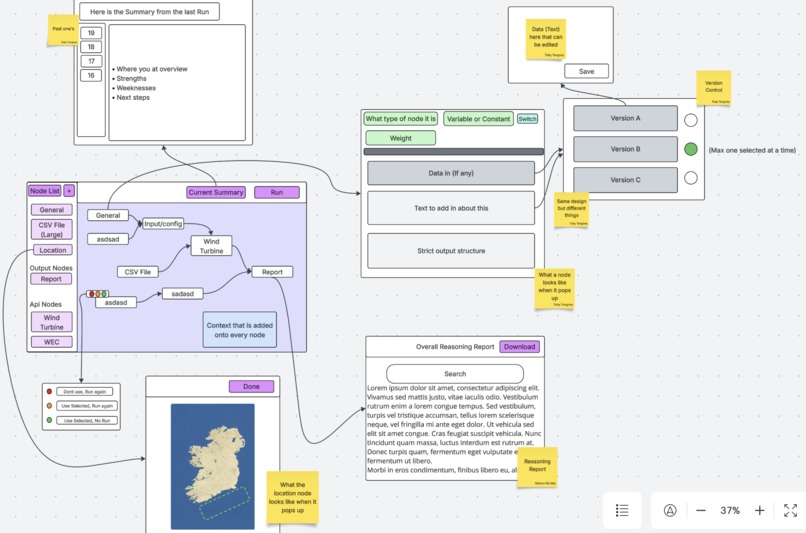
Web App WireFrame
## Inspiration
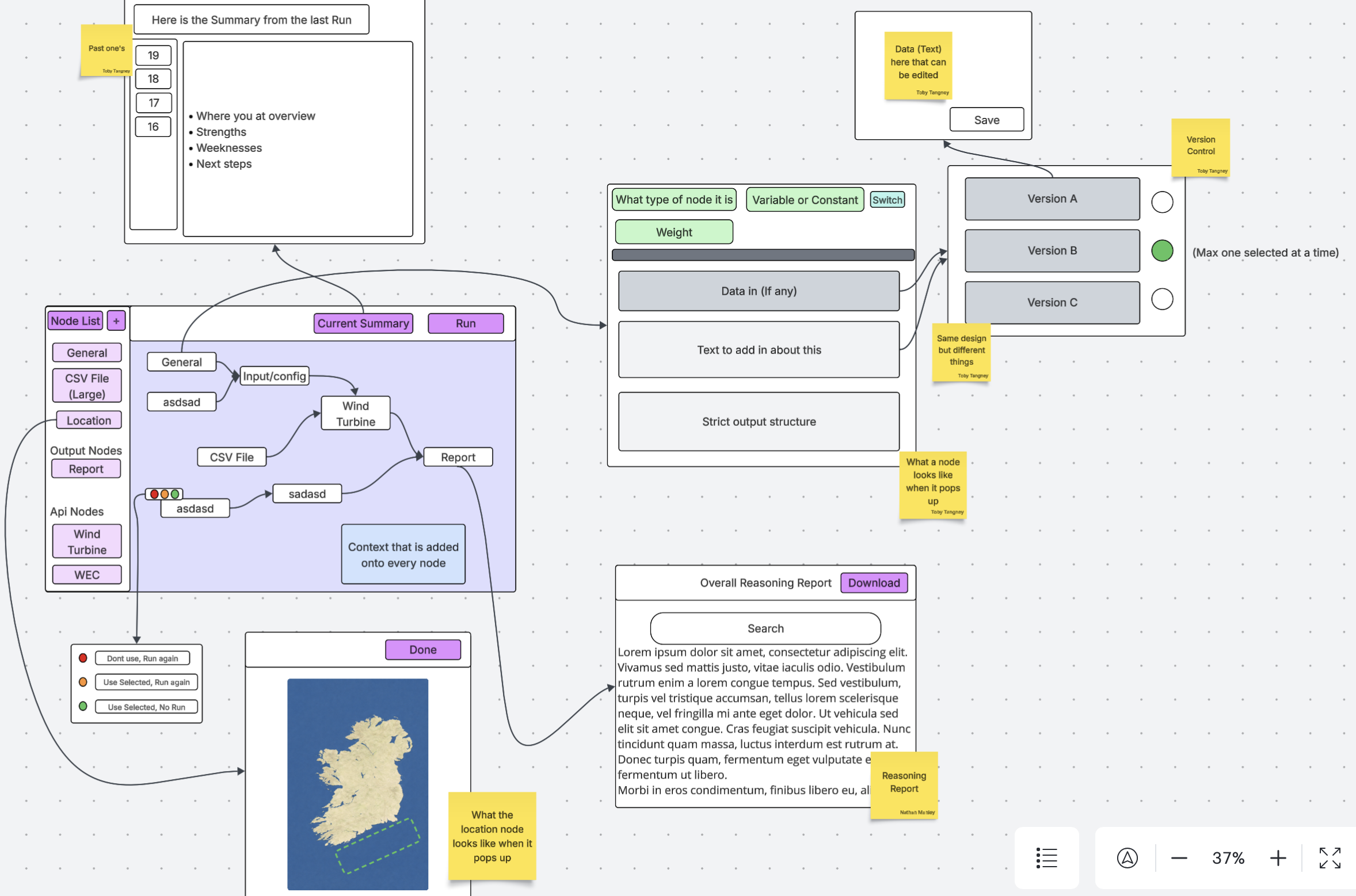
Many detailed planning initiatives are made with word documents. In the Ai agents and digital whiteboarding tools this seems inefficient. We felt it would be cool if we could have a React Flow flow chart like UI where teams could do their planning. This would be structured with set inputs and outputs for nodes, and an AI agent could then walk through the graph in an iterative fashion performing tests and providing real time feedback.
What it does
WindSite is a team oriented engine for the planning stage of offshore wind turbine projects. Users define a project zone on a map, or let our site find suitable ones for them. The system integrates marine datasets, evaluates technical suitability, estimates energy production, and provides a structured regulatory overview. Instead of a static analysis, feasibility becomes a connected decision graph.
How we built it
We modeled feasibility as interdependent nodes: depth, seabed, wind, environmental constraints. Deterministic calculations handle energy modeling, while AI structures reasoning and reporting. This ensures transparency and explainability.
Challenges we ran into
Offshore feasibility spans multiple domains, and we focused on building a coherent core rather than overextending functionality. Balancing AI reasoning with explicit physical modeling was key.
Accomplishments that we're proud of
In 30 hours, we built a functioning feasibility core that integrates spatial, technical, and regulatory evaluation into one structured workflow. Every output is traceable and explainable.
What we learned
Fragmentation, not lack of data, is the real bottleneck.
Structuring decision logic creates clarity and reduces early-stage uncertainty.
Offshore renewable development does not lack data, it lacks integration.
Technical, environmental, and regulatory information is fragmented across tools and domains. Before permits are requested, months are spent assembling a coherent feasibility picture.
WindSite was built to structure that process into a single, transparent workflow.
What's next for WindSite
Next, we aim to evolve WindSite into a dynamic feasibility layer that adapts as data and regulations change. Our goal is to turn offshore site selection into a living, data-driven decision system.
Built With
- geopandas
- lovable
- python
- rasterio
- supabase
